Santa Maria di Sturla: A Parish Church in Carasco, Italy
Site at a Glance
- Popularity
- Very Low
- Country
- Italy
- Primary era
- Early Modern
- Eras represented
- Early Modern, Modern
- Civilizations
- Genoese, Italian, Kingdom of Sardinia
- Site type
- Religious
- Remains
- Church
On this page12 sections
History
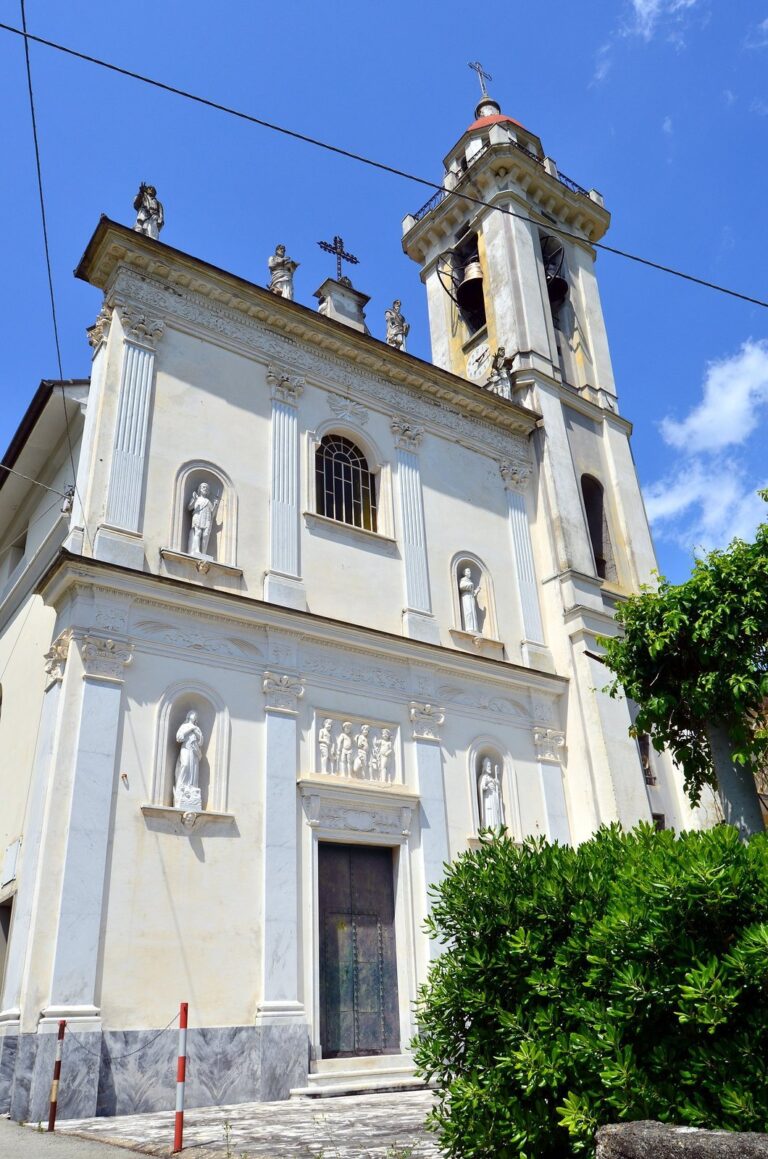
Santa Maria di Sturla is a Roman Catholic parish church in Carasco, Italy, dedicated to the Nativity of the Virgin Mary and also known as the Church of San Pellegrino. It is the seat of the local parish, or church community, within the Sturla and Graveglia vicariate, a grouping of parishes in the Diocese of Chiavari, a larger ecclesiastical district. The parish is described as a rectory, a church or church office administered by a rector.
Medieval records and rebuilding
A deed dated 30 March 1283 refers to land beside the Sturla stream adjoining property of the Church of Saint Mary of Sturla. In a will made on 7 August 1308, Guglielmo Bego, son of Bonaparte, requested burial either at this church or at the Church of Saint John the Baptist in Chiavari.
Santa Maria di Sturla was already a parish in the fourteenth century. Monsignor Francesco Bossi visited its small, older church in 1582. The building was later rebuilt and enlarged between 1690 and 1700.
Parish ties, independence, and devotion
Plague outbreaks in 1443, 1493, and 1528 killed many clergy, and one priest was sometimes assigned to several parishes. At different periods, Santa Maria di Sturla was joined with Rivarola, San Nicolò di Paggi, or San Colombano di Cogorno. It was also a dependency of the Church of Saints Quiricus and Julitta at Rivarola.
Priests of Rivarola took possession of Santa Maria di Sturla when they entered office, although Giuseppe Gaetano Podestà, a parish priest of Rivarola, argued that the formal appointment documents did not include it. During the period of subordination, a custodian carried out parish functions apart from marriages and the Easter blessing of homes. The journey to Rivarola was about three kilometres, with the Lavagna stream between the communities. Registers at Paggi refer to baptisms in 1783 and 1794, with sponsors from Santa Maria di Sturla, and to a marriage in 1801 with witnesses from the parish.
Efforts to restore the parish’s independence reached the Archbishop of Genoa in 1746 and were renewed after 1826. Antonio Maria Gianelli, then archpriest of Chiavari and a regional church supervisor, supported the later appeal. Archbishop Salvatore Magnasco established the parish by decree on 6 June 1882; it received civil recognition through a royal decree on 16 November 1885.
The Nativity of the Child Mary is celebrated on 8 September, and the feast is locally associated with the name “Madonna of the Eighth.” The celebration was held annually except in 1894, when a cholera outbreak led the Archbishop of Genoa to suspend it; it took place instead on the third Sunday of October. In more recent years, the feast of San Pellegrino, the church’s other co-titular saint, has gained prominence. San Pellegrino is described as the son of a Scottish king, and his feast is held on the second Sunday of August.
Remains
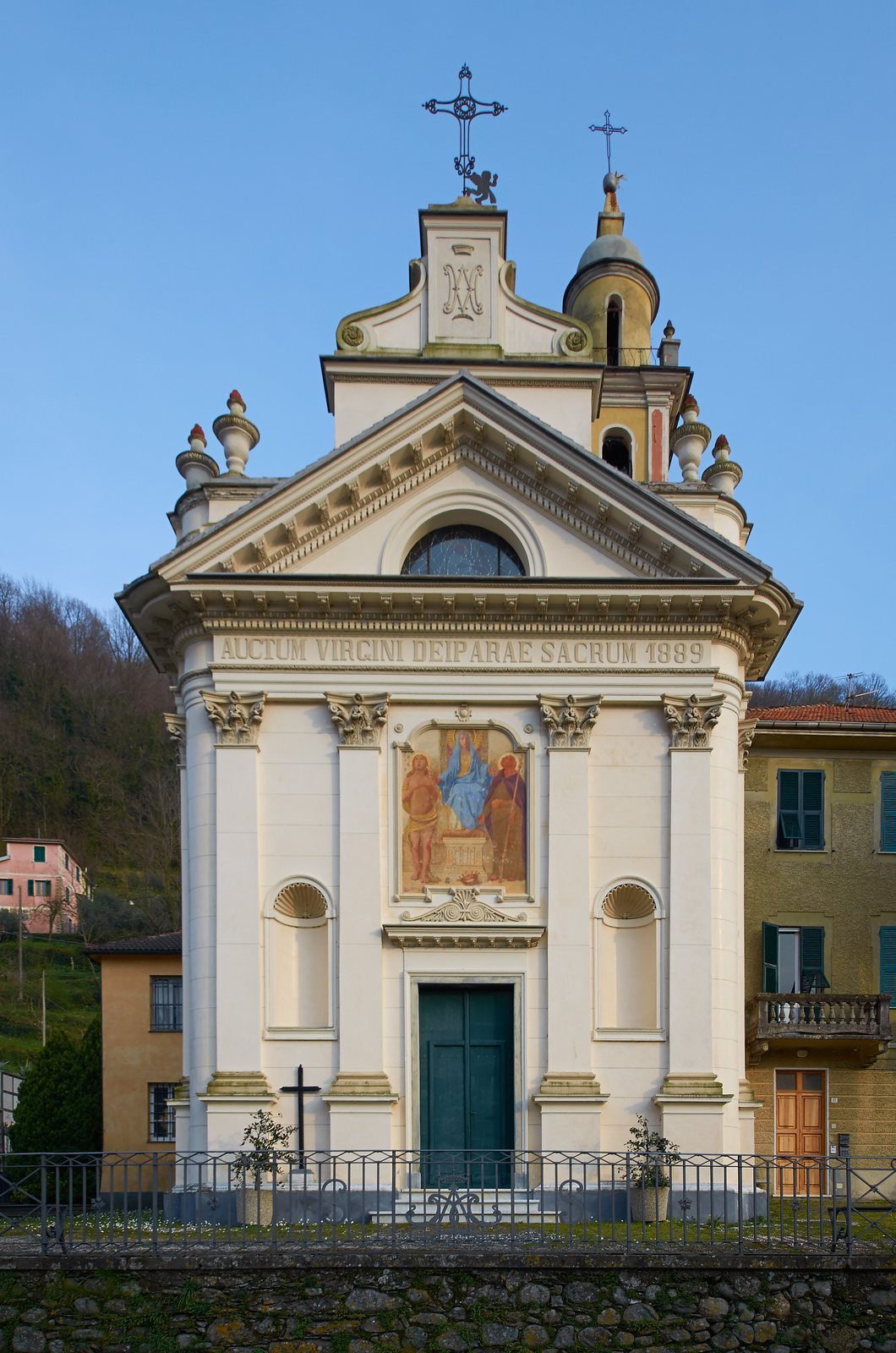
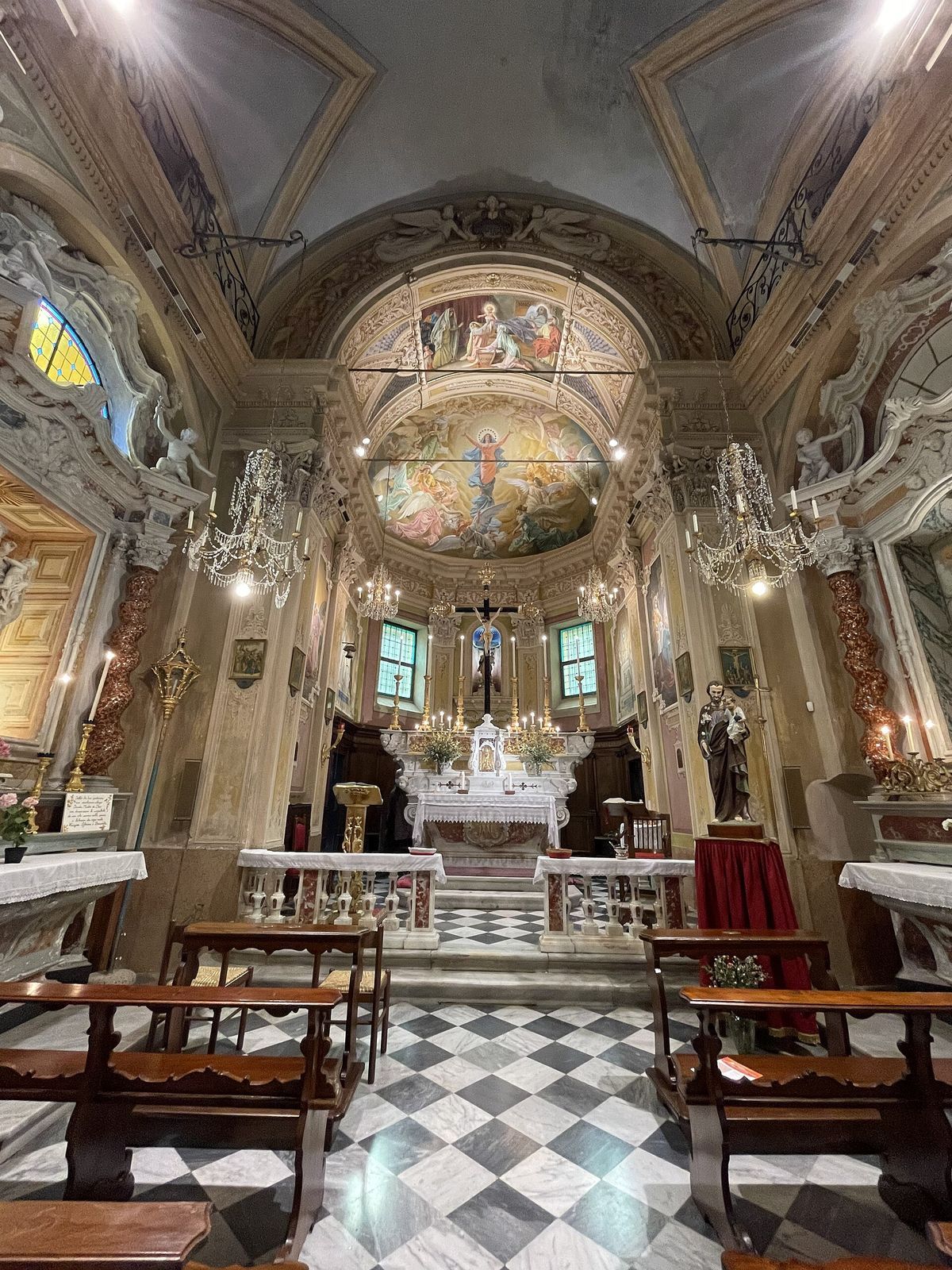
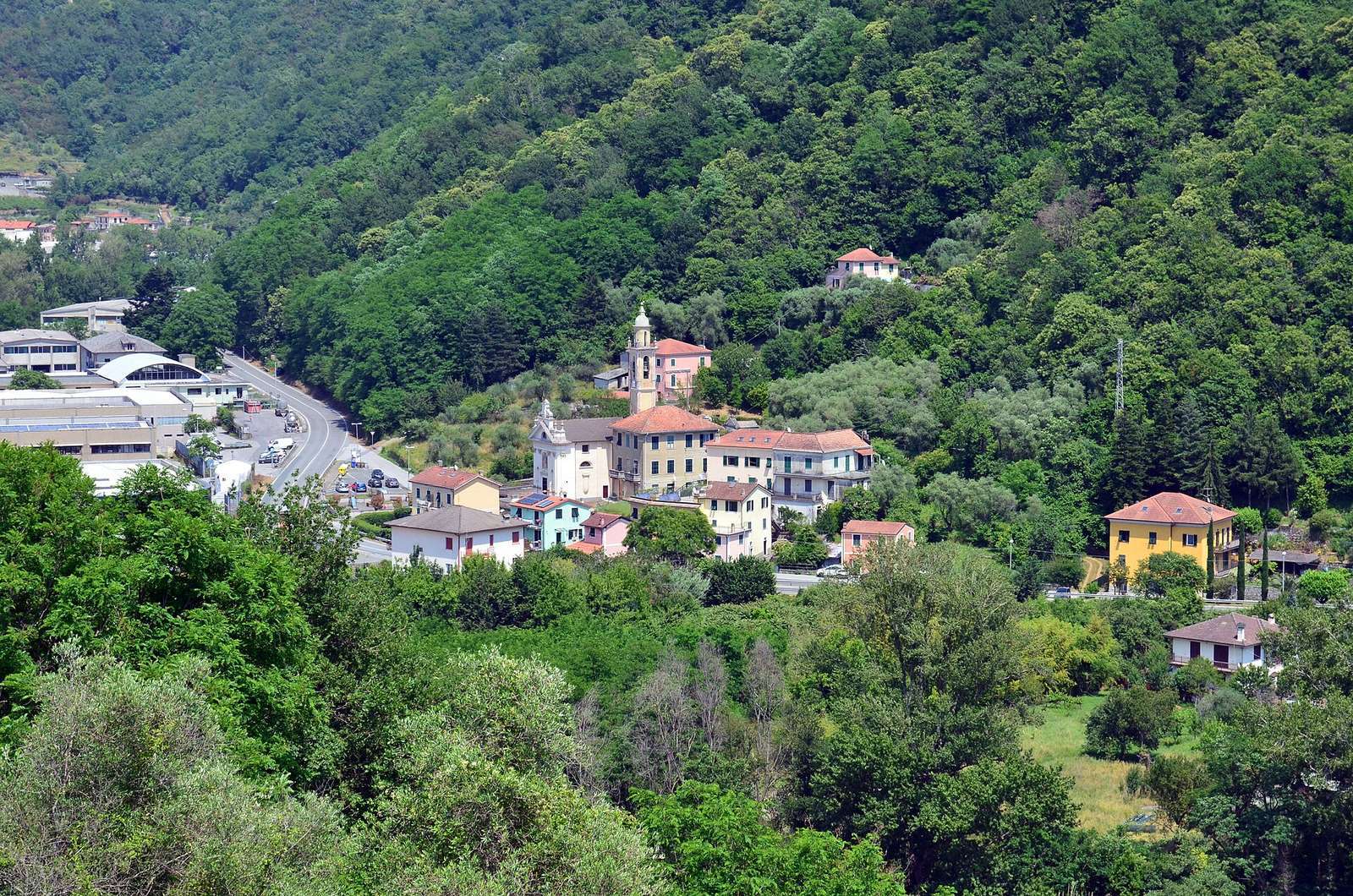
The church stands on the left bank of the Sturla stream, with the parish cemetery adjoining its right side. Its interior is arranged as a single nave, 18.50 metres long, counting the presbytery, or area around the altar, and choir, 7 metres wide, and 11 metres high. A polished-stucco façade fronts the church, while marble and terracotta are used for its altars and other interior fittings. The bell tower is attached to the building, and the sacristy and rectory house adjoin it.
Exterior and churchyard
Façade
The façade bears an image of the Virgin Mary and Saint Sebastian, along with an inscription dedicating the church to the Virgin, Mother of God, and giving the date 1889. During work carried out from September 1887 to July 1889, the façade wall was extended by two metres to make room inside for a choir loft, a raised platform for singers or an organ.
Forecourt and steps
The forecourt has patterned paving made from colored pebbles gathered along the nearby Lavagna shore. Parishioners helped lay it between 1871 and 1875. In February 1922, the single staircase in front of the church door was replaced with separate north and south staircases to accommodate traffic, and an iron railing was added.
Bell tower and adjoining spaces
The bell tower was raised in 1844. Its bells were cast in Genoa in 1880 by the Boero Brothers firm. The sacristy and rectory house form adjoining parts of the church complex.
Interior furnishings
Altars
The church had four altars in 1735 and five in 1746, comprising three marble and two terracotta altars. The first altar on the right as one enters is marble and dedicated to Saint Sebastian. Reverend Benedetto Sturla bought and donated it from the Sanctuary of Our Lady of the Guard at Gavi. Its niche holds a wooden statue transferred from an abandoned chapel at Colla di Paggi, which had been abandoned around 1670. Opposite is a marble altar dedicated to San Pellegrino, with a wooden statue of the saint in its niche.
The third altar, on the right, is made of terracotta and dedicated to the Holy Crucifix. Opposite it, another terracotta altar is dedicated to the Madonna of the Grapes. Its marble statue shows a bunch of grapes between the Virgin’s fingers. The marble main altar is dedicated to the Nativity of the Virgin Mary. On the door beneath its tabernacle, the receptacle for the Eucharist, a low-relief carving shows the Sturla family arms: a bridge topped by a tower.
Choir and furnishings
Domenico Badaracco of Levaggi made the wooden choir in 1861. After the church was enlarged, a new choir loft was built and fitted with an organ made by the Paoli firm; Stefano Sturla donated the instrument. The baptismal font, pulpit, balustrades, and floor are marble.
Painted and carved decoration
Work on paintings in the presbytery was inaugurated on 19 August 1923. Luigi Agretti of Arcola painted the presbytery and completely repainted the façade fresco. Agostino Castagnino of Chiavari carried out carving and gilding work.