Volfštejn: A Medieval Castle Ruin in Czechia
Site at a Glance
- Rating
- 4.4
- Popularity
- Low
- Country
- Czechia
- Primary era
- Medieval
- Eras represented
- Medieval
- Civilizations
- Holy Roman Empire, Kingdom of Bohemia
- Site type
- Military
- Remains
- Castle
On this page10 sections
History
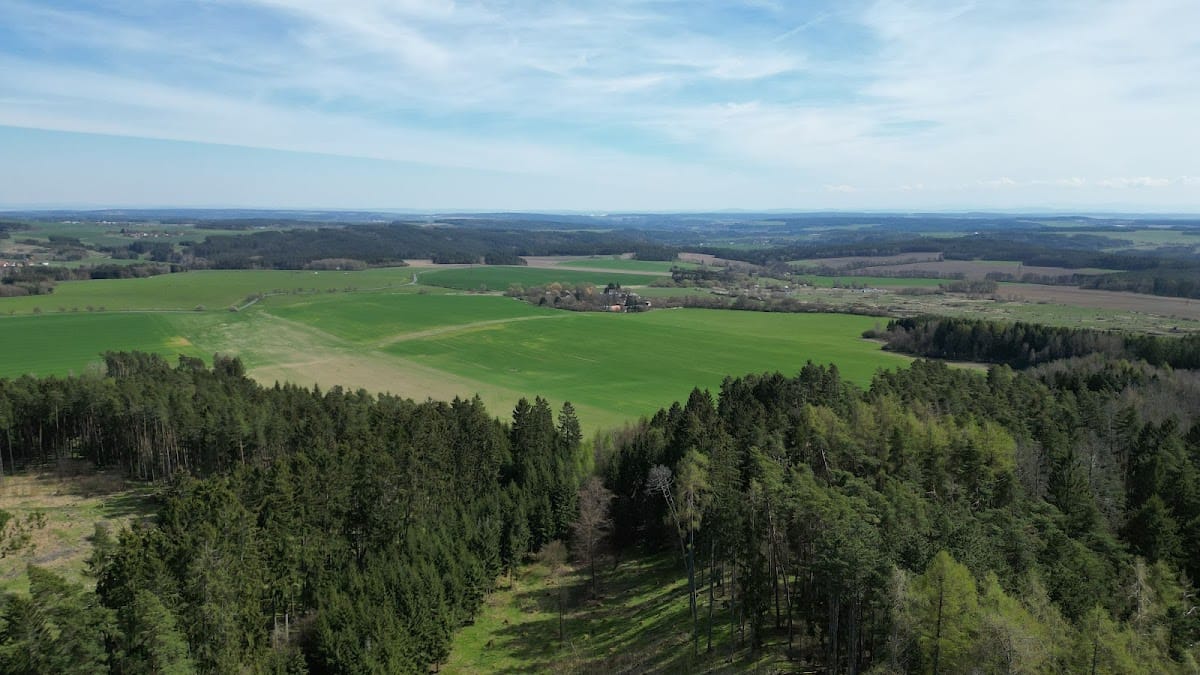
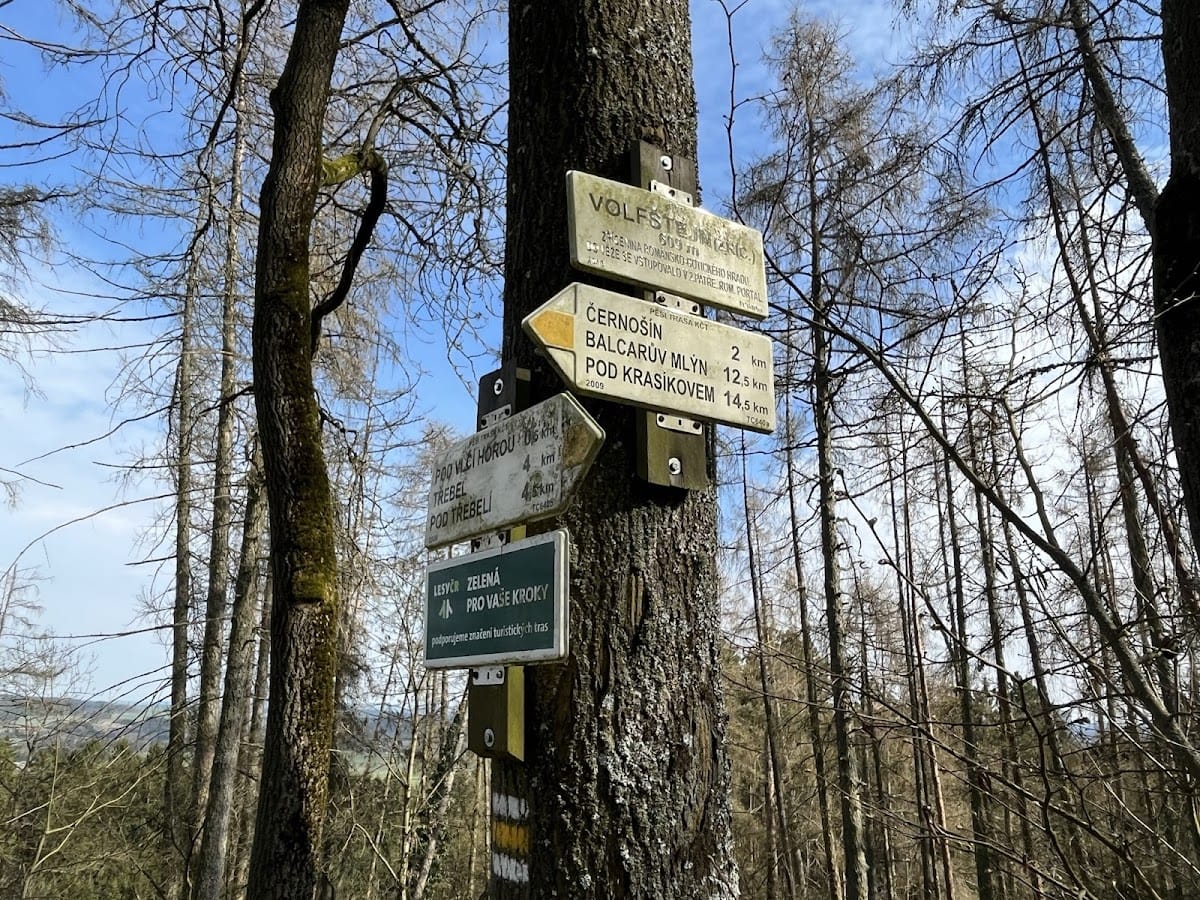
Volfštejn is a medieval castle ruin in Czechia, located less than two kilometres southwest of Černošín on the southeastern spur of Vlčí hora. Probably founded during the first half of the thirteenth century, it was built as the seat of the Lords of Volfštejn. Its earliest securely identified phase is represented by the round bergfried, a powerful castle tower used mainly for defence and as a stronghold, whose entrance portal has a late Romanesque character.
The Lords of Volfštejn
The first written reference to the castle dates from 1316, when it belonged to Beneda of Volfštejn. In that year, Beneda brought Dluhomil and Bedřich of Brod before the land court, the high medieval court of Bohemia that dealt with noble property and serious crimes. He accused them of murdering his father, Ctibor of Volfštejn.
Volfštejn remained the family seat throughout its existence. The Lords of Volfštejn were related to the Lords of Svojšín and the Lords of Třebel. Their heraldic emblem used transverse stripes, while the crest showed either a wolf’s head or a complete wolf.
During the second half of the fourteenth century, the family included the brothers Protiva, Beneda, and Ctibor. Protiva acquired estates around Plasy and separated his property from that of his brothers, leaving Beneda and Ctibor to divide Volfštejn. Ctibor died no later than 1360, and his share passed to his son, who was also named Ctibor. Beneda then obtained confirmation from Emperor Charles IV, the fourteenth-century ruler who was King of Bohemia and Holy Roman Emperor, that his nephew’s share would pass to him as a fief, or property held conditionally from a superior lord, if the boy died before reaching adulthood.
Beneda was last recorded in 1360, after which Volfštejn disappears from the historical record for almost forty years. In 1396, its owner was Oldřich of Volfštejn, who exercised the right of patronage over the church at Černošín. This was the legally recognized power to nominate or help appoint a parish priest.
Division of the estate and abandonment
At the beginning of the fifteenth century, Volfštejn belonged to the brothers Vilém and Beneda of Volfštejn. They concluded a peace agreement with the Bavarian dukes in 1406 and jointly appointed the parish priest of Černošín in 1409. Their property was later divided: Beneda received Prostiboř, while Vilém retained Volfštejn.
During the Hussite Wars, the religious and political conflicts in fifteenth-century Bohemia that followed the reform movement associated with Jan Hus, Vilém supported the Catholic side. Emperor Sigismund rewarded his services with several estates held in pledge. In 1415, Vilém received part of Buben Castle from Heřman of Nečtiny. In 1437, he transferred that holding to Ctibor, Vilém, and Jan of Volfštejn. Vilém probably died soon afterward, while Ctibor lived at Hostouň until his death in 1463. Volfštejn passed to Jan.
In 1460, Jan received the nearby castle of Třebel in pledge. Although the agreement required Třebel to be redeemed after twenty years, this did not happen, and the castle remained with the Lords of Volfštejn. From 1461, Jan used the byname “of Třebel,” and Volfštejn became part of the Třebel estate. The family moved from Volfštejn to Třebel in 1460.
According to historian Tomáš Durdík’s interpretation, Volfštejn probably ceased to exist during fighting between the Green Mountain League and King George of Poděbrady at the end of the 1470s. The Green Mountain League was a political alliance of Catholic nobles formed against George, the Hussite King of Bohemia. A reported meeting of the brothers Jiří and Šebestián of Banbach took place at Volfštejn in 1527, when the castle was described as deserted. Volfštejn has been protected as a cultural monument of the Czech Republic since 1964.
Remains
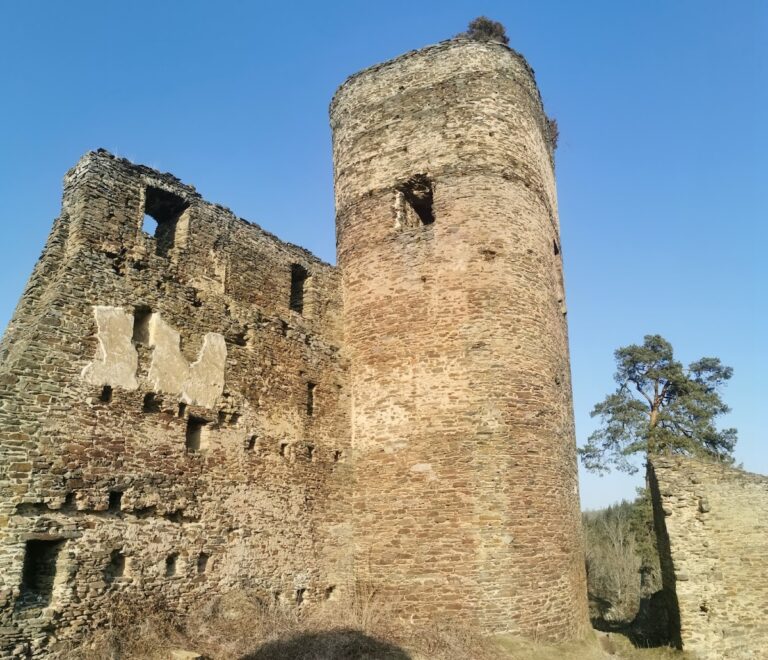
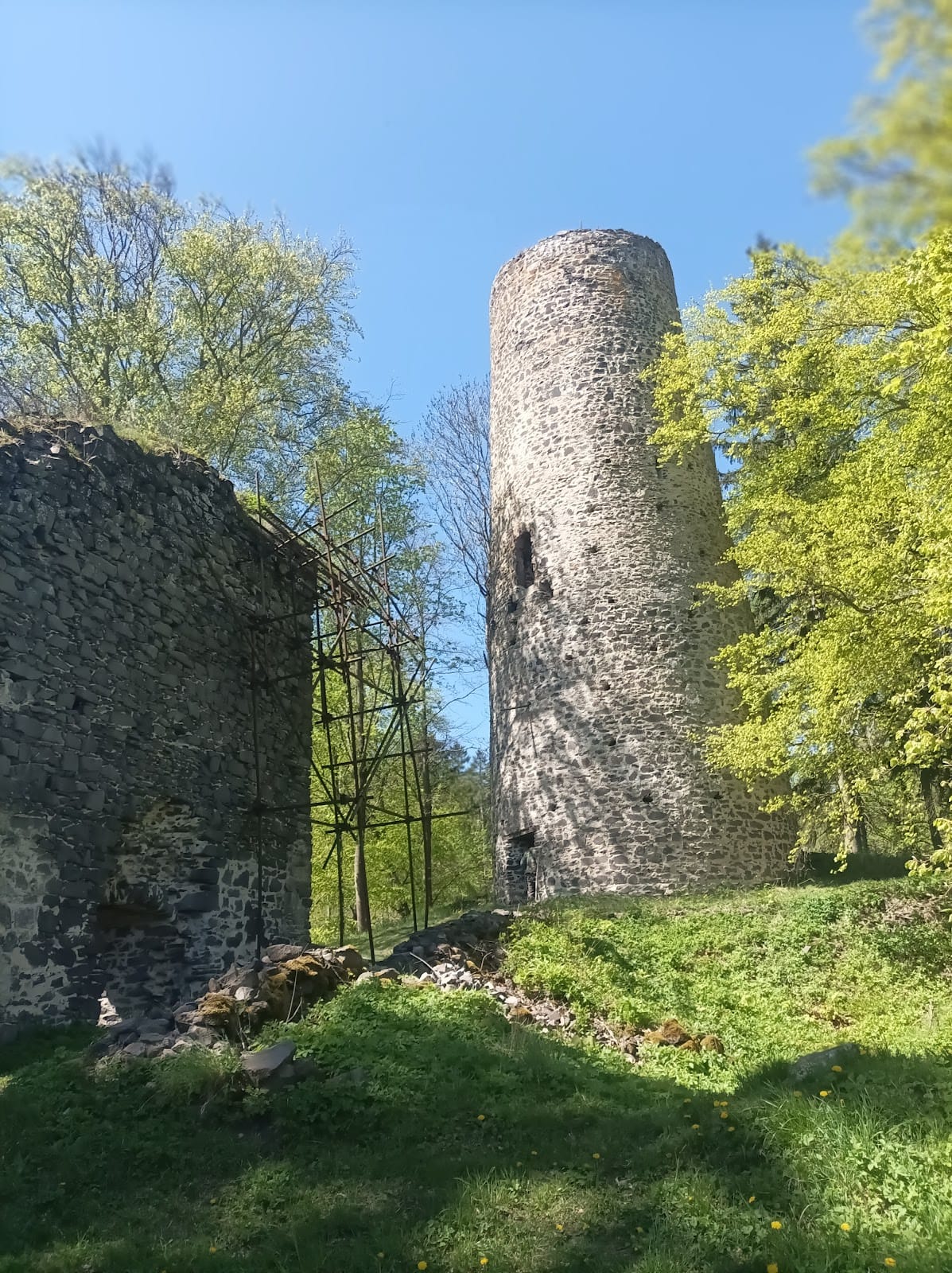
Volfštejn is a bergfried-type castle with an almost oval ground plan. The complex was not substantially rebuilt as a whole, allowing its surviving structures to preserve the character of its medieval arrangement. The dates of individual buildings remain uncertain, although the round tower provides evidence for the earliest construction phase. The castle’s principal elements include the tower at the head of the layout, a palace opposite it, and smaller buildings along the eastern curtain wall.
Principal buildings
Round bergfried
The round bergfried stood at the head of the castle layout and is the oldest surviving component. Its entrance portal has late Romanesque architectural features, making it the main evidence for the castle’s earliest securely identified phase. The tower had a flat-ceilinged interior, and one of its levels was heated by a fireplace. Dendrological examination of scaffolding found during repairs established that the ash trees used in its construction were felled between 1260 and 1262.
Palace
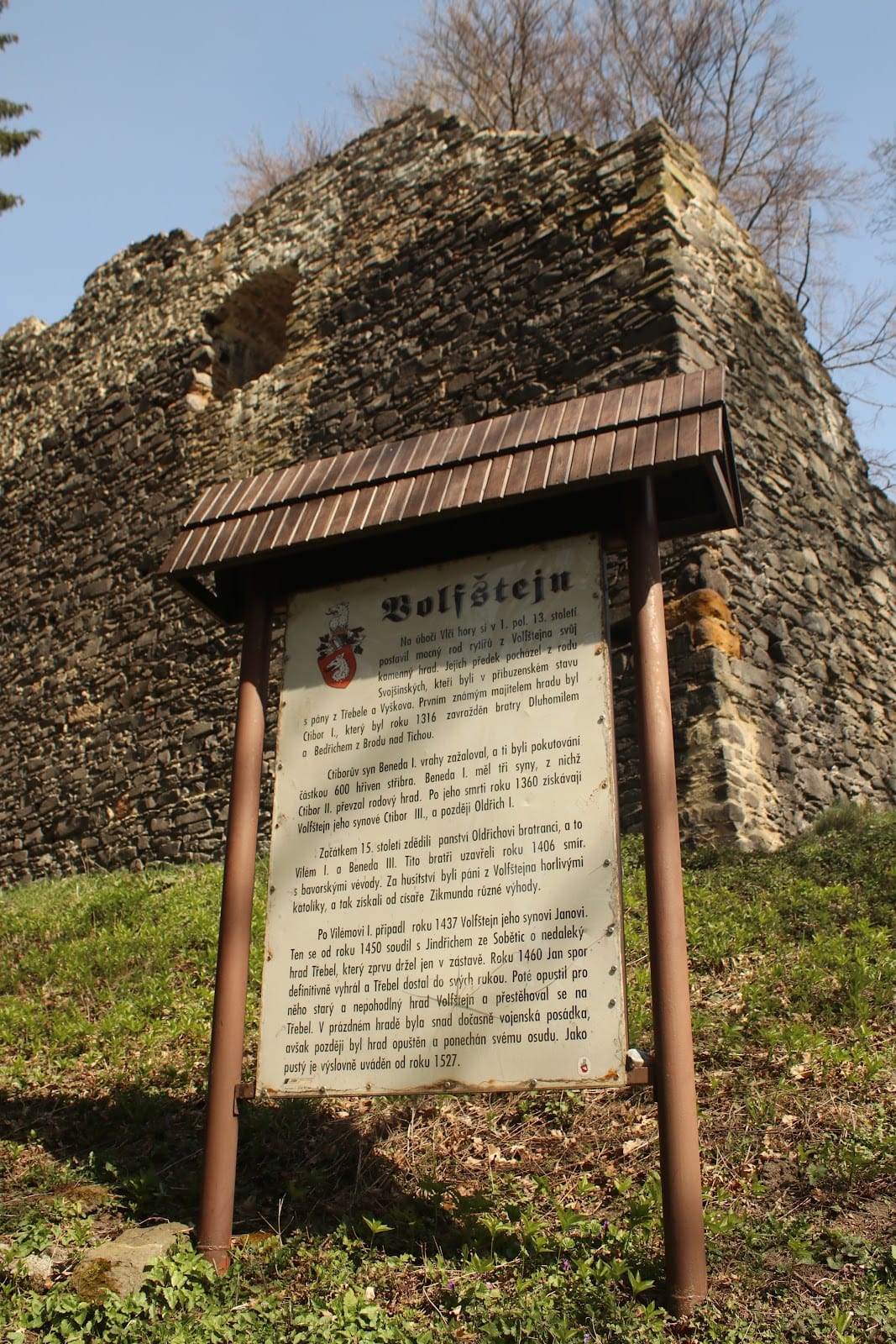
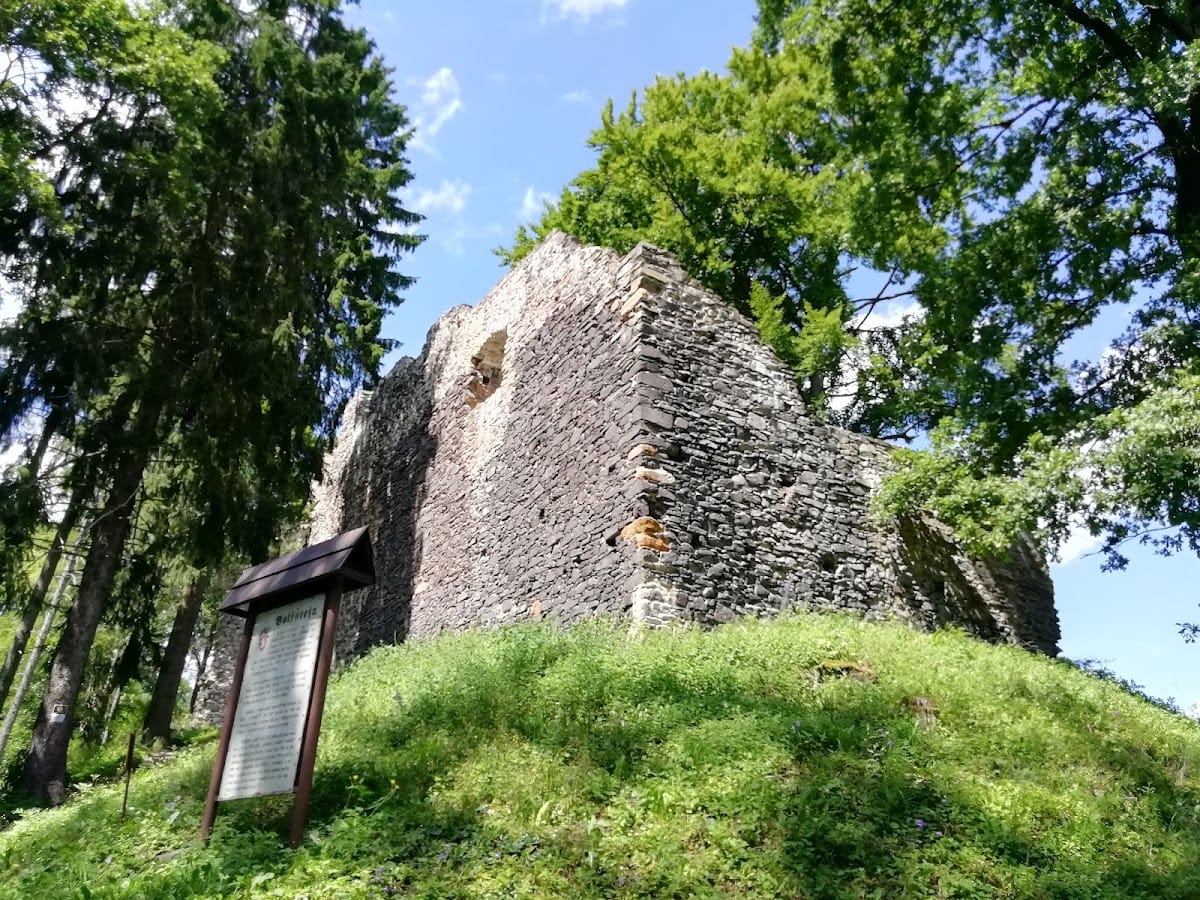
A palace stood on the opposite side of the castle. Its surviving ruin rises to the height of two storeys. Architectural elements reused in its masonry suggest that it may belong to a later construction phase than the round tower.
Buildings along the eastern wall
Two-room building
Beneath the tower, along the eastern curtain wall, stood a partially preserved building divided into two rooms. Its remains form part of the smaller structures that completed the castle’s oval arrangement.
Square tower-like structure
Opposite the two-room building was a tower-like structure with a square ground plan. It survives as one of the identifiable elements within the castle complex, alongside the round bergfried and the palace.
Nearby sites