Sheriff Hutton Castle: A Medieval Royal and Noble Stronghold



Site at a Glance
- Rating
- 4.3
- Popularity
- Low
- Country
- United Kingdom
- Primary era
- Medieval
- External website
- Open
- Eras represented
- Medieval
- Civilizations
- English
- Site type
- Military
- Remains
- Castle
On this page12 sections
History
Sheriff Hutton Castle is a medieval castle in the United Kingdom, rebuilt in stone in the late fourteenth century at the western end of Sheriff Hutton village. Its history began with an earlier motte-and-bailey castle in the Forest of Galtres, followed by a substantial quadrangular stone fortress associated with John Neville and the political affairs of northern England.
The early earthwork and the stone castle
The first castle was built by Bertram de Bulmer, Sheriff of York, during the reign of King Stephen, between about 1135 and 1154. A motte-and-bailey castle combined a raised earthen mound, or motte, with an enclosed lower area, or bailey. The earthwork remains lie south of the churchyard, separate from the later stone castle.
John Neville, 3rd Baron Neville de Raby, commissioned the later castle during the late fourteenth century. In 1377 he secured a charter for a Monday market and an annual fair held on the eve of the Feast of the Exaltation of the Holy Cross, 14 September. Richard II granted Neville a licence to crenellate in 1382, meaning royal permission to fortify a building, although it is uncertain whether work had already started by then. The castle is attributed to John Lewyn on stylistic and documentary grounds.
The Neville inheritance
After John Neville’s death, the castle passed to his son Ralph Neville, 1st Earl of Westmorland. When Ralph died in 1425, the Neville estates were divided. His grandson Ralph Neville, 2nd Earl of Westmorland, retained the title and the Durham estates, while Richard Neville, 5th Earl of Salisbury, received the Yorkshire properties, including Sheriff Hutton.
Following the death of Richard Neville, 16th Earl of Warwick, at the Battle of Barnet in 1471, the Yorkshire estates passed to Richard, Duke of Gloucester, through his marriage to Anne Neville. Richard, later King Richard III, often stayed at Sheriff Hutton while serving as Lord of the North, the monarch’s senior representative or military authority in the region. The castle’s proximity to York helped make it a useful base.
Richard III and the Council of the North
The castle was involved in northern military and political affairs during Richard’s years in the region. In October 1480, while he was at Sheriff Hutton, the Earl of Northumberland warned him that the Scots might retaliate for a raid Richard had led across the border. After York’s authorities sent an alderman to consult him about raising an armed force, Richard advised the city’s representatives.
In 1484 Richard established a royal household at Sheriff Hutton for Edward, Earl of Warwick, the son of George Plantagenet, 1st Duke of Clarence, and for John de la Pole, 1st Earl of Lincoln. In July that year he also established the Council of the North, a royal administrative body responsible for governing England’s northern counties. Sheriff Hutton and Sandal Castle became its principal headquarters, and the council continued for approximately a century and a half.
In 1485, while waiting at Nottingham for Henry Tudor’s invasion, Richard sent Elizabeth of York, her sisters, the Earls of Warwick and Lincoln, Lord Morley, and John of Gloucester to Sheriff Hutton. After Richard’s death at the Battle of Bosworth that year, Henry Tudor became King Henry VII and the castle entered Crown ownership.
Crown ownership and decline
Thomas Howard, later 2nd Duke of Norfolk, and his family occupied Sheriff Hutton while it remained Crown property. Thomas Howard served as the King’s Lieutenant in the North from 1489 to 1499 and may also have been the castle’s constable. The poet John Skelton visited in 1495 and wrote The Garlande of Laurell about Elizabeth Tilney, Countess of Surrey and Thomas Howard’s wife.
Sir Thomas Darcy became constable and steward around 1499 or 1500, replacing Howard, and Sir Richard Cholmondeley replaced Darcy in 1509. A survey from this period described the castle as needing repair. Henry Fitzroy, the illegitimate son of Henry VIII, may have been sent there in 1525 to be raised, indicating that the castle was still Crown property at that time.
Thomas Howard, 3rd Duke of Norfolk, repaired the castle in 1537. After the Council of the North moved to York in the middle of the sixteenth century, Sheriff Hutton declined. Henry Hastings, 3rd Earl of Huntingdon, carried out another repair campaign in 1572, hoping that the council’s president would live there. He described the building as an old castle that was almost ruined.
Ruin, reuse, and preservation
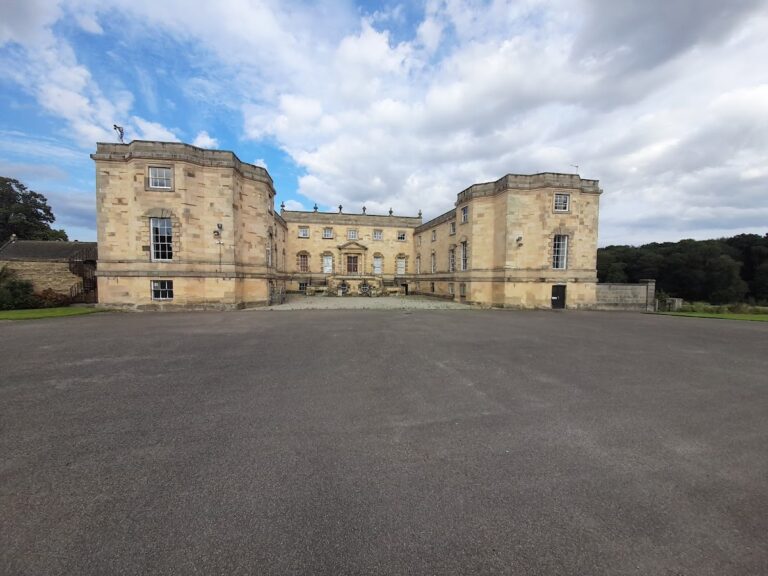
The castle was again described as ruinous in 1618. The Ingram family acquired it in 1622 and reused stone from the site in buildings at Sheriff Hutton, including nearby Sheriff Hutton House. The property remained with the Ingrams until the early twentieth century, when the ruins served as a farmyard or storage area.
The Howarth family held the castle from the 1940s until it was sold to another private owner in 2019. It was designated a scheduled ancient monument in the 1950s and later received repairs by English Heritage, the organisation responsible for many historic monuments and archaeological sites in England. Sheriff Hutton Castle is also a Grade II* listed building, a designation for a structure of particular importance and more than special interest, and is recognised as an internationally important structure. It remains privately owned and is not open to the public.
Remains
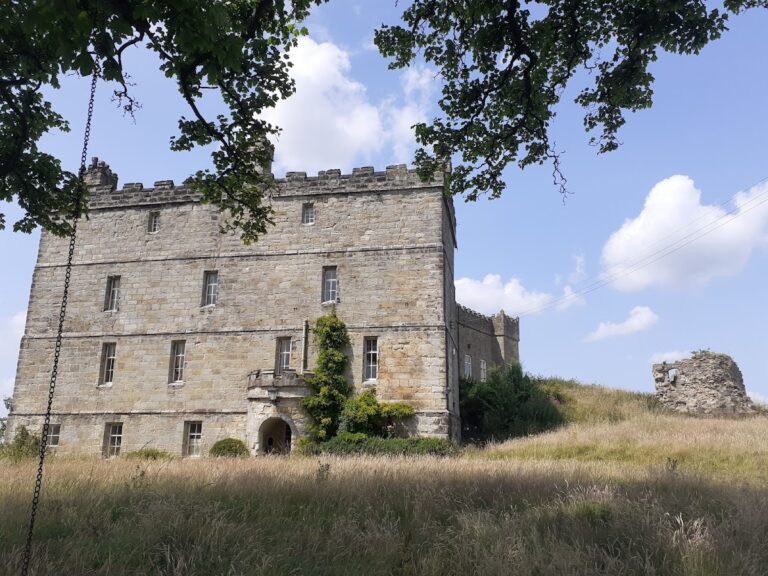
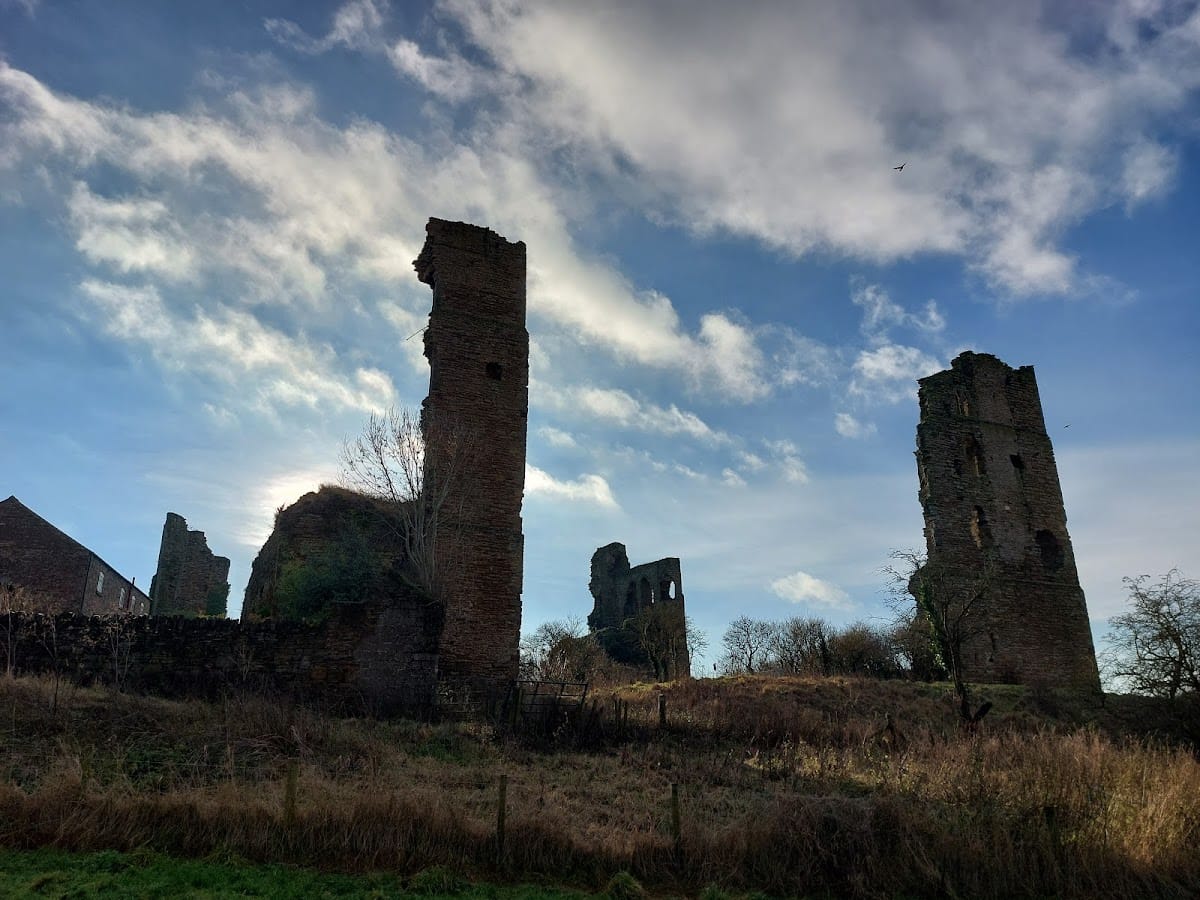
Sheriff Hutton Castle’s later stone fortress is an irregular quadrangle arranged around an inner courtyard. Four rectangular corner towers are joined by ranges of buildings. The north and west sides run straight, while the south and east sides contain central, outward-projecting angles. The entrance lies in the east wall and is defended by a gatehouse. Tall sections of the corner towers and gatehouse survive to their original height, while most of the enclosing walls and connecting ranges have disappeared.
The stone castle
Towers, walls, and gatehouse
The castle was built mainly from rubble mudstone faced or detailed with sandstone quarried at Terrington. The parapets of the corner towers rise in steps to form turrets. Their massive rectangular form, combined with the quadrangular plan and stepped parapets, resembles nearby Bolton Castle and supports the attribution to John Lewyn. Comparable arrangements also occur at Wressle, Lumley, and the earlier castle at Chillingham. The surviving castle is described as approximately 98 feet, or 30 metres, high.
Courtyard and outer wards
The inner courtyard was originally accompanied by a middle ward and an outer ward. A ward was a separate enclosed area within a castle complex. These additional areas are now covered or occupied by the adjacent farm, while the surviving tall towers and gatehouse define the most substantial parts of the stone castle.
The earlier earthwork
Motte-and-bailey remains
The earlier motte-and-bailey survives as earthwork south of the churchyard. Its raised mound and enclosed lower area belong to the first castle built during the reign of King Stephen. The earthwork is physically separate from the later stone castle at the western end of the village and represents the site’s earlier defensive phase.