Carmarthen Castle: A Medieval Royal Fortress in Wales


Site at a Glance
- Rating
- 3.7
- Popularity
- Low
- Country
- United Kingdom
- Primary era
- Medieval
- External website
- Open
- Eras represented
- Medieval, Modern
- Civilizations
- English
- Site type
- Military
- Remains
- Castle
On this page16 sections
History
Carmarthen Castle is a medieval fortress in Carmarthen, United Kingdom, built by Anglo-Norman authorities under the authority of King Henry I in the early twelfth century. Its first construction on the present site is dated variously to 1104, around 1105 to 1106, or 1109, and is attributed to Walter, Sheriff of Gloucester. The castle remained directly associated with the English Crown and developed into a military base, royal administrative centre, and prison.
Norman Foundation and Welsh Conflict
An earlier Norman fort called Rhyd-y-gors stood about 1.4 kilometres south of the present castle. William FitzBaldwin of Devon built it for King William II, probably after the death of the Welsh king Rhys ap Tewdwr in 1093. A Welsh attack may have destroyed Rhyd-y-gors around 1096, and the fort was last mentioned in 1106. The fortress on the present site began as a timber motte-and-bailey castle, combining an earthen mound carrying a fortified structure with an enclosed courtyard.
Carmarthen Castle was repeatedly attacked during the twelfth century. In 1116, Gruffydd ap Rhys captured it in a night assault, dismantled the defences, and plundered the surrounding town. The castle was rebuilt, but Owain Gwynedd, the leading ruler of the Welsh kingdom of Gwynedd, destroyed it in 1137. It was destroyed again in 1143, briefly recaptured in 1144, and taken by Cadell ap Gruffydd in 1146. Cadell held it for several years.
Gilbert de Clare, Earl of Pembroke, recovered and rebuilt the castle in 1145, but Cadell ap Gruffydd soon regained control. Cadell’s successor, Rhys ap Gruffydd, appears to have surrendered Carmarthen to Henry II in 1158. After Rhys rebelled in 1159, he besieged the castle, but an English relief army forced him to withdraw. Henry II ordered further expansion between 1181 and 1183, while the timber fortress was reconstructed in stone during the later twelfth century, including substantial rebuilding in the 1190s.
Carmarthen remained a royal English possession after Henry II granted Rhys ap Gruffydd most of Deheubarth in 1171. Rhys, a major Welsh ruler of South Wales, besieged the castle again in 1189 and during his final campaign against the English in the late 1190s. The later campaign resulted in the castle’s capture and destruction. Following Rhys’s death in 1197, his sons disputed his inheritance. King John granted Carmarthen and Cardigan castles to Maelgwn ap Rhys in 1200, later recovered them, and entrusted them to William Marshal, Earl of Pembroke, in 1214.
Thirteenth-Century Royal Stronghold
Llywelyn the Great, the dominant ruler of Gwynedd in the early thirteenth century, captured Carmarthen after a five-day siege in December 1215 and destroyed the castle. The settlement of Aberdyfi assigned Carmarthen to Maelgwn ap Rhys, but William Marshal, 2nd Earl of Pembroke, recovered it for the English Crown in 1223. He strengthened the site with stone walls around the motte.
The castle returned to Henry III in 1226 and was held by Hubert de Burgh from 1228 until his fall in 1232, when it reverted to the Crown. Richard Marshal, allied with Welsh forces, besieged Carmarthen from late 1233. A relief fleet from Bristol, commanded by Henry de Turberville, broke the blockade in March 1234. Gilbert Marshal received the castle that year and held it until his death in 1241.
Carmarthen subsequently became one of the principal English military bases used against Llywelyn the Last, the final independent prince of Gwynedd. After Edward I’s conquest of Wales in 1283, the castle became the administrative centre of the new county of Carmarthenshire and the seat of the royal Justiciar of South Wales. The Justiciar was a senior royal official with judicial and financial powers over the region.
Administrative Centre and Prison
In 1301, Edward I made the principality of Wales an apanage, meaning territory or revenue assigned to a member of the ruling dynasty, for his son Edward, later the first English Prince of Wales. Carmarthen Castle thereafter had a more administrative than military role. The Justiciar was based there, and the fortress also served as a prison.
The castle was prepared for defence during the revolt of 1321, when Roger Mortimer of Chirk refused to surrender it to Edward II’s representatives. After Edward II’s deposition in 1327, Roger Mortimer of Wigmore held custody of the castle until his fall in 1330. During the Hundred Years’ War, the long conflict between England and France, Carmarthen was placed in a defensive state against possible French incursions. The office of Justiciar increasingly became a sinecure, an office carrying status or income but little active responsibility, and its holders no longer lived at the castle.
During the revolt led by Owain Glyndŵr, the Welsh nobleman who headed the major early fifteenth-century rising against English rule, rebels captured Carmarthen in 1403 after the constable, Roger Wigmore, opened the gates. Henry IV recovered the castle shortly afterward, but Glyndŵr took it again in 1405. English control was restored by 1409, and the garrison was disbanded in 1411, reflecting the defeat of the revolt.
Wars of the Roses and Tudor Associations
Control of Carmarthen shifted repeatedly between the houses of Lancaster and York during the Wars of the Roses, the dynastic conflict between those rival royal houses. Gruffudd ap Nicolas, a Lancastrian-aligned Justiciar, was expelled in 1455 after the First Battle of St Albans. Edmund Tudor then took possession for the Lancastrians, but Yorkist forces led by William Herbert and Walter Devereux captured the castle in August 1456 and imprisoned him there.
Edmund died as a prisoner on 1 November 1456. His widow, the thirteen-year-old Lady Margaret Beaufort, gave birth to their son Henry, the future Henry VII, the following January. The castle changed hands again when Jasper Tudor held it in 1457 and Richard of York recovered it in 1460. William Herbert became Justiciar in 1461. After Herbert’s execution in 1469, Richard Neville, Earl of Warwick, seized Carmarthen and the office of Justiciar. Lancastrian forces later recovered the castle, before Edward IV appointed William Herbert’s son as Justiciar after the Yorkist victory of 1471.
Early Modern Decline and Civil War
The Laws in Wales Acts of 1535 and 1542 incorporated Wales more fully into the English legal and administrative system. Carmarthen remained the seat of the South Wales circuit court, although royal officers ceased to reside at the castle during the sixteenth century. Written records mention further castle works up to 1546, and the site continued in use as a prison.
During the 1620s, the castle was sold to the Philips family of Cwmgwili. By 1642 it belonged to the Vaughan family of Golden Grove. Richard Vaughan, Earl of Carbery, supported the Royalist cause during the First English Civil War, the conflict between supporters of the monarchy and Parliament, and Charles I appointed him commander-in-chief of South Wales.
Parliamentary forces under Major-General Rowland Laugharne captured the town of Carmarthen in April 1644, but the castle held out until 12 October 1645. Its defences were dismantled in 1660 after the Restoration, ending its military and administrative functions. The site then continued solely as a prison.
Prison, Civic Buildings, and Conservation
An eight-cell prison occupied the inner bailey. John Nash designed a new County Gaol there, rebuilt between 1789 and 1792. A women’s wing was added in 1857 to 1858, and the prison was enlarged between 1868 and 1872. It closed in the early 1920s, with 1924 recorded as the closure date, and was demolished by 1936.
A two-storey police station and lock-up was built between the outer and inner walls around 1860. It held prisoners being transferred to the nearby courthouse until 1947 and is now known as Castle House. Carmarthenshire County Council acquired the former prison site in 1925 for county administration and a museum. County Hall was built there during the mid-twentieth century. Construction was delayed by the Second World War, and the building was completed and opened in the 1950s.
The surviving castle remains have been Grade I listed since 1954 as the substantial remains of a major medieval castle and are also protected as a Scheduled Monument. Archaeological investigation and restoration between 2002 and 2005 made the Square Tower and Southwest Tower accessible and improved the visibility of the surviving fortress. The upper levels of the gatehouse and shell keep opened to the public in 2003.
Remains
Setting and Surviving Fortress
Carmarthen Castle occupies a high terrace about 20 metres above sea level overlooking the tidal River Towy. The site lies approximately 11 miles from the sea at a former lowest crossing point of the river, with Carmarthen Bridge below it. Built as a motte on a rocky position above the Towy, the castle controlled the formerly navigable river and the surrounding settlement. Its position influenced the town’s layout, as streets and property boundaries extended outward from the fortress.
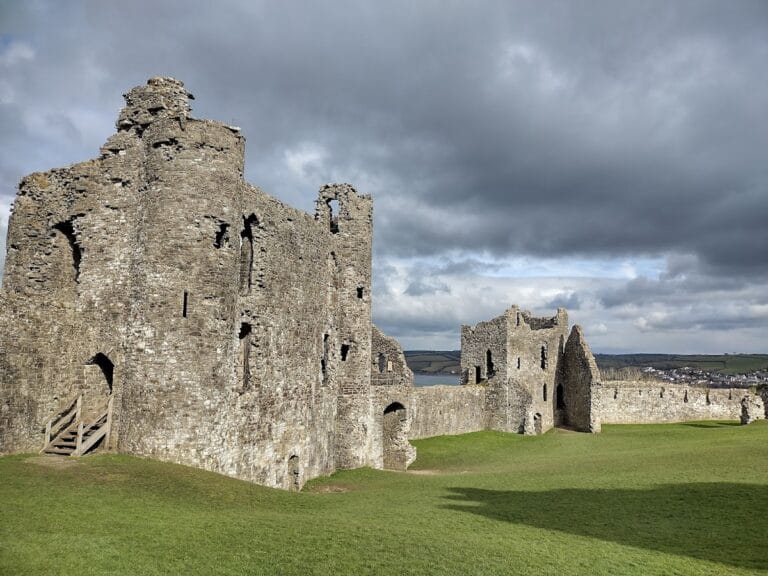
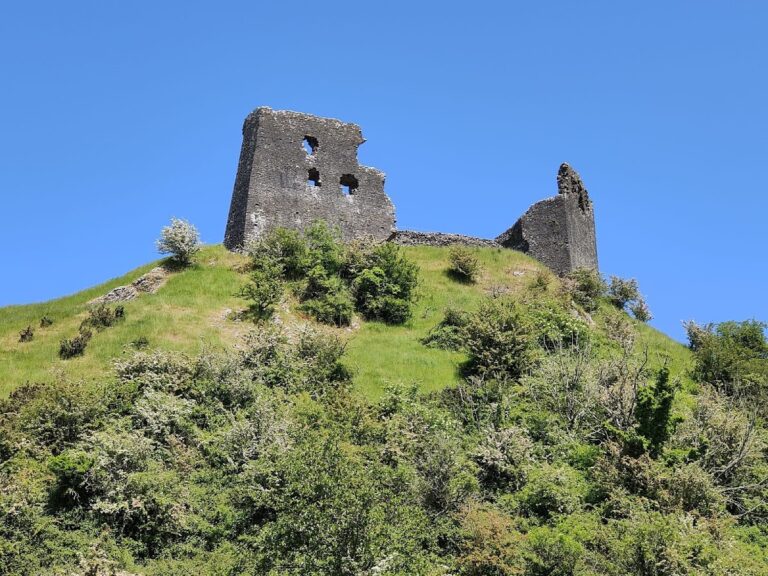
Modern buildings and roads surround the castle. The roughly square eastern bailey was first built over by the former prison and later by County Hall, while the surviving medieval ruins are concentrated in the western part of the former fortress. The remains include the late-thirteenth-century gatehouse, sections of curtain wall, the Southwest Tower, a square wall tower, and the keep on the original motte.
Gatehouse
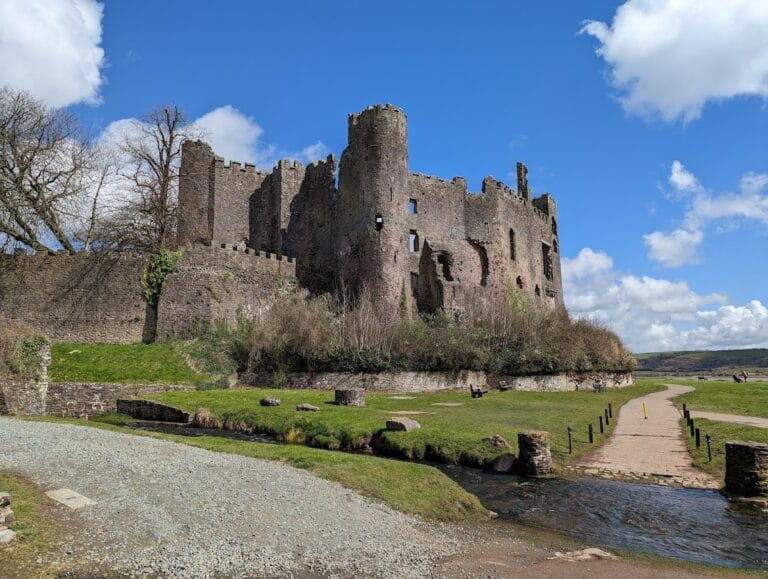
The late-thirteenth-century gatehouse is about 13 metres high and is the best-preserved part of the castle. Its entrance passage is flanked by two round towers and protected by machicolations, projecting openings through which defenders could attack people below the walls, together with openings for dropping missiles. A restored spiral staircase leads to the upper storey, which formerly contained the constable’s lodging.
Walls and Towers
South of the gatehouse, the surviving curtain wall, the enclosing defensive wall between towers, extends toward the Southwest Tower and the ruin of a square wall tower. The Southwest Tower changes from a square plan to a round tower. North of the gatehouse, another stretch of curtain wall runs toward the keep.
Keep and Motte
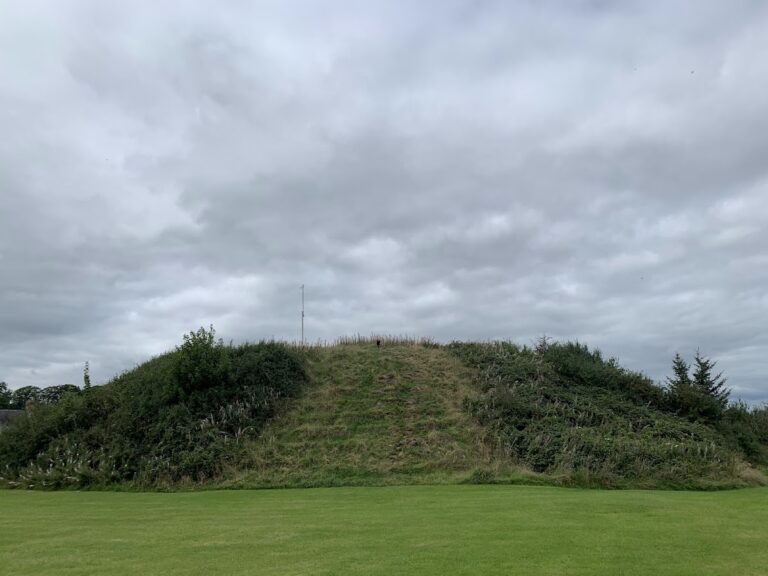
The keep is the oldest surviving part of the castle. The original motte was enclosed by walls in the thirteenth century and converted into a shell keep, a stone-walled enclosure built around the top of an earthen mound rather than a solid masonry tower. Restoration created a grassed area with benches on the summit of the keep mound.
Later Buildings on the Castle Site
Castle House
Castle House stands between the keep and the former prison wall. Built in the mid-nineteenth century as a police station and lock-up, the two-storey building held prisoners being transferred to the nearby courthouse until 1947. It now accommodates a museum and Carmarthen’s Tourist Information Centre.
County Hall
County Hall rises above the earlier castle and prison walls. It is a three-storey building arranged in four wings and constructed in the Chateau style from grey Forest of Dean stone, with white Portland-stone dressings and a steep grey-green slate roof. Its broad northern entrance is made of Portland stone and decorated with eleven reliefs by David Evans representing county-government functions, including health care, education, and taxation.
Name and Meaning
The Welsh name Castell Caerfyrddin has a pleonastic, or repeated, meaning. The element caer means “fort,” while fyrddin is thought to derive from the Latin Moridunum, meaning “sea fort.” The combined sense is approximately “fort sea-fort castle.”