Hasegg Castle: Saltworks Fortress and Historic Mint in Austria


Site at a Glance
- Rating
- 4.5
- Popularity
- Low
- Country
- Austria
- Primary era
- Medieval
- External website
- Open
- Eras represented
- Medieval, Early Modern
- Civilizations
- Habsburg, Holy Roman Empire
- Site type
- Military
- Remains
- Castle
On this page14 sections
History
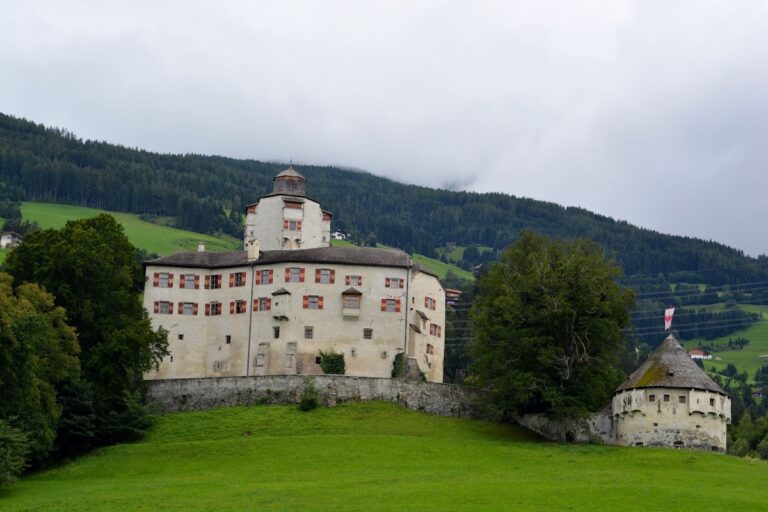
Hasegg Castle is a medieval castle complex in Hall in Tirol, Austria, whose origins lie in the thirteenth-century fortifications of the town’s saltworks. It protected the salt-boiling works, river traffic, the crossing of the Inn, and the old Roman road, before becoming a princely residence and a major mint under the Tyrolean branch of the Habsburg dynasty.
The saltworks fortress
Hall’s saltworks used brine from the Hall Valley, which was boiled in four pans. A watchtower was erected at the southwestern corner of the works during the thirteenth century to help detect fires. It was mentioned in 1296 as a tower at the saltworks, while Hasegg Castle itself was first named in 1306.
The name Hasegg is understood as “house at the corner,” referring to the castle’s position at the corner of the salt-boiling complex. Its original defensive purpose was closely connected with the protection of salt production and the routes around Hall. The castle also incorporated part of the town’s defensive system.
Princely residence and Habsburg mint
When Duke Frederick IV gave Hall his former urban residence, the Königshaus, to serve as the town hall in 1406, the Tyrolean Habsburgs were left without a suitable residence in the city. Archduke Sigismund, the Habsburg ruler known as “the Rich in Coin,” began transforming the southern part of the saltworks area into a princely residence in 1446 and continued the work in 1480.
A mint was operating at Hasegg by 1477. The complex became associated with mechanized roller minting, a process in which engraved rollers pressed coin designs into sheets of metal before individual coins were cut or stamped out. This method supported the production of large silver coins, including the guldengroschen and, later, the taler. The mint master also acted as custodian of the castle, linking the administrative, industrial, and defensive functions of the site.
The mint gate and the massive Mint Tower were built in 1480, replacing the earlier, lower watchtower. In 1490 the Hasegg Gate was strengthened with a projecting defensive work, commemorated by a coat-of-arms stone belonging to Archduke Sigismund. A tradition associates Hasegg with the celebration of the second marriage of the future Emperor Maximilian I and Bianca Maria Sforza in 1494. The wedding may instead have taken place in Innsbruck, but the marriage remained closely linked with Hasegg.
Maximilian I resumed construction at the castle in 1515. The timber eastern wing was rebuilt in stone, and the Chapel of Saint George was created by Niklas Thüring the Elder, the builder of Innsbruck’s Golden Roof, together with his son Gregor. The chapel gave the ruler and his closest entourage a private place of worship within a larger hall.
After Maximilian’s death, wooden intermediate floors were inserted into the large halls so that they could be used temporarily as grain stores. The princely rooms continued to house the territorial ruler and other guests. In 1567, mint officials began holding annual commemorative services in the Chapel of Saint George. The chapel was desacralized under Emperor Joseph II in 1787, and religious services resumed there in 1975.
Industrial change and modern preservation
In 1567, under Archduke Ferdinand II, mint workshops were established west of the fortified inner space after the mint was moved from Sparberegg. That relocation followed the establishment of a royal women’s convent at Sparberegg. Parts of Hasegg subsequently provided housing for mint officials, and a mint office was installed in the courtyard.
An earthquake in 1670 led to the reduction of the smaller tower north of the Mint Tower to approximately its present height. During the early nineteenth-century Tyrolean conflicts, Bavarian authorities closed the mint, with its operation ending by 1809. The former workshops became storage rooms, while other parts of the castle were converted into apartments for saltworks employees.
The medieval saltworks continued operating until 5 August 1967, when the Austrian salt administration ended production. During alterations to an apartment in 1974, workers rediscovered the princely room and its substantial Gothic beam ceiling. This discovery prompted a comprehensive renovation of the castle. The former mint reopened in 1975 as the Alte Münze museum and produced a 100-schilling commemorative coin for the 1976 Winter Olympics in Innsbruck. After renovation in 2003, it was renamed Münze Hall, where historical minting methods, demonstrations, and special coin production continued.
Hasegg Castle now houses the Hall city museum and Münze Hall. A gallery occupies the former saltworks arsenal, and the complex also includes a restaurant and event rooms. The Mint Tower was restored in 2005 and is regarded as Hall’s landmark. Archaeological excavations after a burst water pipe recovered artifacts that may be parts of the drive mechanism from a sixteenth-century roller minting machine.
Remains
The castle occupies the southern part of the former saltworks area and combines defensive walls with buildings created for court residence, religious use, coin production, and storage. Its principal surviving elements include the Hasegg Gate, the Mint Gate, the Mint Tower, the princely rooms, the stone eastern wing, the Chapel of Saint George, the former mint workshops, and the saltworks arsenal.
Fortifications and Mint Tower
Hasegg and Mint Gates
The Hasegg Gate forms part of the former town fortifications and was reinforced in 1490 with a projecting defensive work. A coat-of-arms stone commemorating Archduke Sigismund marks that phase. The Mint Gate was built in 1480 as part of the expansion that replaced the earlier watchtower with a larger defensive and industrial complex.
Mint Tower
The 45-metre Mint Tower has a five-storey circular lower section built of rubble masonry. This base is about 10 metres in diameter. Above it rises a three-storey, twelve-sided section crowned by a twelve-sided lantern. A spiral staircase of 204 steps connects the round lower levels.
The tower received its distinctive upper form through an enlargement above the corbels around 1500, although a capsule placed in the finial at completion carries the date 1490. Its first principal role was surveillance of the saltworks, where three or four watchmen were stationed permanently. Two Baroque sundials on the exterior and a mechanical clock reflect its additional use as a clock tower, particularly for workers at the saltworks.
The tower also contains the Europataler, a silver coin made for the 2008 European Football Championship. The coin measures 36 centimetres in diameter and weighs more than 20 kilograms.
Princely and sacred rooms
Chapel of Saint George
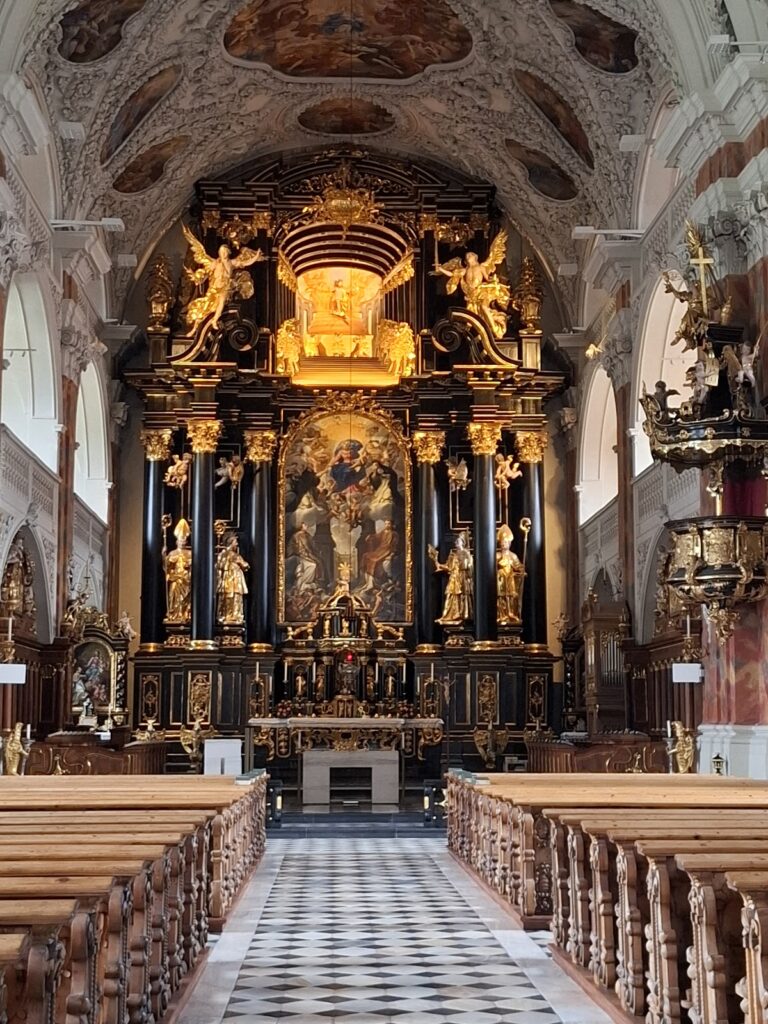
The Chapel of Saint George was built within a much larger hall. Openings in its side walls allowed people in the surrounding hall to see into the chapel, while an opening in the ceiling enabled the emperor to watch Mass from his private rooms above. The chapel’s apse, a small projecting sanctuary end, extends toward Münzergasse in the form of a bay or oriel.
Its ceiling has a net-rib vault supported by seven angel busts. The busts hold coats of arms representing Tyrol, Carinthia, Burgundy, the Holy Roman Empire, Austria, Styria, and Carniola. Beside the altar, a wall recess held liturgical equipment. Its iron-plated door carries symbols of the Order of the Golden Fleece, a chivalric order associated with the Burgundian and Habsburg courts, including firesteels, the Saint Andrew’s cross, and the imperial eagle.
The Gothic entrance portal is made of red marble. Around 1740, it received door leaves and a Rococo grille in the upper semicircular panel, bearing the imperial eagle. Foliage paintings and pointed-arch tracery windows decorate the chapel. Its Rococo altar, installed during the nineteenth century, shows Saint George in the centre with Saints Sebastian and Florian at the sides.
Princely room
The princely room retains a substantial Gothic beam ceiling, rediscovered in 1974 during alterations to an apartment. Its eastern wall contains a fifteenth-century lavatory that was originally separated from the room by a door. The room belongs to the residential phase that followed the Habsburg conversion of the saltworks area into a princely residence.
Mint and saltworks buildings
Former mint workshops
The former mint is represented in Münze Hall by a reconstruction of the first minting machine. The machine illustrates the mechanized roller process associated with Hasegg and is described as capable of producing about 4,000 coins per day. Displays and demonstrations present historical methods of coin production. Artifacts recovered after a water-pipe break may belong to the drive system of a sixteenth-century roller minting machine.
Saltworks arsenal
The former saltworks arsenal occupies vaulted basement rooms with Gothic net-rib vaulting. Weapons used to defend the saltworks, from halberds to small artillery pieces, were stored there. Large iron hooks remain in the vaults. They supported leather bags containing gunpowder and other supplies that required protection from dampness and rodents.
The arsenal vaults were later used for mint storage and, after the mint closed, as accommodation. They now contain a gallery, preserving the rooms as part of the castle’s later sequence of industrial and civic uses.