Stadtpfarrkirche: Hall in Tirol’s Gothic and Baroque Parish Church


Site at a Glance
- Rating
- 4.7
- Popularity
- Low
- Country
- Austria
- Primary era
- Medieval
- External website
- Open
- Eras represented
- Medieval, Early Modern
- Civilizations
- Habsburg, Holy Roman Empire
- Site type
- Religious
- Remains
- Church
On this page17 sections
History
Stadtpfarrkirche, the Roman Catholic parish church of St. Nicholas in Hall in Tirol, Austria, developed from a small church first recorded in 1281 into a Gothic and Baroque religious complex. It was also dedicated to St. Ingenuin, a bishop associated with Sabiona, an early Christian center in the Alpine region. The church’s original size reflected an earlier phase of Hall’s history, before the settlement expanded as a salt-producing town.
Medieval growth and Gothic rebuilding
Hall’s growth soon made the first church too small. In 1352 it was rebuilt and enlarged, and it received baptismal rights that year while remaining subordinate to the mother parish of Absam. The priest of Absam lived in Hall from 1413. After the parish church at Absam was destroyed during the Bavarian invasion, and as Hall’s population rose sharply during the fifteenth century, the parish church underwent a much larger transformation.
Between 1420 and 1440, the master builder Hans Sewer changed the earlier single-nave church into a three-nave Gothic building. The older choir was retained, but the new structure could not be extended toward the south. It therefore had to meet the earlier choir at an angle, creating the church’s characteristic bent axis and angled presbytery, the area around the high altar and principal clergy’s space.
Chapels and religious foundations
The church complex grew through foundations connected with prominent Hall families and religious institutions. The Fieger Chapel was added to the front of the parish church around 1490. The Waldauf Chapel was consecrated in 1501 through the foundation of Florian von Waldauf, a late-medieval Tyrolean knight and patron who established a major collection of Christian relics. The chapel housed this collection, known as the Haller Heiltumsschatz, and became the burial place of Waldauf’s family.
Waldauf also built the Wolfgang Chapel, consecrated in 1505, so that his relics could be displayed to the population once each year. The chapel was destroyed when the parish church tower collapsed in the earthquake of 17 July 1670. A new Josef Chapel was built on the site between 1695 and 1698. The Magdalenenkapelle, probably erected around 1320, later became a memorial chapel for those killed in the world wars from 1923 onward.
Baroque transformation and later damage
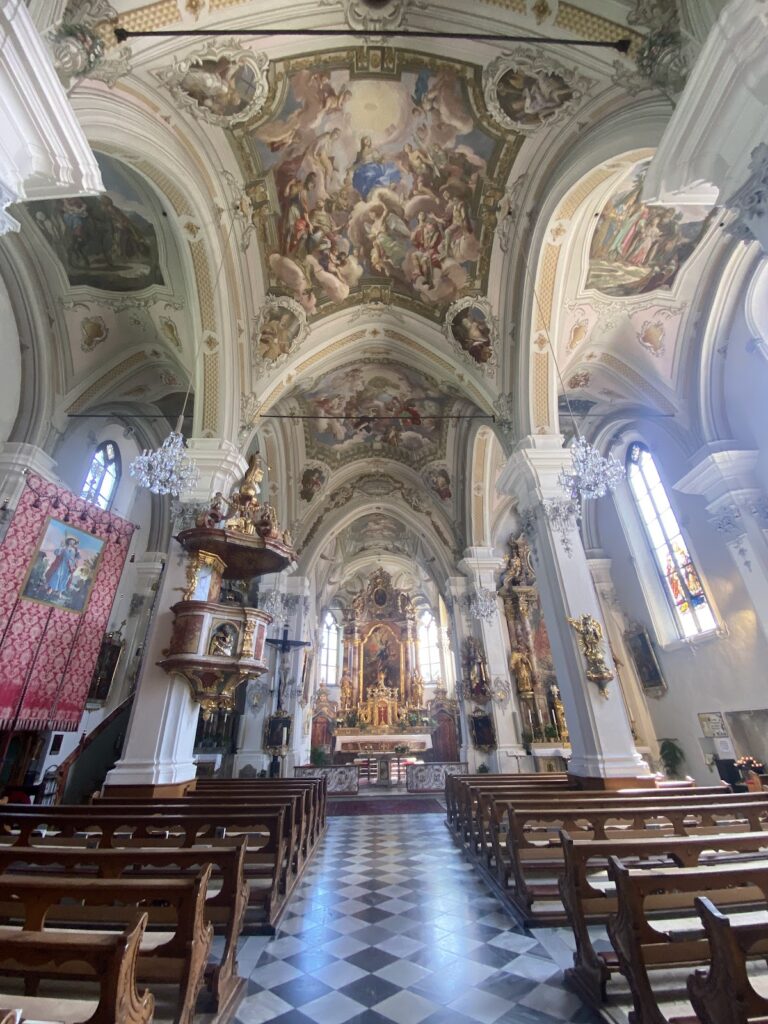
The church was first renovated toward the end of the sixteenth century. The earthquake of 1670 brought more severe damage when the tower collapsed. It was rebuilt in Baroque form and completed in 1676. From the second half of the seventeenth century through the eighteenth century, the interior was progressively reshaped in the Baroque manner. The painter Josef Adam Mölk completed the vault and wall decorations in 1752, and the sculptor Gregor Fritz created three side altars in 1754.
A fire in 1875 partly destroyed the roof structure, the roof, and part of the west-façade gable, including the statue of St. Nicholas. These elements were renewed afterward. The ceiling paintings underwent restoration twice during the twentieth century. The burial history of the complex also continued: Josef Lambichler, a popular youth pastor who lived from 1883 to 1956, was buried in the Waldauf Chapel in 1978.
Organ, bells, and civic traditions
Stadtpfarrkirche has long been connected with Hall’s guild processions. Guild staffs kept in the two side aisles are still carried during these ceremonies. A local tradition links the nickname “Haller Kübel” for Hall’s inhabitants with an Ascension Day ceremony. According to the tradition, a suspended statue of Christ fell when its rope broke; its fragments were then placed in a bucket and symbolically drawn upward toward heaven.
The former Baroque organ was built by Franz Köck in 1689. After several alterations and reconstructions, it was replaced in 1999 by an instrument made by Pirchner. Most of its 50 registers were installed in the restored 1689 case behind the historic prospect. Three of the four bells melted down during the Second World War were replaced in 1951 by the Grassmayr bell foundry of Innsbruck. The large bell was recast in 2001 after developing a crack, and the bells are tuned to the opening notes of the Salve Regina.
Remains
Church layout and Gothic structure
Stadtpfarrkirche stands on the Upper Town Square in Hall’s old town. Its basilical plan has a projecting choir and a three-aisled nave divided by pillars. The church combines Gothic and Baroque elements, while the preserved Gothic choir and later nave create the building’s distinctive angled axis.
Choir and tower
The Gothic choir was built between 1312 and 1318 and retained when the nave was reconstructed. Its misalignment with the later nave makes the presbytery appear angled. Along the side facing the Upper Town Square are the Gothic choir, a two-storey sacristy, and the 67-metre-high tower. The tower is crowned by an onion-shaped cupola and preserves the Baroque form given to it after the collapse of 1670.
Fieger Chapel
The two-storey Fieger Chapel is attached to the western front of the nave. Its lower level forms the entrance vestibule at the main portal. Fifteenth-century wall paintings survive there, while tombstones identify the family crypt of the Fieger merchant family beneath the chapel.
Interior decoration and altars
The choir vault carries a central image of Hall under the protection of the Virgin Mary and numerous saints. Around this scene are representations of the four Western Church Fathers, Gregory, Jerome, Augustine, and Ambrose. The Baroque high altar includes a painting made in 1657 by the Flemish painter Jan Erasmus Quellinus. It shows the seated Virgin and Child surrounded by angels, St. Stephen, St. Lawrence, St. Cassian, and St. Nicholas. Its arrangement changes with the liturgical season, presenting the risen Christ at Easter, an Annunciation image during Advent, and a plank-built Nativity scene at Christmas.
A large Renaissance epitaph, a commemorative funerary monument, for the Fieger family was made by Melchior Ritterl in 1574 and set into a niche in the north wall of the choir. Beneath it hangs an Ecce Homo panel from around 1510, attributed to the Hall painter Sebastian Frosch.
Nave paintings
Josef Adam Mölk’s Baroque wall and ceiling paintings extend throughout the nave. The four large ceiling paintings in the central nave depict scenes from the life of St. Nicholas.
Side altars
Three Baroque side altars were erected near the triumphal arch around 1754 by Gregor Fritz. The north Cross Altar contains a sculptural Crucifixion group, with a Sacred Heart image placed before it. On the south side, the Apostles’ Altar has a painting by Mölk showing the handing of the keys to Peter. Beside it stands the John Altar with the Fassermadonna, a radiant Madonna standing on a crescent moon, donated by the coopers’ guild.
The north aisle contains the Katharina Altar, dating from around 1740, accompanied by several reliquary shrines. A reliquary is a container for sacred relics. The south aisle contains the Altar of St. John Nepomuk, made in 1734 in the workshop of Theodoro Benedetti, five years after John Nepomuk’s canonization. Nearby is a carved statue of St. Joseph with the Christ Child, made by Franz Stöckl in 1730.
Chapels and associated spaces
Waldauf Chapel
The Waldauf Chapel occupies the front left area of the nave. It contains the large relic collection associated with Florian von Waldauf, the Haller Heiltumsschatz, and the burial place of the founder’s family. The chapel also contains the grave of Josef Lambichler, who was buried there in 1978.
Magdalenenkapelle
The Magdalenenkapelle lies east of the parish church. It was probably originally a two-storey structure. Its lower storey faces the Langen Graben and was formerly dedicated to St. James, while the upper room retains fifteenth-century frescoes showing the Virgin surrounded by saints, the Three Magi, and the Last Judgment.
The chapel contains a Late Gothic winged altarpiece from St. Magdalena in the Halltal. A winged altarpiece has hinged panels that can be opened or closed. It also holds an early-sixteenth-century oil painting of the Adoration of the Lamb. Since 1923, the chapel has served as a memorial chapel for those killed in the world wars.
Josef Chapel
The Josef Chapel was built in Baroque form between 1695 and 1698 on the site of the former Wolfgang Chapel. Its ceiling paintings and altar depict scenes from the life of St. Joseph, and its exterior has rich copper roofing.
Memorials, organ, and bells
The church’s external walls carry tomb tablets for nobles and nuns associated with the former Hall women’s convent and Poor Clare convent. They also bear a memorial plaque to the Tyrolean freedom fighter Joseph Speckbacher, who died in Hall in 1820. His remains were transferred in 1858 to the Court Church in Innsbruck, where they rest beside those of Andreas Hofer.
Under the organ gallery are the Stations of the Cross, made in 1742 by the Schwaz artist Johann Georg Höttinger. A fourteenth-century baptismal font stands to the right of the main entrance, while a holy-water basin dated 1506 is positioned to its left. The two aisles contain guild staffs used in processions.
The historic organ case and prospect date from 1689. The replacement instrument installed in 1999 has 50 registers, most of them placed in the restored historic case. The bells include the Holy Cross Bell, cast in 1570 by Hans Christoph Löffler for the former Hall women’s convent, and the death bell, cast in 1665 by Barthlmä Köttelath. An old small death bell is also recorded among the church’s bells.