Norman Castle: Norman-Swabian Fortress and Museum in Salemi


Site at a Glance
- Rating
- 4.4
- Popularity
- Low
- Country
- Italy
- Primary era
- Medieval
- Eras represented
- Medieval
- Civilizations
- Kingdom of Sicily, Norman
- Site type
- Military
- Remains
- Castle
On this page11 sections
History
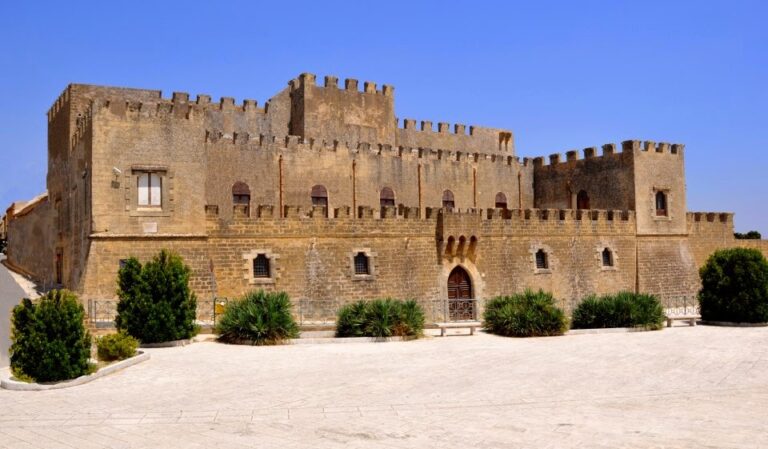
Norman Castle is a medieval Norman fortress in Salemi, Italy, built by Roger I of Sicily in 1077 on the summit of the hill occupied by the town. Roger was the Norman ruler who conquered and consolidated Norman control over Sicily in the late eleventh century. The castle formed part of a defensive chain across western Sicily and controlled the valley around Salemi while serving as a center for local administration, justice, and aristocratic assembly.
Norman foundation and Swabian expansion
The castle replaced or incorporated earlier Greco-Roman fortifications, whose history also included Byzantine and later Arab phases. A religious inscription reading “I.C.N.C.R.I.” belongs to this early period. The geographer al-Idrisi mentioned the castle in the twelfth century, confirming its place in the landscape during the period of Norman rule.
In the thirteenth century, Frederick II of Hohenstaufen altered and enlarged the fortress. Frederick II was Holy Roman Emperor and king of Sicily, and his intervention explains the “Swabian” element in the name Norman-Swabian Castle. The completed castle is dated to approximately 1220–1233. Its fortified entrance was arranged to prevent rebellious townspeople from easily entering from the parade ground, an arrangement that proved useful during the Muslim uprising in western Sicily against Frederick II from 1243 to 1246.
Roger I’s defensive system also included fortifications at Mazara del Vallo, Marsala, Trapani, and other locations. Within this network, Salemi Castle protected the surrounding valley and supported the authority of the local government. After French Angevin rule, Sicily came under Aragonese control. The Aragonese granted the castle and the territory of Salemi as a fief to local nobles, who further equipped the residential areas.
Castellans and political events
During the period of Manfred of Sicily, the castle’s castellany belonged to the noble Bruno family. A castellany was the territorial jurisdiction administered by a castellan, who governed a castle and its associated lands. From 1282, Pedro de Sanclemente, a Catalan knight and ancestor of the Sicilian branch of the Sanclemente family, held the office after supporting Peter III of Aragon in the War of the Sicilian Vespers. That conflict ended Angevin rule in Sicily and brought Aragonese influence to the island. Pedro also received the fiefs of Gibilichaleph and Gibiluasili.
In 1300, Frederick III of Sicily reconfirmed the castellany to Giovanni Bruno. After Giovanni’s death in 1344, his eldest son Pietro became lord of Canetici and was confirmed as castellan. Through Pietro’s marriage to Luigia de Sanclemente, the castellany passed to their descendants, who retained it at least until the first half of the sixteenth century.
On 11 December 1441, the castle hosted the formation of a confederation linking Salemi, Trapani, Mazara, Monte San Giuliano, Castelvetrano, and Partanna. The confederation was established to defend Queen Bianca of Aragon. The gathering reflects the castle’s continuing role as a place where regional political and military decisions were made.
Prison, Garibaldi, and modern conservation
The castle was converted into a prison in 1789. In 1798, the municipality purchased it from Baron Ripa, the last baron of Salemi, and constructed a prison along the side between the two square towers. This prison remained in use until the late nineteenth century and was demolished in 1959.
On 14 May 1860, during Giuseppe Garibaldi’s campaign against Bourbon rule in the Kingdom of the Two Sicilies, Garibaldi raised the Italian tricolor from the castle’s round tower. Garibaldi was a revolutionary and military leader whose campaign helped overthrow Bourbon rule in Sicily and advance Italian unification. He proclaimed Salemi the “capital of Italy” and established the Garibaldian dictatorship there.
The castle housed Salemi’s municipal library from 1934 to 1984. The 1968 Belice earthquake damaged the building, after which it closed for 35 years while the Sicilian Region carried out restoration and structural consolidation. It reopened in 2002, and the works were definitively completed in 2010. The castle has Italian national heritage status and, since 2002, has housed the municipal museum, whose archaeological displays include finds from beneath the castle and from other parts of Salemi.
Remains
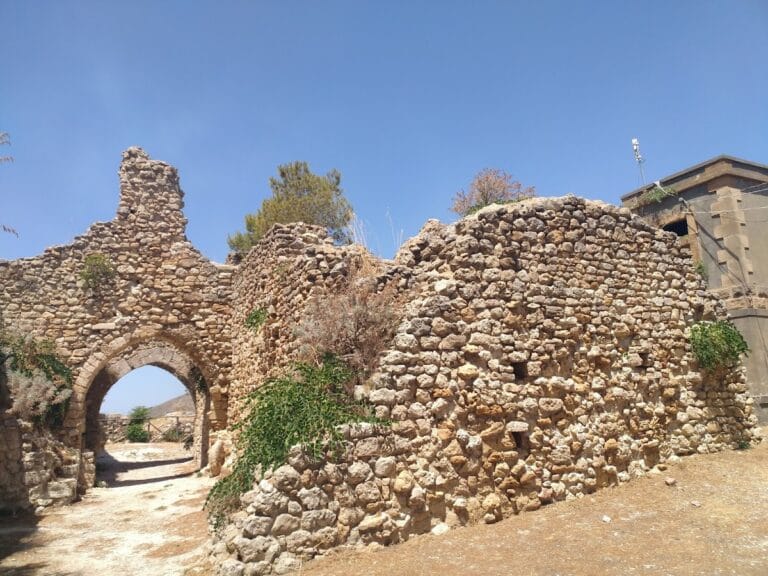
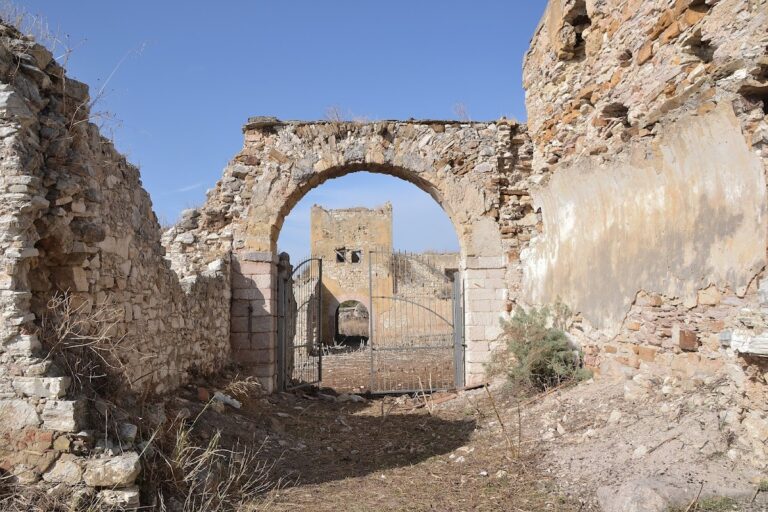
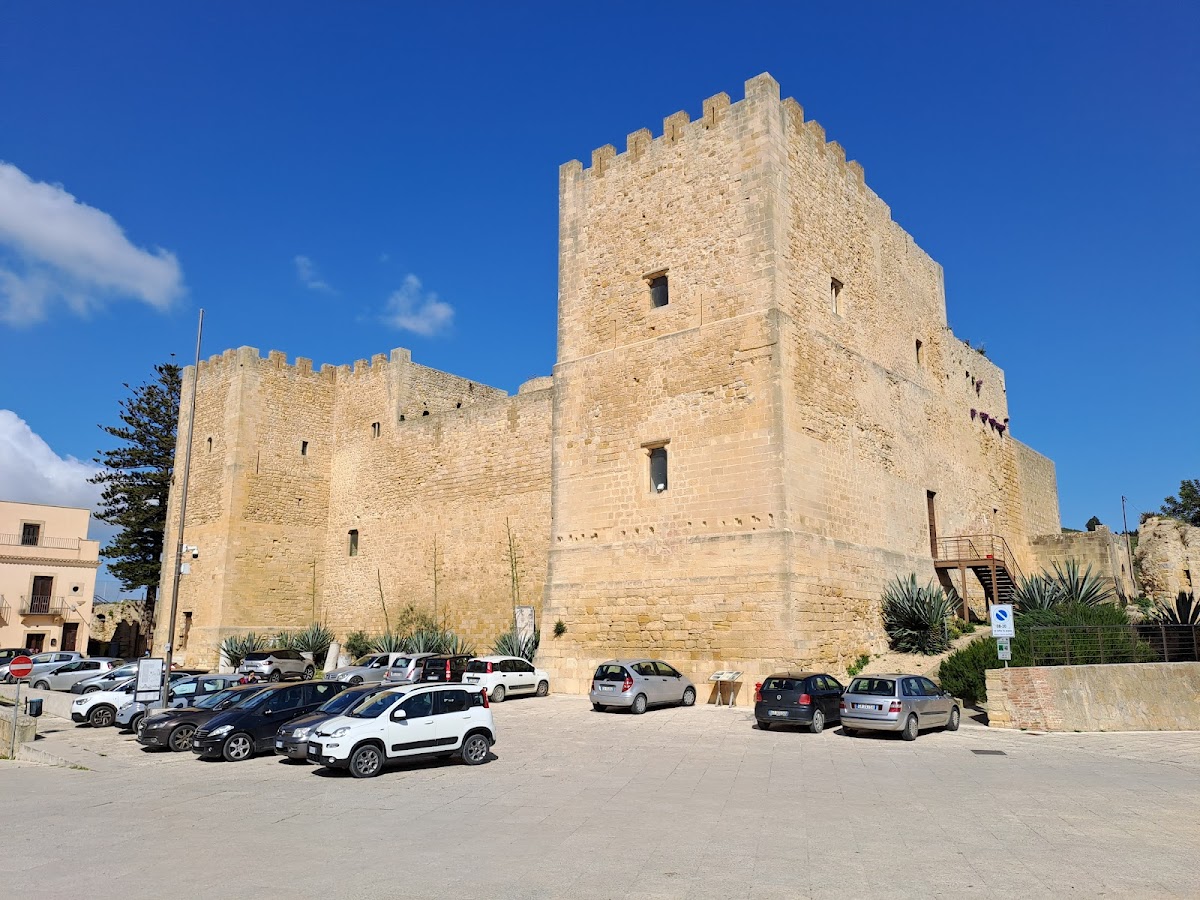
Norman Castle stands on a hill in central Salemi, in the valley of the River Grande, identified in the historical material with the ancient Alicos. Its relatively unified plan was little altered after the Norman-Swabian period. The building is set slightly off a northeast to southwest axis and is organized around a rectangular courtyard enclosed by two ring walls, whose heights are described as ranging from approximately 1.15 to 2.40 meters.
Walls, courtyard, and entrance
The castle’s defensive enclosure consists of the courtyard and its surrounding ring walls, with the principal surviving towers positioned at the corners. The fortified entrance was shaped by the military concerns of the thirteenth century, limiting access from the parade ground. A chapel formerly stood within the courtyard, while the residential section occupies the northern side of the complex.
Corner towers and residential wing
Cylindrical western tower
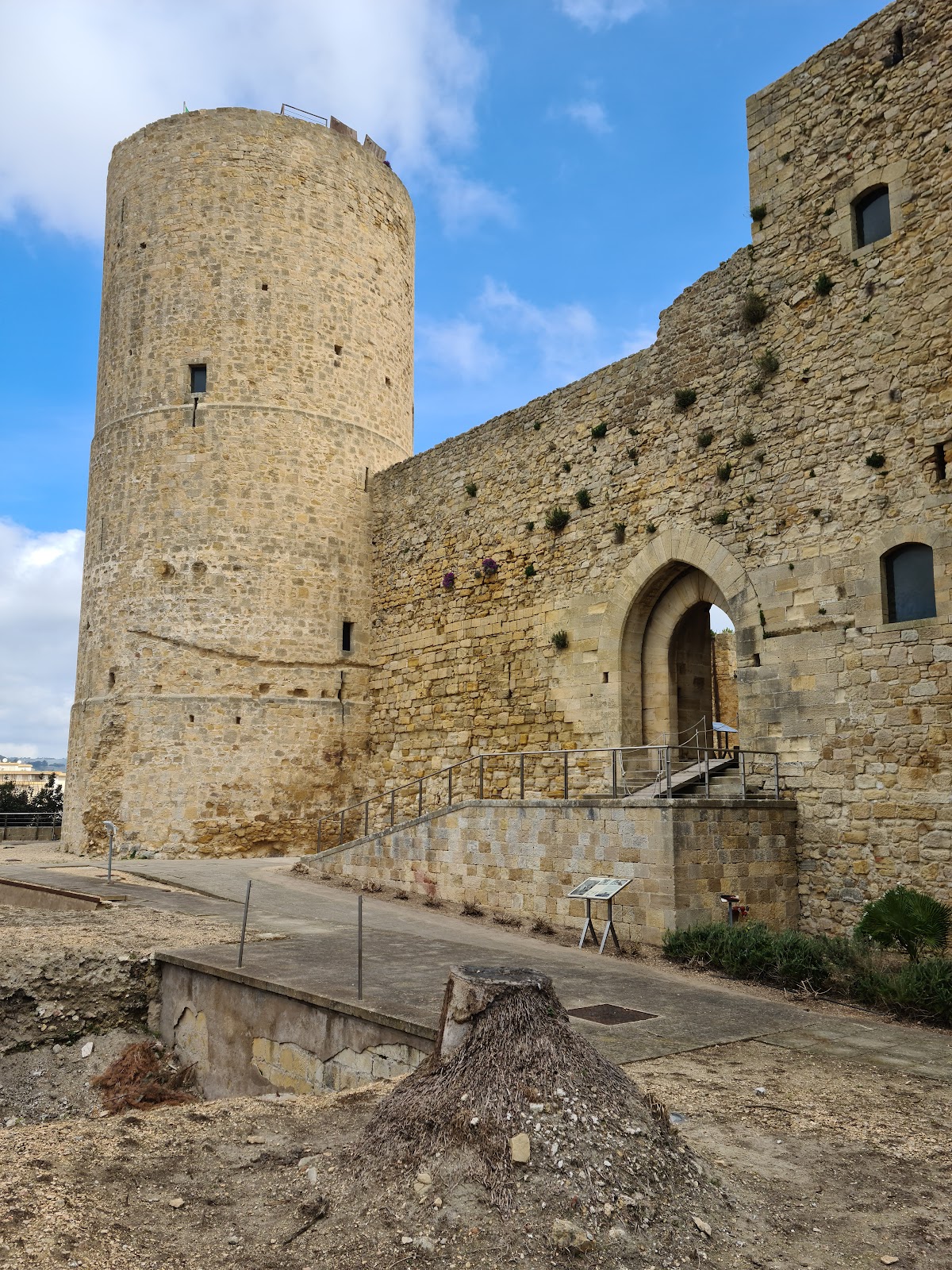
The western corner is occupied by a cylindrical tower. It is the highest of the surviving towers and remains the highest point in Salemi. The tower also became associated with Garibaldi’s proclamation in 1860, when the Italian tricolor was raised from it.
Square corner towers
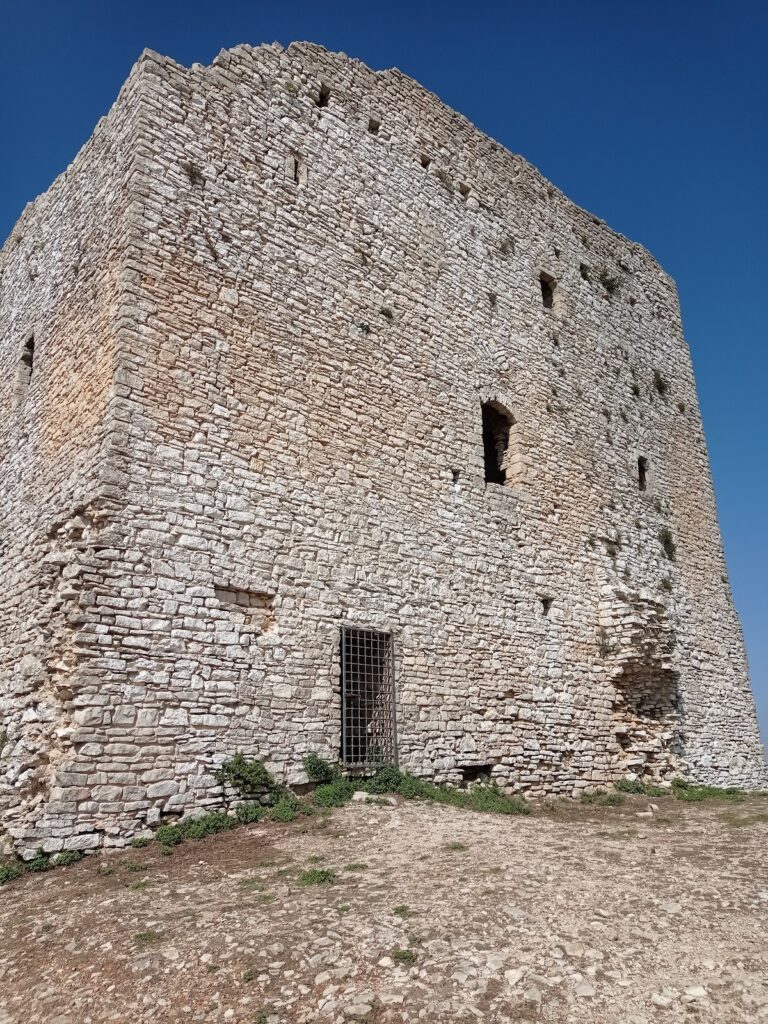
Square towers survive at the eastern and southern corners. A fourth square tower occupied the northern corner until approximately the seventeenth century. The square towers do not rise above the roof terrace of the cylindrical tower, preserving a marked difference in height among the castle’s corner defenses.
Northern residential section
The residential section remains along the northern side of the castle. Parts of this area display Gothic features associated with Frederick II’s thirteenth-century expansion. Under Aragonese rule, local noble holders further fitted out the residential spaces, adding to the complex’s role as both a fortified center and a place of residence.
Museum use and archaeological displays
The castle now functions as a museum. Its museum hall is also used for concerts, and the building hosts conferences. Archaeological finds displayed there come from the subsoil beneath the castle and from other locations in Salemi, linking the surviving fortress to the wider archaeological history of the town.