Pustý hrad: A Medieval Castle Complex in Slovakia


Site at a Glance
- Rating
- 4.8
- Popularity
- Low
- Country
- Slovakia
- Primary era
- Medieval
- Eras represented
- Stone Age, Bronze Age, Medieval, Early Modern
- Civilizations
- Hungarian
- Site type
- Military
- Remains
- Castle
On this page13 sections
History
Pustý hrad, also called Old Zvolen Castle, is a medieval castle complex in Zvolen, Slovakia, built under the medieval Hungarian crown from the twelfth century onward. Set above the confluence of the Hron and Slatina rivers, it comprises an Upper Castle, a Lower Castle, and an intermediate fortified section. The complex served as a royal county centre, a military-administrative base, and a refuge fortification, while also functioning as a favoured residence of Hungarian kings hunting in the Zvolen Forest.
Prehistoric occupation and early medieval origins
The hill was used long before the medieval castle was built. Archaeological material indicates activity during the Eneolithic, or Copper Age, the Late Bronze Age, and the La Tène period, a later Iron Age culture of much of Central Europe. Finds include Baden-culture material, pottery associated with the Lusatian and Kyjatice cultures, and La Tène brooches and ceramics.
A Bronze Age hoard was found beneath a rock about eight metres high on the northwestern slope of the Upper Castle in 1944. Part of it was probably divided after its discovery by partisans, and the last known portion came to light in 2001.
The oldest medieval structure is a tower belonging to a royal county castle, a fortified administrative centre of the medieval Hungarian kingdom. It was built in the twelfth century at the highest point of the hill, and the Upper Castle probably originated between 1172 and 1196, during the reign of Béla III of Hungary.
The earliest surviving written notice of Zvolen Castle appears in Gesta Hungarorum, a medieval Latin chronicle concerned with the early history of the Hungarian kingdom. It attributes the establishment of the first historical stronghold at the site to Bors, a figure whose historical identity and role remain uncertain, supposedly at the turn of the ninth and tenth centuries. The castle first appears in a document in 1214, under forms including Zolum sub castro Polona, castrum Zoulum, castrum de Zoulum, and castrum de Zolyo.
Royal refuge and Gothic expansion
After the Mongol invasion, a large refuge fortification was built or expanded at Pustý hrad. The work was organized by the stonemason Bertold, whom King Béla IV rewarded in 1255 with property exempted from the authority of Zvolen Castle. This post-invasion building campaign probably created or greatly enlarged the defences of both the Upper and Lower Castles and added a 206-metre wall across the saddle below the Lower Castle.
The castle was associated with the Zvolen domain, a large territory that later became Zvolen County. Its royal and military functions continued as the complex developed. A Gothic building phase lasted from the end of the thirteenth century into the first third of the fourteenth century.
Between about 1290 and 1301, during the reign of Andrew III of Hungary, the Lower Castle was developed as a separate defensive and residential unit protecting access to the Upper Castle. Between 1307 and 1337, Donč, a trusted official of Charles Robert of Hungary and administrator of Zvolen County until 1337, created or expanded a new residential section at the northern end of the Upper Castle. This area became known as Donč’s Castle and was associated with the Balaša family as well as with the county officials Demeter and Donč.
Decline, destruction, and later military use
Pustý hrad lost importance after Zvolen Castle was built between 1370 and 1382. Its decline culminated during the conflicts between John Hunyadi, a fifteenth-century Hungarian military leader and regent, and John Jiskra of Brandýs, a commander active in the struggles over central Slovakia. A document from 1451 states that John Hunyadi burned Old Zvolen. The castle was then abandoned and fell into ruin.
During the threat of Ottoman expansion at the turn of the sixteenth and seventeenth centuries, a watchtower or guard station was erected at the site and occupied by a small military garrison. It was the last known building added at Pustý hrad.
Archaeological investigation
Systematic archaeological work began between 1886 and 1899, followed by historical research in the 1950s and another archaeological survey in the 1960s. Extensive excavations directed by Václav Hanuliak on the Upper Castle from 1992 to 2008 showed that the medieval fortification had been built over an earlier prehistoric stone-and-earth rampart.
Research on the Lower Castle began in 2009 through the Institute of Archaeology of the Slovak Academy of Sciences in Nitra and its Zvolen field workplace. Excavation, reconstruction, and protective work have exposed and stabilized substantial parts of the complex. Calculations of the total area give approximately 7.6 hectares, while a later calculation gives 4.7 hectares. Its extent places Pustý hrad among the largest castle ruins in Slovakia and Central Europe.
Remains
Pustý hrad occupies a hill rising from approximately 475 to 571 metres above sea level. The Upper Castle stands at the summit, about 571 metres above sea level, while the Lower Castle occupies a lower position. The two complexes are linked by a fortified section nearly 400 metres long. The Upper Castle covers approximately 3.5 hectares, the Lower Castle about 1 hectare, and a 206-metre defensive wall crosses the connecting saddle near the Lower Castle.
Upper Castle
The earliest medieval core stood at the hilltop. It probably began as a high square stone tower, or keep, enclosed by a dry moat. Later fortifications surrounded a large outer settlement or refuge area with its own wall. Part of its entrance gate survives, together with numerous mostly wooden economic buildings and a stone cistern, a built reservoir for storing water.
Royal county-castle tower
The royal county-castle tower occupies the highest point of the Upper Castle and represents the earliest medieval building phase. Its associated fortification was later incorporated into the larger castle complex.
Residential tower and bastion
Tower 2 dates from the post-Mongol building phase and served as a residential tower. Northeast of it stood a bastion, a projecting defensive structure that strengthened the wall, connected to a transverse section of fortification.
Main entrance gate
A four-storey tower was added to the Upper Castle’s main entrance gate during the Gothic building phase. The gate is among the best-preserved architectural remains at Pustý hrad.
Donč’s Castle
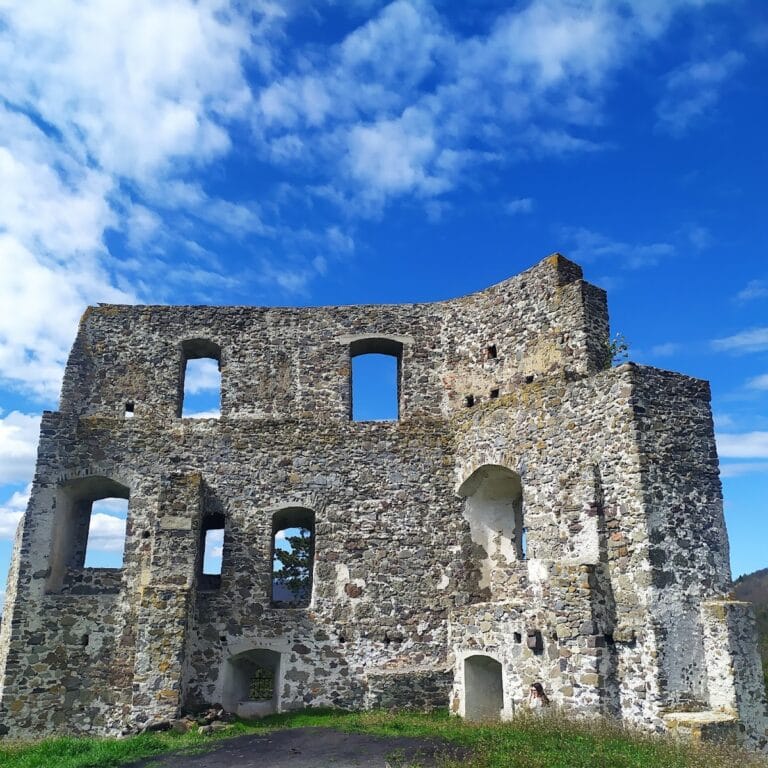
Donč’s Castle occupies the northern end of the Upper Castle as a separately fortified defensive and residential unit. Its remains include a palace, a structure positioned in front of the palace, a cistern, and a courtyard arranged across terraces. During the first half of the fifteenth century, troops under John Jiskra reused these terraces for ground-level residential buildings.
Lower Castle
The Lower Castle was laid out as an elongated oval and possessed its own enclosing wall, gate, and tower. Its donjon, the principal fortified tower combining defensive and residential functions, probably belongs to the post-Mongol building phase. The square structure measures 20 by 20 metres and is one of the largest residential-type structures in Central Europe.
The Lower Castle’s tower and entrance gate survive among the clearest remains of the complex. The castle’s courtyard also produced material from the Middle and Late Bronze Age, linking the medieval buildings with the hill’s earlier occupation.
Prehistoric earthworks and archaeological finds
Excavations beneath the western line of the Lower Castle’s medieval fortification revealed an earlier prehistoric rampart made of stone and earth. Its fill contained pottery from the Late Stone Age. On the Upper Castle, the prehistoric rampart contained mainly Late Bronze Age pottery associated with the Lusatian and Kyjatice cultures, and the medieval wall was built over this earlier earthwork.
Excavations since 1992 have yielded hundreds of finds, including pottery, bronze ornaments, iron weapon fittings, spurs, and horseshoes. These objects, together with the surviving towers, gates, walls, cisterns, and residential structures, help define the complex’s prehistoric, royal, military, and residential phases. Archaeological finds from Pustý hrad are displayed in the “History of Zvolen” exhibition at Zvolen Castle.