Castle of Jarafuel: A Medieval Defensive Fortress in Spain


Site at a Glance
- Rating
- 4.4
- Popularity
- Low
- Country
- Spain
- Primary era
- Medieval
- Eras represented
- Medieval
- Civilizations
- Unclassified
- Site type
- Military
- Remains
- Castle
On this page10 sections
History
Castle of Jarafuel is a ruined medieval defensive fortress in Jarafuel, Spain, originating as a Muslim stronghold probably built during the twelfth century. The settlement grew around the fortification, which occupied a defensible position at the centre of the town and later passed through Castilian, Aragonese, and Valencian control.
Early settlement and Muslim foundation
Jarafuel was inhabited during the Iberian period, the pre-Roman era associated with the Iberian peoples of eastern and southern Iberia. Finds near the modern settlement indicate this early occupation. The settlement containing the castle is considered probably Roman in origin, a connection associated with the relocation of communities in the Cofrentes Valley to places near water.
The castle itself began as a Muslim fortification, probably during the twelfth century. Pressure from Christian forces made a defensive stronghold necessary, and the settlement developed around it. The fortress therefore formed the central point of a community whose earlier history reached back to the Iberian and Roman periods.
Conquest and Valencian administration
Castilian troops commanded by Infante Alfonso, later King Alfonso X, and Aragonese soldiers led by Juan Sarriá under the orders of James I of Aragon conquered the castle in 1243–1244. Jarafuel initially remained under Castilian control. The Treaty of Campillo in 1281 transferred it definitively to the Kingdom of Valencia.
Juan Pérez de Ayerbe became the castle’s first Valencian alcaide, a governor responsible for administering and defending a castle. This appointment marked the beginning of the fortress’s role within the Valencian political and military system.
War, repair, and decline
In March 1366, during the War of the Two Peters, Castilian troops acting on the orders of Pedro the Cruel burned everything they could not carry away. The conflict was fought between Pedro I of Castile and Pedro IV of Aragon, and the attack left Jarafuel Castle ruined.
Repair efforts followed. In 1386, Pedro IV of Aragon ordered Aldons of Aragon, Marquis of Villena and lord of the castle, to repair all the fortresses in the Cofrentes Valley. The castle continued to have practical uses in the early seventeenth century. During the Morisco revolt in autumn 1609, a conflict opposing the expulsion of the Moriscos, it and the rest of Jarafuel suffered the effects of war. Moriscos were Muslims compelled to convert to Christianity, or their descendants, whose expulsion from Spain had been ordered at that time.
When the Duke of Gandia took possession of the castle in 1621, it had not yet been completely destroyed. It still served as the lord’s house and as the town prison. The castle finally fell into ruin in 1707, during invasions and looting connected with the War of the Spanish Succession.
Heritage protection
Castle of Jarafuel was protected under Spain’s decree of 22 April 1949 concerning the protection of castles. It was included in the 1968 European Cultural Heritage Protection Inventory as a medieval castle in the military-architecture category. The site holds Property of Cultural Interest status with monument designation and ministerial registration RI-51-0010937, recorded on 4 December 2002.
Remains
Hilltop fortress
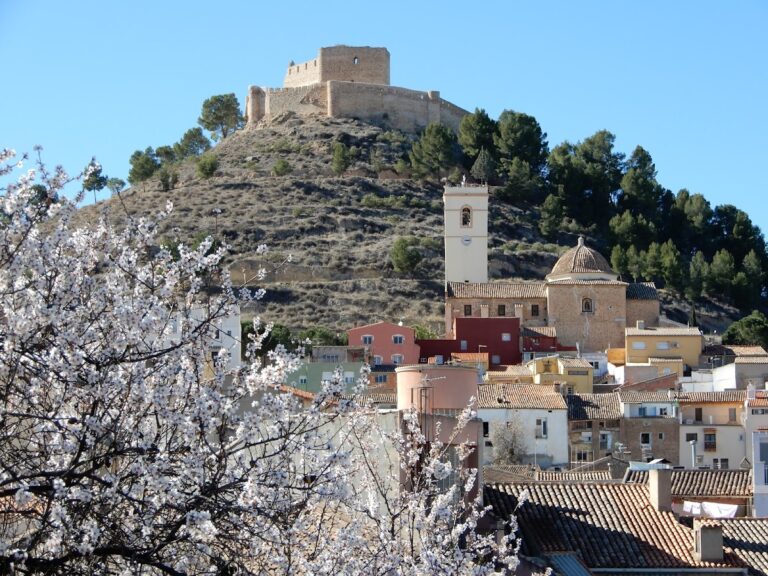
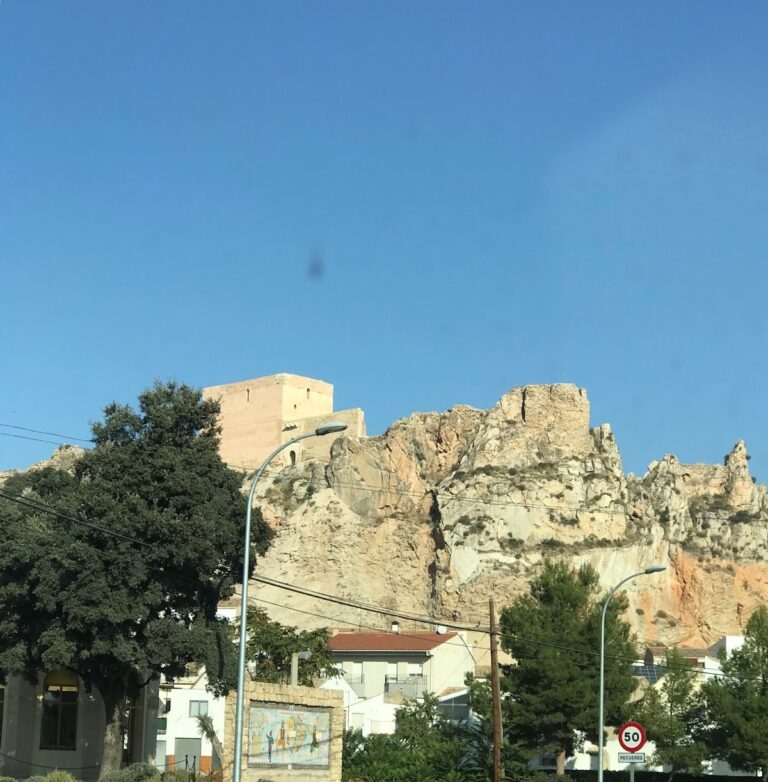
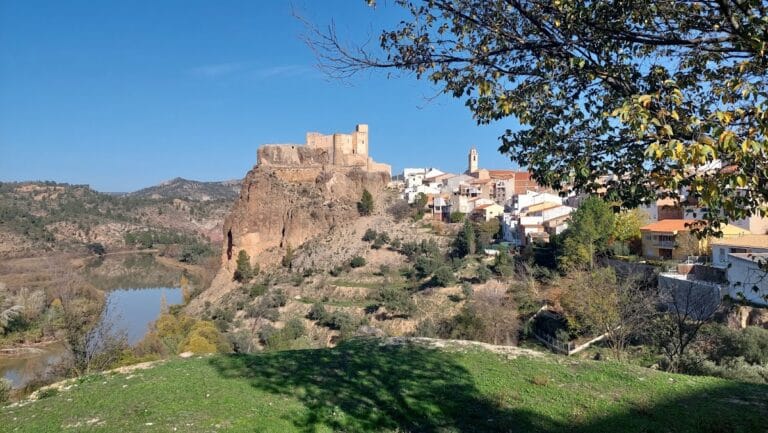
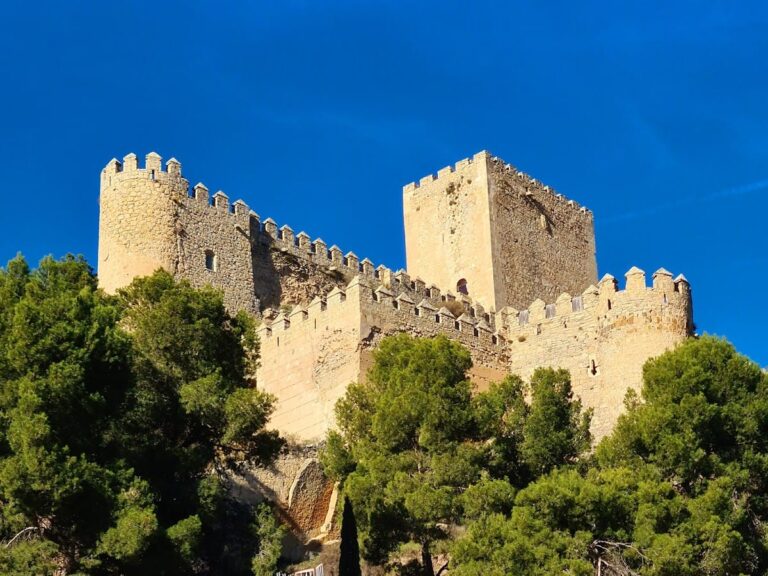
The remains occupy the summit of a hill in the centre of Jarafuel. The surviving defensive fabric includes part of a cylindrical tower and a section of the castle wall, preserving elements of the fortress that once formed the focus of the settlement.
Cylindrical tower and wall
The cylindrical tower survives in fragmentary form beside the remaining section of wall. A ceramic panel belonging to the Morisco Route was installed on the surviving part of the tower, adding a later interpretive feature to the medieval structure.
Former chapel
A later chapel was attached to the surviving wall. It had a square plan measuring 6 by 6 metres and a two-pitched tiled roof supported on beams.
Calvary
The castle’s former parade ground contains a Stations of the Cross, or Calvary, a devotional arrangement representing Christ’s final journey and crucifixion. Small shrine structures enclose ceramic panels for the individual stations.
Nearby sites