Castle of Cofrentes: A Twelfth-Century Fortress in Spain

Site at a Glance
- Rating
- 4.3
- Popularity
- Low
- Country
- Spain
- Primary era
- Medieval
- Eras represented
- Medieval, Early Modern
- Civilizations
- Almohad, Crown of Aragon, Spanish
- Site type
- Military
- Remains
- Castle
On this page13 sections
History
Castle of Cofrentes is a twelfth-century fortress in Cofrentes, Spain, begun during the Islamic period using rammed-earth construction, in which compacted earth forms walls within wooden frames. Its position above the meeting point of the Júcar and Cabriel rivers made it an important stronghold on the Júcar route, overlooking irrigated lowlands that supported the local economy.
Early occupation and Islamic origins
Human activity at the site began before the castle itself. Bronze Age, Iberian, and Roman ceramic remains show that the location was occupied across several earlier periods. Architectural and construction remains indicate that work on the fortress began between 1147 and 1172, when Muslim-ruled polities governed parts of the Iberian Peninsula.
The castle later occupied a frontier position between the Crowns of Castile and Aragon. After its conquest by Castilian forces, it passed to the Kingdom of Valencia under the Treaty of Campillo in 1281. The agreement was concluded by Alfonso X, king of Castile and León, and Peter III, king of Aragon.
Transformation and wartime damage
The fortress was altered repeatedly as its functions changed. During the sixteenth and seventeenth centuries, it was converted into a palace residence, adding a residential role to its earlier defensive purpose.
During the War of the Spanish Succession, the eighteenth-century conflict over the Spanish throne, Bourbon troops loyal to Philip V captured the castle from local inhabitants who supported his Habsburg rival, Archduke Charles. The site was later attacked during the Peninsular War, the Iberian phase of the wider Napoleonic Wars, and again during the Carlist Wars, nineteenth-century civil conflicts involving rival claims to the Spanish throne. These successive conflicts contributed to the castle’s deterioration, and by the beginning of the twentieth century it stood in ruins.
Protection
Castle of Cofrentes is protected as a Bien de Interés Cultural, Spain’s formal designation for protected cultural heritage, under reference RI-51-0010687. The declaration is dated 12 September 2001, while a separate administrative entry gives 5 March 2003.
Remains
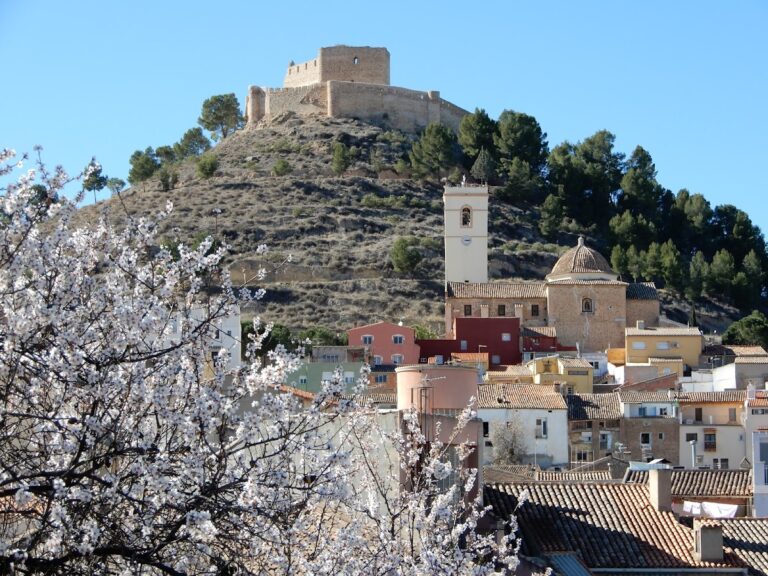
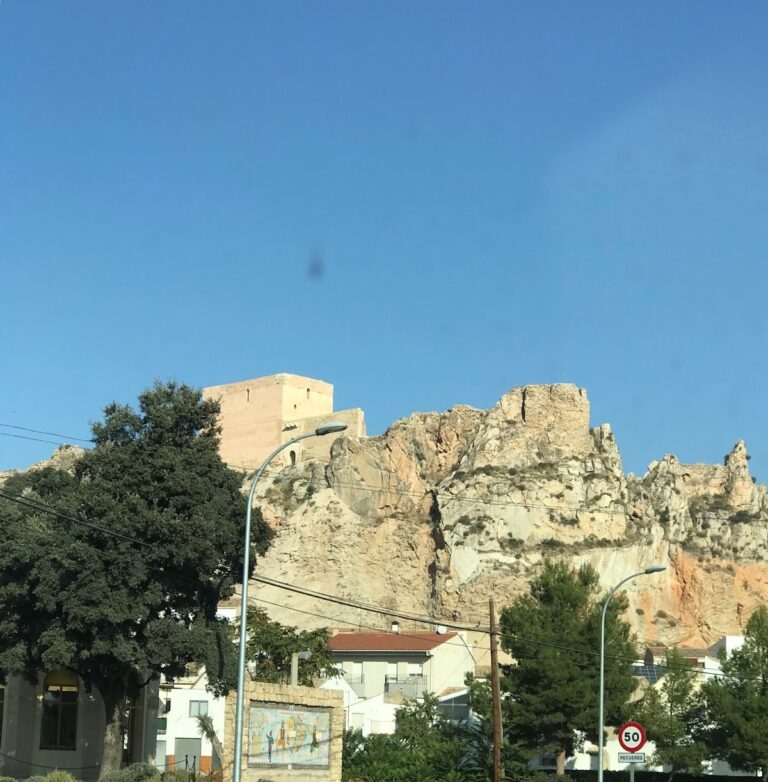
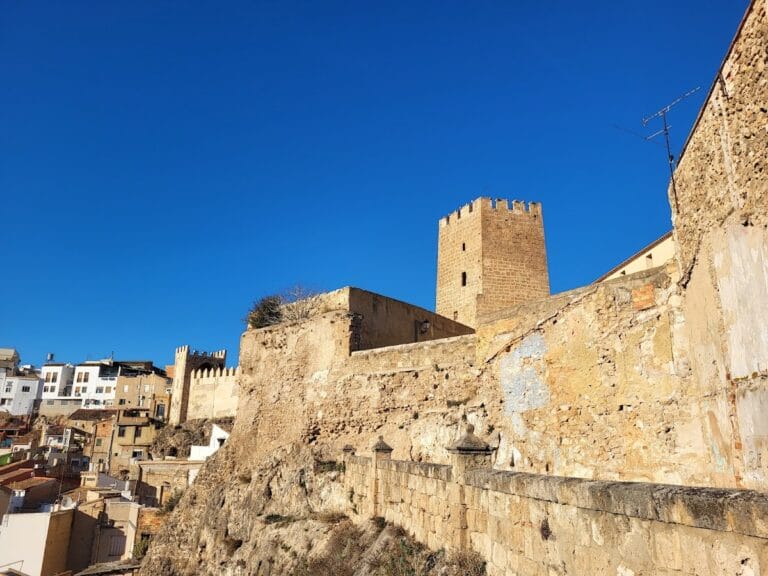
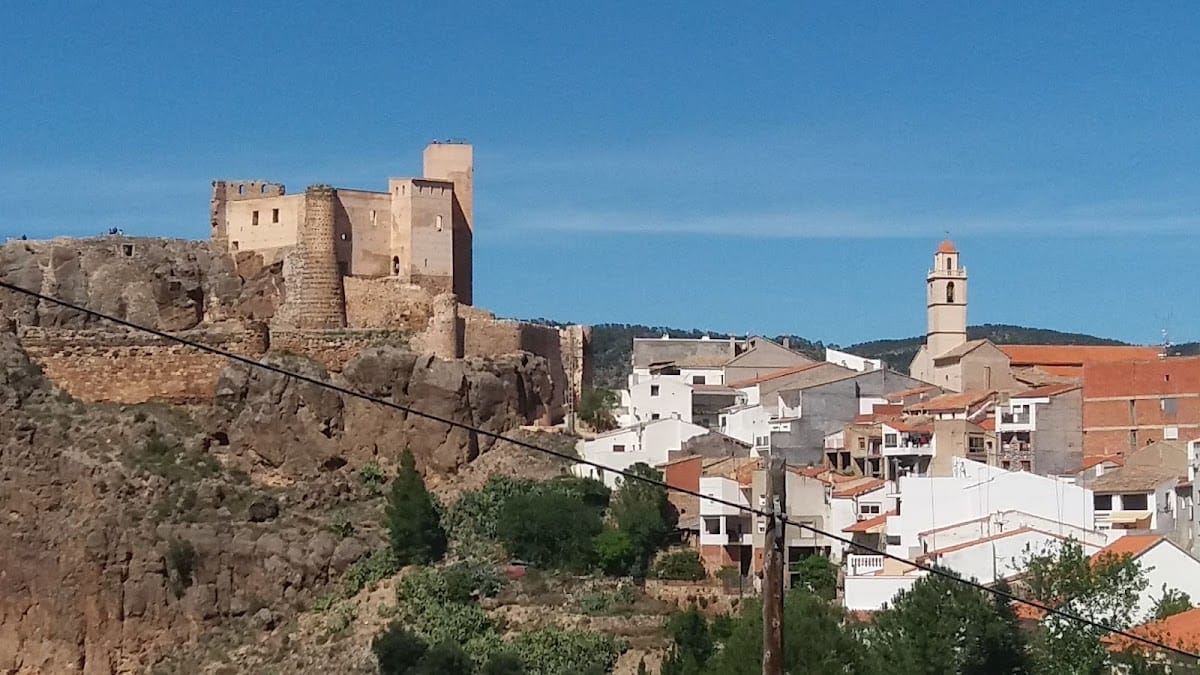
The fortress occupies the highest part of Cofrentes at 394 metres above sea level, rising 95 metres above the Cabriel riverbed. It stands on basaltic volcanic rock at one of the vents of Cerro de Agrás, opposite the church at the western end of the settlement. The fortification has a rectangular plan of approximately 800 by 600 metres, with its principal buildings concentrated on a central mound.
Enclosures and defensive works
Lower enclosure
The castle is divided into two clearly defined enclosures. The lower enclosure functioned as an albacar, an enclosed area associated with a castle and commonly used to shelter livestock or people during danger.
Upper enclosure and entrance
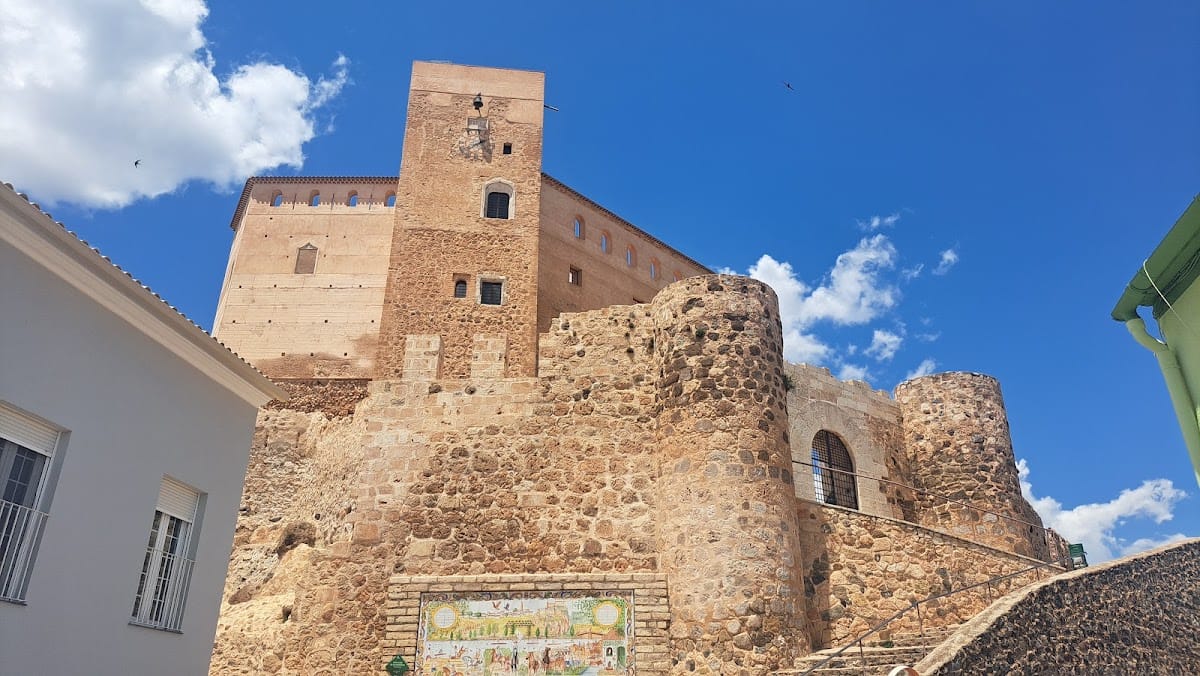
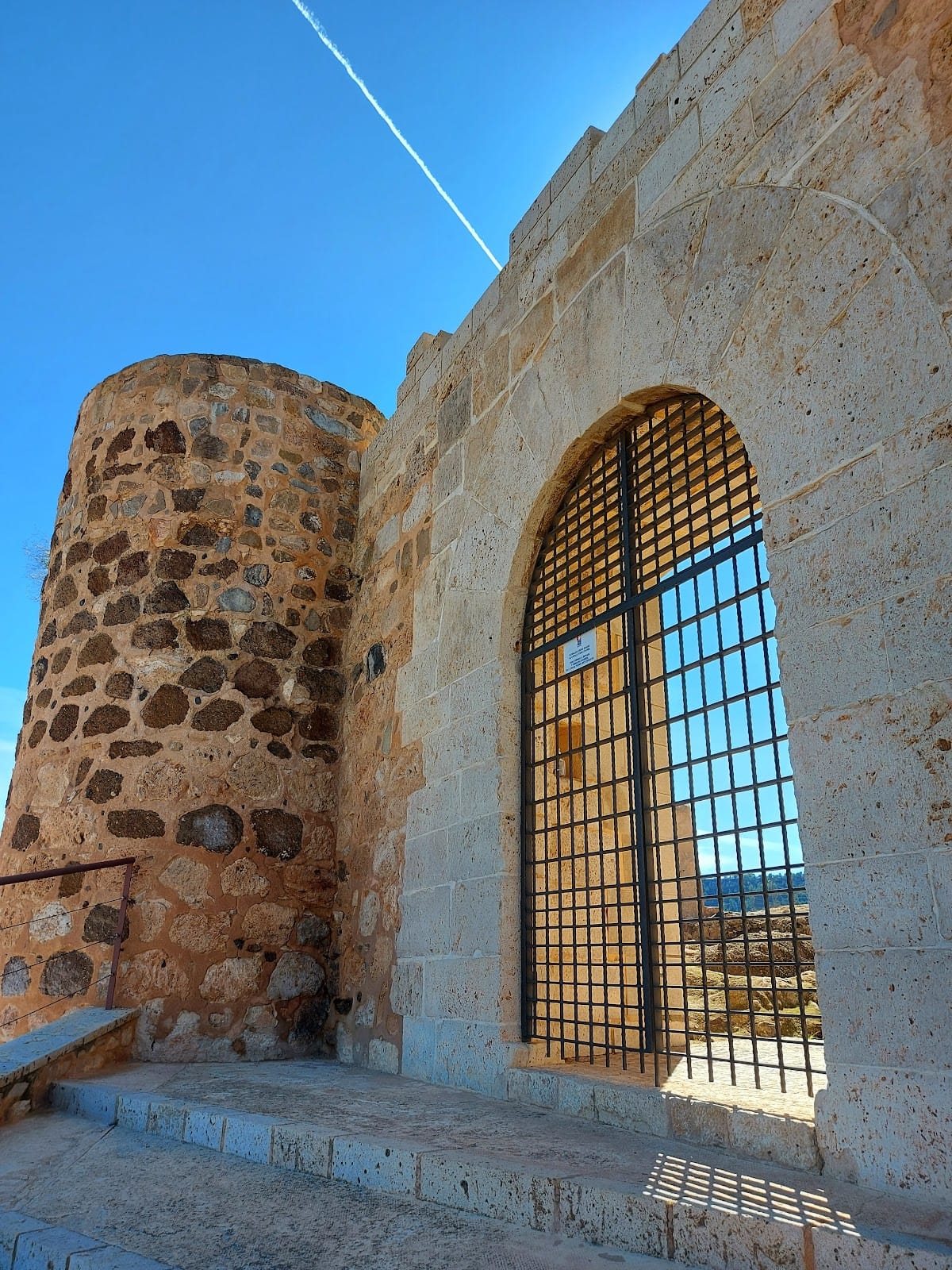
A ramp reaches the upper enclosure through a stone-built gate with a semicircular arch. Two semicircular towers flank the entrance. They are constructed from small, roughly worked ashlar blocks, which are cut and dressed stones laid in regular courses.
Outer towers and barbican
Beyond the entrance towers, four further towers survive, two along the northern side and two on the southwest side. Parts of the surrounding wall also remain, including a tall barbican tower designed to protect the entrance.
Central buildings
Keep
The central buildings stand on the mound within the fortification and are chiefly built of stone in masonry. Four levels survive in the square-plan keep, the castle’s principal fortified tower and a structure that could serve both defence and residence. The first level can be reached only from the level above. A slightly pointed Gothic-arched window has an unusual notch at its crown, producing an upward-pointing vertex.
Clock
A clock is installed in the keep. The Valencian heritage record dates it to the nineteenth century, although it has also been attributed to the sixteenth century. It was restored at the beginning of the twenty-first century.
Archaeological evidence
Ceramic remains from the Bronze Age, Iberian period, and Roman period have been found at the site. Architectural and construction remains associated with the early fortress, including its rammed-earth building tradition, preserve evidence of the castle’s Islamic-period beginnings.
Nearby sites