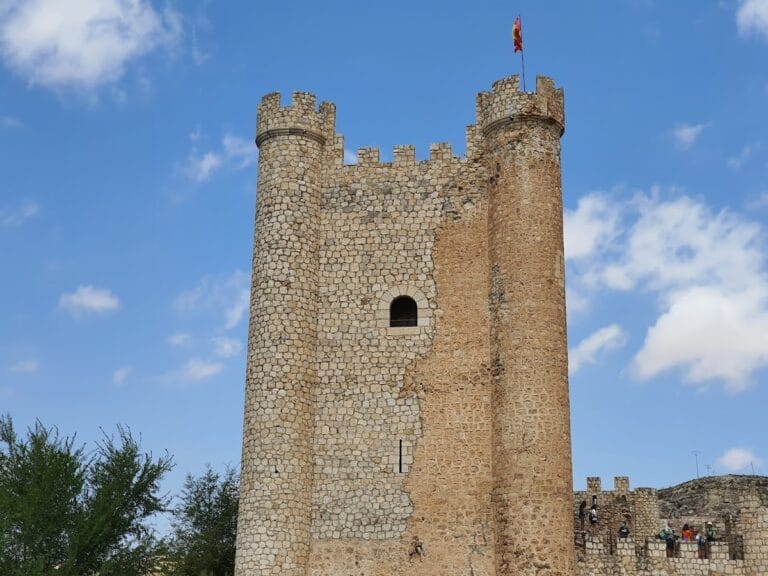
Castillo de Jalance: A Muslim Frontier Fortress in Valencia, Spain


Site at a Glance
- Rating
- 3.5
- Popularity
- Very Low
- Country
- Spain
- Primary era
- Medieval
- Eras represented
- Iron Age, Medieval
- Civilizations
- Iberian, Taifa of Valencia
- Site type
- Military
- Remains
- Castle
On this page8 sections
History
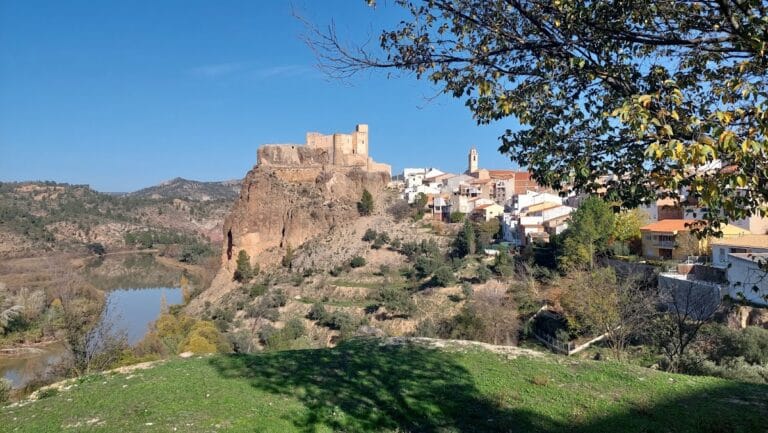
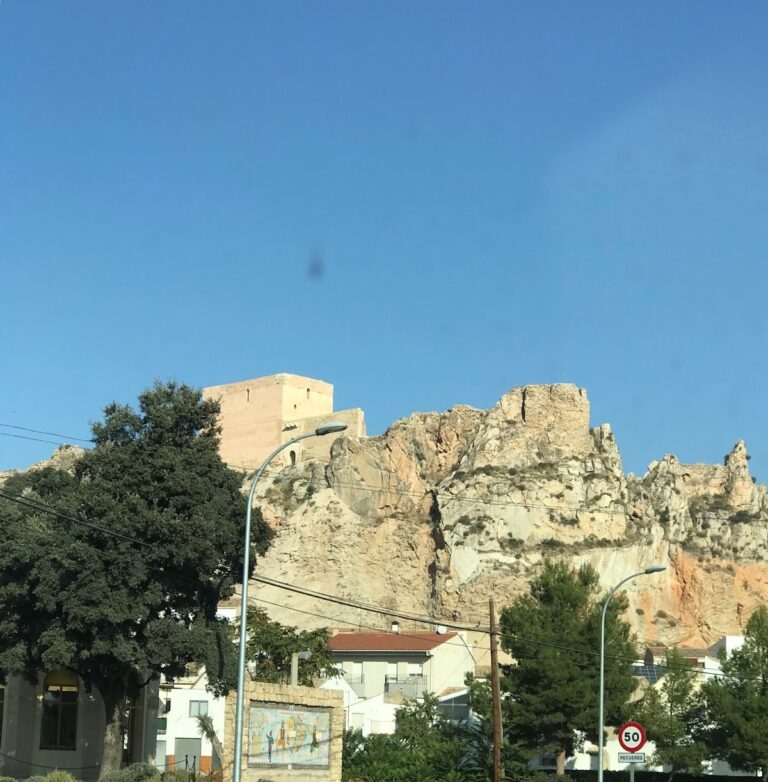
Castillo de Jalance is an eleventh-century Muslim fortress above the municipality of Jalance in Valencia, Spain, later altered by Christian builders. It stands on the remains of a much older Iberian fortress and served as a defensive stronghold for the frontier, its lands, and the local population.
Muslim and Christian rule
The fortress and settlement were connected with Jalance during both the Muslim and Christian periods. Its role was defensive rather than that of a feudal castle ruling over dependent tenants. Ceramic remains recovered in archaeological excavations show that the castle was inhabited from the eleventh through the nineteenth century.
James I of Aragon, the king who led the Aragonese conquest of Valencia, conquered Jalance and later transferred it to the king of Castile under the Treaty of Almizra. This thirteenth-century agreement defined territorial arrangements between the two rulers. The territory then became the lordship of Infante Juan Manuel, a Castilian nobleman and member of the royal family. In 1281, an agreement between Peter III of Aragon and Alfonso X of Castile placed these lands within the Kingdom of Valencia, a political territory of the Crown of Aragon established after the Christian conquest of Valencia.
Jalance remained dependent on Jarafuel until 1535 and on Cofrentes until 1564. In the fifteenth century, the Marquess of Santillana, a Castilian nobleman and writer, described the castle as an “impregnable fortress.”
Conflict, restoration, and decline
The castle and town were drawn into the seventeenth-century expulsion of the Moriscos, Muslims who remained in Christian-ruled Spain after the medieval conquests, often under forced conversion. Thousands of Moriscos from the Cofrentes Valley and nearby districts resisted the royal order in the Muela de Cortes. Royal armies defeated them and forced them to embark for Africa, leaving Jalance and nearby settlements almost uninhabited for years.
In 1836, during the First Carlist War, the castle and town were defended against attacks by the Carlist leader Quílez. The walls were restored during the nineteenth century to shelter the population during the civil wars between Carlists and Liberals. When the castle was no longer needed for this purpose, it deteriorated into a ruin.
The Júcar River floods also affected the surrounding town. A flood in 1740 destroyed a bridge more than 200 metres long, while the floods of 1864 destroyed orchards and mills and carried away the town’s ashlar bridge. Gradual consolidation and conservation work is being undertaken at the castle. Spain designated it a Monument on 20 June 2001 under the country’s cultural-heritage protection system.
Remains
Fortified layout
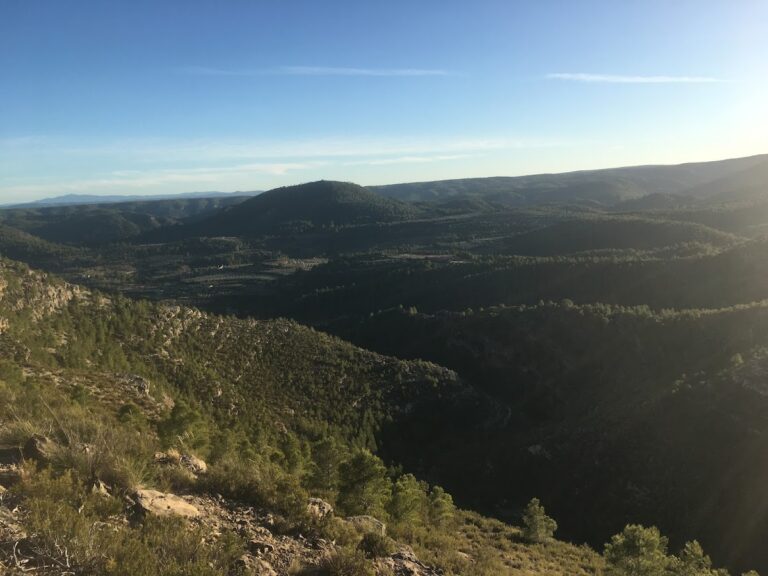
Castillo de Jalance occupies a hill in the Ayora-Cofrentes Valley above Jalance. Its plan forms a ten-sided polygon. Curtain walls, meaning fortified walls that connect towers, enclose the site, while circular towers stand at the corners. Arrow slits, narrow openings designed for shooting projectiles, crown the walls.
The fortress is arranged in an upper and a lower zone. The upper zone is the principal fortified enclosure. The lower zone began as an Islamic-period albacar, an outer enclosure providing protected space beyond the main fortress, and Christian builders later converted it into a military courtyard.
Upper enclosure
The upper enclosure covers approximately 300 square metres. A staircase leads to an entrance corridor, which gives access to several rooms and then to the upper floor. The arrangement preserves the connection between the approach to the fortress and its internal spaces.
Domestic and storage features
Rooms within the upper enclosure contain a hearth, ovens, storage rooms, a circular silo, and a rectangular cistern. A silo is a storage structure often used for grain, while a cistern is a tank for storing water. Together, these features reflect the provisions and facilities maintained inside the fortified enclosure.
Archaeological remains
Excavations have recovered ceramic remains dating from the eleventh to the nineteenth century. These objects correspond with the long period of occupation represented by the fortress, from its Muslim foundation through its Christian alterations and later use.
Nearby sites