Castillo de Chirel: A Medieval Fortress in Valencia, Spain


Site at a Glance
- Rating
- 4.7
- Popularity
- Low
- Country
- Spain
- Primary era
- Medieval
- Eras represented
- Medieval
- Civilizations
- Crown of Aragon
- Site type
- Military
- Remains
- Castle
On this page9 sections
History
Castillo de Chirel is a fortress in Spain, in the municipality of Cortes de Pallás, Valencia, whose origins are generally regarded as Arabic. Its position gave it importance during the revolt associated with Al-Azraq, a Muslim leader linked to the thirteenth-century Mudejar revolt in the Kingdom of Valencia. After Christian forces arrived in the area, the fortress was improved and continued to serve a defensive purpose.
Medieval development
The castle is mentioned in 1349 in an order concerning the provision of food to several fortresses. Its building methods and materials point to later rebuilding. Regularly cut stone blocks, known as ashlar masonry, appear at the entrances, while carved shields and wedge-shaped stones forming parts of arches, called voussoirs, also support the possibility that its first major reconstructions took place during the fifteenth century.
Conflict after the Morisco expulsion
After the conquest and the expulsion of the Moriscos in 1609, conflict continued in parts of Valencia. Moriscos were Muslims forcibly converted to Christianity in Spain and their descendants. Their continued settlement in the region, followed by the expulsion, contributed to armed struggles involving royal troops and Christian inhabitants, while local commerce also suffered.
Government troops used Castillo de Chirel as an operational base during actions against Morisco guerrillas who had rebelled in the Muela de Cortes, the mountainous area associated with this activity. The fighting ended in less than a year. Once the conflict was over, the castle’s strategic value declined. Its reduced importance, together with the sparse population of the surrounding area, led to abandonment and eventual ruin.
Heritage status
Castillo de Chirel was declared an Asset of Cultural Interest on 16 June 2002, a formal Spanish designation that gives legal recognition and protection to important cultural properties. It is listed under references RI-51-0010804 and 46.19.099-004. Since 2008, it has also appeared on Hispania Nostra’s Red List of Endangered Heritage.
Remains
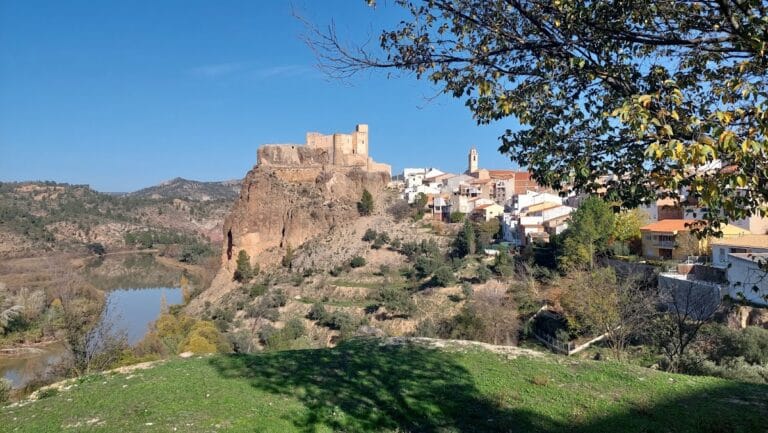
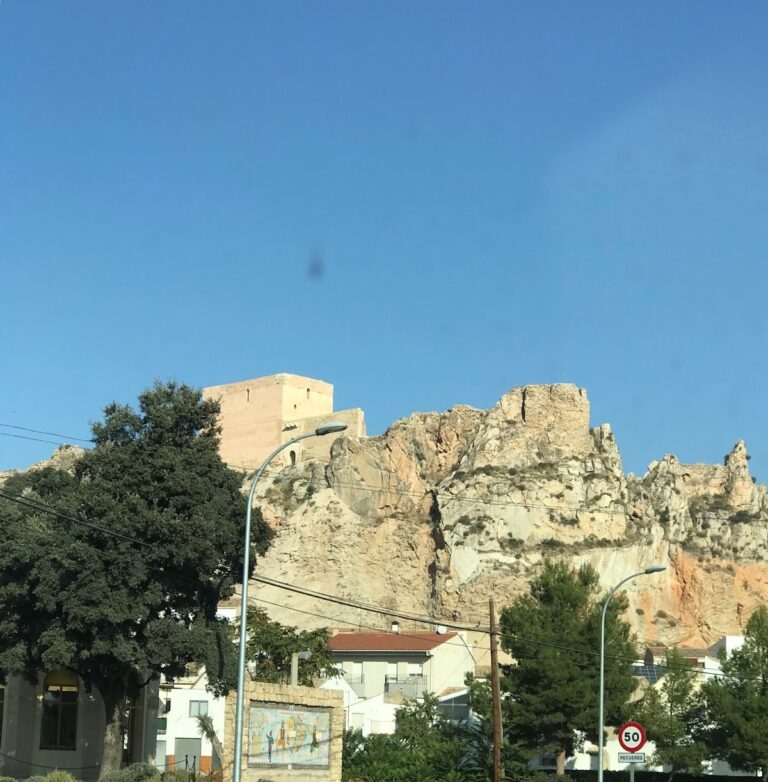
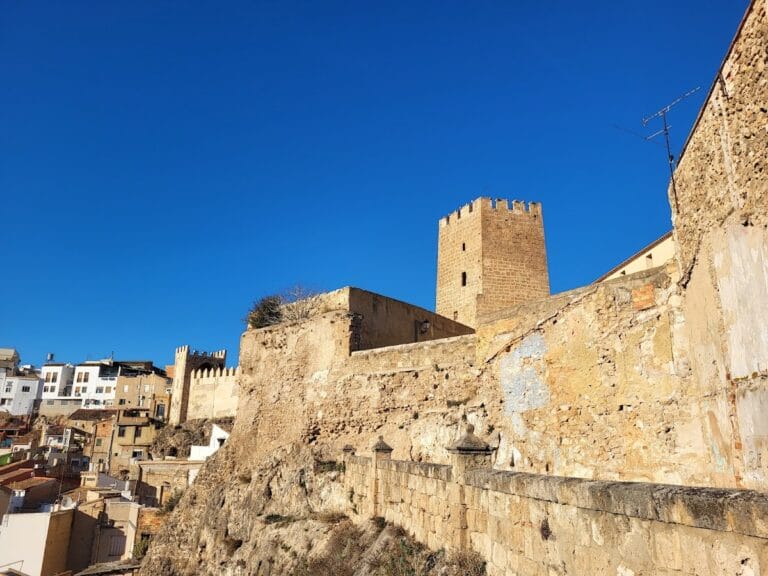
The fortress occupies a small elevation called the Muela del Cinto del Castillo. It follows the shape of rugged ground bordered by gorges, giving the enclosure a triangular plan and a naturally defensible position. A double-walled enclosure, a cistern used to collect and store water, and the main tower remain observable despite the castle’s ruinous condition.
Enclosure and defensive works
The military character of Castillo de Chirel is expressed in its construction and surviving defenses. Arrow slits, parapets, loopholes, and a moat along one side strengthened the enclosure. Two towers placed at the eastern and western ends completed the defensive perimeter, while the double walls created a protected internal passage.
Entrances and towers
Entrance passages
Access to the fortress was difficult and involved crossing an elevated passage about one metre high. The entrance arch was pointed on the exterior and semicircular on the interior. It opened into a vestibule that connected laterally with the passage running between the castle’s two walls. A comparable arrangement was used at the approach to the watchtower, extending the controlled access system beyond the main entrance.
Defensive towers
The two terminal towers have different forms. One has a trapezoidal plan and several levels, although its interior has collapsed. The other is square and retains two levels. Its lower level preserves a barrel vault, a continuous semicircular vaulted ceiling, built using a brick-on-edge technique, while the upper level has lost its roof.
Nearby sites