Birklingen Monastery Church: A Marian Pilgrimage Church in Germany
Site at a Glance
- Rating
- 3.5
- Popularity
- Very Low
- Country
- Germany
- Primary era
- Medieval
- External website
- Open
- Eras represented
- Medieval
- Civilizations
- Holy Roman Empire
- Site type
- Religious
- Remains
- Monastery
On this page8 sections
History
Birklingen Monastery Church, established by Augustinian canons as a Marian pilgrimage shrine in what is now Iphofen, Germany, began construction in 1458. The community belonged to the Diocese of Bamberg, and its church became a destination for pilgrims before the monastery’s destruction and eventual dissolution.
Devotion and foundation
A small chapel stood at Birklingen before the monastery was founded. Abbot Johannes Trithemius recounted a tradition that an image of the Virgin Mary had been found in nearby woods and brought to the chapel, where people believed it had been created through divine agency. The monastery chronicle instead connects the chapel’s growing fame with a Pietà, an image of Mary mourning or holding the dead Christ, placed there around 1455.
Pilgrimage increased, and in 1457 Würzburg Bishop Johann III von Grumbach and Bishop Isidor of Sabina granted indulgences, remissions of temporal punishment for sin associated with specified religious acts. The proceeds were intended to enlarge the church. Johann III, a prince-bishop who held both diocesan and secular authority, initiated the new Augustinian-canons house. Its cornerstone was laid on 24 May 1458, and Balthasar Monachi, a canon from Heidenfeld, became its first rector, or appointed head, on 22 February 1459. A papal bull issued by Pius II on 16 April that year marked the monastery’s formal foundation.
Reform and growth
The small community had limited resources and struggled to attract members. In 1461 Johann III brought in the Windesheim Congregation, a reform movement among communities of canons. Kirschgarten monastery near Worms supplied clergy, and Monachi was replaced, though he later joined the reforming congregation. Birklingen remained under the authority of Kirschgarten’s prior, the head of a monastic community. In March 1462 the prior separated Birklingen from Iphofen’s parish of St Martin, to which its chapel had belonged.
During the Bavarian War, a mid-fifteenth-century conflict between Margrave Albrecht Achilles and Duke Louis IX of Bavaria, Albrecht had issued Birklingen a letter of protection. Nevertheless, his bailiff Jörg von Gebsattel attacked the convent from Uffenheim on 25 April 1462 and set it alight. The monks fled to Iphofen, while the principal monastery buildings escaped the fire. They returned in August and began repairs.
After the first reforming rector died in September 1462, Johann von Offenburg took his place. The canons won the right to elect their own prior in April 1463 and confirmed Johann in office. He laid the cornerstone of a new dormitory, the monks’ sleeping quarters, in July, then left office that September. Johannes von Sonsbeck, a theologian from Kirschgarten, succeeded him. The church’s chancel was consecrated on 18 September 1463, and its first service took place on 24 December. As the monastery became more firmly established, it attracted pilgrims from across Europe.
Under Prior Meffried, who succeeded Petrus Megen after Megen resigned in 1474, the monastery expanded its property and church responsibilities. It purchased Birklingen from Iphofen’s hospital, acquired Iphofen’s parish of St Martin on 20 April 1476, and received the Holy Sepulchre benefice, an endowed church office that provided income, in Iphofen in 1481. The church also served as a burial place for the Counts of Castell. About six members of the family were probably interred there; in 1479 Wilhelm II was brought to the church. After the monastery’s destruction in 1525, Count Wolfgang I zu Castell arranged for his ancestors’ remains to be moved to the Church of St John in Castell or the abbey church at Ebrach.
A second pilgrimage developed in 1501 around a Pietà at the Birklinger Steige, but Würzburg Bishop Lorenz von Bibra soon ended the competing foundation. Meffried died in 1510. His successor, Ditterich, focused on maintaining the monastery’s property rather than extending its influence.
Destruction and dissolution
The monastery’s decline accelerated under Prior Michael Wisandt. On 14 February 1524, townspeople from Iphofen plundered its wine cellar in the town. During the German Peasants’ War, a widespread uprising in German-speaking lands in 1524–1525, people from Markt Bibart demanded the canons’ grain for local residents. The monastery courtyard in Iphofen was occupied on 18 April 1525. On 3 May, Iphofen citizens burned the monastery buildings, including the Marian church, after rebels had taken the church’s rich furnishings. The uprising ended in June, but the destruction prompted the monks, then living in Iphofen, to consider ending the community.
In January 1526 Michael transferred the monastery’s possessions to Würzburg Bishop Konrad II von Thüngen in exchange for an annual pension for himself and the community. Pope Clement VII annulled the agreement and ordered a visitation of Franconian monasteries. The visitation began in 1527 and initially restored the canons’ self-government. The visitors removed the elderly Michael and appointed Hieronymus Roeß, who reported to the bishop each year. They also sought to restart pilgrimage services and bring back the absent monks; the religious habit and monastic enclosure were restored.
Bishop Konrad II seized the monastery’s assets in 1542, and the community was formally dissolved on 22 February 1546. Its revival had been undermined by the extensive damage, the lack of people to rebuild, and the deep division between the canons and their peasant subjects after the Peasants’ War.
Remains
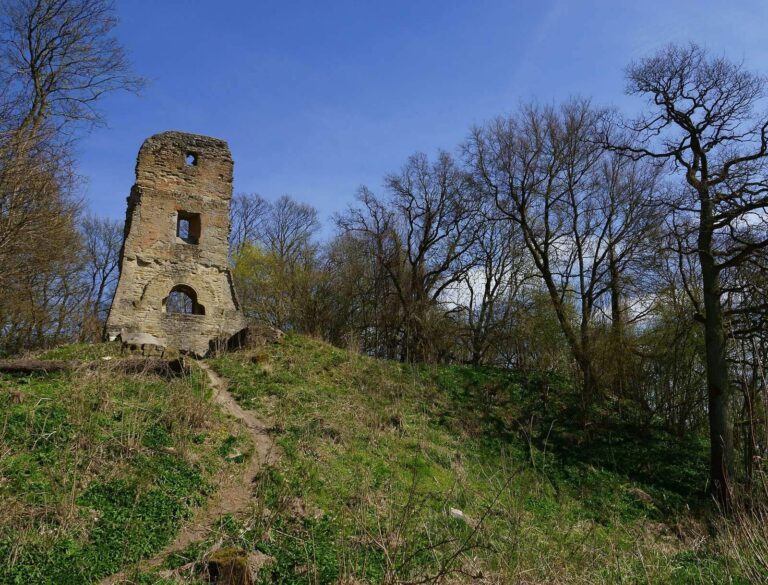
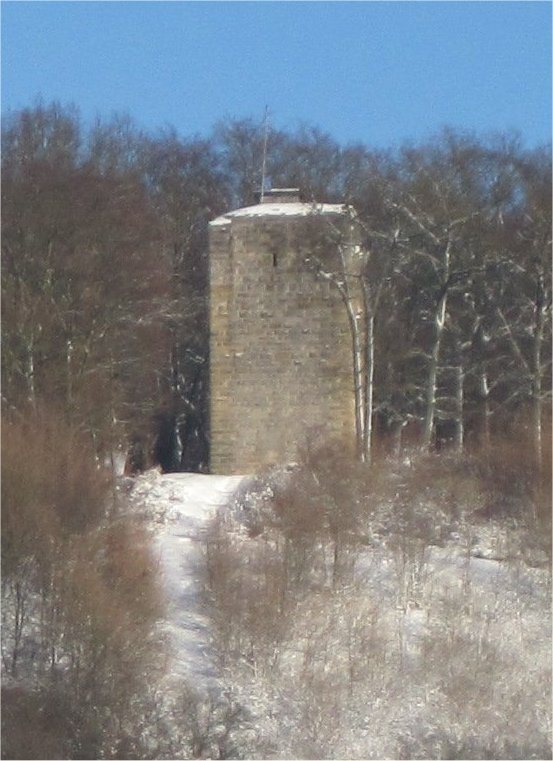
The monastery’s building group comprised the Marian church and communal buildings for sleeping, dining, and religious life. Its construction took place over several decades, with recorded additions to both the church and the convent buildings.
Monastic buildings
Marian church
The church’s building work included a chancel consecrated in 1463 and a roof vault completed in 1506. Several altars stood inside, including one dedicated to the holy martyrs, noted in 1512. The church also contained multiple winged altarpieces, paintings on hinged panels that could be opened or closed, associated with the Nuremberg painting school, a tradition of painting linked to that city.
Dormitory, refectory, and cloister
The dormitory was enlarged from 1480 and completed by 1482. A refectory, the community’s shared dining hall, was established in 1482, and the cloister, a covered walk around a monastery courtyard, was completed in 1500. The monastery was also known beyond the surrounding region for its many relics, objects associated with saints or other sacred figures.