Poligné Castle: A Historic Manor and Estate in Forcé, France
Site at a Glance
- Rating
- 4.3
- Popularity
- Very Low
- Country
- France
- Primary era
- Early Modern
- Eras represented
- Early Modern, Modern
- Civilizations
- French
- Site type
- Domestic
- Remains
- Manor House
On this page7 sections
History
Poligné Castle is an estate in Forcé, France, whose present château is partly eighteenth-century. The place appears in records by 1127, and its lordship was held directly from the County of Maine.
Early lordship
The name appears in several forms over the centuries, including Deima de Polineio in 1127, Poligné in 1260, and Poligny in 1585; Poligné was in use again by 1627. In 1260, Yvon d’Anthenaise transferred Poligné and its associated lands in the parish of Bonchamp to his elder brother Hamelin.
The Ouvrouin family held the lordship in the fourteenth and early fifteenth centuries. Jean Ouvrouin made a contract in 1325, while Guillaume Ouvrouin, a priest who later became bishop of Léon, is recorded in 1364 and 1383. One Jean Ouvrouin died at Nicopolis in 1396; another, recorded in 1405, was killed at the Battle of Baugé in 1420. Jeanne Ouvrouin, his sister, died without children. Her heirs carried out her religious bequests in 1423, and Jacques de Mascon was lord of Poligné by 1459.
Members of the Feschal family held Poligné in the fifteenth and sixteenth centuries. Jean de Feschal was baron of Poligné in 1527, and Louis de Feschal acquired the land of Gougeonnière in 1563. Olivier de Feschal, recorded in 1578 as a knight of the king’s order, died without children after 1592.
Jurisdiction and religious authority
Poligné’s lordship carried duties and judicial rights. In wartime, the lord was to summon his tenant subjects to guard Pont Perrin at Le Mans. Around 1400, the count challenged a claim to hold court at a three-pillar gallows, a structure marking the lord’s authority to administer justice. The count initially treated Poligné’s lord as a vassal without the jurisdiction of a castellan, a lord with castle-related authority. The title was later accepted, and by 1603 the lordship exercised justice at a four-pillar gallows. It also had a seal for contracts, protected hunting grounds, and rights to build a castle, drawbridges and a fortress. Notaries continued to sit at Poligné’s court until the late eighteenth century, although the court remained under the County of Laval.
The lords of Poligné founded the Cimetière-Dieu chapter, a collegiate body of clergy, and controlled appointments to its prebends, endowed incomes attached to canonries, and chapels. This gave the family influence over religious offices beyond the estate itself.
Protestant worship and conflict
Louis de Feschal introduced Protestantism at Poligné around 1560. In October 1571, Forcé’s new parish priest said he could not safely minister because preaching took place every Sunday near his church. From 1600 to 1648, Poligné served as a refuge for the Protestant Church of Laval. The church was vacant in 1637 and did not send representatives to the Alençon synod, an assembly of church representatives.
In 1609, Catherine de la Roussardière donated four cords, a local land measure of variable size, from a garden near Forcé on the road to Entrammes. The land was intended to replace an inadequate cemetery used by local Protestants. In 1660, the Parlement of Paris ordered the removal and whitewashing of funerary decorations that Poligné’s Protestant lord had placed in Laval’s Cimetière-Dieu church, and barred their return while he remained Protestant. The decorations reappeared after later lords became Catholic. From that year, Protestants in the County of Laval could no longer worship at Poligné and were restricted to Terchant.
Later owners
Ownership passed through the Duboys de Mayneuf and Montbourcher families in the seventeenth century. In 1660, Marthe Durcot sold Poligné to the Protestant Sébastien-René Cahideuc, baron of Guildo, but later reclaimed it. François de Franquetot de Coigny, marquis of Coigny and marshal of France, held the estate from 1707 to 1733 through his marriage to Henriette de Montbourcher. Jean-Baptiste-Joachim Colbert de Croissy acquired it from Marie-Josèphe de Nevet, countess of Coigny, and held it from 1754 to 1776.
Jean-Baptiste Duchemin de Mottejean bought the château on 8 March 1780. His son emigrated in 1793, and Duchemin died in 1797. In 1816, Léon Leclerc bought the bare ownership, meaning the property itself without the immediate right to enjoy it; Madame Duchemin retained that right. The de Waresquiel family has owned Poligné since the beginning of the twentieth century. The estate’s funerary chapel was listed as a historic monument in 1992.
Remains
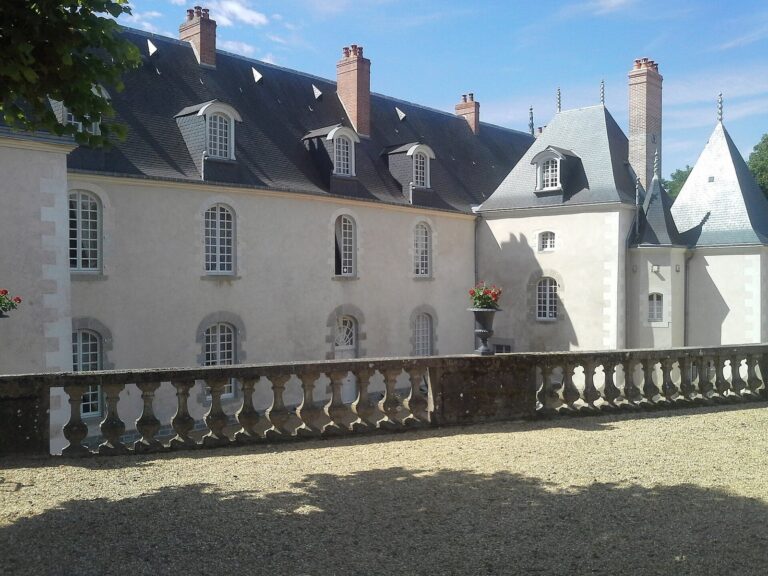
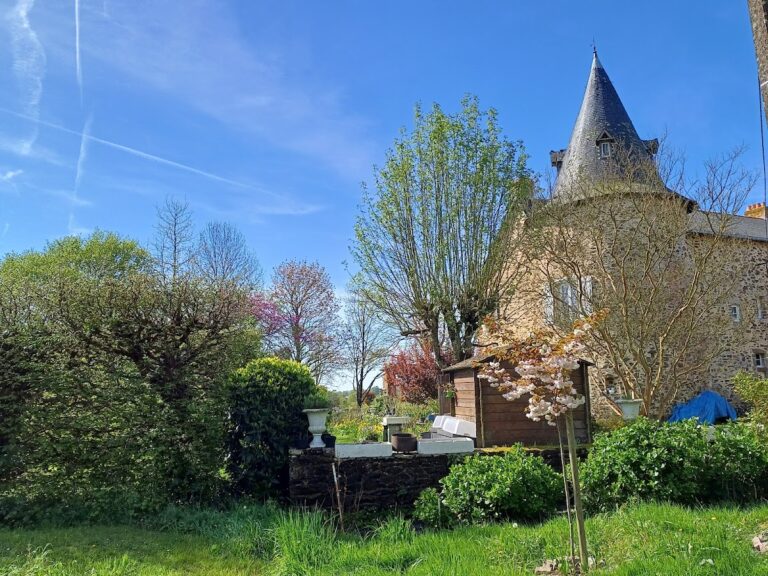
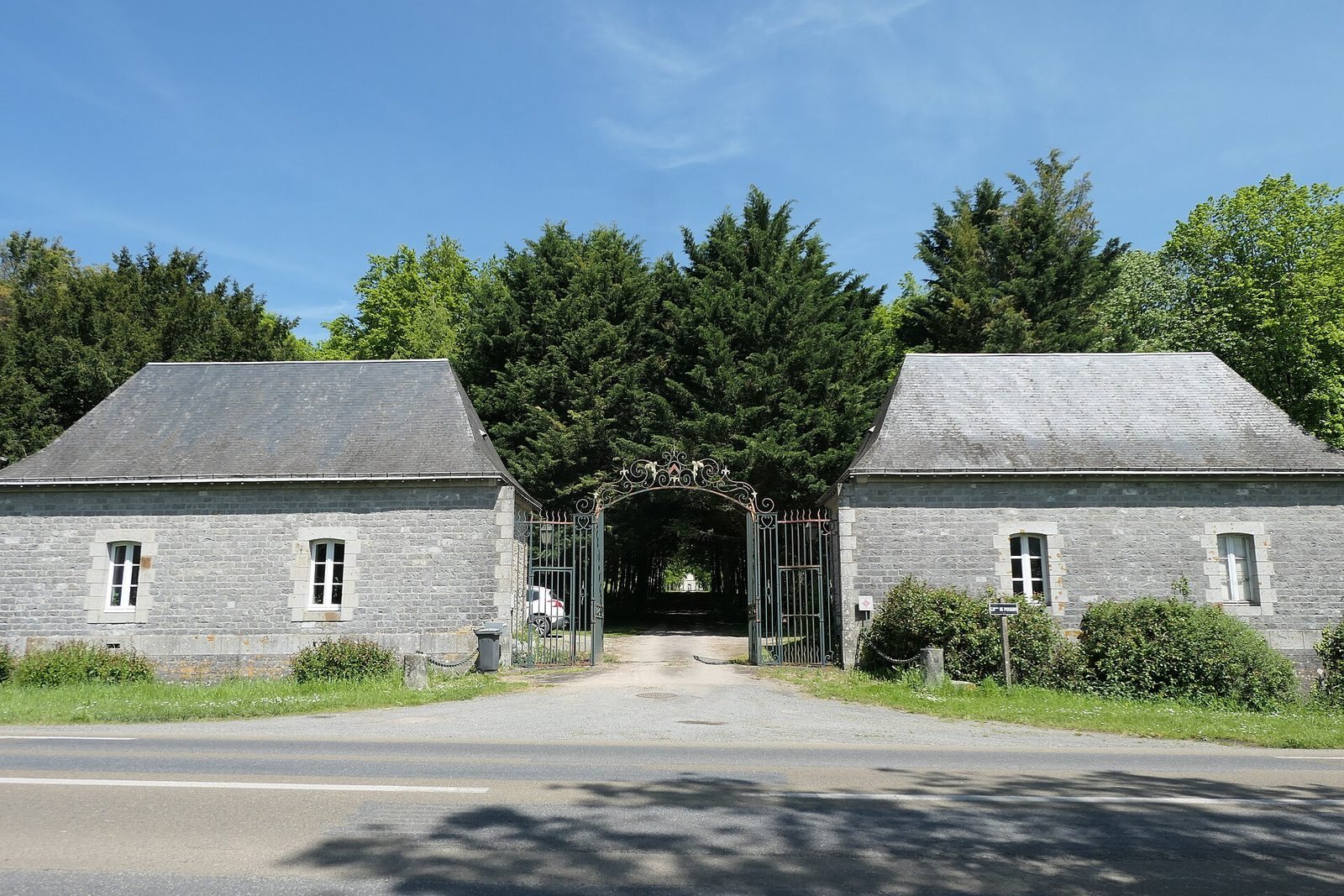
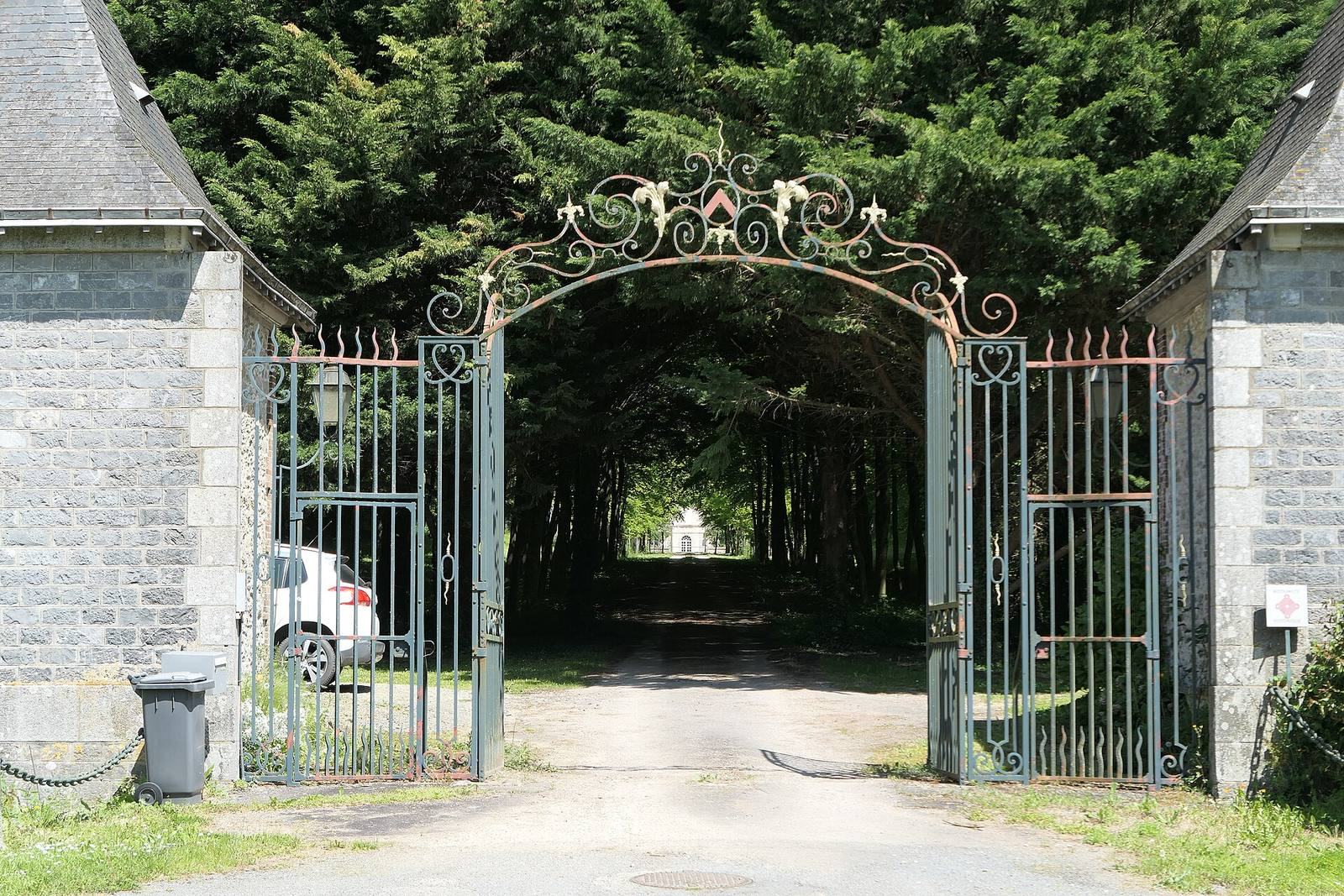
The estate lies about 300 metres northeast of Forcé and comprises a farm and manor house. The manor has undergone later alterations and additions. A description from 1627 presents a castle enclosed by walls, with barns, stables and gardens arranged around a courtyard with mounds. It also records high forest and oak woodland extending across 15 journaux, a local land measure whose value varied by place and period.
The wider estate included 50 journaux of former domain, six quartiers of vineyards, another local land measure of variable size, 53 units of meadow, a mill and the meadow of Frémusson. Fishing rights extended along the Joanne River between Pochard Mill and Souffrette Mill. The estate also encompassed meadows on former ponds, coppice woods and heathland.
Funerary chapel
The funerary chapel stands underground in the château’s avenue. Its walls are faced richly with white marble, and a marble sculptural group evokes the death of the woman whose funerary vault the chapel contains.