Palazzo Mozzi: A Fortified Medieval Palace in Florence
Site at a Glance
- Rating
- 4.7
- Popularity
- Very Low
- Country
- Italy
- Primary era
- Medieval
- External website
- Open
- Eras represented
- Medieval, Early Modern
- Civilizations
- Grand Duchy of Tuscany, Republic of Florence
- Site type
- Domestic
- Remains
- Castle
On this page10 sections
History
Palazzo Mozzi is a medieval palace in Florence, Italy, formed for the Mozzi family between 1266 and 1273 by joining several houses and towers. Its transitional architecture combines features of medieval tower houses with those of the large public palaces built in the late thirteenth and early fourteenth centuries. The palace also served as a fortification for Ponte alle Grazie.
A fortified palace and center of mediation
The wealthy and influential Mozzi family included papal treasurers across several generations. Its Guelph sympathies brought persecution. Guelphs and Ghibellines were rival political factions in medieval Italy, associated respectively with papal and imperial interests. The palace’s protected position outside Florence’s center, near Porta San Niccolò, may have helped attract prominent visitors. During the Avignon Papacy, when the papal court was based at Avignon, it became a point of reference in Florence for Roman prelates.
Pope Gregory X stayed at the palace in 1273 in connection with a peace between the Guelphs and Ghibellines. Papal envoys who came later as peacemakers included Cardinal Latino Orsini in 1286, the Cardinal of Acquasparta in 1300, and Cardinal Niccolò Alberti da Prato in 1303. In 1314, Pietro d’Angiò, brother of King Robert of Anjou, was present for a peace agreement between the Florentines and the people of Arezzo. Gualtieri di Brienne, Duke of Athens, visited in 1326, and in 1380 the notary Ser Ristoro recorded a peace with King Charles III of Naples.
Changes in ownership and use
The palace was modified into a Renaissance house in the fourteenth century. Financial difficulties led the Mozzi to sell their houses in the early fifteenth century; subsequent owners included members of the Bardi and Nasi families. The Mozzi regained the property in 1551 and enlarged their holdings by purchasing land rising behind the palace toward Porta San Giorgio.
In the late eighteenth and early nineteenth centuries, the palace underwent extensive restoration to designs by architect Gasparo Maria Paoletti. Teresa Mozzi, a friend and admirer of Napoleon, arranged the acquisition of Pietro Benvenuti’s large painting The Oath of the Saxons before the Emperor.
In 1861, a few months after the proclamation of the Kingdom of Italy, the palace became the first headquarters of Masonic Loggia Concordia, a local unit of Freemasonry. In 1865, Concordia and the Ausonia lodge of Turin played leading roles in establishing the Grand Orient of Italy, a national Masonic organization. Concordia held republican views, while Ausonia was monarchist.
Bardini and public ownership
After the Mozzi family became extinct, further financial reverses left the property in disrepair. Princess Vanda Carolath von Beuthen bought it in 1880. The antiquarian and art collector Stefano Bardini acquired it in 1913, using it to store and exhibit works for sale and to house workshops for their restoration and reassembly. Together with Bardini’s other palace across the piazza, Palazzo Mozzi formed an ensemble illustrating medieval and Renaissance architectural traditions.
The palace appeared on Italy’s 1901 list of monumental buildings considered part of the national artistic heritage, and it has been protected as an architectural property since 1912. When Bardini died in 1922, he named his son Ugo as heir and directed that the properties and collections pass to cultural institutions after Ugo’s death. A prolonged inheritance dispute delayed their public use. The Italian State acquired the palace in 1996, and it later housed the Bardini Museum. Following a major restoration of its interior and exterior, completed in 2020, the complex became the headquarters of the Regional Secretariat for Tuscany and the Regional Directorate of National Museums of Tuscany, within the Ministry of Culture. The Italian State owns the property.
Remains
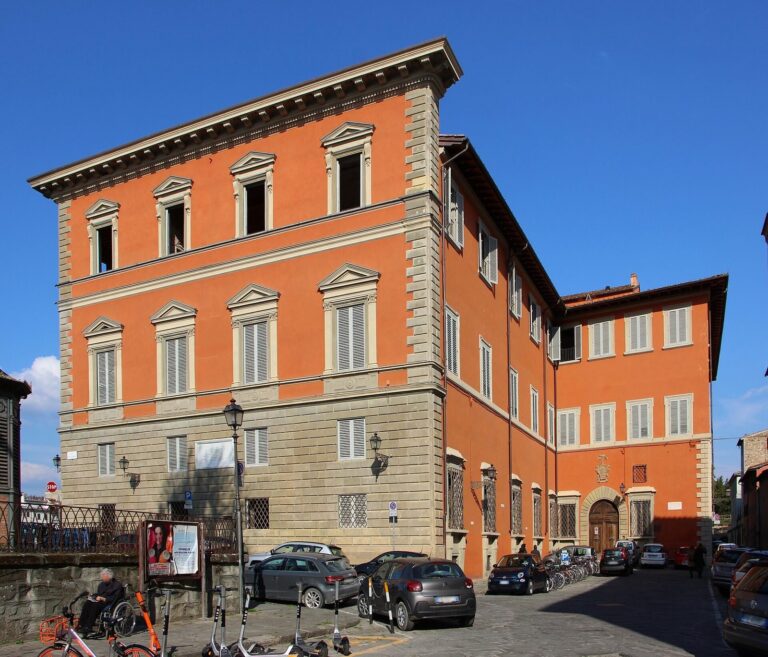
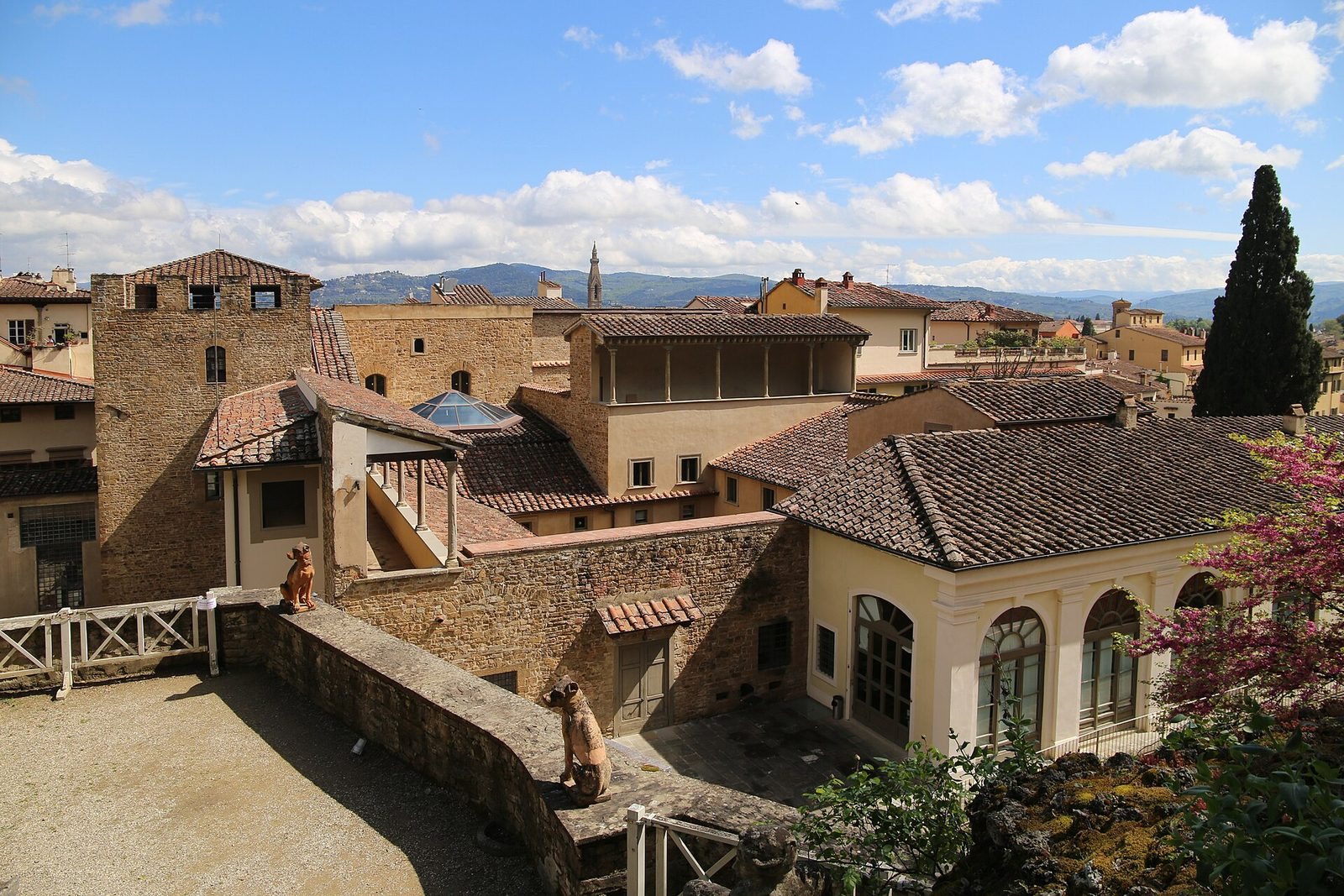
At the end of Piazza dè Mozzi, beside Ponte alle Grazie and where Via San Niccolò meets Via dei Bardi, the palace is larger than a typical medieval tower house. Its transitional character combines elements associated with medieval towers and late thirteenth- and early fourteenth-century public palaces.
Façade and tower
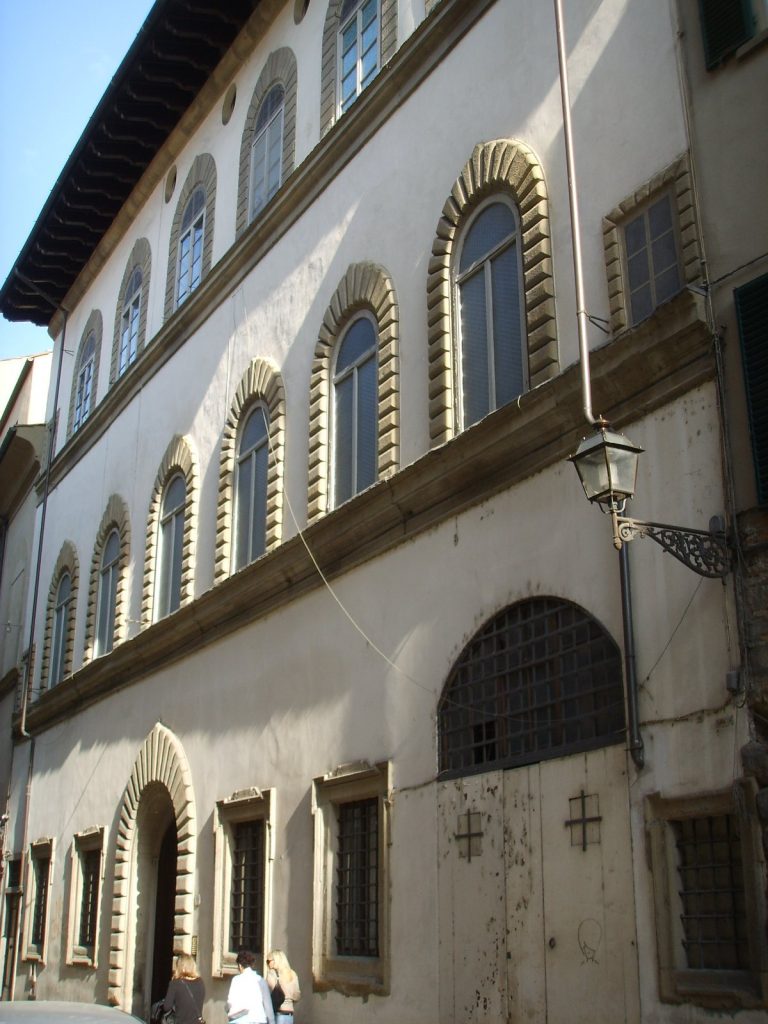
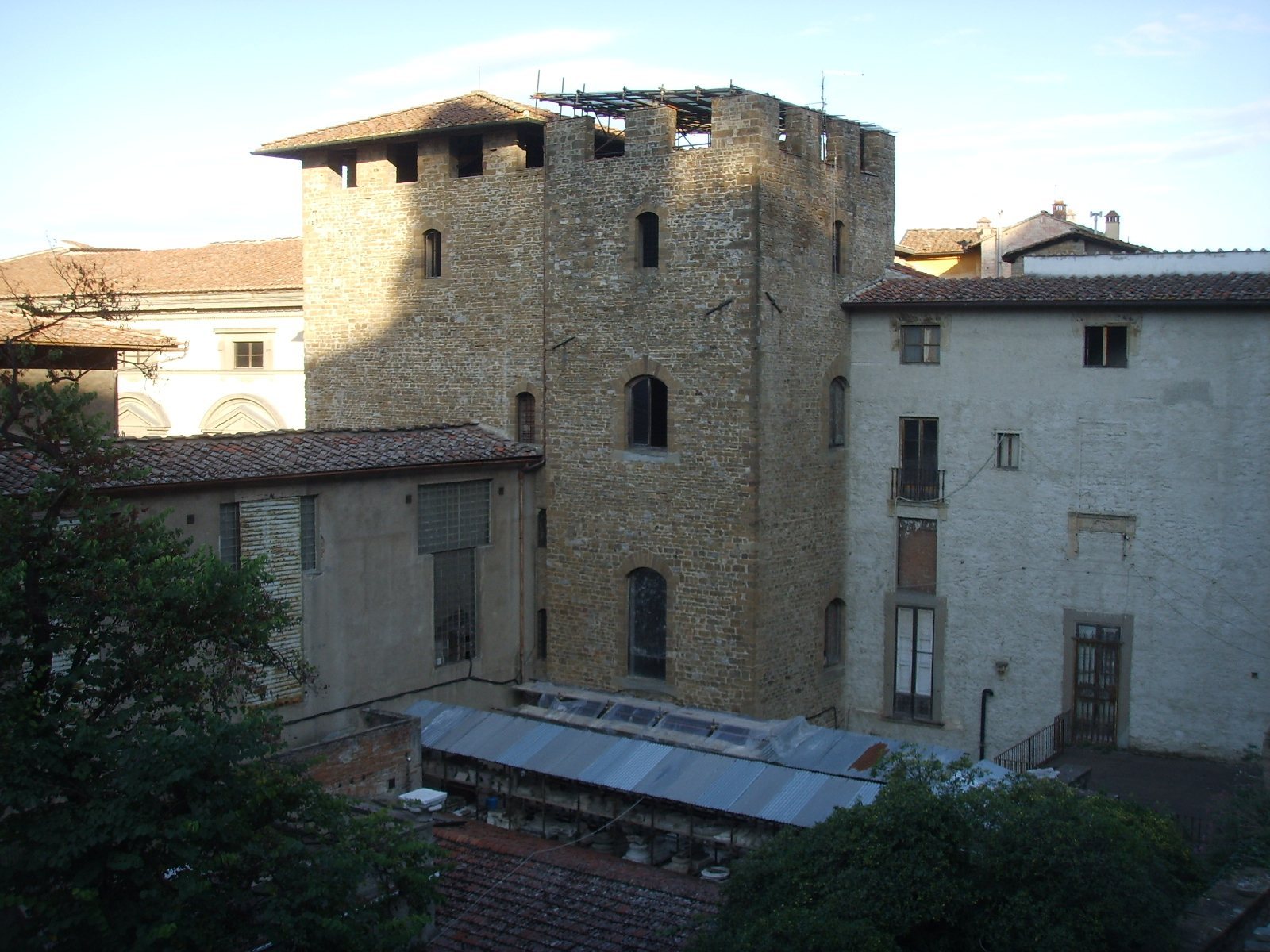
The long, austere main façade is faced with small squared blocks and arranged around a tall central tower. A continuous sequence of arches runs along the ground floor, while projecting roof coverings define the building’s asymmetrical masses. At the center of the façade, a large shield bears the Mozzi arms: a Cross of Toulouse, a heraldic emblem associated with Toulouse, shown without heraldic colors.
The tower once carried square-topped Guelph-style crenellations, alternating raised blocks and gaps along a wall; its crown was later removed. Nineteenth- and early twentieth-century alterations sought to give the façade a medieval appearance. They also removed Baroque additions and large kneeling windows, windows with projecting sills supported by brackets, installed on the ground floor in the sixteenth or seventeenth century.
Interior features
The main hall on the first floor has wall paintings dated 1778 that were recovered during restoration. The palace’s interior also incorporates portals taken from urban buildings dismantled during Florence’s nineteenth-century renewal.
Garden and collections
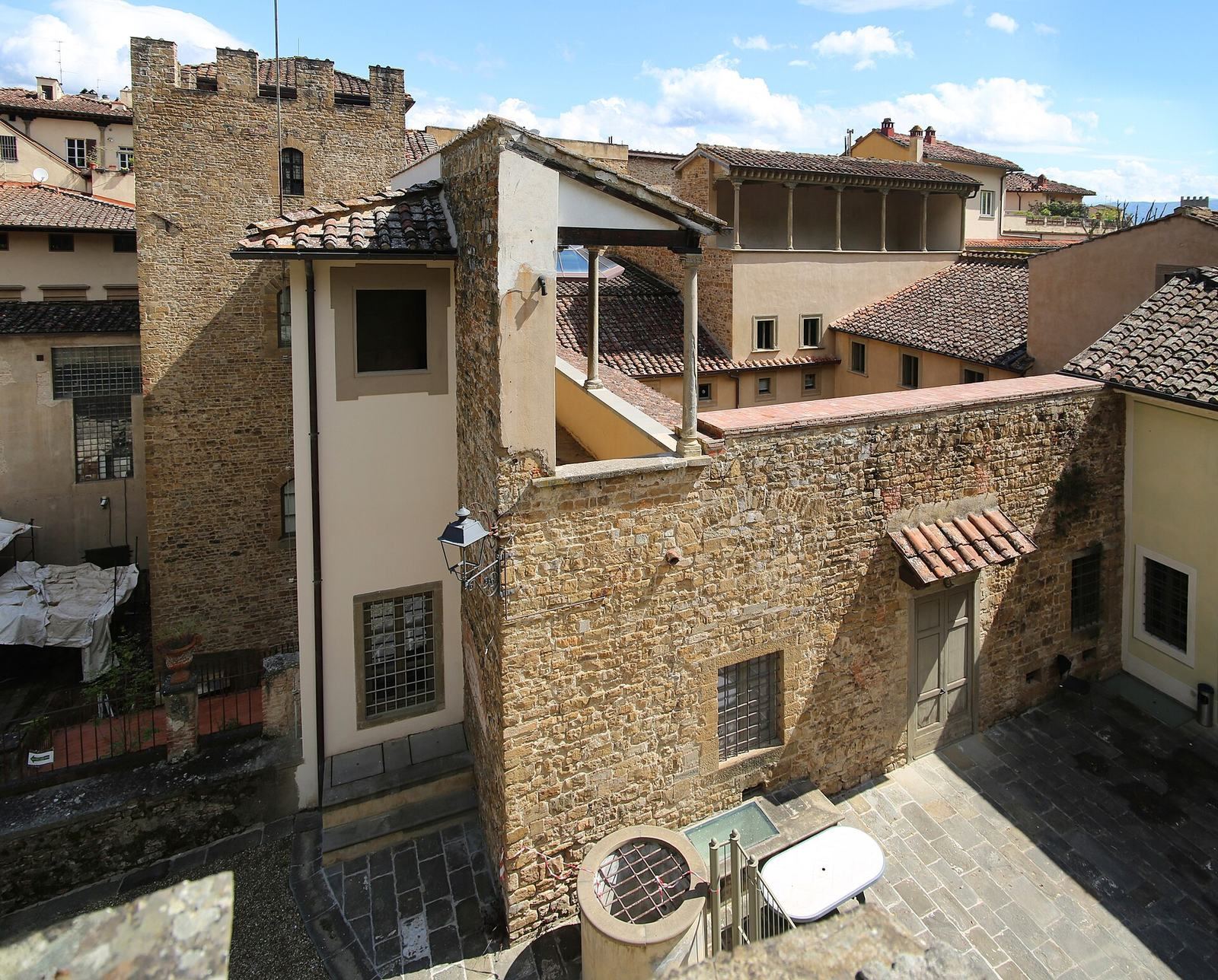
The steep hillside behind the palace was an olive grove when the Mozzi acquired the land in the sixteenth century. Bardini later developed the grounds, which are now part of the Giardino Bardini.
Bardini Museum collection
The Bardini Museum’s collection includes Tino di Camaino’s statue Allegory of Charity, Antonio del Pollaiuolo’s painting Saint Michael the Archangel, Domenico Beccafumi’s The Choice of Hercules, a painted crucifix attributed to Bernardo Daddi, and Donatello’s carved wooden Madonna della Mela. Other holdings include decorative chests, weapons and armor, fifteenth-century polychrome stuccoes and wooden sculpture, old musical instruments, frames, doors, ceramics, and painted ceilings.
Corsi collection
The second floor displays the Corsi collection, with works dating from the twelfth through the nineteenth centuries. Mrs. Carobbi, Corsi’s widow, donated the collection in 1938.