Palazzo Serristori: A Historic Palace in Florence’s Oltrarno
Site at a Glance
- Country
- Italy
- Primary era
- Early Modern
- Eras represented
- Early Modern, Modern
- Civilizations
- Grand Duchy of Tuscany, Italian, Republic of Florence
- Site type
- Domestic
- Remains
- Elite Residence
On this page10 sections
History
Palazzo Serristori is a palace in San Niccolò, in Florence’s Oltrarno district, Italy, commissioned by Lorenzo Serristori between 1520 and 1522. Lorenzo, Bishop of Bitetto in southern Italy, intended it as a residence near the mills of the Renai area, including fulling mills where workers beat wool cloth to clean and thicken it. The Serristori family came from Figline, and its name derived from Ser Ristoro, a local magistrate.
Sixteenth-century expansion
Lorenzo’s nephew Averardo Serristori enlarged and improved the residence. As an ambassador to Cosimo I de’ Medici, who ruled Florence and later became Tuscany’s first grand duke, Averardo also added a large garden toward the Arno.
In the sixteenth century, Antonio Serristori, governor of Livorno’s port, expanded the property further, turning the garden house into a palace with a decorated ballroom. Gherardo Silvani designed the transformation, and architect Felice Gamberai helped complete the ballroom.
Early nineteenth-century changes and residents
In 1803, Senator Averardo Serristori, named after his earlier relative, commissioned Giuseppe Manetti to refurbish the palace and reorganize its garden and river-facing setting. Soon afterward, an elevated passage connected the palace toward Ponte alle Grazie. A projecting lookout stood at the bridge end, and oil lamps lit the passage.
The palace hosted the Demidoff family in 1822. This prominent Russian family, associated with mining and industry, later moved to nearby Palazzo Amici-Demidoff. After the Restoration, Joseph Bonaparte, Napoleon’s brother and former King of Spain, moved in with his family and died at the palace on 28 July 1844. His wife, Julie Clary, lived there in exile until her death in 1845.
The Lungarno and the Serristori household
The opening of the Lungarno in 1873 brought major changes. Work demolished the palace’s river-facing section, reduced the garden and separated it from the riverbank; it also removed the elevated passage to Ponte alle Grazie. Mariano Falciani designed new façades facing the Lungarno and Piazza Demidoff, while most interiors were rearranged.
When Alfredo Serristori died in 1884, the palace passed to his nephew Umberto, who made it a gathering place for Florentine aristocrats. Chef Alfredo Benucci, trained in Paris, became part of Europe’s elite culinary world. In the twentieth century, Gino Mariani worked at the palace for nearly 60 years with his wife, Giuseppina Maestripieri. They served first Countess Hortensie De La Gandara Serristori, a lady-in-waiting to Queen Elena, and later her daughter, Countess Sofia Bossi Pucci Serristori.
The 1966 flood and later work
The Arno flood of 4 November 1966 badly damaged the ground-floor apartment made available to Joseph Bonaparte and part of the first floor. University students and other young volunteers known as the “mud angels” worked at the palace for several days under the leadership of Paolo Baldassarri, a Red Cross worker from Pistoia. LDC Hotels & Resorts, a Taiwanese group led by Nelson Chang, purchased the palace in March 2020. Restoration and renovation work began in late 2021.
Remains
The palace’s surviving fabric brings together an early courtyard-centered plan and later changes to its street and river façades. The exterior includes a corner front associated with the sixteenth-century palace and a nineteenth-century river frontage with neoclassical forms, inspired by classical architecture.
Courtyard and early plan
The original palace had a U-shaped plan, described as inspired by classical Roman buildings, around a four-sided courtyard. A loggia, a covered gallery open on one side, faced the courtyard and garden through three arched windows. Giuliano da San Gallo has been proposed as the architect by comparison with other buildings.
Via de’ Renai façade
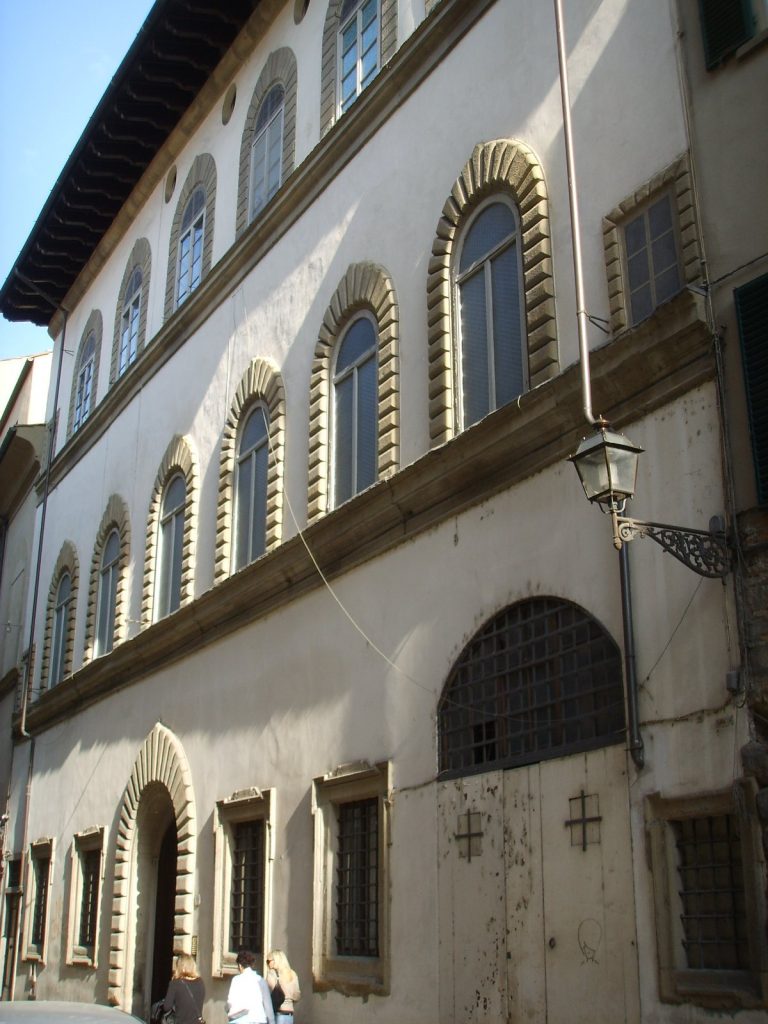
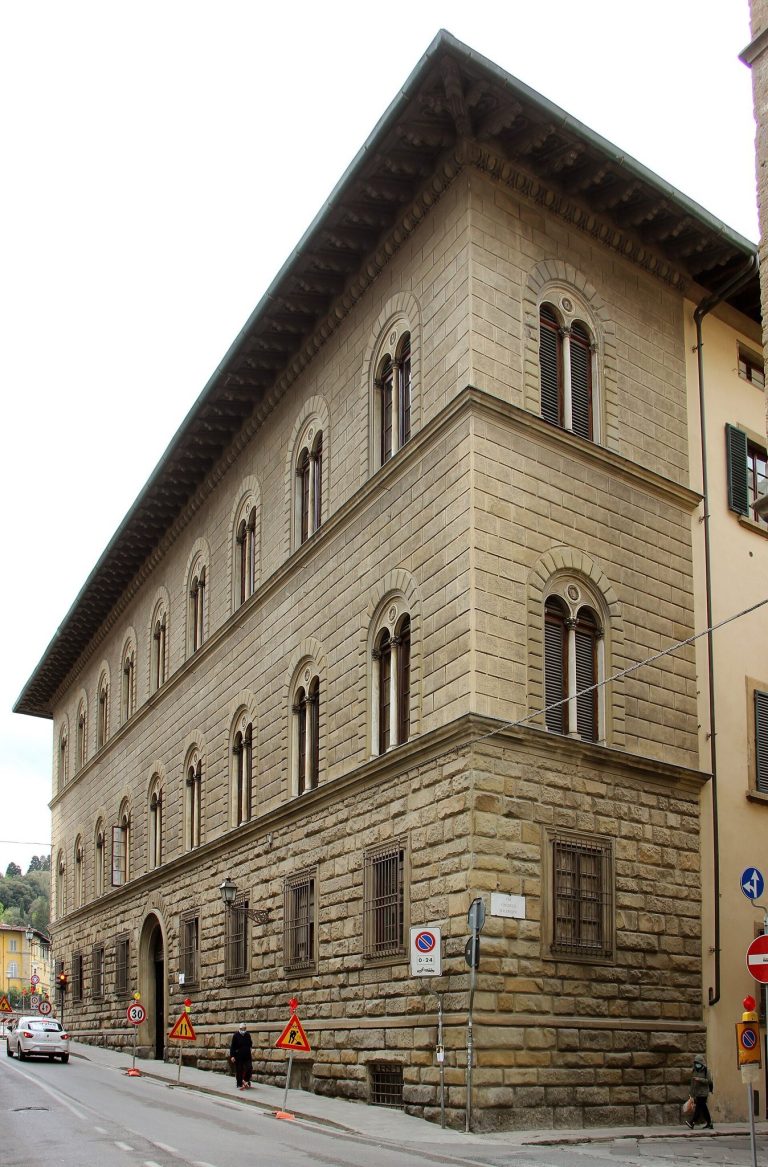
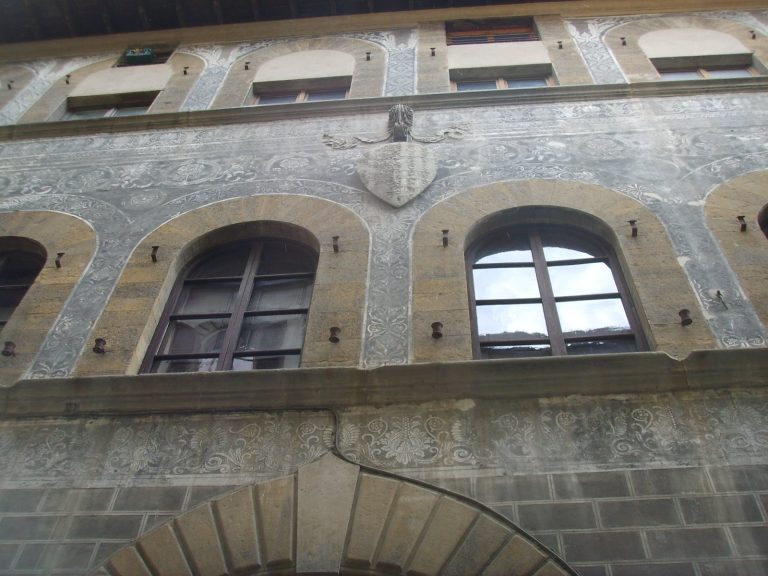
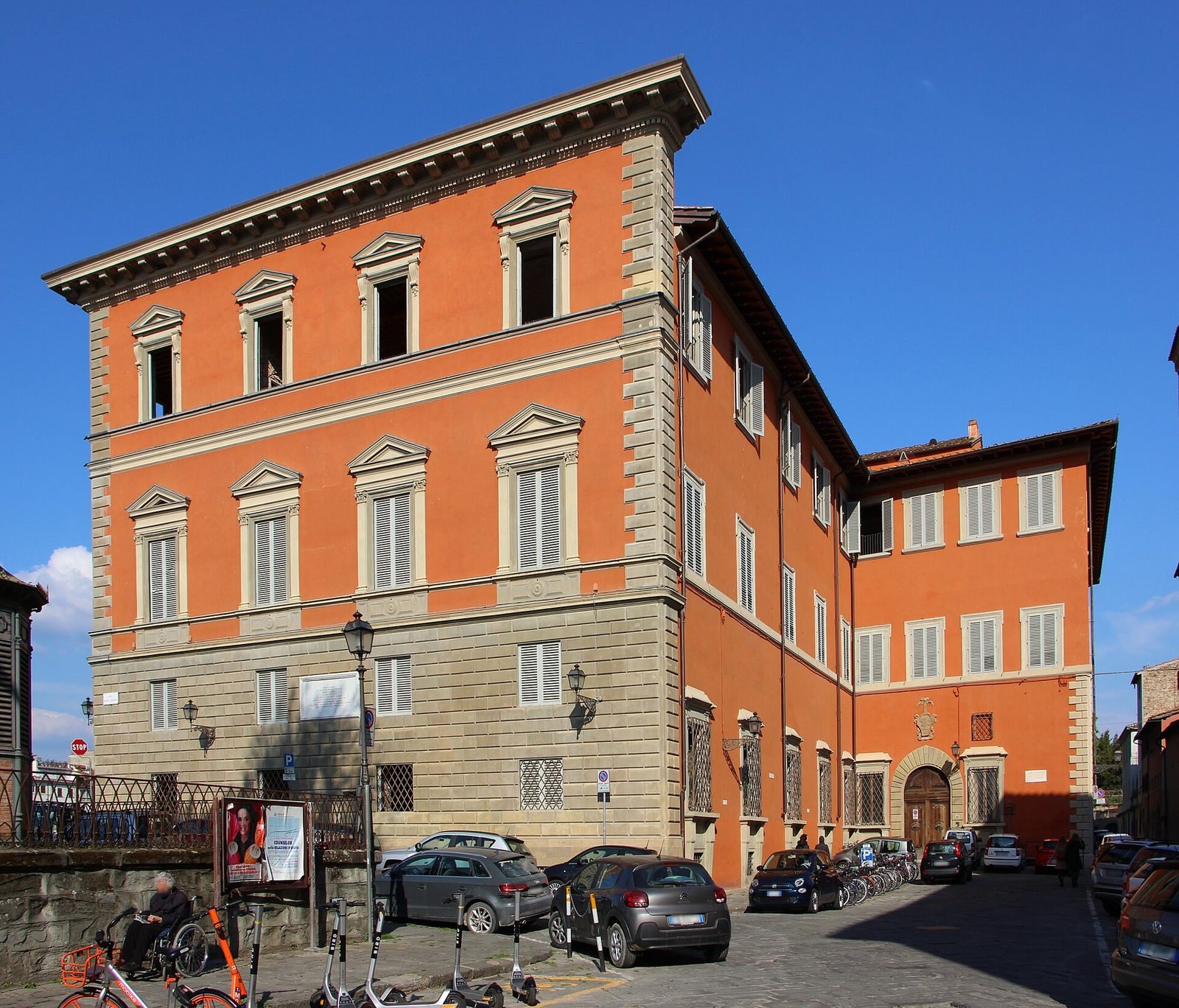
The surviving exterior associated with the sixteenth-century palace is the corner façade on Via de’ Renai, where the main entrance stands. Its Florentine-style doorway is framed by hard sandstone blocks set in a radiating pattern and topped by the Serristori coat of arms. Dated 1515, the arms were altered by Pope Leo X, who added three lilies to the three stars already shown. Seven large “kneeling” windows, with projecting supports that resemble bent knees, continue around the curved corner on the ground floor. Above a sculpted horizontal band, rectangular windows have broken-line surrounds; the second-floor openings are simpler. Projecting eaves and rough-faced stonework extend the treatment down to the first floor. The façade’s red plaster is less common in Florence than white and ochre finishes.
Lungarno façade
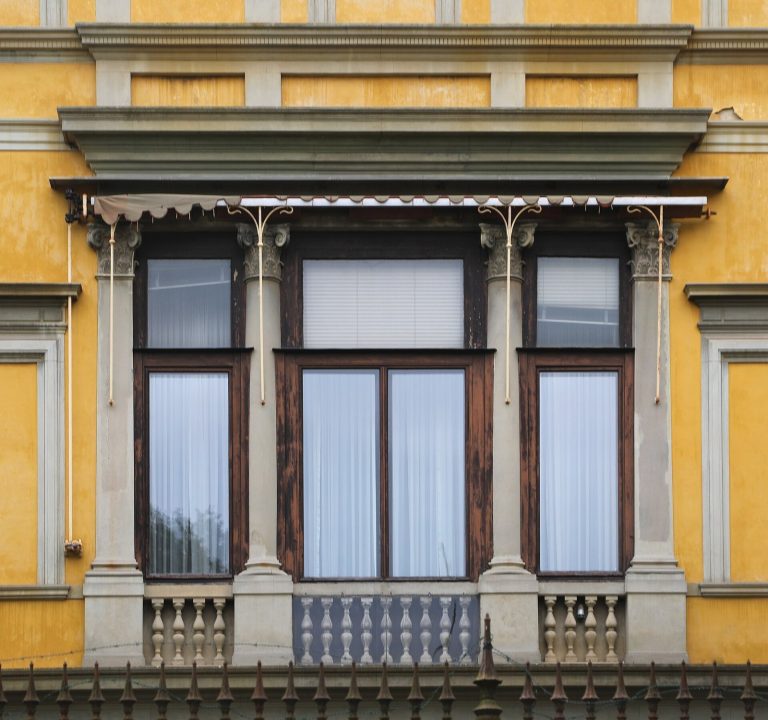
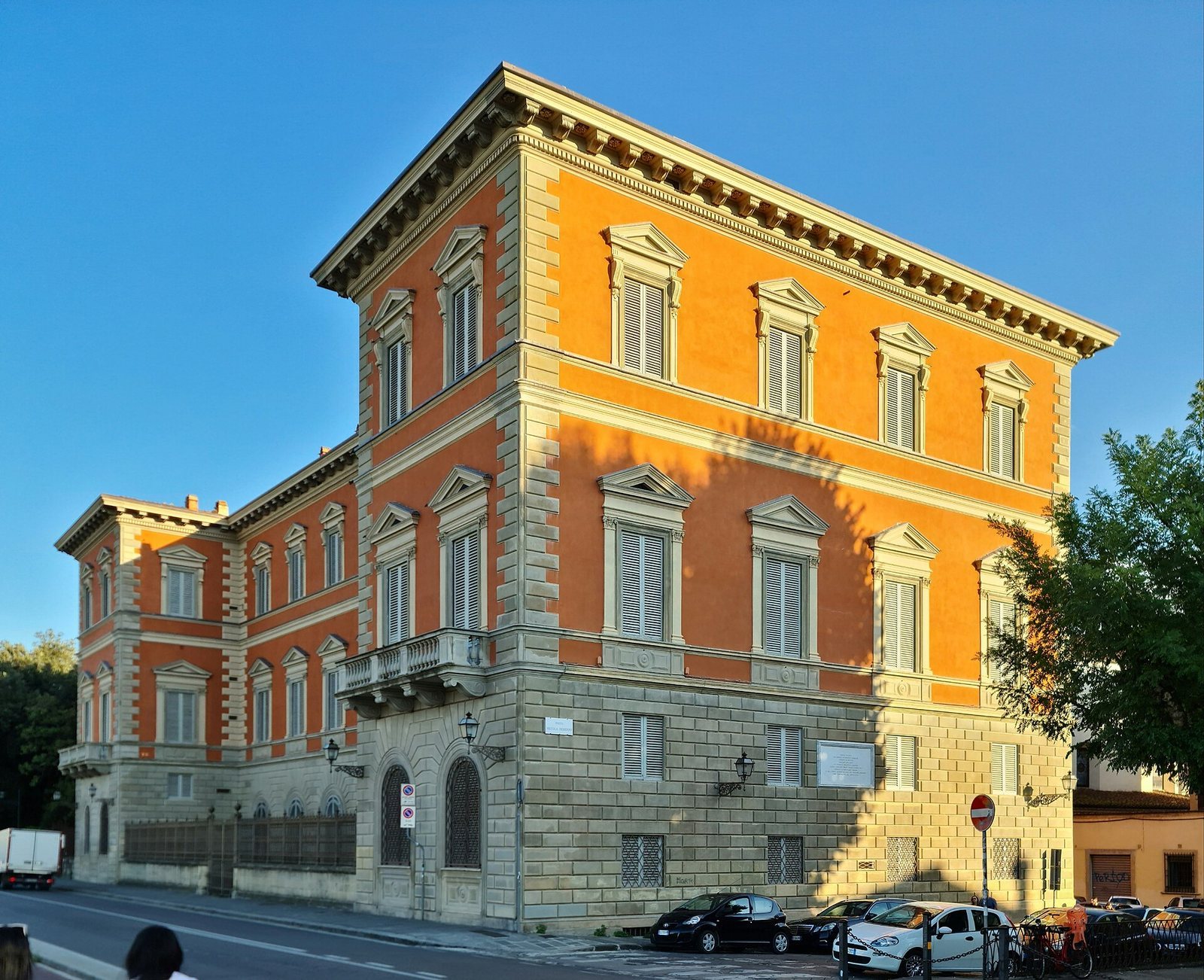
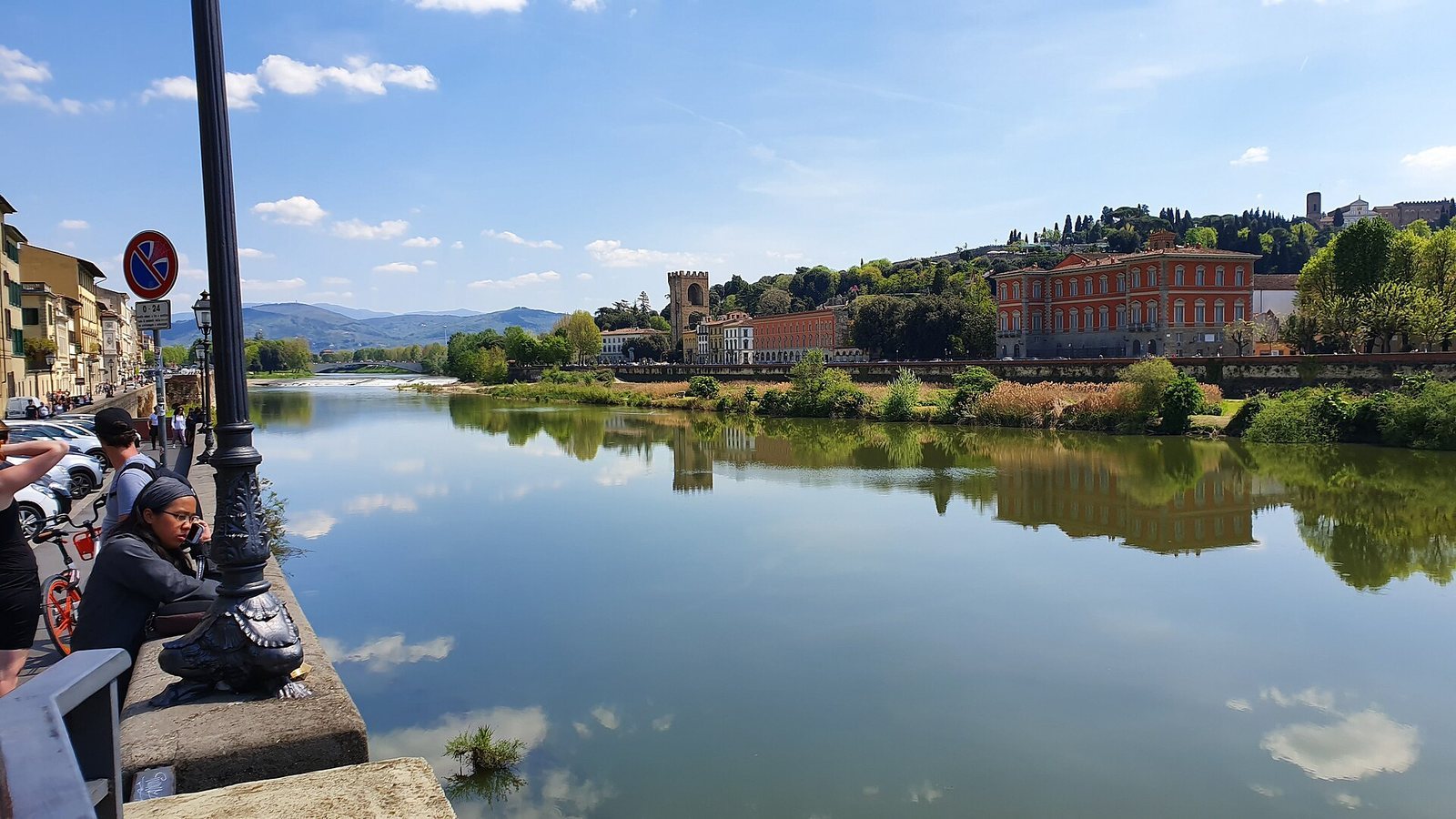
The river-facing façade has two projecting sections with the present garden between them. Smooth, roughly finished masonry combines with neoclassical windows framed by pilasters, capitals and rectangular pediments. Stone balustrades and stucco decoration run along the line of the window sills. The second-floor windows also have pediments, decorated with scroll-shaped forms but without stone balustrades. A large cornice replaces the projecting eaves and rises above the interior rooms. The same design continues across the west, north and east sides; on the river side, two terraces occupy the projecting sections at the level of the principal upper floor.
Interior and other features
The ballroom has three large windows, each topped by a smaller one, and Murano-glass chandeliers. Pier Paolo Lippi, Agnolo Gori and Cosimo Ulivelli decorated its curved ceiling and walls. Inside the palace, a spiral staircase designed by Gherardo Silvani in 1650 winds around a central axis; it was the first of its kind in Florence. A statue of Ser Ristoro stands in the entrance stairwell. Between Via dell’Olmo and Via de’ Renai, a small wine window, an opening associated with serving or selling wine, remains partly visible.