Rijeka City Tower: A Medieval Gateway and Civic Landmark
Site at a Glance
- Rating
- 4.5
- Popularity
- High
- Country
- Croatia
- Primary era
- Medieval
- External website
- Open
- Eras represented
- Medieval, Early Modern, Modern
- Civilizations
- Austria-Hungary, Habsburg, Holy Roman Empire, Hungarian
- Site type
- Civic
- Remains
- Monument
On this page11 sections
History
Medieval origins and Habsburg rule
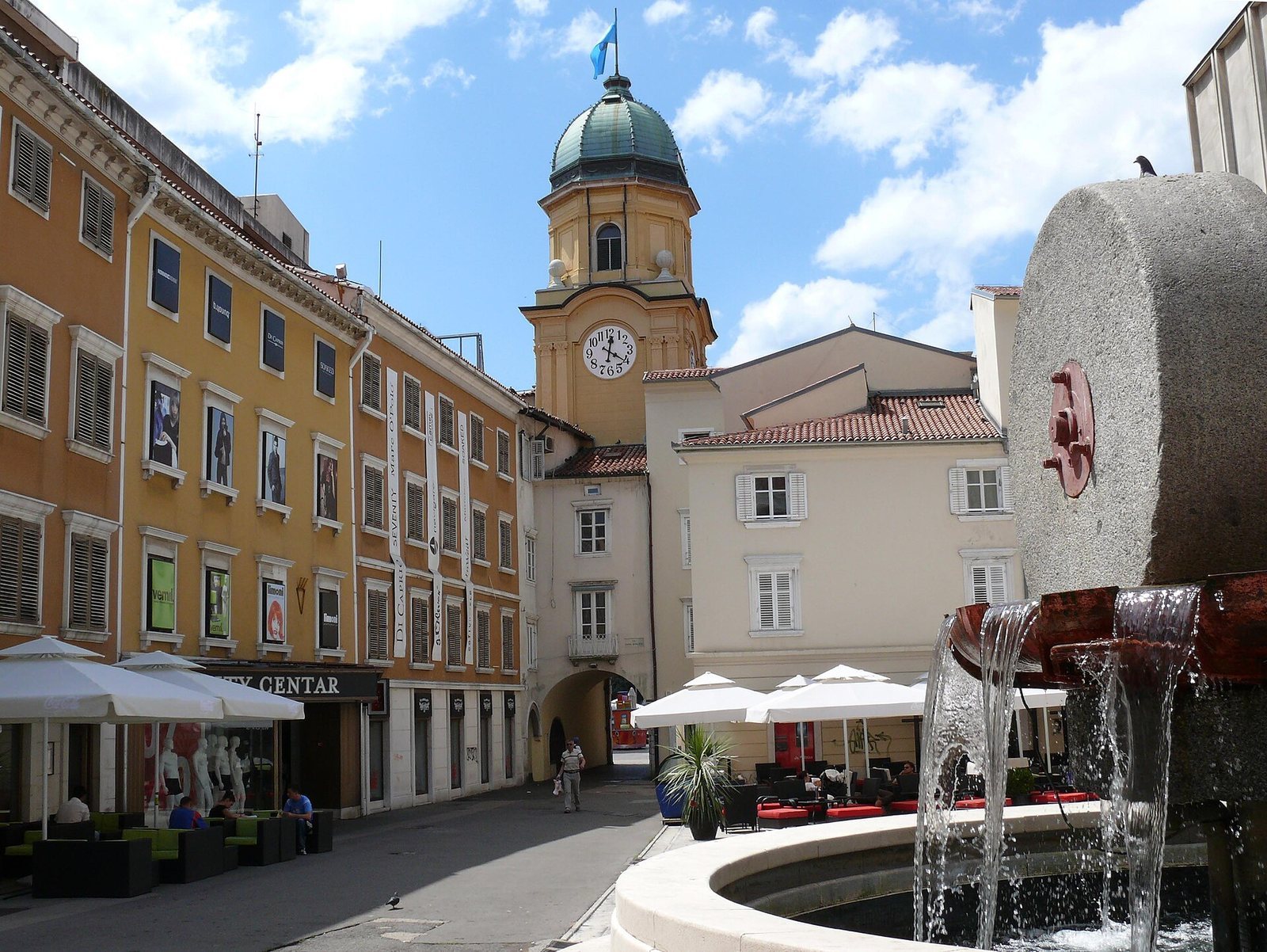
Rijeka City Tower is a medieval tower in the Old Town of Rijeka, Croatia, probably built on the foundations of the ancient Sea Gate. Rijeka remained enclosed by walls until the late eighteenth century, and much of its public, cultural, and commercial life unfolded within them.
Rijeka became a Habsburg possession in 1446 and later grew into an important port under the Austrian Empire and Austria-Hungary. The tower’s appearance reflected Habsburg rule. In the seventeenth century it was raised and fitted with a clock, inscriptions, coats of arms, and busts of Habsburg rulers. Residents called it the Clock Tower, or Torre d’orologio, and used it as a familiar meeting place. On June 6, 1659, Emperor Leopold I approved Rijeka’s coat of arms. Emperor Charles VI granted the city free-port status in 1719, allowing goods to move through its port with reduced or no customs duties. An inscription on the tower also commemorates Charles VI’s visit in 1728.
Reconstruction and changes to the tower
After a devastating earthquake struck in 1750, Empress Maria Theresa provided funds for rebuilding Rijeka and approved an urban plan that left the Old Town unchanged. The redevelopment added a monumental portal to the tower. In 1784 the city council commissioned Ludovico Ruppani to design a sculpture of Rijeka’s coat of arms for the roof, replacing a sphere topped by a cross. That earlier roof sculpture was later removed when the dome was constructed. The council also ordered four clocks, one for each side of the tower. Their mechanisms were replaced in 1873 with ones from the international exhibition in Vienna, and these mechanisms remain in operation.
Architect Antun Gnamba reconstructed the tower around 1801. In 1890, architect Filibert Bazarig designed its present dome, giving the building a historicist appearance inspired by earlier architectural styles.
The eagle and its restoration
A bronze double-headed eagle was placed on the dome in 1906. After Austria-Hungary dissolved in 1918, Italy and the newly established Kingdom of Serbs, Croats and Slovenes disputed Rijeka’s future. During the occupation led by Italian nationalist Gabriele D’Annunzio, his paramilitary followers, known as the arditi, removed one of the eagle’s heads on November 4, 1919. They argued that the two-headed eagle represented Austria and that a single-headed eagle was Roman. Yugoslav communist authorities removed the sculpture in 1949, viewing it as a symbol of the bourgeoisie.
The tower was renovated and conserved in 1983. After Croatia’s independence from Yugoslavia and the end of communist rule in 1991, calls grew to restore a replica of the eagle. Rijeka’s city council approved the project in 2016, and the replica was installed on April 19, 2017. The tower remains one of the city’s principal landmarks and symbols.
Remains
Position and medieval passage
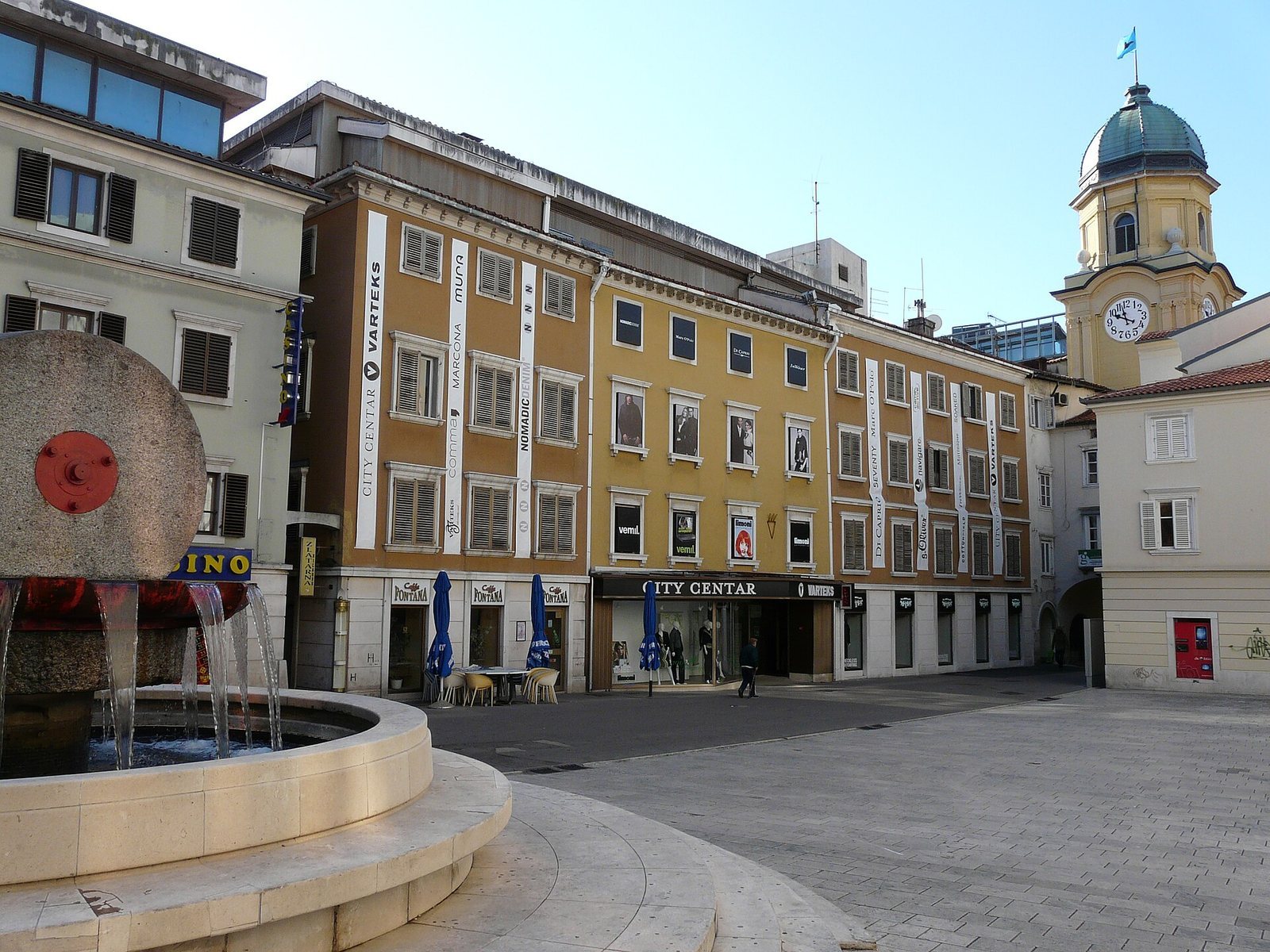
The cream-yellow tower stands at the center of Korzo in Rijeka’s Old Town. Its portal forms a passage between Korzo, the city’s main pedestrian street, and Ivan Kobler Square. The medieval structure probably occupies the foundations of the ancient Sea Gate. Entry to the walled city was historically through either the Sea Gate or the Upper Gate, reached by crossing a wooden bridge over a water-filled moat.
Portal and civic emblems
Monumental portal
The portal is topped by relief busts of Habsburg emperors Leopold I and Charles VI, made by local sculptor Antonio Michelazzi. Inscriptions on the architrave commemorate both rulers.
Coat of arms
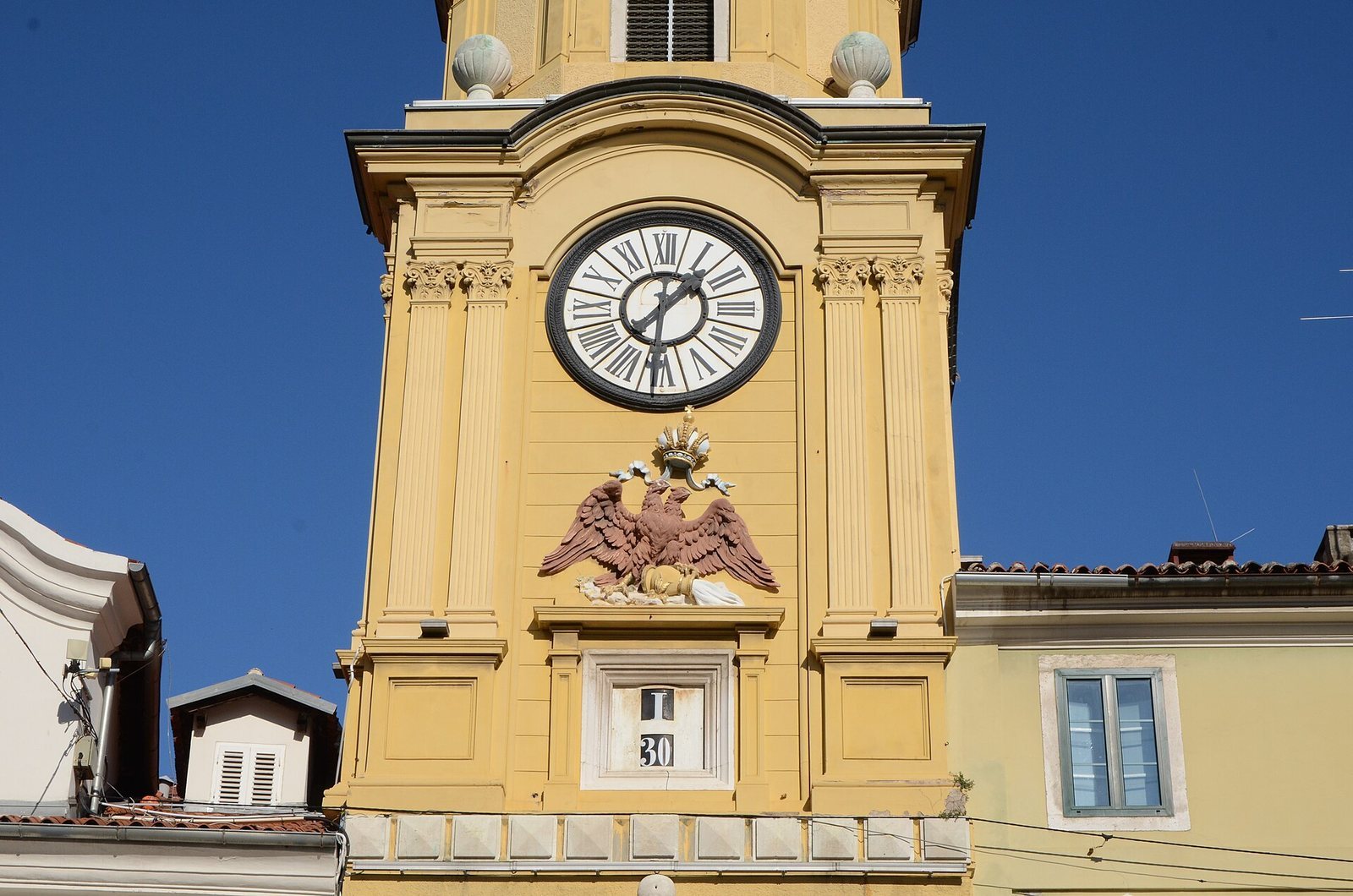
A relief of Rijeka’s coat of arms appears on the tower’s front beneath an inscription dated 1695. It depicts a double-headed eagle with both heads turned in the same direction, one foot on a cliff and the other on a vessel pouring out water. The Latin motto Indeficienter means “inexhaustible.”
Clocks and dome
Four clock faces mark the tower’s sides, and the mechanisms introduced in 1873 continue to function. Above them, a tambour, the raised section beneath a dome, supports the present dome designed for the 1890 reconstruction. Its historicist appearance draws on architectural styles from earlier periods.
Eagles on the dome
The original bronze eagle, designed by Vittorio de Marco, stood 2.2 metres high, spanned 3 metres across its wings, and weighed 2 tonnes. The replica now atop the dome was made by sculptor Hrvoje Uremović at the Zagreb Academy of Fine Arts’ art foundry, using archival records and guidance from Rijeka’s conservation office. Made of aluminum, it weighs about 270 kilograms, is 255 centimetres high, and has a 300-centimetre wingspan. It stands about 30 metres above ground.