Basilica of San Francesco d’Assisi: Franciscan Shrine and Mother Church
Site at a Glance
- Popularity
- Very High
- Country
- Italy
- Primary era
- Medieval
- Eras represented
- Medieval, Early Modern, Modern
- Civilizations
- Italian, Papal States
- Site type
- Religious
- Remains
- Basilica
On this page26 sections
History
Foundation and burial of Francis
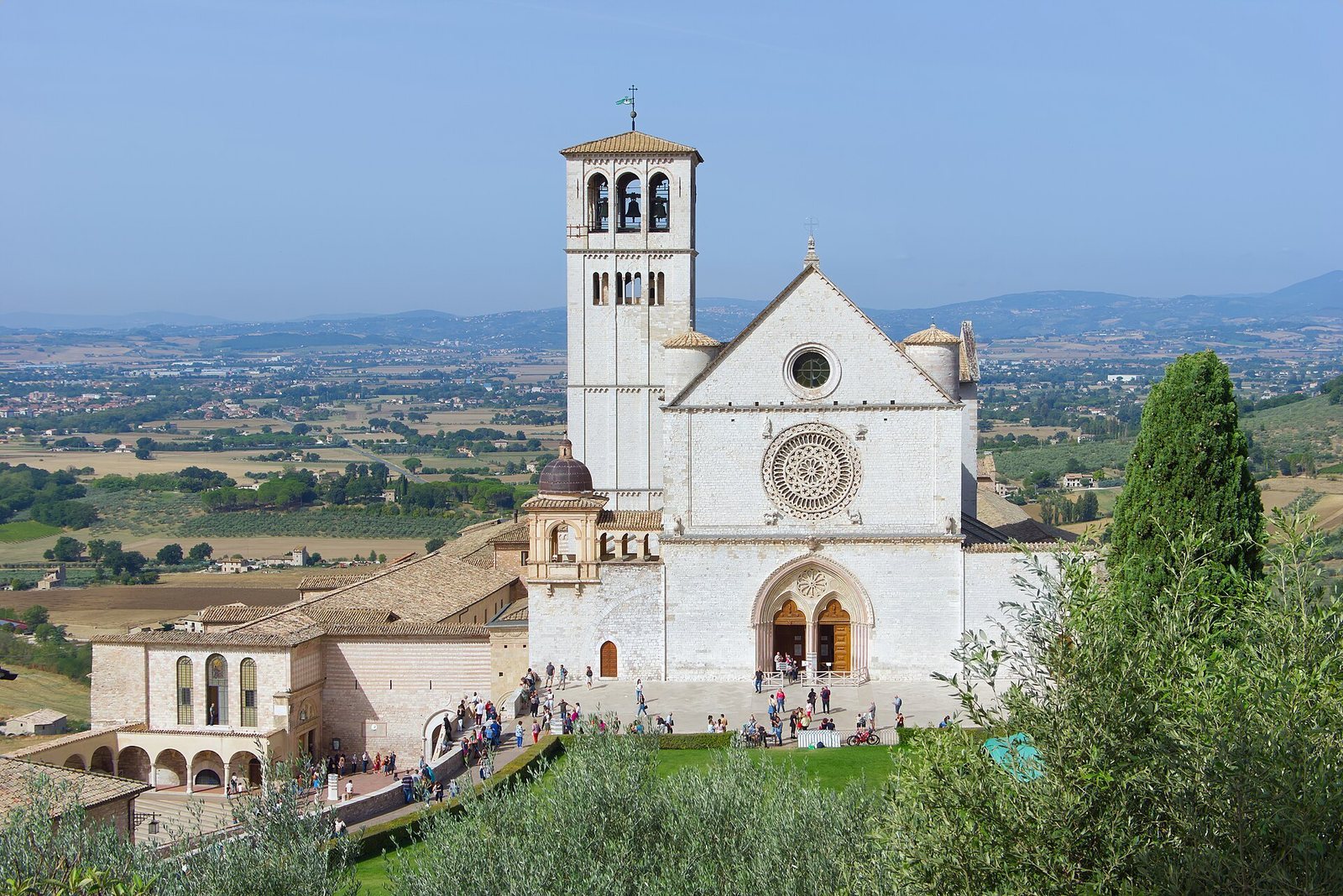
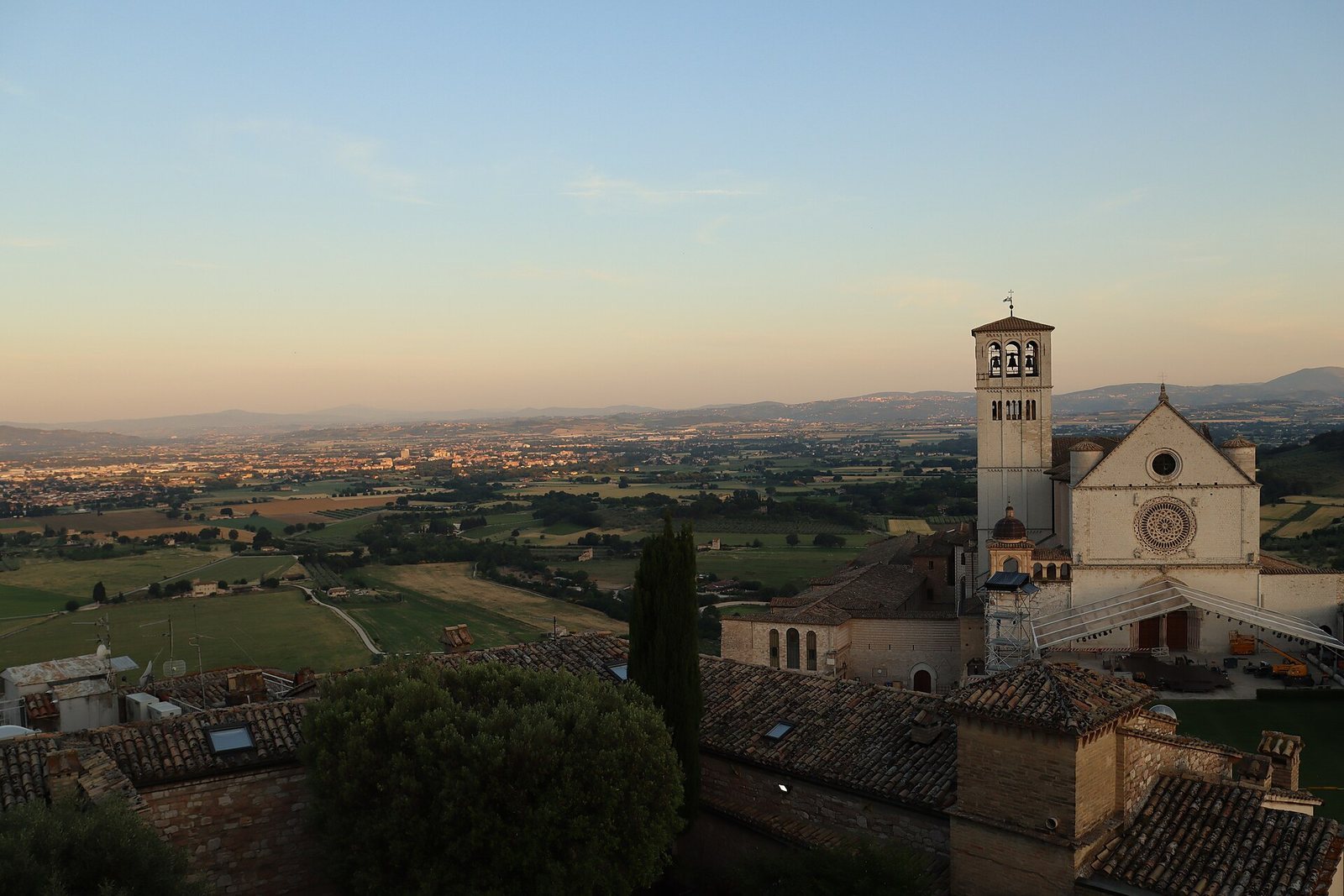
The Basilica of San Francesco d’Assisi is a Franciscan shrine in Assisi, Italy, begun in 1228 in Romanesque and Gothic forms. Built as the burial place of Francis of Assisi and the principal church of the Order of Friars Minor Conventual, it grew into a complex of two churches and the adjoining friary. Francis, who founded the Franciscan movement with its emphasis on poverty and religious life, had, according to tradition, chosen the site for his burial.
Simone di Pucciarello donated land west of the city, on a hill where executions had previously taken place. The site became known as the Hill of Paradise. Pope Gregory IX laid the foundation stone in July 1228, after work had started, and Brother Elias of Cortona supervised construction. The Lower Basilica was ready in 1230. On 25 May that year, Francis’s body was moved there from the church of San Giorgio.
The transfer drew a disorderly crowd, and civic forces intervened. To guard the remains from theft and dispersal, the burial place was concealed. In the 1480s, Pope Sixtus IV ordered measures to secure the tomb. Friars excavating beneath the Lower Basilica’s altar rediscovered the passage to the burial chamber in 1818; Francis’s burial there was officially confirmed in 1820.
Church, order, and pilgrimage
The Upper Basilica was built after 1239 and completed in 1253, when Pope Innocent IV consecrated the complex. The churches served both as a shrine for Francis and as the mother church of the Conventual Franciscans. Their scale and rich decoration stood apart from Franciscan ideals of poverty. The papacy supported the project, including by granting indulgences to contributors, while the order and Assisi’s commune also raised funds.
Gregory IX made the church papal property. In 1288, Pope Nicholas IV, the first Franciscan pope, granted it the status of a papal church. Pope Benedict XIV elevated it to a patriarchal basilica and papal chapel in 1754. Since 1969, a cardinal acting as the pope’s legate has governed the basilica. Its role as a Franciscan mother church and a Catholic pilgrimage destination continues.
Because Francis’s tomb was hidden and access to it restricted, pilgrimage remained largely local or regional until the nineteenth century. Women were not allowed beyond the choir entrance, and devotion at the basilica competed with pilgrimage to the Porziuncola. The complex’s fresco decoration developed in successive campaigns over more than a century and a half, beginning in the Lower Basilica, moving to the Upper Basilica, and later extending into chapels.
Disruption and conservation
French forces invaded and looted the basilica in 1798. The treasury had also been plundered in 1320, 1492, 1497, and again in the late eighteenth century. The Franciscan Order was suppressed in 1810 and restored in 1814. Following Italian unification, it was suppressed again, and the convent became a national boarding school. The Church regained possession in 1927. In 1939, when Francis was named patron saint of Italy, the basilica was designated a national shrine.
Restoration from 1965 to 1983 strengthened the buildings and secured detached frescoes. Preparatory drawings recovered during the work were placed in the Treasury Museum. Two earthquakes struck the region on 26 September 1997. A later shock hit as friars and specialists were inspecting damage to the Upper Basilica, killing two friars and two specialists. The basilica closed for conservation until 1999. Later work reassembled fragments, restored eight fallen saint figures in 2001, and recovered about 70 percent of the Saint Jerome vault fresco in 2002. Work completed in 2006 on the Saint Matthew vault and starry ceiling brought together about 20 percent of the 120,000 fragments of the Saint Matthew fresco.
The basilica and Sacro Convento form part of the UNESCO World Heritage property Assisi, the Basilica of San Francesco and Other Franciscan Sites, inscribed in 2000, and are also Italian national heritage. Pope John Paul II held interreligious World Day of Prayer for Peace gatherings in Assisi in 1986 and 2002. More than 120 representatives of religions and Christian denominations attended.
Remains
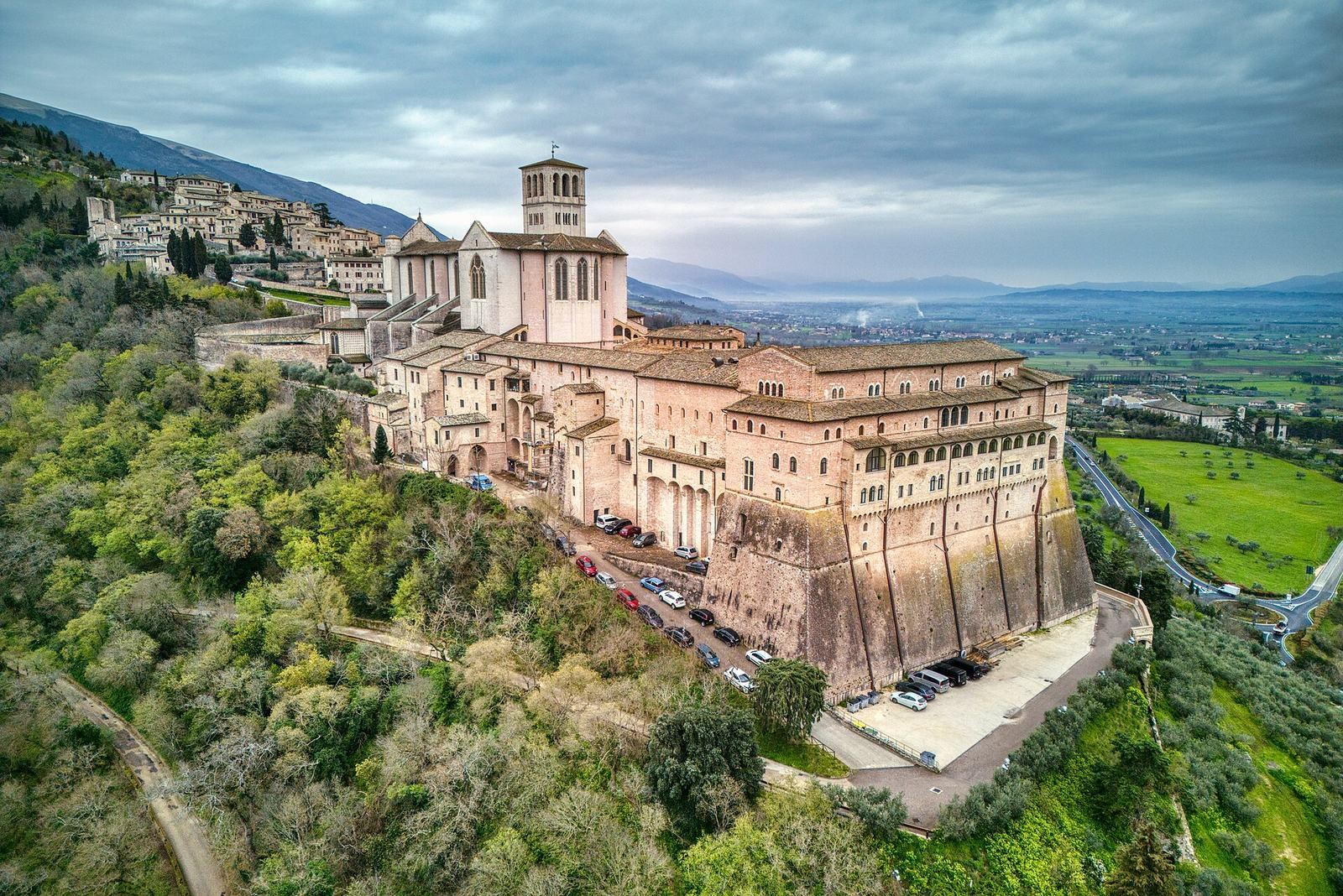
Set on a hillside, the complex comprises the Upper and Lower Basilicas, a burial chamber beneath the lower church, and the adjoining Sacro Convento. The churches together measure about 80 metres long and 50 metres wide. Both have a single nave and a crosswise arm called a transept, but their layouts differ: the Lower Basilica is partly built into the slope and has numerous chapels, while the Upper Basilica rises above it. Romanesque features and Gothic forms appear across the complex.
The church buildings
Lower Basilica
The Lower Basilica is partly embedded in the hill and in the surrounding convent buildings. Its plan is also described as T-shaped. The earliest design was probably a rectangular, aisle-less hall corresponding to the present church’s second, third, and fourth sections. It was enlarged with an eastern section, a projecting transept, a semicircular apse (the space at the end of a church), exterior supports, and ribbed vaults, ceilings carried by intersecting masonry ribs.
Low, semicircular ribbed cross-vaults cover the nave, while barrel-shaped vaults span the transept arms. The transept leads to the richly decorated apse. Side chapels and chapels in the transept, including additions from the later fourteenth century, make the interior more intricate than that of the Upper Basilica. The addition of lateral chapels and the closure of nave windows left the church darker.
The church’s principal exterior entrance is a Gothic portal on the south side, dating to the second half of the thirteenth century. A Renaissance porch stands in front of it. The entrance has a rose window and two carved wooden doors made by Umbrian craftsmen in the sixteenth century. Nearly all the porch’s upper mosaics and coloured tin-glazed pottery decoration have been lost. Because of the slope, the approach into the church was shifted to the left side of the nave. The entrance opens onto the stone-paved Lower Plaza of Saint Francis.
Upper Basilica
The Upper Basilica has a four-section nave, transept, and polygonal apse. Its ribbed cross-vaults rest on pointed transverse ribs that rise from grouped columns. A narrow gallery runs along the walls, and stout exterior supports strengthen the building. Tall Gothic windows with geometric tracery bring light into the nave and apse. The church is approached from the grassy Upper Plaza.
The façade, made of whitewashed brick, has a large rose window, relief symbols of the four Evangelists, a Gothic doorway, and a circular window in the gable. A Baroque Benediction Loggia, built in 1754 when the church became a patriarchal basilica and papal chapel, is attached on the left. It was once used to display the Holy Veil of the Virgin.
Bell tower and exterior supports
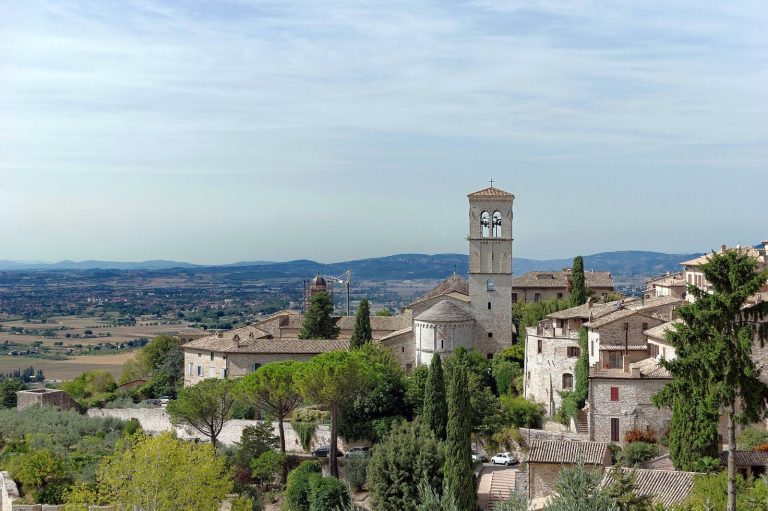
A Romanesque bell tower about 60 metres high stands beside the church. Lightning destroyed its spire in 1530. Buttresses and flying buttresses frame the basilica; they can be seen on the north side, while the tower and adjoining structures obscure them from the Lower Plaza.
Painted programs and stained glass
Upper Basilica
The Upper Basilica’s painted decoration ranges across the apse, transepts, vaults, and nave. Cimabue and his workshop began work in the west transept and apse around 1280. Their paintings include a Crucifixion with Francis kneeling at the cross, an Apocalyptic Christ, the Evangelists, and scenes such as the Kiss of Judas. Lead oxide in the paint and an unstable plaster base contributed to severe deterioration; much of the colour has darkened or become difficult to read. In the right transept, an unidentified Northern Master, possibly English, painted angels and apostles in two semicircular panels and a round image in the late 1260s. An unidentified Roman painter added Isaiah, King David, and the remaining wall beneath one of those panels.
Two rows of paintings on the upper nave walls contain 32 scenes from the Old and New Testaments. The first sequence runs from Creation to Joseph’s reconciliation with his brothers, and the second from the Annunciation to the women at Christ’s tomb. Pentecost and the Ascension appear on the upper part of the entrance wall. Roman and Tuscan painters took part, including followers of Cimabue and artists named Giacomo, Jacopo Torriti, and Pietro Cavallini. Two paintings of Isaac blessing Jacob and Esau, dated around 1290–1295, were once associated with the young Giotto. Their authorship remains disputed; they are also attributed to the unidentified Isaac Master and his workshop, and Pietro Cavallini has been proposed.
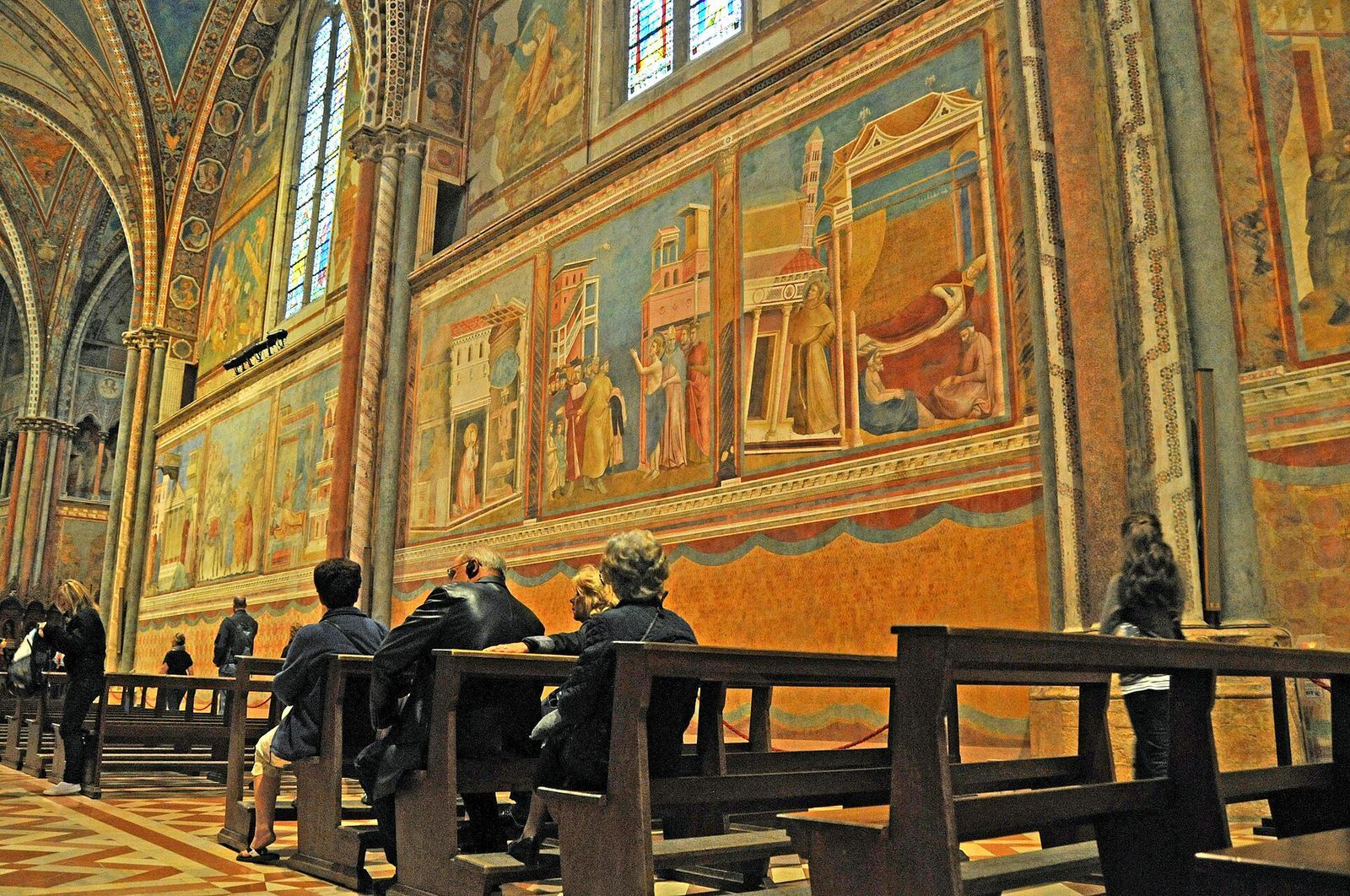
The lower nave walls carry 28 scenes from Francis’s life, based on Bonaventure’s 1266 account. The paintings proceed through Francis’s conversion and the approval of his rule, the growth of the order, his death and funeral, his canonization, and posthumous miracles. Episodes include his renunciation of his inheritance, Pope Innocent III’s dream and approval of the rule, Francis before the Sultan of Egypt, the Christmas celebration at Greccio, his preaching to birds, and his reception of the stigmata, bodily marks understood to correspond to Christ’s wounds at the Crucifixion.
The cycle’s authorship is debated. The Master of the Legend of Saint Francis is considered its principal painter, and the Master of the Obsequies of Saint Francis and the Cecilia Master are also associated with it. Architectural framing makes the painted spaces seem to extend beyond the church walls, while urban and rural settings surround the figures. The same cycle includes Francis’s death and funeral, Clare and her companions mourning him, the saint’s canonization, and scenes of healing and rescue attributed to his posthumous intervention.
The vaults have blue backgrounds with gold stars and painted figures of Christ, Francis, the Virgin Mary, and John the Baptist. A vault near the entrance depicts Gregory the Great, Jerome, Ambrose, and Augustine, the four Doctors of the Church, attributed to the Isaac Master. Another vault has medallions of Christ, Mary, John the Baptist, and Francis, attributed to Jacopo Torriti.
Medieval stained glass survives throughout the Upper Basilica. The apse windows, dated to 1253 and attributed to north German craftsmen, link episodes from the life of Jesus with figures from the Old Testament. Windows on the left side of the nave are attributed to a French workshop and dated to 1270; those on the right are associated with the workshop of the Master of Saint Francis. Other windows in the nave and transept, attributed to French craftsmen and a workshop linked to that master, depict Francis, Anthony of Padua, the Virgin, and other saints.
Lower Basilica
The oldest frescoes in the Lower Basilica’s central nave date to about 1260–1263. Painted in tempera on dry plaster, they are attributed to the unidentified Master of Saint Francis. Five scenes from Christ’s Passion occupy one wall and five scenes from Francis’s life the other, setting the two narratives alongside each other. The ceiling is blue with gold stars. Extensive losses have affected the paintings, though fragments survive, including Cimabue’s Madonna and Child with an Angel. Other notable scenes include the Deposition from the Cross and the Lamentation.
The Lower Basilica’s apse vault paintings, dated to 1315–1320, depict Francis’s triumph and allegories of obedience, poverty, and chastity. They are attributed to the Master of the Assisi Vaults, a follower of Giotto. Stained glass in the lower church is attributed to Giovanni di Bonino and his workshop. Puccio Capanna painted two scenes from the life of Saint Stanislaus, the choir gallery, and a Crucifixion.
Chapels and transepts
Saint Martin of Tours and Saint Peter of Alcantara
The first chapel on the left is dedicated to Martin of Tours and was built by Cardinal Gentile Partino da Montefiore. Simone Martini painted ten scenes from Martin’s life there in 1317–1319, alongside a multi-panel altarpiece of saints. The scenes show Martin sharing his cloak with a beggar, dreaming, becoming a knight, giving up arms, raising a child, meditating, celebrating Mass, performing a miracle with fire, dying, and being buried. Lead white has darkened parts of the paintings. The next chapel on the left is dedicated to Peter of Alcantara.
Saint Catherine of Alexandria
The chapel of Catherine of Alexandria stands at the far end of the entrance vestibule. Built around 1270 and later enlarged by Gattapone da Gubbio, it was decorated at the expense of Cardinal Egidio Albornoz. Andrea de’ Bartoli and assistants painted eight scenes from Catherine’s life in 1368–1369. The work bears the painter’s signature. Saint figures are by Pace di Bartolo d’Assisi, and the stained glass is attributed to Giovanni di Bonino. Albornoz was first buried in the chapel; his remains were transferred to Toledo in 1372.
Mary Magdalene
Bishop Teobaldo Pontano, whose episcopate ran from 1296 to 1329, had the chapel of Mary Magdalene built. Its frescoes, from Giotto’s workshop and possibly painted by Giotto himself, date to about 1320. The side walls recount episodes from Magdalene’s life, including her meeting with Pontano. Round images in the vault show Christ, the Virgin, Magdalene, and Lazarus. Other scenes include Magdalene receiving clothing from Zosimas, the raising of Lazarus, Christ appearing to Magdalene, her conversation with angels, and her voyage to Marseille.
Saint Nicholas
The chapel of Nicholas in the right transept contains a cycle dated around 1295–1305, showing the saint’s miracles and acts of charity. The paintings, including an Annunciation, are attributed to the unidentified Master of Saint Nicholas. Five figures of saints by Simone Martini include Francis, Louis of Toulouse, Elizabeth, Margaret, and Henry of Hungary. The chapel also contains an Orsini funerary monument and a stained-glass window.
Saint John the Baptist and the left transept
Cardinal Napoleone Orsini commissioned the chapel of John the Baptist in the left transept. Pietro Lorenzetti or his workshop painted a multi-panel image of the Madonna and Child with John the Baptist and Francis. From 1315 to 1330, Lorenzetti and his workshop also decorated the left transept with six scenes from Christ’s Passion. The expressive Deposition from the Cross is a notable part of the cycle, which includes an early depiction of a cast shadow and required about 330 stages of work. Beneath the monumental Crucifixion is the Madonna of the Sunsets, named for evening light entering through the opposite window.
Other chapels and entrance monuments
A small chapel of Sebastian to the left of the Lower Basilica’s entrance contains a canvas by Giacomo Giorgetti and wall scenes of the saint’s life by Girolamo Martelli, including Irene tending Sebastian and Sebastian before Domitian. Paintings by Ottaviano Nelli and an image of Saint Christopher by an Umbrian artist are also associated with the chapel. Two monuments on the right side of the entrance are the tombs of Giovanni de’ Cerchi and John of Brienne, King of Jerusalem and regent emperor of Constantinople.
The chapel dedicated to Louis of Toulouse and Stephen I of Hungary has frescoes by Dono Doni dated 1575 and a stained-glass window attributed to Simone Martini. Nearby, the chapel of Anthony of Padua has frescoes by Cesare Sermei dated 1610; its stained glass depicts episodes from Anthony’s life.
In the right transept, frescoes of Christ’s childhood are partly by Giotto and his workshop, while the Nativity is attributed to the unidentified Master of Saint Nicholas. Lower scenes show Francis appearing after death to help children. The paintings are noted for expressive figures and naturalistic landscapes. On a transept wall, Cimabue’s Madonna Enthroned with Saint Francis stands alongside work by Giotto with a more naturalistic approach.
Altars and burial spaces
Lower Basilica apse and choir
The papal altar in the Lower Basilica’s apse is made from a single block of stone brought from Como in 1230. Ornamental Gothic arches around it rest on columns of different styles; twelve columns were removed in 1870. The walnut choir stalls, completed in 1471 by Apollonio Petrocchi da Ripatransone and assistants, are Gothic in design. A Crucifixion by Stefano Fiorentino was destroyed in 1622. The apse now has a Last Judgment by Cesare Sermei di Orvieto.
The Upper Basilica’s apse also contains a thirteenth-century marble high altar, restored in 1942. Its choir has 102 wooden stalls, made around 1501 by Domenico Indovini and assistants.
Crypt and tombs
The burial chamber beneath the Lower Basilica’s main altar is reached by two stairways near the middle of the nave. Its older access was a narrow underground passage, later sealed as the chamber was forgotten. The burial cell is incorporated into a pillar supporting the altar. An old stone sarcophagus, held above the altar by iron ties, contains Francis’s remains. A gilded metal urn dating to 1818 encloses a transparent inner urn from 1978, when the remains were examined.
Four companions of Francis were placed around the altar in the 1930s, and five others are buried in the right arm of the Lower Basilica. The tomb of Jacopa dei Settesoli, a Roman noblewoman and friend and benefactor of Francis, is near the crypt entrance. Architect Pasquale Belli first finished the crypt in marble in a Neoclassical style. Ugo Tarchi redesigned it between 1925 and 1932 in a Neo-Romanesque style, using rough-faced stone.
Friary and associated spaces
Sacro Convento and cloister
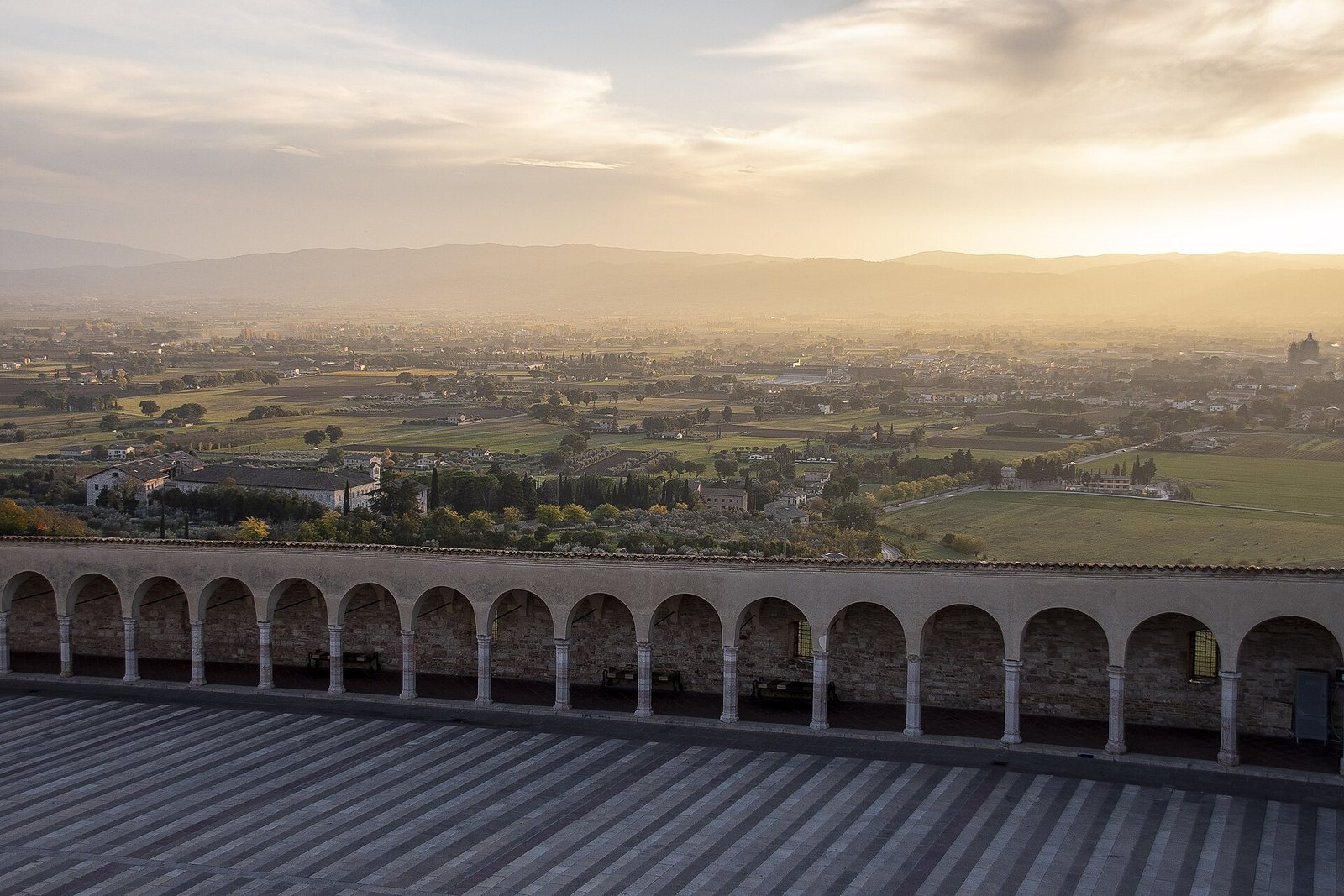
The adjoining Sacro Convento is built of pink and white stone from Mount Subasio. Romanesque and Gothic forms coexist in the friary, whose structure includes 53 Romanesque arches and substantial supports. Friars were living there by 1230; a substantial phase of later construction took place under Sixtus IV between 1474 and 1476. The large cloister was built in 1476 at his direction. Dono Doni painted scenes from Francis’s life there between 1564 and 1570, and a terrace overlooks the cloister.
The convent houses a library of medieval handwritten books and early printed works, and a museum with art donated over the centuries. Its holdings include the Perkins collection of 57 paintings, mainly from Florentine and Sienese schools. Some objects in the collections have been lost through deterioration or theft.
Chapel of the Relics
The Chapel of the Relics occupies the former chapter room of the first friary. Its Franciscan objects include Francis’s habit and sandals, a leather piece used to keep blood from a wound in his side from staining his tunic, and an ivory horn given to him by Sultan al-Malik al-Kamil in 1219. The chapel also holds two texts in Francis’s own hand, the Blessing to Brother Leo and Praises to the Most High God, the original Franciscan Rule, and a chalice and plate used by friars at the Porziuncola. Opposite the entrance, a fresco of the Crucifixion with Mary, John, Peter, and Paul is attributed to Puccio Capanna.
Oratory and plaza colonnades
The oratory of San Bernardino stands opposite the atrium before the Lower Basilica entrance. Lombard craftsmen built it around the middle of the fifteenth century for the Franciscan Third Order. Colonnades around the Piazza del Loge date to 1474 and were built to shelter pilgrims. A separate sculpture titled Tau, by Guido Dettoni della Grazia, is displayed permanently; the Tau is a T-shaped cross used as a Franciscan emblem.