Lilliendal: A Danish Estate in Mern
Site at a Glance
- Popularity
- Very Low
- Country
- Denmark
- Primary era
- Early Modern
- Eras represented
- Early Modern, Modern
- Civilizations
- Danish
- Site type
- Domestic
- Remains
- Manor House
On this page6 sections
History
Lilliendal is an estate in Mern, Denmark, established in the 1760s by naval officer Hans Gustav Lillienskiold. Its main building has a core dating to 1765 and is in the Empire style, a form of Neoclassical architecture. The estate took shape through the joining of Skuderup and Skuderupgaard.
Skuderup and the founding of Lilliendal
Skuderupgaard, Lilliendal’s predecessor estate, is associated with 1664 and was first recorded as belonging to Anne Gjordes. In the seventeenth century, Skuderup was a village of ten farms and four houses, with Skuderupgaard as its largest farm.
In the 1710s, the rest of Skuderup belonged to the Vordingborg Cavalry District, an administrative land unit associated with supporting cavalry forces. The district’s twelve estates were put up for auction at Vordingborg Castle on 27 September, and Lillienskiold acquired Skuderup and Høvdingsgaard. He acquired Skuderupgaard in 1760 and later brought it together with Skuderup as Lilliendal. His marriage to Elisabeth Sophie Charlotte de Malleville provided the means to acquire the estates. She died at Skuderupgaard in 1768.
Changes in ownership and the Knuth family
Lillienskiold sold the estate to Copenhagen merchant Niels Lunde Reiersen in 1785. Reiersen died unmarried in 1795, and the estate was auctioned to State Prosecutor General Peter Uldall, who planned to create a barony for his son. The plan was not carried out after Uldall died in 1798. His widow sold Lilliendal to Thomas Bech in 1800.
Adam Christopher Knuth bought the estate from Bech in 1802. In 1804, he received royal permission to dissolve his barony of Christiansdal, and in 1821 he established Lilliendal as an entailed family estate, with inheritance restrictions intended to keep the property within the family. Lilliendal passed to his son Christian Frederik and then to his grandson Adam Knuth, who took over in 1852.
The estate in the twentieth century
Adam Knuth’s son Christopher sold most of the remaining tenant farms to the tenant farmers as freeholds. The entailed estate was dissolved in the early twentieth century, following the abolition of such estates in Denmark. Christopher transferred Lilliendal to his son Christian in 1936, and Ulrich Knuth succeeded his father in 1950.
Knuth family ownership, which had lasted for nearly two centuries, ended in the late twentieth century when the estate passed to Ted Kallehave. An agreement allowed Ulrich Knuth to continue living at Lilliendal until his death in 2002.
Remains
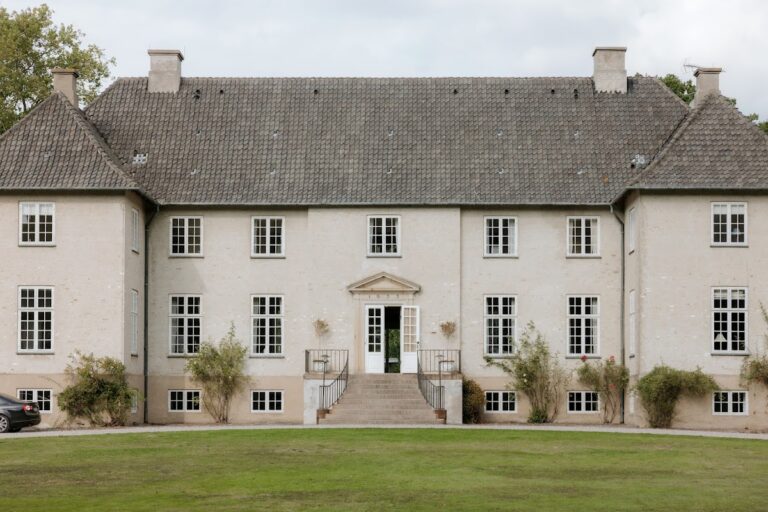
Lilliendal covers approximately 800 hectares, most of it farmland. Its yellow main building combines a core dating to 1765 with later alterations. The original building was single-storey and designed in the Empire style. Changes in the early nineteenth century included alterations in 1825.
Main building
In 1852, the building was lengthened and an upper storey was added. Its roof was replaced with a shallower, half-hipped tiled roof, with sloping ends that leave upper sections of the gable walls exposed. The facade received projecting horizontal cornices and triangular pediments, ornamental triangular forms, above the second-storey windows. On the garden side, a central projecting section has a veranda topped by a pediment. The building was lengthened again in 1919.