Piarist Monastery in Podolínec: An Early Baroque School and Monastery
Site at a Glance
- Popularity
- Very Low
- Country
- Slovakia
- Primary era
- Early Modern
- Eras represented
- Early Modern
- Civilizations
- Polish–Lithuanian Commonwealth
- Site type
- Religious
- Remains
- Fortified Monastery
On this page13 sections
History
The Piarist Monastery in Podolínec is an early Baroque Catholic monastery and school in Slovakia, founded in 1642 by Polish nobleman Stanisław Lubomirski. The complex was built from 1642 to 1648 for the Piarists, a Catholic order devoted to education. Podolínec was then under the Polish king, and Lubomirski intended the foundation to strengthen Catholicism in Spiš, where Protestantism had gained ground during the Thirty Years’ War. He also sought to provide basic schooling and establish a centre for preaching and missionary work.
Foundation and educational work
The first Piarists arrived in late 1642 as refugees from Moravia during the Thirty Years’ War. The group included priests, brothers and novices from several backgrounds, including Czech, German, Slovak, Hungarian and Austrian communities; Polish teachers joined later. The convent was formally inaugurated and the school blessed on 10 December 1642. Classes began on 18 June 1643 in two buildings in the castle courtyard while the purpose-built school was being prepared.
The school grew from two classes to seven by 1651. Pupils included Slovak- and German-speaking students, as well as some Hungarian speakers, while teaching was conducted in Latin. Students came from different social classes. Most were Catholic, though some were Protestant, and some converted to Catholicism. The school first emphasized basic education and offered higher studies by the second half of the seventeenth century. Enrolment was around 200 during that century and reached 365 in 1701.
The foundation was among the earliest Piarist establishments beyond the order’s original homeland. Joseph Calasanz, who founded the order and its educational mission, visited the school and considered it comparable in importance to the Piarist school at Mikulov. The church, dedicated to Saint Stanislaus, an eleventh-century bishop of Kraków and martyr, was consecrated in 1651 by Mikołaj Oborski, an auxiliary bishop of Kraków. Stanisław Konarski, who joined the order in 1715, later became one of the convent’s best-known superiors.
Damage, reform and the school’s closure
Floods damaged the complex in 1662 and 1682, and again in 1813. Fires caused damage in 1669 and 1684, after which the buildings were rebuilt. In 1701 the convent sheltered Francis II Rákóczi, a Hungarian nobleman and political leader who opposed Habsburg rule, as he fled toward Poland after escaping imprisonment at Wiener Neustadt.
When Spiš returned to the Kingdom of Hungary in 1772, tighter state regulation of education brought the school’s flourishing period to an end. The Piarists remained under their order’s Polish province until 1782, then transferred to its Hungarian province. This change may have helped the convent avoid the religious suppressions associated with Habsburg emperor Joseph II. Under the 1777 education regulation for the Kingdom of Hungary, the school was reorganized as a gymnasium, an academic secondary school.
The gymnasium later closed during restrictive measures associated with Austrian statesman Alexander Bach, although elementary classes continued for a time. With support from local citizens and the bishop of Spiš, it reopened on 1 October 1866 with 38 pupils. A proposal in 1912 to adapt the old building for a full eight-year course was considered uneconomic, and a new school was recommended. The First World War prevented its construction. As enrolment fell, the school became a lower gymnasium on 4 June 1917.
After Czechoslovakia was established, the Piarists remained under a Hungarian provincial, while the new government showed little interest in schools in remote parts of Slovakia. The gymnasium closed, its pupils were sent home, and the Piarists left on 30 August 1919. The army took over the gymnasium on 10 November, ending its 277 years of operation. Czech military forces occupied the monastery complex from autumn 1918 until spring 1920, and Felix Szepesi, a native of Spiš, remained as caretaker.
Podolínec’s citizens continued to seek the school’s restoration. Education ministers Milan Hodža in 1925 and Ivan Dérer in 1931 rejected their proposals, judging the old building unhygienic and unsuitable and calling instead for a new school.
Redemptorists and changing uses
On 2 February 1922 the Piarists granted the bishop of Spiš use of the monastery, church and garden for eight years. Bishop Ján Vojtaššák assigned the complex to Redemptorists of the Prague Province, a Catholic congregation devoted especially to preaching and pastoral work, under an agreement dated 23 May 1922. They provided spiritual care for Slovak residents, while German residents attended Mass at the parish church. Army use of the complex continued, and the Redemptorists moved to Stráže near Poprad in 1927.
The Redemptorists returned in 1941 after purchasing the property. Novices arrived in August, but their training did not begin. During the Slovak National Uprising, retreating German forces planned to destroy the ammunition-filled monastery. The friars secured its survival by promising to throw the ammunition into the river. In 1946 the novices had to leave because the Czechoslovak government did not permit private schools, and they moved to Rožňava. The convent then served as a retreat house and was later rented to the municipality for public schools.
Internment and return to church use
On the night of 13–14 April 1950, about 50 gendarmes and militiamen occupied the monastery. From 14 April, clergy from other Slovak monasteries were brought there, along with diocesan priests from Močenok, Franciscans from Hlohovec and Greek Catholic priests, members of an Eastern Catholic tradition in communion with Rome, who refused to become Orthodox. More than 700 members of religious orders were interned. Among them were future cardinal Ján Chryzostom Korec, bishop Pavol Hnilica, future bishop Peter Dubovský and poet Gorazd Zvonický. Local people who tried to help the internees were arrested, beaten, imprisoned and sentenced. Valuable manuscripts, religious objects and paintings were also destroyed.
The internment camp closed in late November 1951. About 350 religious sisters were held at the monastery from 1956 to 1961. State schools later occupied the buildings, including an apprentice school and a special boarding school. The Redemptorists returned in January 1990, and the buildings were returned to the Church on 1 August 1991. After repairs, the complex again took on religious and educational functions. The special school became the School of Saint Clement Maria Hofbauer in November 1991. The site later served as a Redemptorist house and, from 1993, a novitiate, the community where candidates prepare to join an order. It also houses a Catholic vocational school, a children’s home and the lay missionary community River of Life. The complex is a Slovak national cultural monument and is associated with the Diocese of Spiš.
Remains
Plan and enclosure
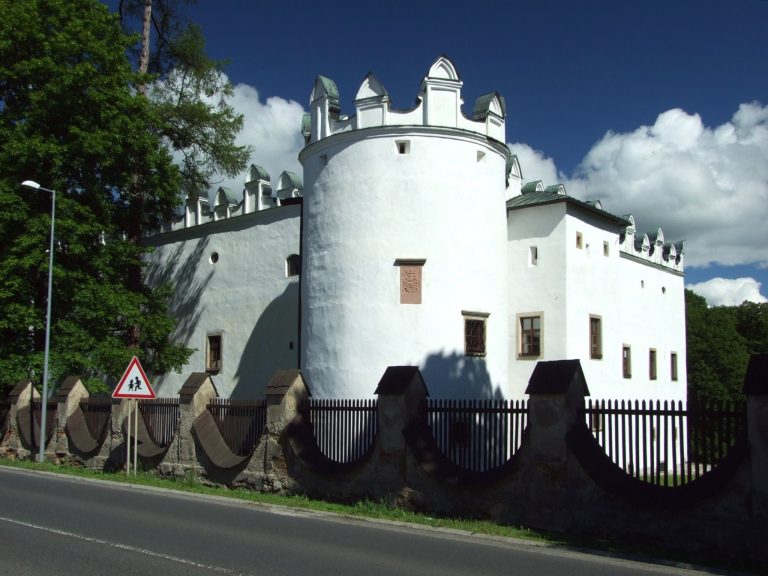
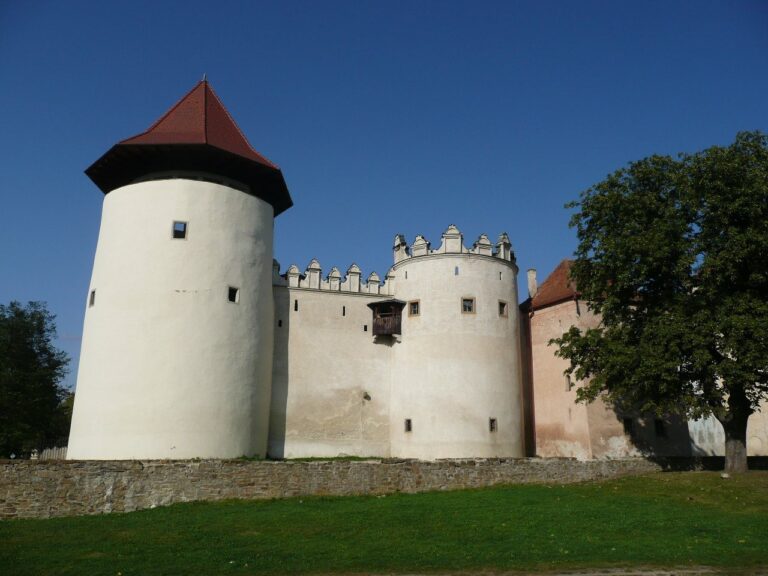
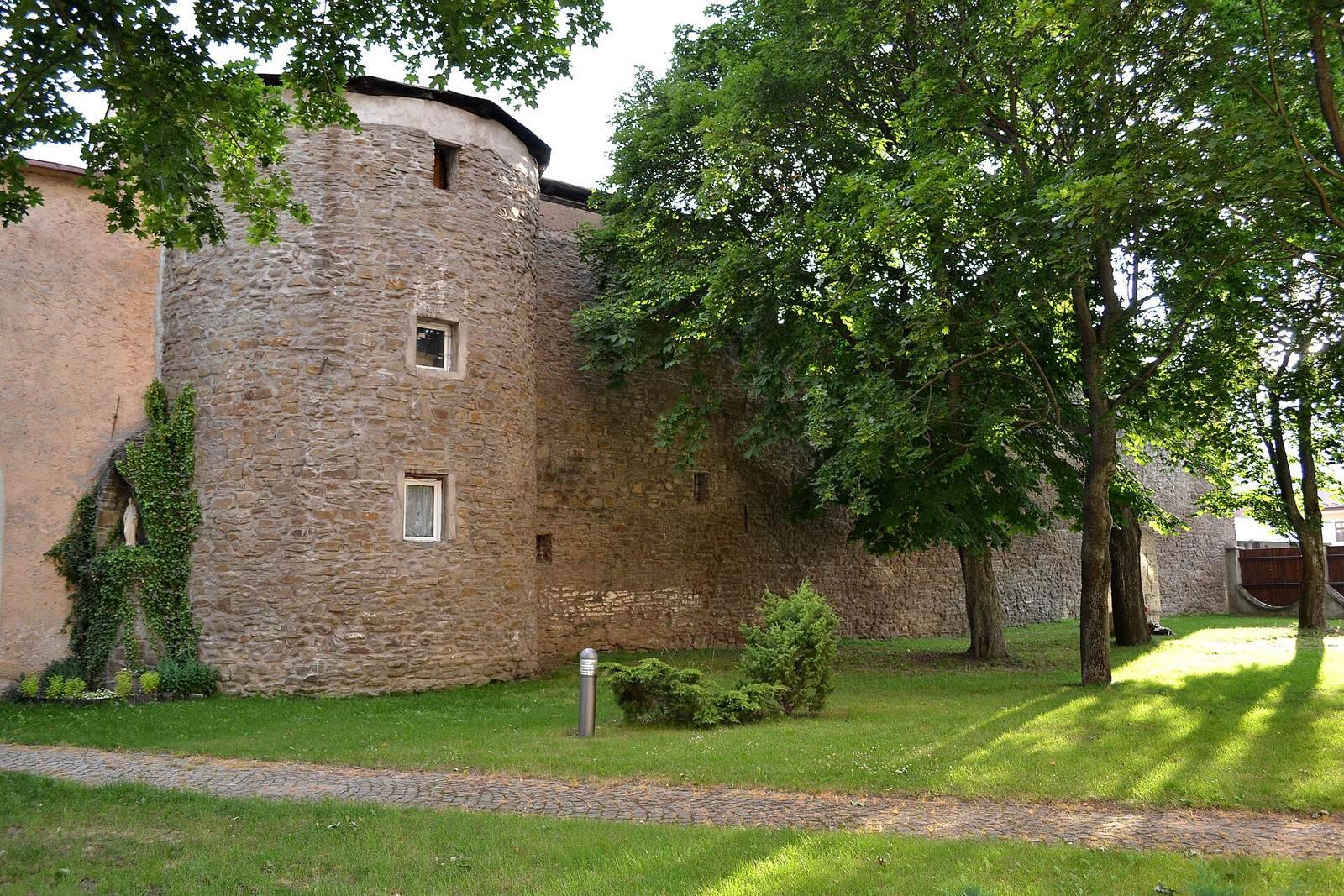
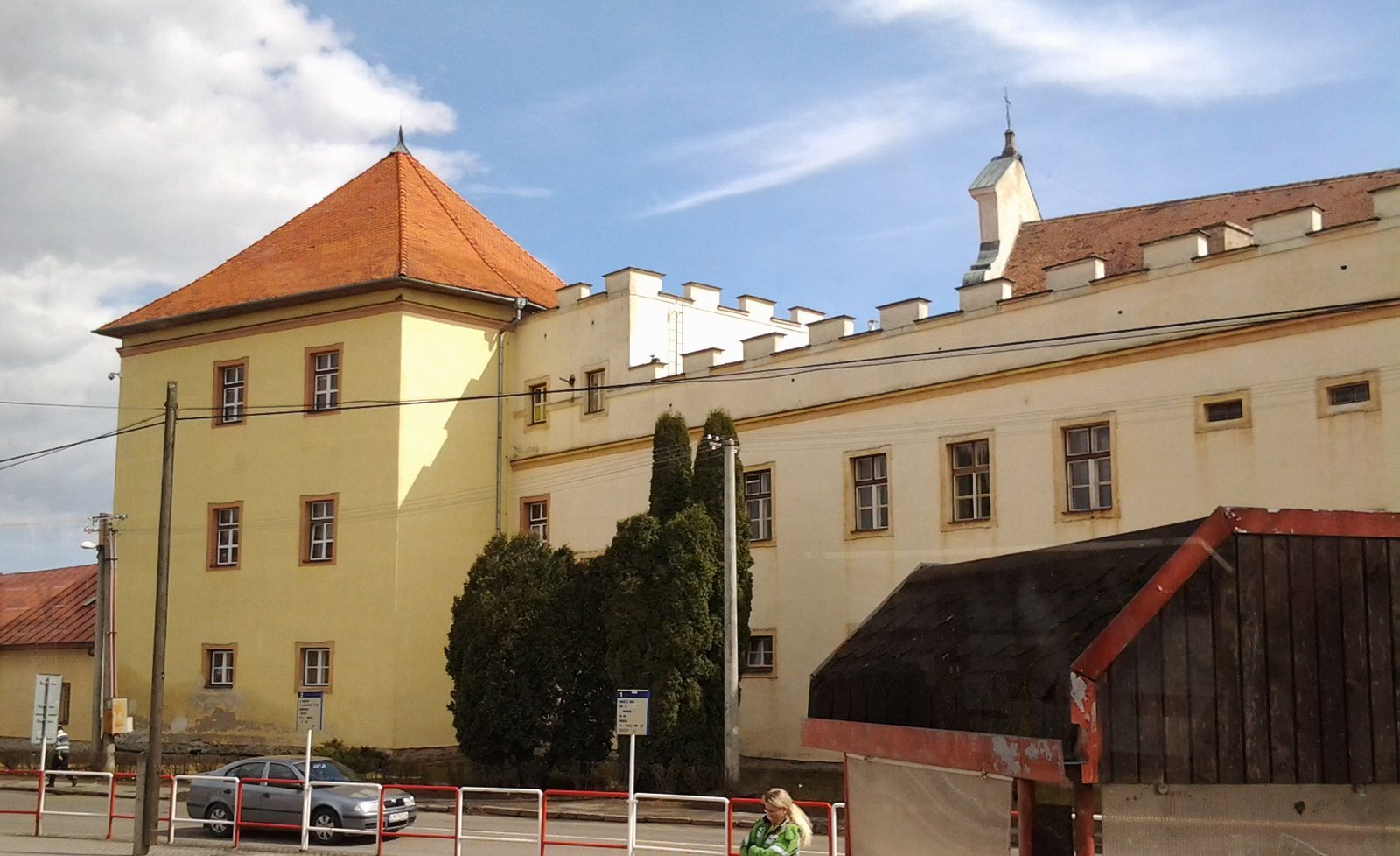
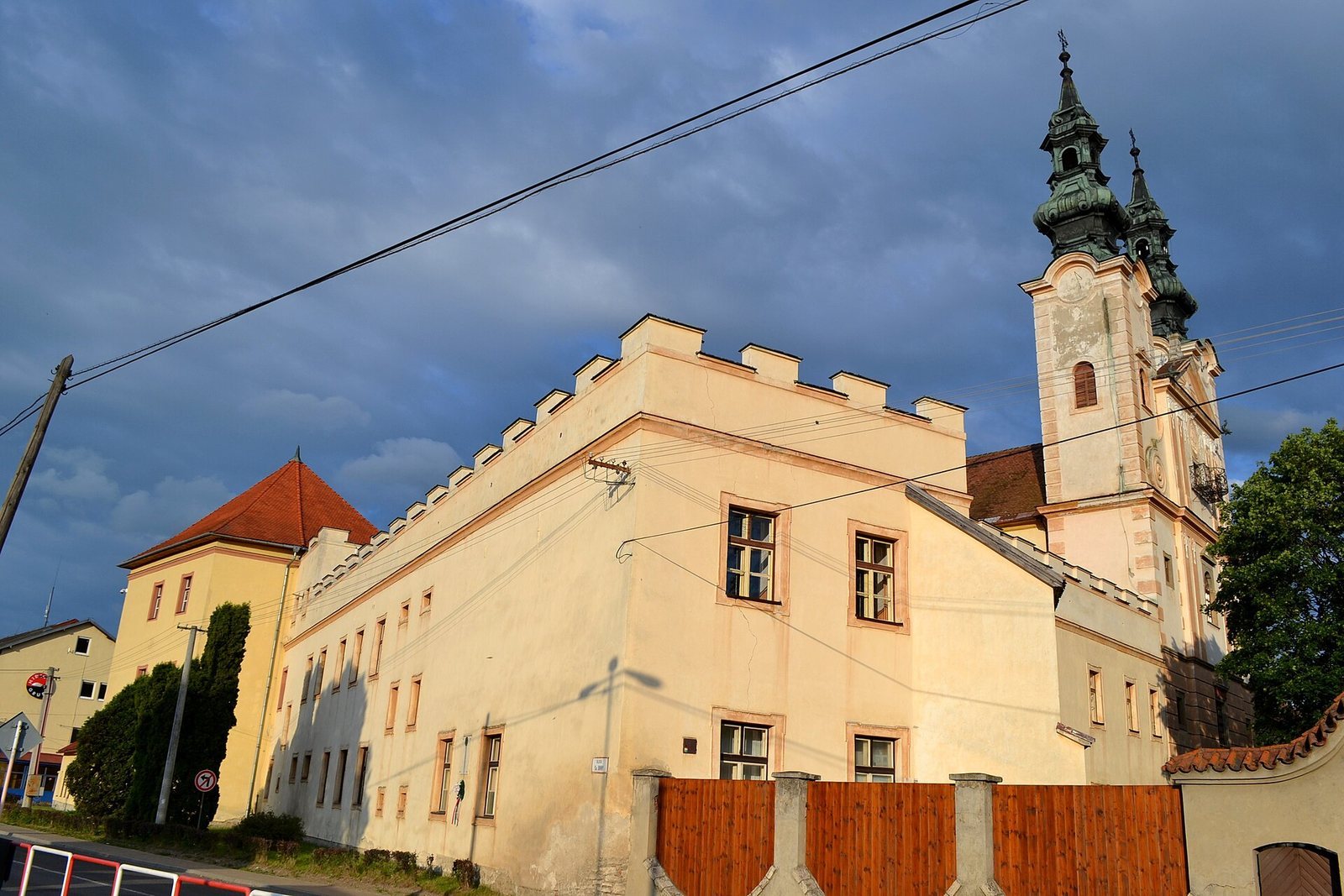
The compact complex stands on the left bank of the Poprad, in the eastern part of Podolínec and outside the town’s former walls. Its fortified enclosure combines ramparts, walls and towers. Three two-storey monastery wings and massive corner towers surround a centrally placed church, which divides the inner court into a northern service yard and a southern courtyard known as the paradise courtyard. Another courtyard has a well and smaller bordering buildings. A walled garden lies beside the buildings facing the river; a sundial is set on its wall. A column bearing a saint’s figure stood in front of the church. The overall plan follows a palace-in-a-fortress model, combining palace-like organization with defensive elements.
Church
Exterior and towers
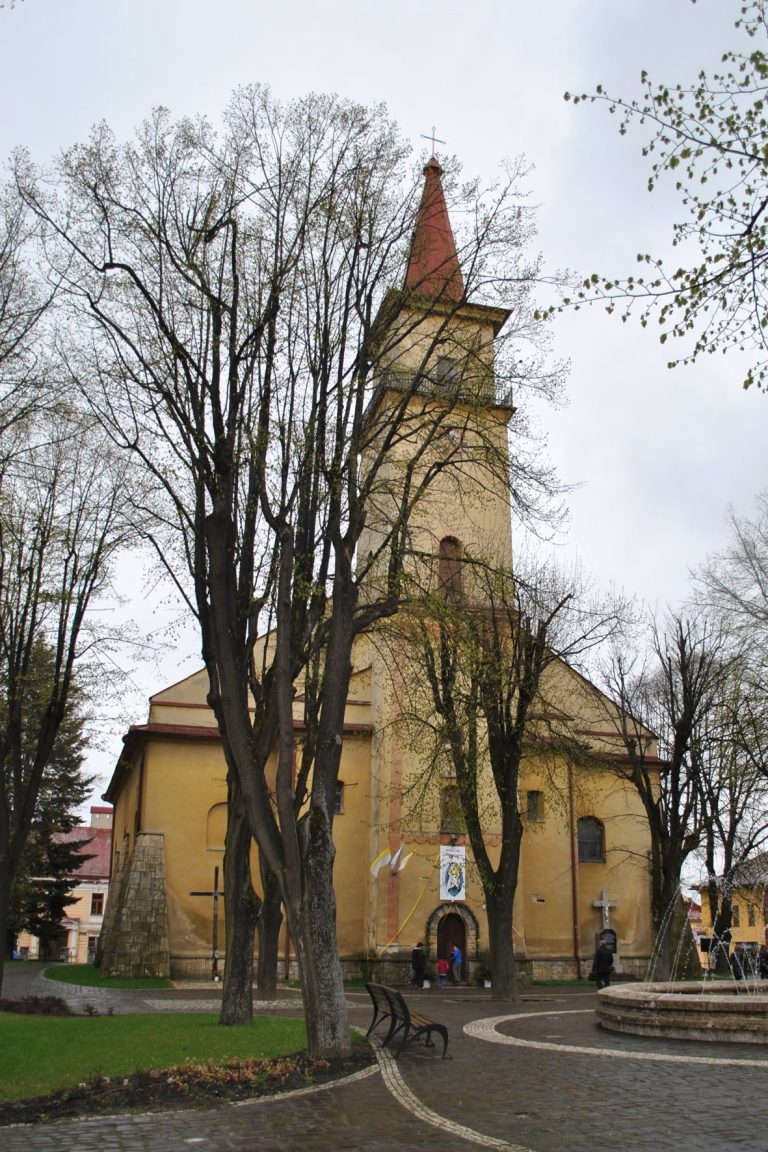
The church is a single-nave building with a rectangular-ended presbytery, the area around the altar. Its three-level façade projects at the centre. The lower level uses rustication, masonry with emphasized joints or roughened faces, while pilasters, shallow rectangular columns attached to a wall, organize the levels above. Spiral scroll ornaments frame the upper level, which ends in a triangular pediment. An ornamental wrought-iron balcony occupies the upper central section, and an image of Saint Stanislaus is positioned above the entrance.
The church’s two towers rise 44 metres and form part of the building’s mass. Their corners are rusticated, and their cornices include circular decorative elements. Baroque caps with lanterns crown the towers. The monastery’s four corner towers have tent-shaped roofs.
Interior and altars
A barrel vault, a continuous arched ceiling, spans the church interior. Lunettes, curved window-like areas formed in a vault, shape the ceiling, and crypts lie beneath the church. The Baroque main altar, dedicated to Saint Stanislaus, dates to 1688 and includes a ten-metre-high painting by an unknown artist. Four side altars are dedicated to the Virgin Mary and the Holy Cross and date from the second third of the eighteenth century, to Saint Philip Neri and date from 1763, and to Saint Catherine of Alexandria and date from the 1760s. A late Baroque pulpit dates to around 1763.
Monastery interiors and decoration
Refectory and corridors
Biblical scenes decorate the refectory ceiling. Portraits of popes and prominent Piarists were displayed in the corridors and refectory, linking the monastery’s communal and working spaces with the order’s religious and educational history.
Entrance hall and inscriptions
Paintings in the entrance hall include scenes from the life of Joseph Calasanz, a Polish eagle bearing the arms of the Vasa dynasty, and the Lubomirski coat of arms, known as Szreniawa without the Cross. The cornerstone inscription says that Lubomirski endowed the church and college at his own expense to promote the glory of God and the Catholic faith and to oppose heresy. It lists his titles, including voivode, a senior provincial governor, and starosta, an administrator of a royal district. A marble plaque installed on the building in 1992 commemorates the school’s 350th anniversary.