Old Calton Burial Ground: A Historic Cemetery in Edinburgh
Site at a Glance
- Popularity
- High
- Country
- United Kingdom
- Primary era
- Early Modern
- Eras represented
- Early Modern, Modern
- Civilizations
- British
- Site type
- Burial
- Remains
- Necropolis
On this page24 sections
History
Old Calton Burial Ground is a historic cemetery on Calton Hill in Edinburgh, United Kingdom. It opened in 1718 to serve the people of Calton, who had previously taken their dead to South Leith Parish Church, a considerable distance away.
Foundation and urban change
The Society of the Incorporated Trades of Calton purchased half an acre from Lord Balmerino, the land’s feudal superior, for £1,013. The Society also secured permission for a road linking the burial ground with the village. First called High Calton, the road later took the name Calton Hill. The Society enlarged the cemetery several times as it continued in use.
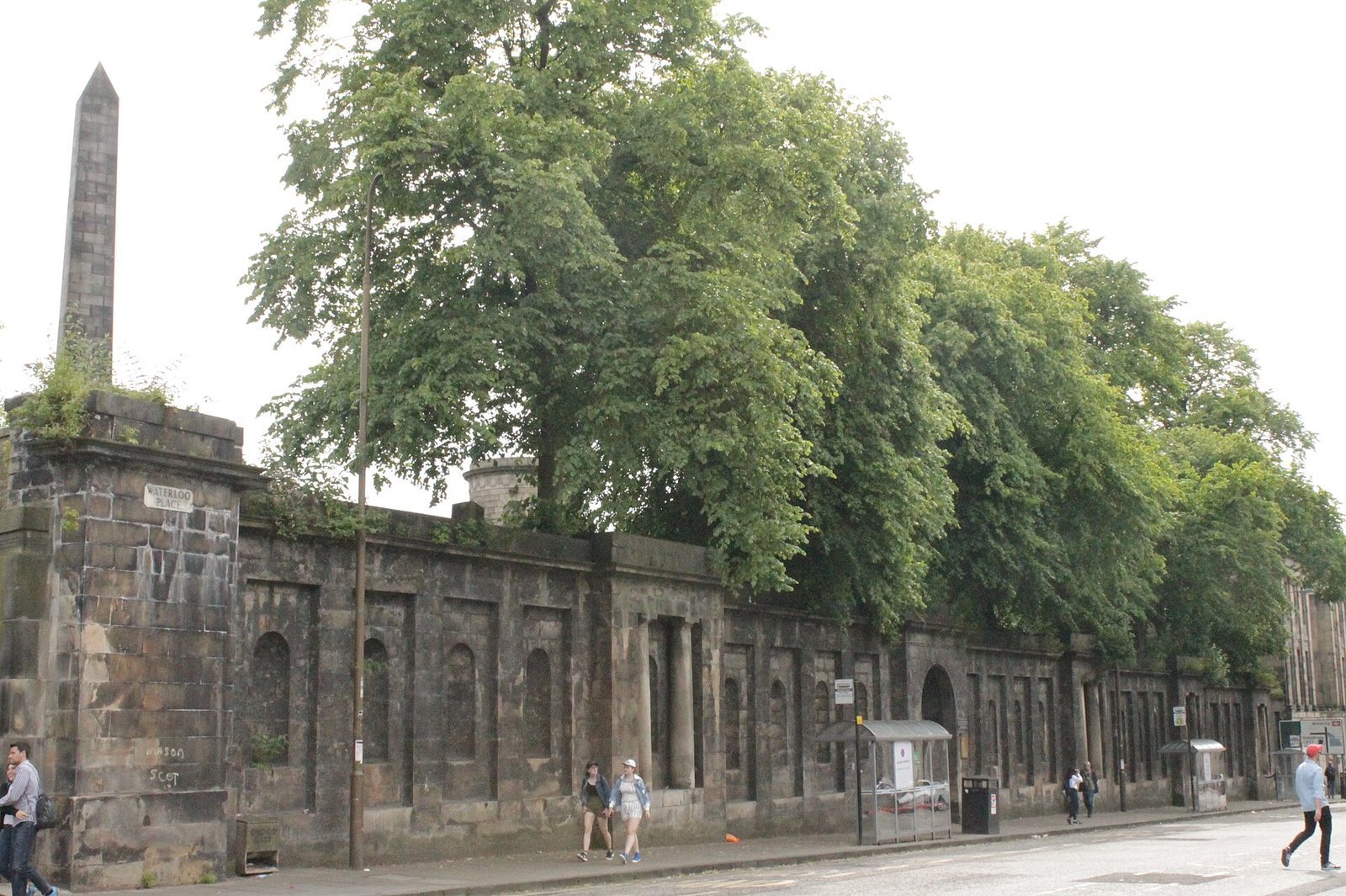
Waterloo Place was approved in 1814 and constructed from 1815 to 1819 across the existing burial ground. The roadworks divided the cemetery, leaving a small northern portion apart from the main ground, with access from Calton Hill. Bodies and gravestones in the construction area were respectfully relocated: bones were wrapped and transferred to New Calton Burial Ground, about half a kilometre to the east, and several large stones were set up again there.
The works also cleared the Incorporated Trades’ former meeting rooms to make way for Waterloo Place and Regent Bridge. A building immediately east of the burial ground, part of Archibald Elliot’s Waterloo Place development, provided replacement meeting rooms for the Trades.
Reform, religious life and commemoration
In 1793, five members of the Friends of the People, a political movement seeking broader representation, were tried by Scottish judge Lord Braxfield. Thomas Muir, Thomas Fyshe-Palmer, William Skirving, Maurice Margarot and Joseph Gerrald received sentences of 14 years’ deportation. They faced charges of treason and what was described as unwitting sedition for trying to correspond with France. Their support for universal suffrage and political rights lay at the heart of the judges’ objections. On 30 August 1793, the five were sent to Botany Bay.
In 1795, a German-born Jewish dentist and foot-care practitioner who had moved to Scotland in 1788 sought a family burial plot from Edinburgh Town Council. The Council agreed on 6 May to convey him a plot on Calton Hill for £17. His request arose because Christian graveyards were not open to him for burial.
The Scottish Reform Act of 1832 widened parliamentary representation in Scotland, and the five reformers were pardoned in 1838. In 1844, the Friends of Parliamentary Reform in England and Scotland raised a monument to them in the burial ground. Its location was likely chosen for the cemetery’s prominent position and lack of affiliation with a church.
The Church of Scotland’s Disruption in 1843 split the church and led many ministers to establish the Free Church of Scotland. During the division, 470 ministers left the General Assembly, the Church of Scotland’s principal governing body. Dr Robert Candlish, who had served at St George’s Parish Church and helped Thomas Chalmers establish the Free Church, became its Moderator in 1861. Because Free Church members lost the right to burial in parish churchyards, and many new urban churches had no burial grounds, Candlish selected Old Calton, a cemetery with a more traditional, effectively non-denominational character. His father, medical lecturer James Candlish, was also buried there.
Writers, artists and public figures
Philosopher and historian David Hume (1711–1776), a leading figure of the Scottish Enlightenment, was buried at Old Calton. His book A Treatise of Human Nature helped establish his reputation. Public opposition to his professed atheism led to his grave being guarded for eight days after his burial. Hume asked in his will for a monument bearing only his name and the years of his birth and death, leaving later generations to add further details. His niece was also buried in the cemetery.
Artist David Allan (1744–1796), sometimes called the Scottish Hogarth, illustrated Allan Ramsay’s The Gentle Shepherd and works by Robert Burns. His grave initially had no marker; the Royal Scottish Academy erected a headstone in 1874. Actor William Woods was a leading Edinburgh stage favourite from about 1772 to 1802. Actor and comedian Charles Mackay (1787–1857) was particularly known for playing Baillie Nicol Jarvie and characters from Walter Scott’s novels.
Peter Williamson (1730–1799), known as Indian Peter, was kidnapped and sold into slavery when he was 13. After escaping, he spent several years living with Native Americans, returned to Scotland and successfully sued Aberdeen Town Council for its part in his enslavement. In Edinburgh he established the city’s first Penny Post in 1773, linked with one of the world’s early street directories. He was buried in the Scott family grave with his daughter Agnes Williamson Scott.
Julius Conrad von Yelin (1771–1826), a German knight and scholar, came to Scotland hoping to meet Walter Scott, but died before they could meet. Scott attended his funeral, his first public appearance after an illness had kept him from public life during his financial troubles. Yelin’s gravestone was erected about a century later. Mathematician and scientist John Playfair (1748–1819) was also buried at Old Calton; a plaque was unveiled at his grave in 2011, and his nephew, architect William Henry Playfair, designed a separate monument to him.
Architecture, publishing and industry
Architect Thomas Hamilton (1784–1858), a co-founder of the Royal Scottish Academy in 1826, designed the Political Martyrs’ Monument. He was buried in his family vault. Architect Robert Burn (1752–1815), whose works included Nelson’s Monument on Calton Hill, lies in a family vault designed by his son William. William and another son, John, were also architects; John was buried at Old Calton, while William was buried in London.
Publisher and magistrate William Blackwood (1776–1834) founded the Edinburgh Encyclopedia and Blackwood’s Edinburgh Magazine and published Walter Scott for many years. His publishing rival Archibald Constable (1774–1827) also published Scott and advised him to issue the Waverley novels. Constable founded Farmer’s Magazine in 1800 and the Edinburgh Review in 1802, took over the Scots Magazine in 1801 and acquired the publishing rights to the Encyclopaedia Britannica in 1812. The bankruptcy of Scott and the Ballantyne brothers also affected Constable.
Daniel Stewart (1741–1814), founder of Daniel Stewart’s Hospital, was buried in the cemetery. The school later became Daniel Stewart’s College and then joined another school to form Stewart’s Melville College. Distiller John Haig was buried with members of his family. After the wine and brandy market declined in the late nineteenth century, he helped promote whisky, develop blended whisky and expand Scottish whisky-making into a major industry. The family business later became United Distillers.
Other people buried or commemorated at Old Calton include lighthouse engineer Thomas Smith, stepfather of civil engineer Robert Stevenson; sculptor Sir John Steell; singer James Lumsden; architect Richard Dickson; antiquary Thomas Dickson; and Professor George Wilson, a textbook author and biographer. Architects William Sibbald and Robert Kay are also buried there. Sibbald and his son worked on Edinburgh’s Second New Town, while Kay was the architect of the South Bridge scheme. Builders John and David Paton, who worked on much of the New Town, are commemorated by a tablet, and their business rival William Lunn was buried in the cemetery. Other memorials include one erected by Archibald Campbell Tait, later Archbishop of Canterbury, for his nanny, Betty Morton.
Later burials and stewardship
John Leishman McDougall (1840–1869), a soldier awarded the Victoria Cross for bravery at the Taku Forts during the Second China War, is commemorated at Old Calton. The war was fought between China and Britain and France. His medal was later stolen from his home.
On 21 August 1893, the Scottish-American Soldiers Monument was dedicated to Scots who fought and died for the Union during the American Civil War. The Union was the United States and the northern states that fought to preserve the country and end slavery. The monument was erected at American expense, after a request initiated by Sergeant Major John McEwan’s widow. Following correspondence from US Consul Wallace Bruce, Edinburgh Town Council approved a burial place in 1892. The six men commemorated are McEwan, Lieutenant Colonel William L. Duff, Robert Steedman, James Wilkie, Robert Ferguson and Alexander Smith. Duff alone is buried beneath the monument; the others lie nearby. Smith’s name was added in 1993 after research.
Burials at Old Calton ended in 1869, and the Incorporated Trades retained control until 1888. The City of Edinburgh Council now manages the burial ground. Its cemetery, screen walls and monuments have Category A listed-building protection, Scotland’s highest grade for buildings of national or international importance.
Remains
Layout and fabric
Old Calton lies on Calton Hill, north-east of Edinburgh’s city centre. Its surviving fabric includes grave plots, screen walls, monuments and stones made in varied forms and materials. Waterloo Place cuts across the burial ground, separating its smaller northern section from the main cemetery; the northern portion is reached from Calton Hill.
Public monuments and tombs
Political Martyrs’ Monument
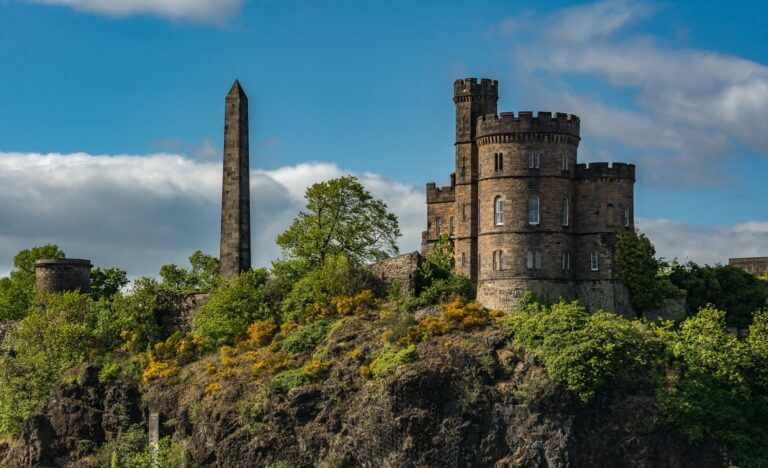
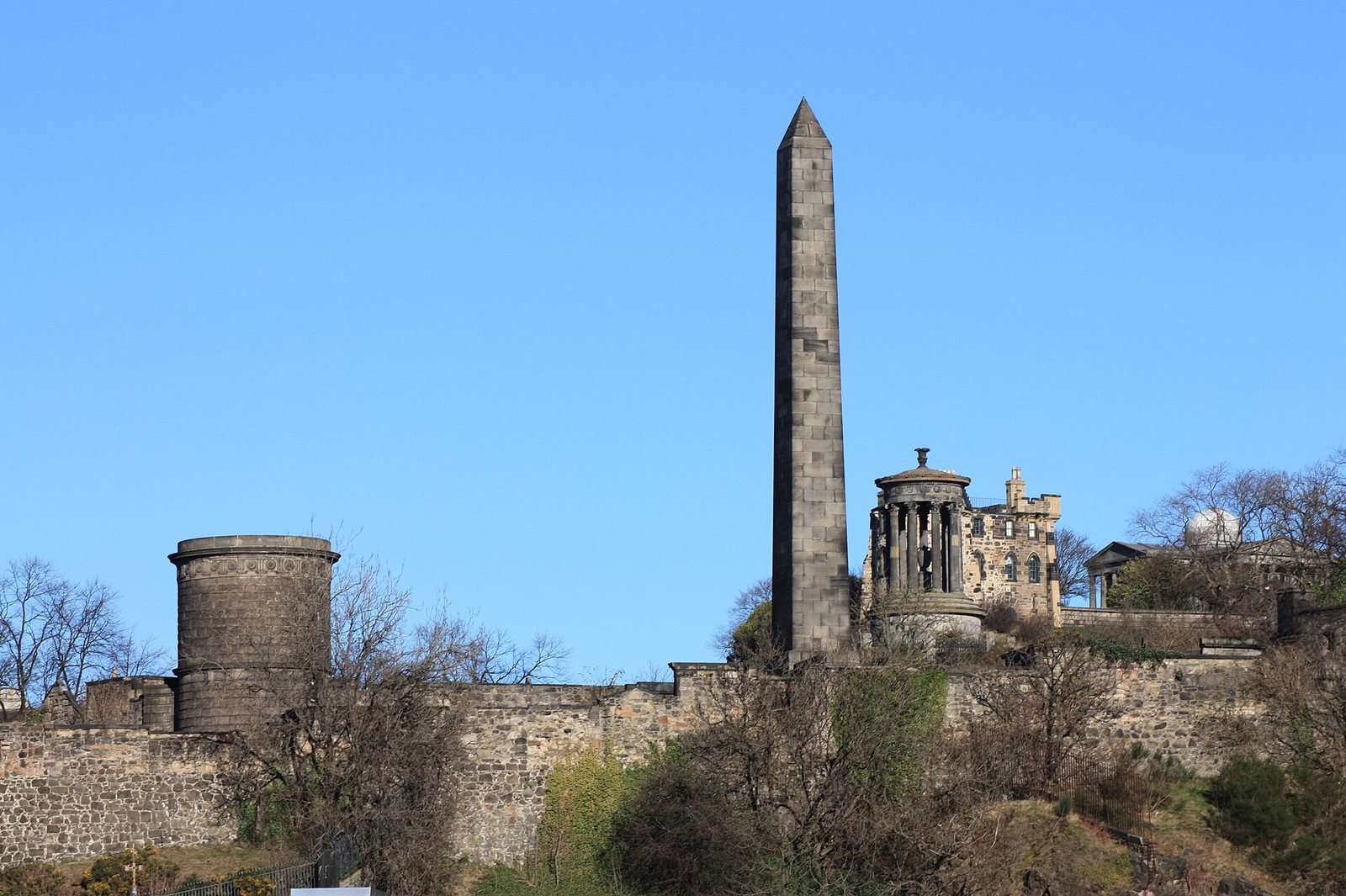
Thomas Hamilton’s monument to the five reformers is a large obelisk. Its inscription names the Friends of Parliamentary Reform in England and Scotland as the organization responsible for its erection, and commemorates the five men. The stone also carries passages from Muir’s speech in court on 30 August 1793 and Skirving’s speech on 7 January 1794. Hamilton’s grave is immediately behind the obelisk.
Hume’s tomb
Designed by Scottish architect Robert Adam in 1777, Hume’s tomb is a substantial cylindrical tower. Its inscription follows Hume’s request to show his name and the years of his birth and death. A panel added by his niece bears a Christian inscription about Christ’s return and victory through God.
Scottish-American Soldiers Monument
The monument stands directly in front of Hume’s tomb. Sculptor George Edwin Bissell created its figures, and Stewart McGlashan & Son executed the stonework. The polished red Aberdeen-granite base is nine feet high. A bronze shield displays an earlier United States flag, with thistles on one side and cotton on the other; two furled regimental flags represent the end of the fighting.
A standing figure of Abraham Lincoln is accompanied by a freed Black man holding a book and giving thanks, representing freedom and education. The inscription attributes to Lincoln a phrase about preserving liberty within the framework of freedom. The plot measures about 14 feet by 14 feet and lies roughly 16 feet north of Hume’s monument. It is the only American Civil War monument outside the United States, the first statue of a US president outside the country, and the only statue of Lincoln in Scotland.
Grave markers and memorial stones
John Morton’s memorial
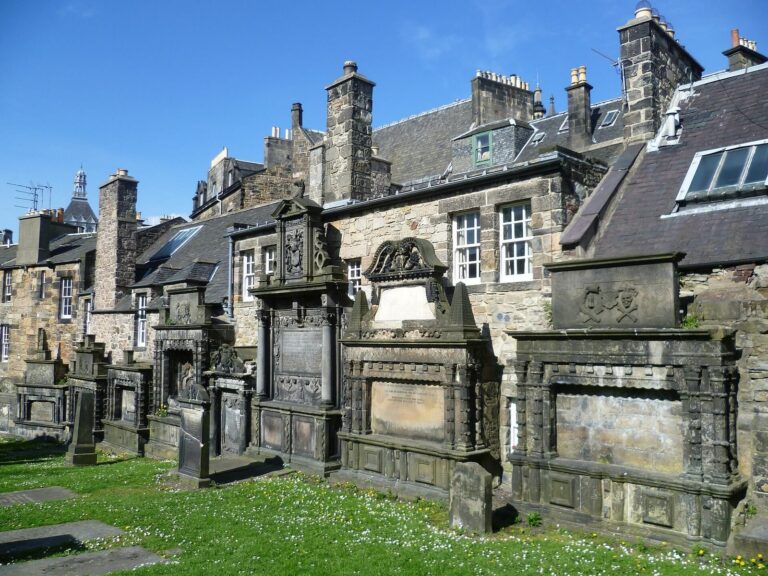
The most elaborate of the eighteenth-century tradesmen’s memorials is the stone of John Morton, a heelmaker who died in 1728, aged 54. Its frame resembles a roofed entrance, with a triangular upper section bearing a crest of two rampant lions. Two carved female figures hold an open book.
Margrat Thomson’s stone
A stone dated 1762 commemorates Margrat Thomson, the wife of Calton shoemaker James Forsyth. Its inscription gives her death as 30 April 1760, aged 43, and remembers eight of her children. Carved symbols include a skull, a sideways hourglass, crossed bones and crossed turf-cutter and spade. The words Memento Mori, meaning remember that you must die, reflect a familiar funerary theme.
John Gray’s memorial
Captain John Gray’s memorial to his parents, dated about 1760, remains in excellent condition. An anchor appears above a bold carving of a three-masted ship flying an ensign. A bearded male head, understood to represent his father, and a bonneted female head, representing his mother, are joined by ribbons to images of mortality, including a scythe, spade, coffin and crossed bones.
David Allan’s headstone
Allan’s 1874 headstone bears a profile portrait medallion by Scottish sculptor John Hutchison.
William Woods’s tablet
Woods’s original marble memorial tablet has eroded until its inscription can no longer be read. A replacement inscription is carved on the reverse. It includes a passage from Shakespeare’s Macbeth describing life as a walking shadow and a reflection by Colley Cibber on how briefly an actor’s performance lasts.
Family vaults and other memorials
Blackwood and Constable memorials
Blackwood’s tomb is an enclosed vault with a decorative iron gate. Constable’s larger, plain monument carries his head in bronze and the date of his death. A monument against the dividing wall to the west commemorates Constable’s nephew. Its small oval medallion depicts a caterpillar changing into a butterfly, representing the soul leaving the body, and its inscription is in Greek.
Hamilton and Burn family vaults
Hamilton’s family vault has a bronze portrait plaque on its rear wall and Masonic imagery on the stone before it. The vault of architect Robert Burn was designed by his son William.
Daniel Stewart’s tomb
Stewart’s tomb has a heavy, studded timber door.
Table stones and iron tablets
A horizontal grave slab raised on supports commemorates Margaret Rowand and James Anderson; their son, architect Robert Rowand Anderson, designed it. Iron memorial tablets were fashionable for a decade or two. The tablet to builders John and David Paton, dating to about 1830, remains legible and in unexpectedly good condition despite the material’s vulnerability to weather.
Playfair monuments and the Calton Hill vault
A 1852 map places the family burial vault of the Jewish dentist and foot-care practitioner just beyond the north wall of William Henry Playfair’s City Observatory. John Playfair’s separate monument stands on Calton Hill rather than at his grave and is visible from the burial ground’s northern section.