Monument to the Great Fire of London: A Commemorative Column in London
Site at a Glance
- Popularity
- Very High
- Country
- United Kingdom
- Primary era
- Early Modern
- Eras represented
- Early Modern, Modern
- Civilizations
- British, English
- Site type
- Civic
- Remains
- Monument
On this page11 sections
History
Fire and rebuilding
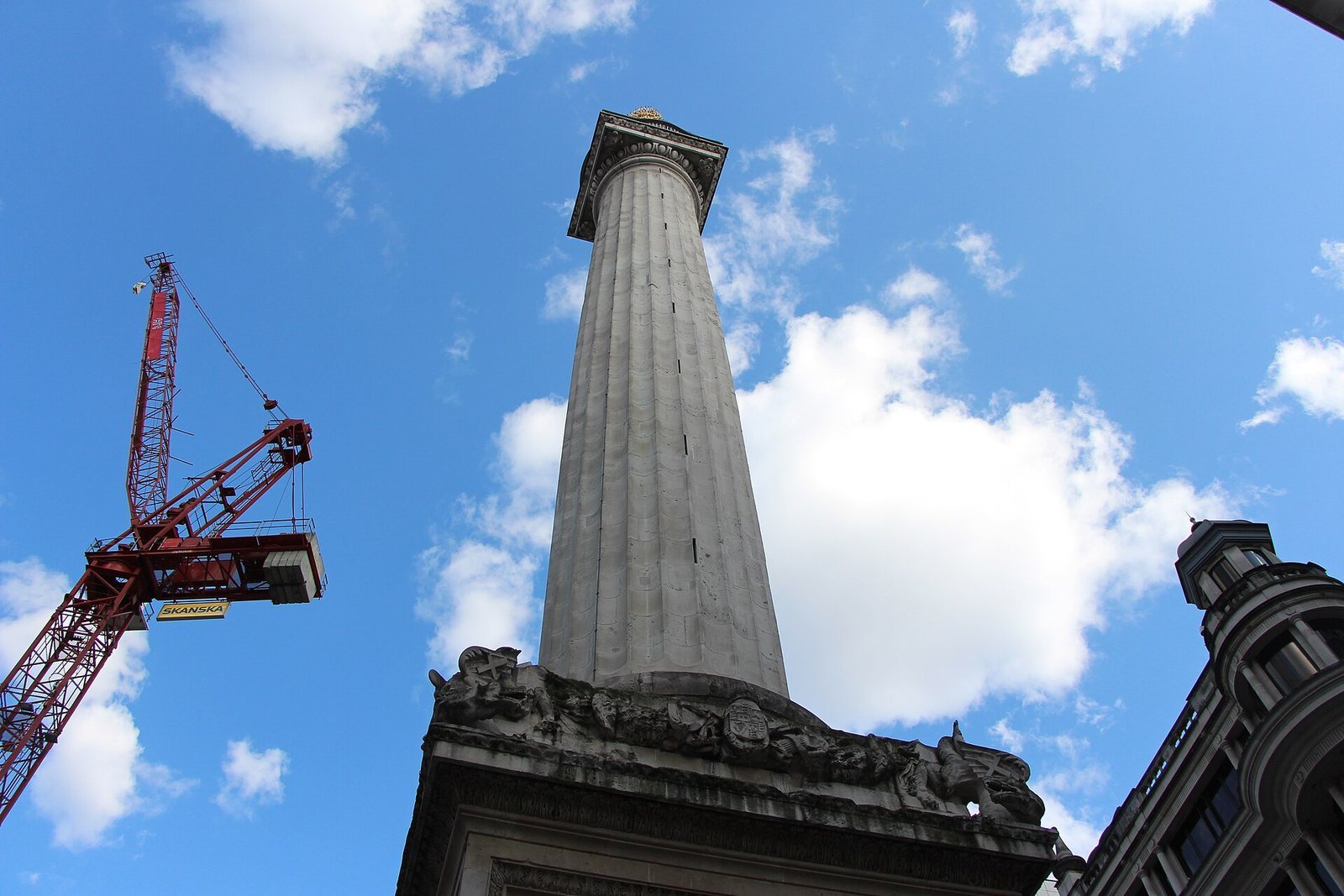
The Monument to the Great Fire of London is a commemorative column in London, United Kingdom, completed in 1677 in the classical Doric style. It marks the Great Fire of 1666, which began at the bakery of Thomas Farriner, the king’s baker, in Pudding Lane during the night of 2 to 3 September. The fire burned for four days, destroying nearly a quarter of the city and almost all of London’s old centre, though few people died.
The disaster led to a major rebuilding of London, with substantial new buildings and wider streets replacing crowded lanes. Christopher Wren played a leading part in this work. The first Rebuilding Act, passed in 1669, called for a brass or stone column on or near Farriner’s bakery to commemorate the fire. The Monument was instead built on the site of St Margaret, New Fish Street, the first church destroyed in the blaze.
Design and construction
Christopher Wren, Surveyor-General of the King’s Works, the royal body responsible for building and maintenance, was asked to submit a design. Robert Hooke, an architect working with Wren, developed it, although their exact contributions are unclear. Drawings bearing Wren’s signature show his approval, but do not establish that he drew them. The City Council approved the design in 1671, and construction took six years. The Monument was completed in 1677, with its inscription added in 1679.
Proposals for the summit included an obelisk, a flame-decorated column and the fluted column that was chosen. Wren considered a phoenix and later a statue of Charles II or a sword-bearing woman representing London. Charles disliked the prospect of his own statue and proposed a gilded ball with flames. Hooke’s design for a flaming urn of gilded bronze was ultimately adopted. The project cost £13,450 11 shillings and 9 pence, of which £11,300 went to mason and contractor Joshua Marshall, Master of the Masons’ Company in 1670.
Political controversy
In 1681, during the anti-Catholic agitation associated with the Popish Plot, a political scare in England, the Court of Aldermen ordered an anti-Catholic phrase added to the Monument. Its east-side inscription also blamed Roman Catholics for the fire. The Catholic poet Alexander Pope ridiculed the column in verse as a “tall bully” that “lies.” The words blaming Catholics were removed in 1830.
Later history and protection
In 1913, two suffragettes, campaigners for women’s right to vote in Britain, unfurled a flag and dropped leaflets from the Monument. One of them was Gertrude Metcalfe-Shaw. The Monument has been Grade I listed since 1950, a status for buildings of exceptional architectural or historic interest, and is also protected as a scheduled monument, a nationally important historic site with legal protection.
Remains
Column and setting
The Monument stands on the east side of Fish Street Hill, near the northern end of London Bridge and the junction with Monument Street. Its surrounding square extends to Pudding Lane. The area was formerly called Monument Yard and became part of Monument Street in 1911; the pedestrian space was created in 2006. The column rises about 61.6 metres (202 feet), roughly the distance west of the bakery where the fire began, and its height represents that distance. When completed, it was the world’s tallest freestanding stone column.
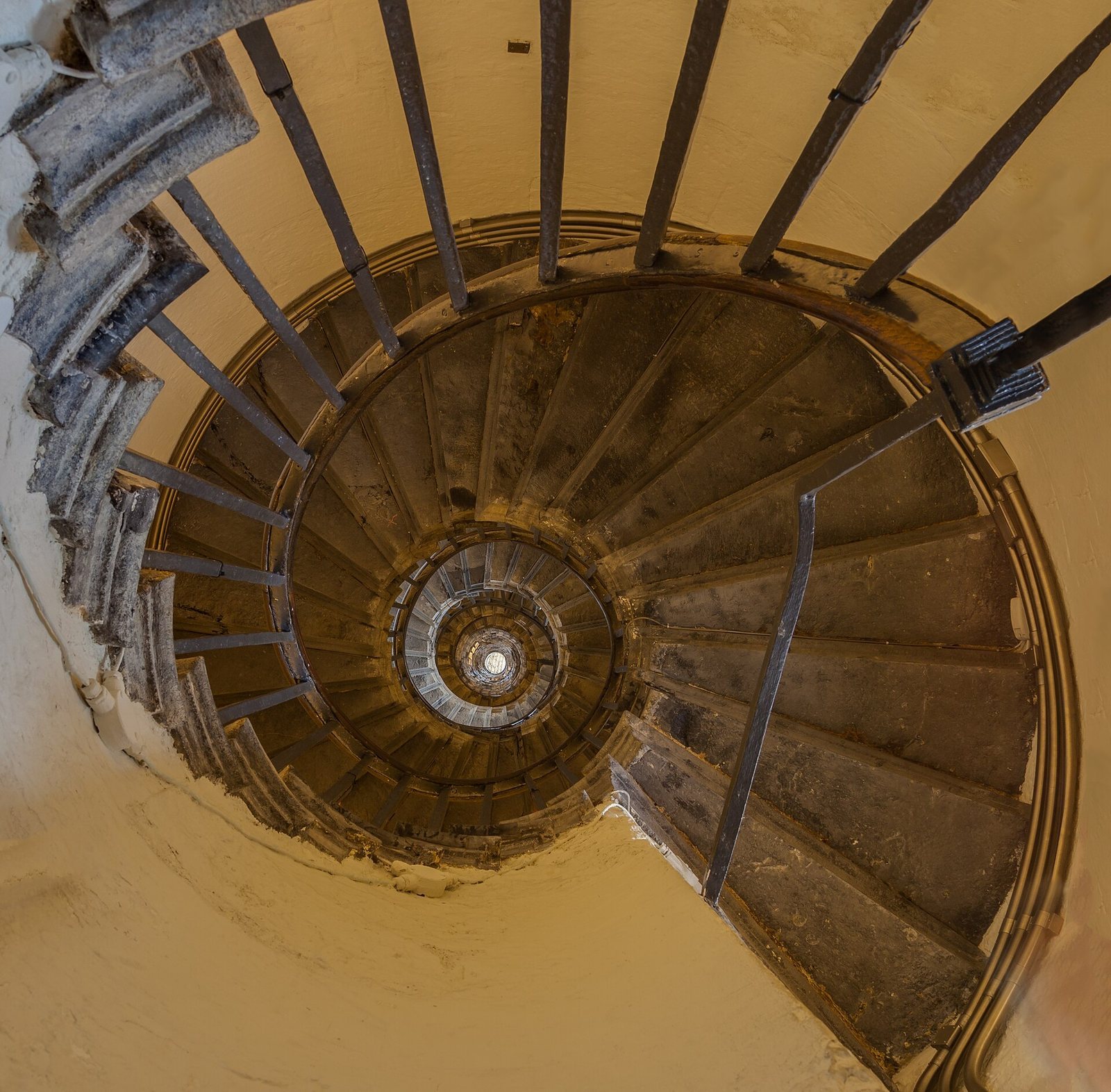
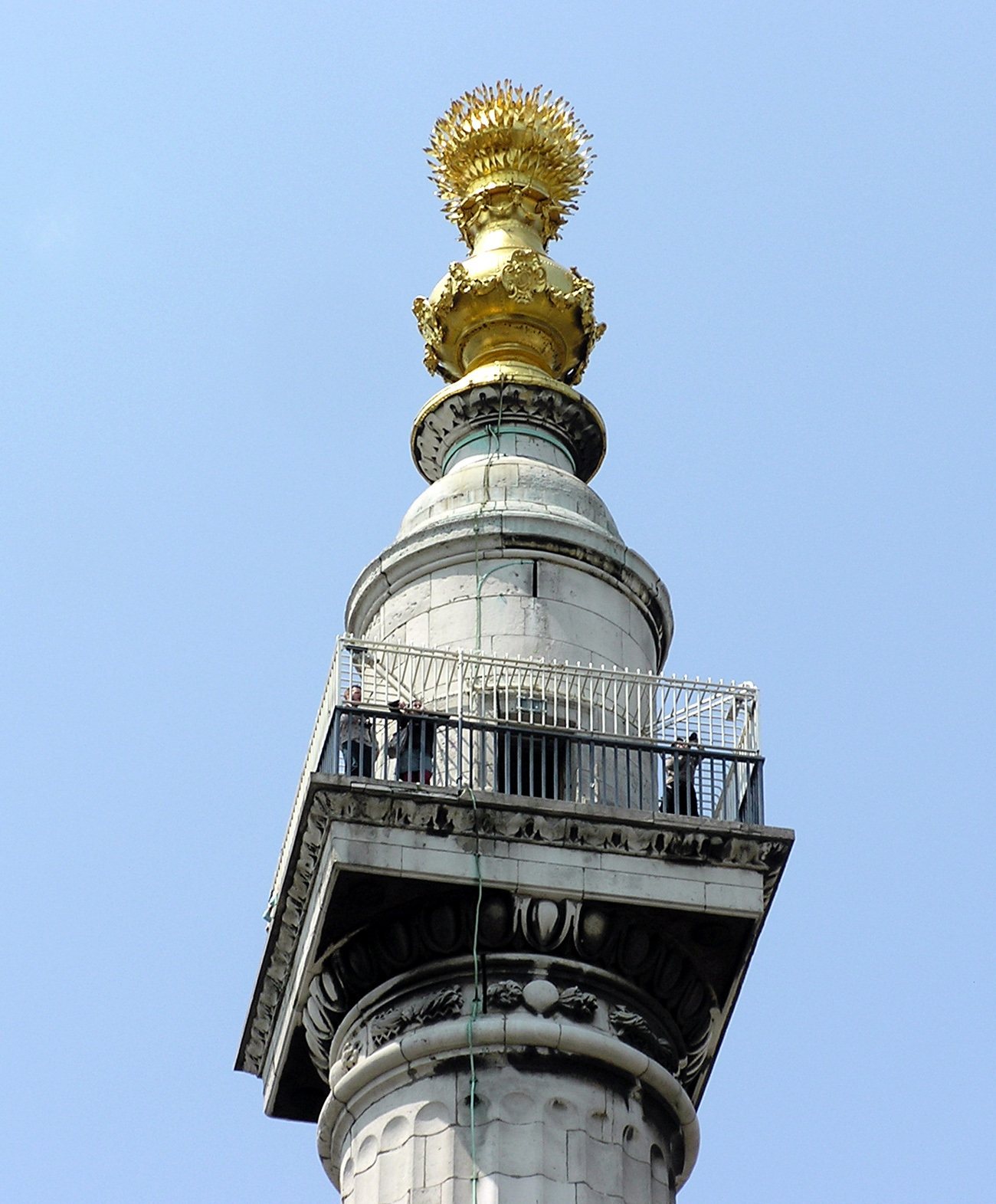
Built of Portland stone, a building limestone, the column has vertical grooves known as fluting and follows the Doric order, a classical form of column. A flaming urn of gilded bronze crowns it. A narrow, winding staircase of 311 steps leads to a viewing platform near the summit.
Base and sculpture
Inscriptions
Latin inscriptions appear on three sides of the base. The south face describes actions taken by Charles II after the fire. The east face recounts the Monument’s construction and names the mayors who served during the work. The north face describes the fire’s origin, the damage it caused and how it was eventually extinguished.
West-side relief
A sculpture by Caius Gabriel Cibber covers the west side of the base, with figures raised to different depths to depict the City’s destruction and rebuilding. London appears as a weakened woman supported by Time and Providence, while Charles II, assisted by his brother James, directs the reconstruction. Other figures personify Architecture, Imagination, Freedom, Justice, Fortitude, Science, Envy, Plenty and Peace.
Interior and scientific features
A central shaft was designed to serve as a zenith telescope, an instrument for observing the sky directly overhead, and for experiments on gravity and pendulums. It connects with an underground observation laboratory reached through a hatch in the ticket-booth floor. A hinged lid in the urn covers the shaft’s opening. Steps within the shaft, each 6 inches (150 millimetres) high, were intended to assist studies of atmospheric pressure. Wind sensitivity and vibrations from heavy traffic on Fish Street Hill made the planned astronomical and physical experiments impractical. In 2020, the shaft was used in a study that detected minute deformation in a suspended wire.
A mesh cage surrounds the summit. It was added in the mid-nineteenth century to deter people from jumping; six people died by suicide at the Monument between 1788 and 1842.