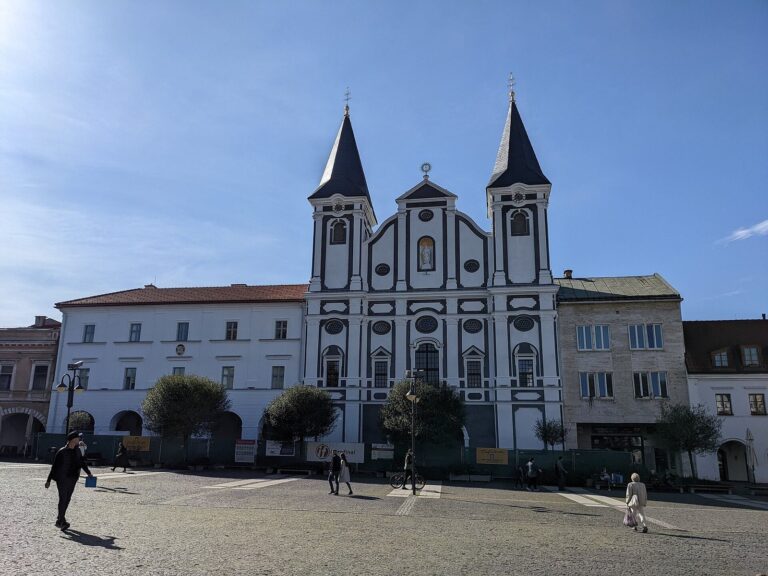
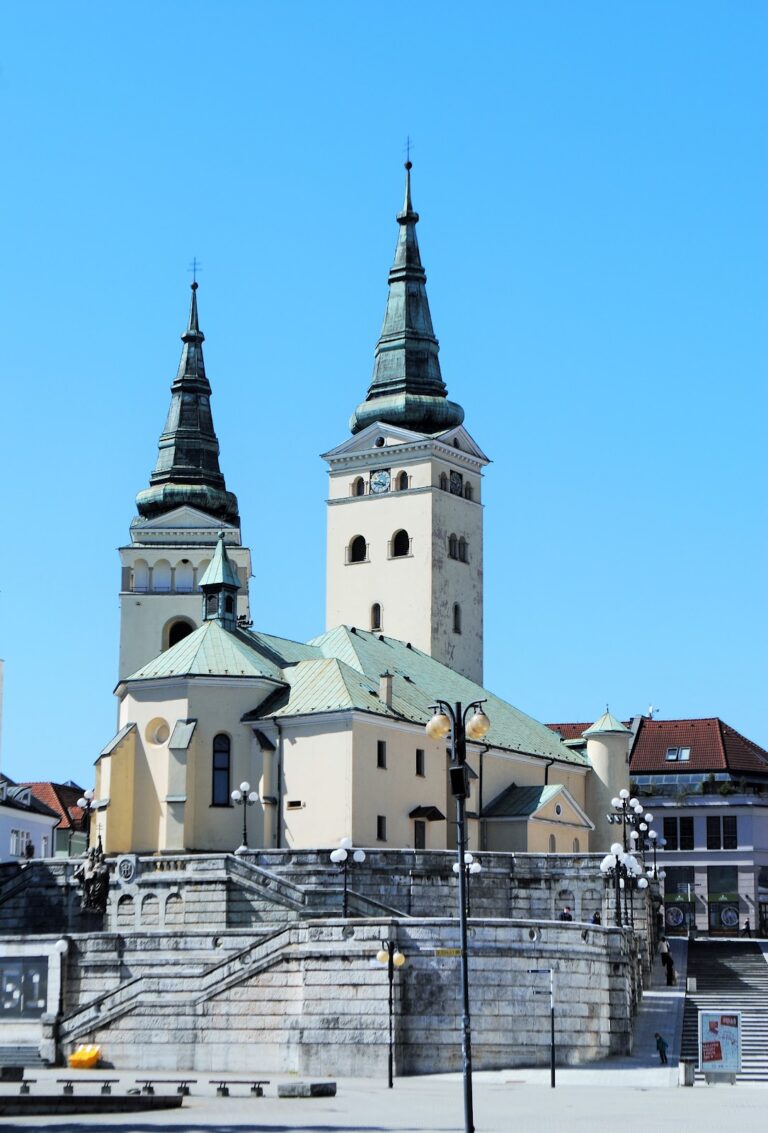
Church of Saint Nicholas in Višňové, Žilina District, Slovakia
Site at a Glance
- Popularity
- Very Low
- Country
- Slovakia
- Primary era
- Early Modern
- Eras represented
- Early Modern, Modern
- Civilizations
- Austria-Hungary, Austrian Empire, Habsburg, Hungarian
- Site type
- Religious
- Remains
- Church
On this page20 sections
History
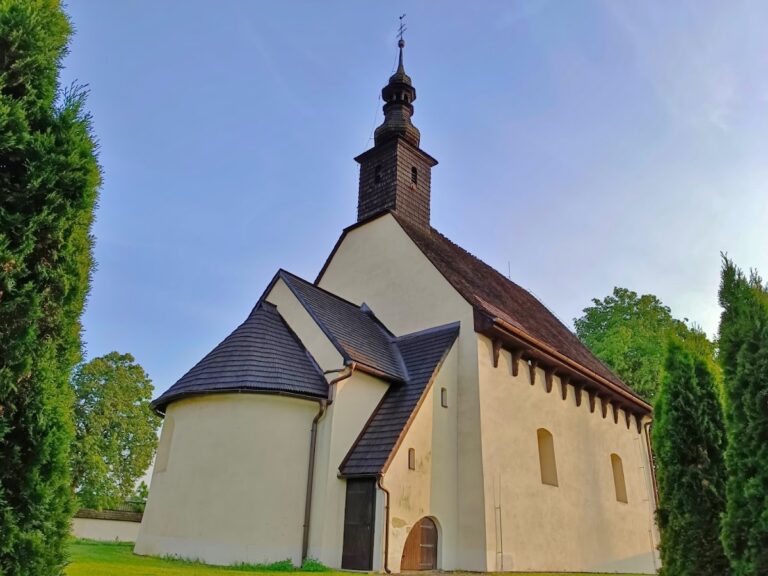
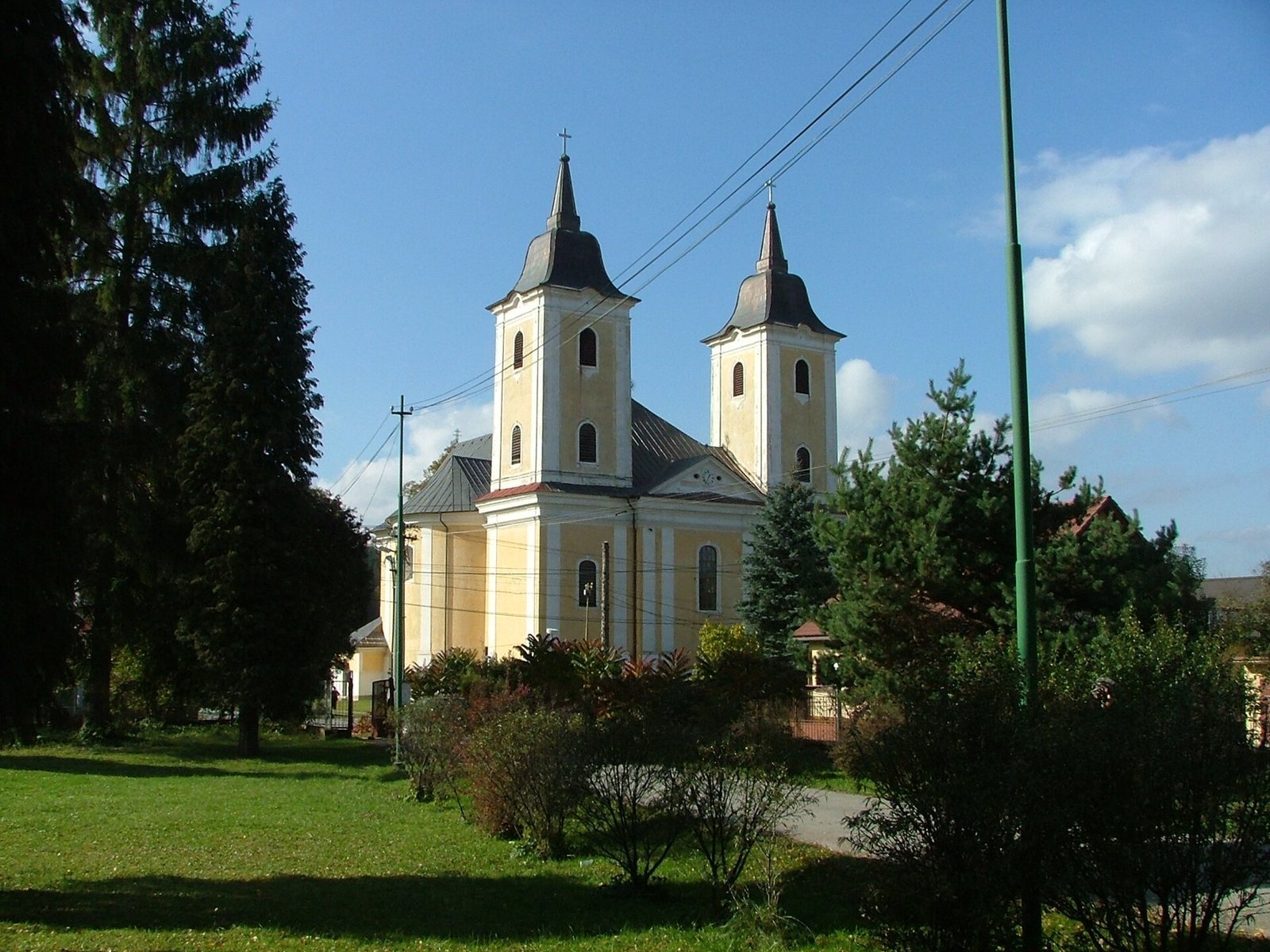
The Church of Saint Nicholas in Višňové is a Roman Catholic church in the Žilina District of Slovakia, dedicated to Saint Nicholas. Its present stone building is Baroque-classicist, combining Baroque design with Classical forms. Work began with the laying of its foundation stone in 1769, and the church was consecrated in 1783. The parish belongs to the Diocese of Žilina, a bishop-led church jurisdiction, and the Rajec deanery, a local grouping of parishes, within the Western Province. The church is also a stop on the Slovak Marian Route, a pilgrimage route associated with devotion to the Virgin Mary.
The Gothic church and Marian pilgrimage
A chronicle entry from 1514 records that local magistrate Wyšnovsky commissioned a single-nave Gothic church with a wooden bell tower. An enclosed area around the building was reserved as a cemetery. By 1674, devotion to the Virgin Mary of Višňové had drawn pilgrims from a broad region. The pilgrimage church could not hold all those who came, and it was enlarged as many as three times over the following decades.
Construction and parish development
In the mid-18th century, Ján Laffiri obtained permission from Nitra Bishop Ján Gustíny to build a new church. The proposed plan kept the older church standing while the walls of the new building were raised around it. The foundation stone was laid in 1769, and the church had been fully roofed by 1782. At its consecration on 29 September 1783, a statue of the Madonna and Child was placed on the main altar.
On 20 November 1801, Pope Pius VII granted the church an indulgence privilege. In Catholic teaching, an indulgence remits temporal punishment associated with sins whose guilt has already been forgiven. A parish was established in Višňové in 1805. In 1816, Nitra Bishop Jozef Kluch directed that the church’s towers be completed.
Painting, repairs and later religious associations
Parish priest Alexej Frátrik organized a collection for the interior decoration, which Slovak painter Jozef Hanula carried out in 1901–1902. In summer 1947, a pilgrimage of crosses was held in the village in memory of Jozef Tiso, a Catholic priest and politician who had served as president of the wartime Slovak state.
The church was registered as a Slovak National Cultural Monument on 5 November 1963. Repairs in the 1980s addressed the roof, exterior walls and interior, and included new lighting and sound systems and a major organ overhaul. During the 1990s, the railing between the sanctuary and main nave was removed. Later conservation work repaired the tower roofs and main roof structure, addressed damp in the plaster, and replaced interior wiring, windows and doors. The stained glass was restored, heating was installed, and repaired plaster on the towers was painted. An avenue of trees that had marked the church precinct and, earlier, its burial area was removed because the trees were in poor condition and contributed to damp in the walls.
On 1 July 2011, Krakow Cardinal Stanislaw Dziwisz gave the church a relic of the blood of Pope John Paul II. Relics of Saints Francis and Jacinta were also given to the church for the centenary of the Marian apparitions reported at Fátima in 1917. A relic of Saint Pio of Pietrelcina was displayed there for the centenary of his stigmatisation, the appearance of marks associated with Christ’s wounds.
Remains
Church plan and exterior
Stone church
The stone building has three naves: a central hall and two parallel side spaces. It measures 46 metres long and up to 27 metres wide, and has two towers, the taller reaching 36 metres. The main altar stands at the western end. The building’s plan was designed to allow the earlier church to remain standing while the new church walls were built around it.
Features around the building
A late-Baroque Calvary group, representing Christ’s crucifixion, stands in front of the entrance. Bartolomej Minich designed the group, and Ján Kurie carved it, at the end of the 18th century. A wooden cross is located near the church’s southeast corner, and a clock once stood on the façade above the entrance. Around 2010, a covered wooden stage was built behind the church for celebrations.
Altars and furnishings
Main altar
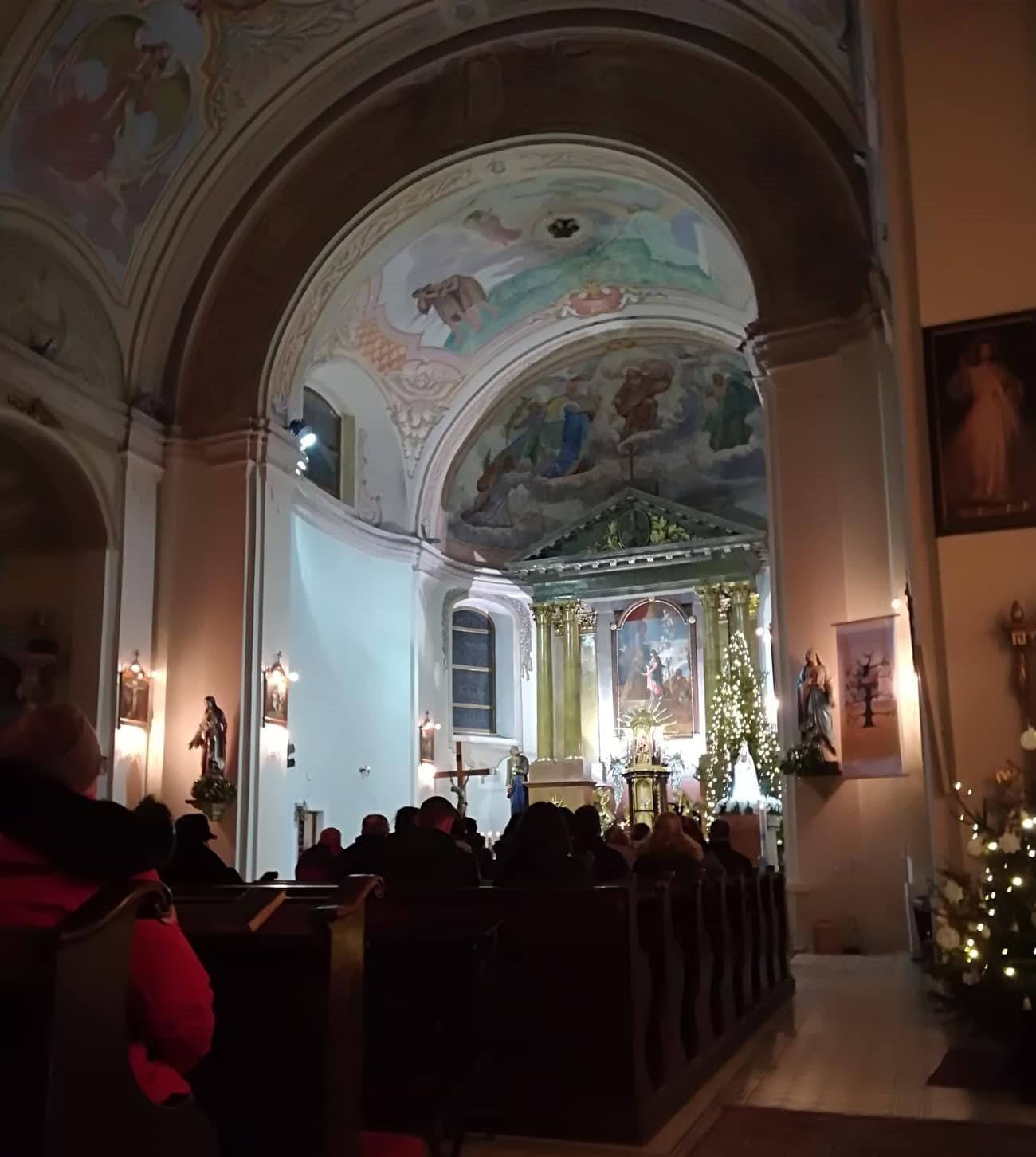
The main altar’s central image is a seated Madonna and Child on a raised throne. Its original winged altar, with hinged panels, included paired statues of Saint John of Nepomuk and Saint Francis Xavier on either side, as well as a Crucifixion; these elements were later altered. Statues of Saints Peter and Paul were added at the sides. Four Corinthian columns support a Classical pediment bearing an image of Saint Nicholas, and a large painting of the Visitation of the Virgin Mary occupies the altar area.
The altar is arranged in three sections. The lowest holds a monstrance, a vessel for displaying the consecrated host, and chalices containing hosts. A semicircular niche in the middle can hold a cross, sanctuary lamp or relics. The upper section is glazed and contains a small statue of the Madonna. Two angels support the covering of the tabernacle, the repository for the consecrated host, while another pair of angels appears above them in adoration.
Side altars
The altar on the left side of the main nave is dedicated to Saint Anthony of Padua. Five masters from Trnava completed it in 1797. Its principal painting shows the saint venerating the infant Jesus in Mary’s arms, with the Eye of God symbol above. The facing altar, probably made by the same craftsmen, dates to 1802 and is dedicated to Saint Nicholas. Its painting shows the saint with three angels holding a bishop’s staff and three golden apples; a monogram of Saint Mary appears above.
Baptismal font and pulpit
A sculptural scene of the Baptism of Christ dominates the baptismal font in the right nave. Jozef Točkovič of Rajec made it in 1810. At the edge of the left side nave stands a pulpit made by three masters from Nitra. Circular reliefs decorate its front, a statue of the Almighty stands on its canopy, and a dove is attached beneath it.
Pews and confessionals
The church retains larchwood pews made in 1795 by Krištof Laur of Mošovce. Their edges have spiral ornaments. Confessionals of approximately the same period stand in the side naves, decorated with gilded S-shaped interlace and cornices edged with small tooth-like blocks.
Paintings and sculpture
Interior paintings
Hanula’s interior paintings emphasize the Virgin Mary and rosary devotion. The curved ceiling above the main altar depicts the Last Judgment, while the area above the sanctuary shows the expulsion from Paradise. An arch marking the transition between the nave and sanctuary bears an inscription describing Jesus as the way, the truth and the life. A narrower panel shows a lamb with a chalice and consecrated bread resting on a book, an image associated with eternal life. The central nave features the Coronation of the Virgin, surrounded at the corners by circular scenes of the Annunciation, Visitation, Flight into Egypt and Death of the Mother of God.
The southern side nave depicts Mary with the infant Jesus surrounded by saints; the northern side nave shows a Pietà, Mary holding the dead Christ. Above the choir, a circular painting presents four figures representing faith, hope, love and wisdom. Another scene shows Saint Cecilia with angels playing instruments, and Hanula’s signature appears on the arch above the choir cornice.
Statues and devotional sculpture
At the main altar, Saint Peter stands on the left with a book in his right hand and a key in his left, held against his chest. Saint Paul stands on the right with a staff in his left hand. Other statues depict Saint Teresa, Saint Joseph, Saint Anthony of Padua and Saint John of Nepomuk. A statue of the Virgin of Fátima, brought directly from Fátima, is in the sanctuary. Statues of the Sacred Heart of Jesus and the Immaculate Heart of Mary have stood on the arch between nave and sanctuary since the early 20th century.
Stations of the Cross
Fourteen painted Stations of the Cross, showing episodes from Jesus’s final journey to crucifixion, are arranged along the church walls.
Stained glass and organ
Stained-glass windows
The stained-glass windows, installed in the early 20th century and probably associated with the interior painting campaign, depict the Immaculate Conception, Saint Aloysius, Saint Elizabeth and Saint Anthony of Padua. Townspeople from Žilina donated them.
Organ
Ján Pažický of Rajec made the organ in 1797. It stands in the choir, the gallery above the entrance used by singers and musicians. The instrument has two keyboards and ten stops, or controls for sets of pipes. Its cases sit on either side of the window between the towers, and small figures of angels playing instruments decorate it.