Bocking Windmill: A 1721 Post Mill in the United Kingdom
Site at a Glance
- Popularity
- Low
- Country
- United Kingdom
- Primary era
- Early Modern
- Eras represented
- Early Modern, Modern
- Civilizations
- British
- Site type
- Economic
- Remains
- Production Complex
On this page11 sections
History
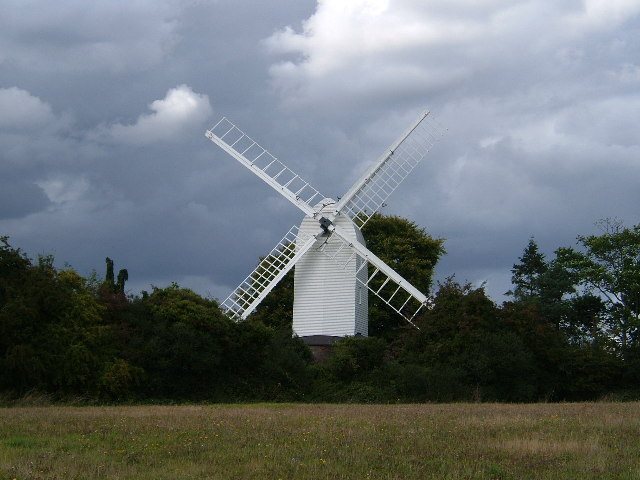
Bocking Windmill, also known as Bocking Churchstreet Windmill, is a post mill in the United Kingdom, built in 1721. Its construction is sometimes dated to 1680, but that date is incorrect. The mill originally stood about 170 yards (160 m) west of its present location.
Origins and ownership
An indenture dated 19 April 1721 records the sale to Joseph Nash, a miller from Halstead, of a lease on enclosed land for a windmill. The lease cost £11. The mill also appears on a map by Warburton, Bland and Smyth dating to about 1724.
Joseph Nash Jr received the mill in April 1772 and soon mortgaged it for £100. After a mortgagee died, miller Thomas French acquired the mill for £135. French sold it in 1774 to Bartholomew Brown of Wethersfield for £170. In 1784, John Tabor lent £100 against the mill as security.
The Brown family and continued milling
The Brown family operated the mill for three generations. John Brown died in September 1829. In 1830, his son, John Brown the Younger, occupied both the mill and the nearby Bull pub. That year, the mill was moved from near the pub to its present site.
William Dixon occupied the mill in 1850. Later millers included Henry Playle, James Hicks and Henry Hawkins. Milling continued through the First World War. Commercial work ended around 1924, although the mill operated for a few more years to fulfil orders.
Preservation
In 1929, owner Edward H. Tabor gave the mill to Bocking Parish Council. Local fundraising supported repairs, with help from parish clerk Alfred Hills, and a maintenance fund was established. The mill was designated a Grade I listed building on 25 October 1951. Grade I is England’s highest listed-building category, for buildings of exceptional interest.
By the early 1960s the mill had fallen into disrepair. Braintree and Bocking Urban District Council led a fundraising appeal, and restoration followed in 1964. The Friends of Bocking Windmill formed to help preserve it.
Remains
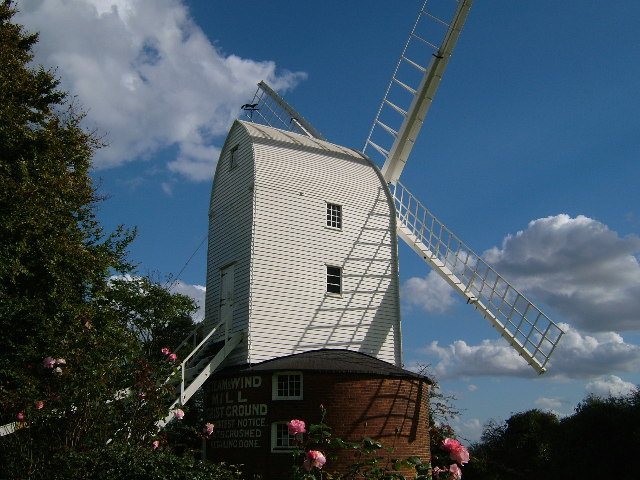
The post mill’s working body turns around a central post to face the wind. The structure stands 43 feet (13 m) high to the roof and has a two-storey brick roundhouse. Its present site is opposite the Bull pub. The mill combines a timber supporting frame and body with four sails and machinery for grinding grain.
Supporting structure
Trestle and mill body
The oak trestle has horizontal crosstrees 22 feet (6.7 m) long. Its main post is 18 feet (5.5 m) long, measuring 28 inches (710 mm) square at the base and 20 inches (510 mm) across at the top. The underside of the lower crosstree is 6 feet 6 inches (1.98 m) above ground. The mill body measures 18 feet 6 inches by 11 feet (5.64 by 3.4 m). Its crown tree, a main structural beam, meets the side girts, which are side-supporting timbers. The crown tree is 21 by 19 inches (530 by 480 mm) in section, and the side girts are 9 by 16 inches (230 by 410 mm).
The meeting point of the crown tree and side girts was shifted about 9 inches (230 mm) toward the rear. This was probably done after 1830, when the number of millstones in the front of the body was doubled. Without the adjustment, the added weight could have made the mill headsick, meaning unbalanced by excess weight toward its front.
Roundhouse
The roundhouse is built of brick and has a boarded roof covered with tarred felt. It was first built as a single-storey structure; the roundhouse and mill were later raised by one storey. A pair of underdrift millstones, driven by machinery beneath them, stands on the roundhouse’s upper floor. A portable steam engine could power them when the wind was insufficient.
Sails and milling machinery
Sails and windshaft
The four sails span 60 feet (18.29 m) and are 6 feet (1.83 m) wide. Two are common sails, which carry cloth on a framework, and two are spring sails, whose adjustable shutters are controlled by springs. In 1837, John Brown paid for a new sail 31 feet 6 inches (9.60 m) long and a shutter bar, indicating that the mill had a pair of spring sails by then. The cast-iron windshaft, which carries the sails and transfers their rotation to the machinery, replaced an earlier wooden shaft. It was probably secondhand when installed, since it is longer than required.
Millstones and gears
The breast of the mill was initially equipped with one pair of millstones and later held two pairs driven by the wind. After the mill’s relocation, it had a pair of French burr stones, made from hard siliceous rock, and a flour dresser, a machine for sifting milled flour. Each stone also had a small driving gear with 20 cogs.
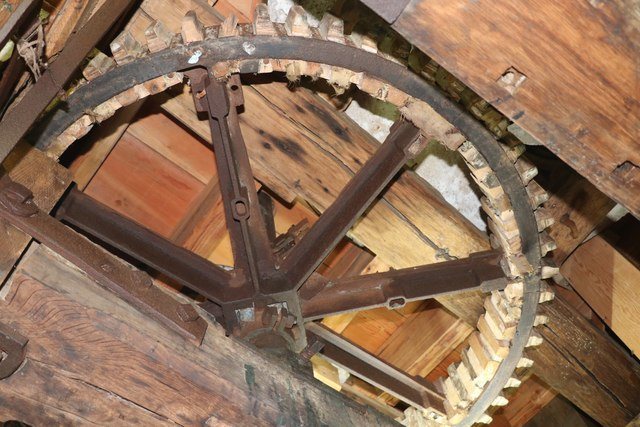
The brake wheel was changed from compass-arm to clasp-arm construction, two arrangements of the wheel’s arms. It measures 7 feet 8 inches (2.34 m) across and has 63 cogs. A cast-iron upright shaft installed by millwright Robert Hunt in 1842 carries three wheels: a cast-iron wheel with 66 cogs that drives the flour dresser, an iron wallower with 24 cogs, and an iron spur wheel with 63 cogs.