Villa Borghese Pinciana: A Borghese Villa and Art Museum in Rome
Site at a Glance
- Popularity
- High
- Country
- Italy
- Primary era
- Early Modern
- Eras represented
- Early Modern, Modern
- Civilizations
- Papal States
- Site type
- Domestic
- Remains
- Elite Residence
On this page15 sections
History
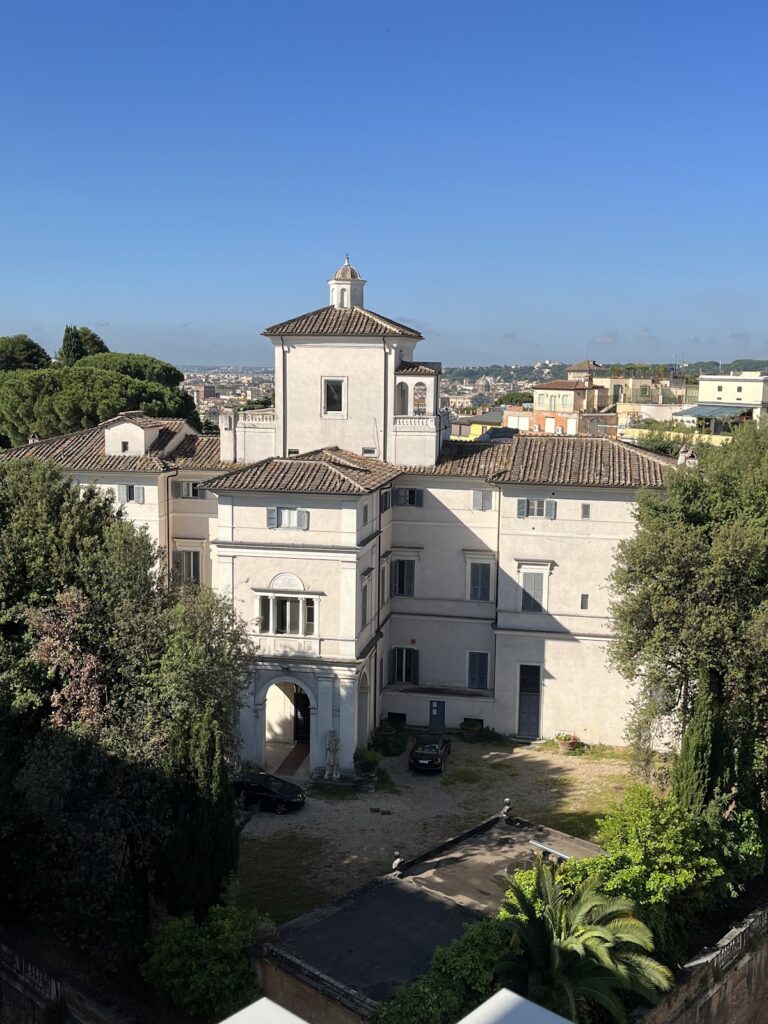
Villa Borghese Pinciana is a Borghese family villa in Rome, Italy, begun in the early seventeenth century as a pleasure retreat, reception venue, and home for an art collection. The estate has also been identified with the gardens of Lucullus, a Roman general and statesman remembered for his lavish gardens. The Borghese family possessed the estate’s core by 1580.
Creation of the villa
Cardinal Scipione Borghese enlarged the estate through purchases and acquisitions, intending to create a pleasure villa and the largest garden built in Rome since antiquity. He entrusted the building project to an architect in 1606. Construction began in the early seventeenth century and the villa was complete by 1633. Scipione’s sketches informed the design. After the architect died in 1613, his assistant continued the work and designed the facade. The project also involved gardener Domenico Savini da Montelpulciano and artists including Gian Lorenzo Bernini.
The main building, the Casino Nobile (here, casino means a small country house), served chiefly as a summer retreat for Scipione and his uncle, Pope Paul V. It also welcomed dignitaries and functioned as a semi-public museum for Scipione’s collection, which included sculptures commissioned from Bernini.
Redecoration and expansion
In 1766, Prince Marcantonio IV Borghese began changing the Casino Nobile, the water-games pavilion, and the park. Late-eighteenth-century work transformed the villa into a public museum. In 1808, amid financial difficulties, Prince Camillo Borghese sold some of the family’s sculptures and antiquities to Napoleon, the French emperor.
During the nineteenth century, Camillo expanded the grounds by acquiring land toward Porta del Popolo and Porta Pinciana. An architect integrated the enlarged estate with the existing grounds. The gardens became a place for holiday promenades and public festivities with singing and dancing. Over the course of the century, much of the formal garden gave way to an English-style landscape.
Transfer and restoration
Unable to meet the cost of maintaining the villa and collection, the Borghese family sold them to the Italian state in the early 1900s for 3.6 million lire. In 1903, the gardens were separated from the villa and transferred to the municipality of Rome as a public park; the complex was also transferred to the municipality that year. The villa underwent a full restoration from 1995 to 1997 and now houses the Galleria Borghese.
Remains
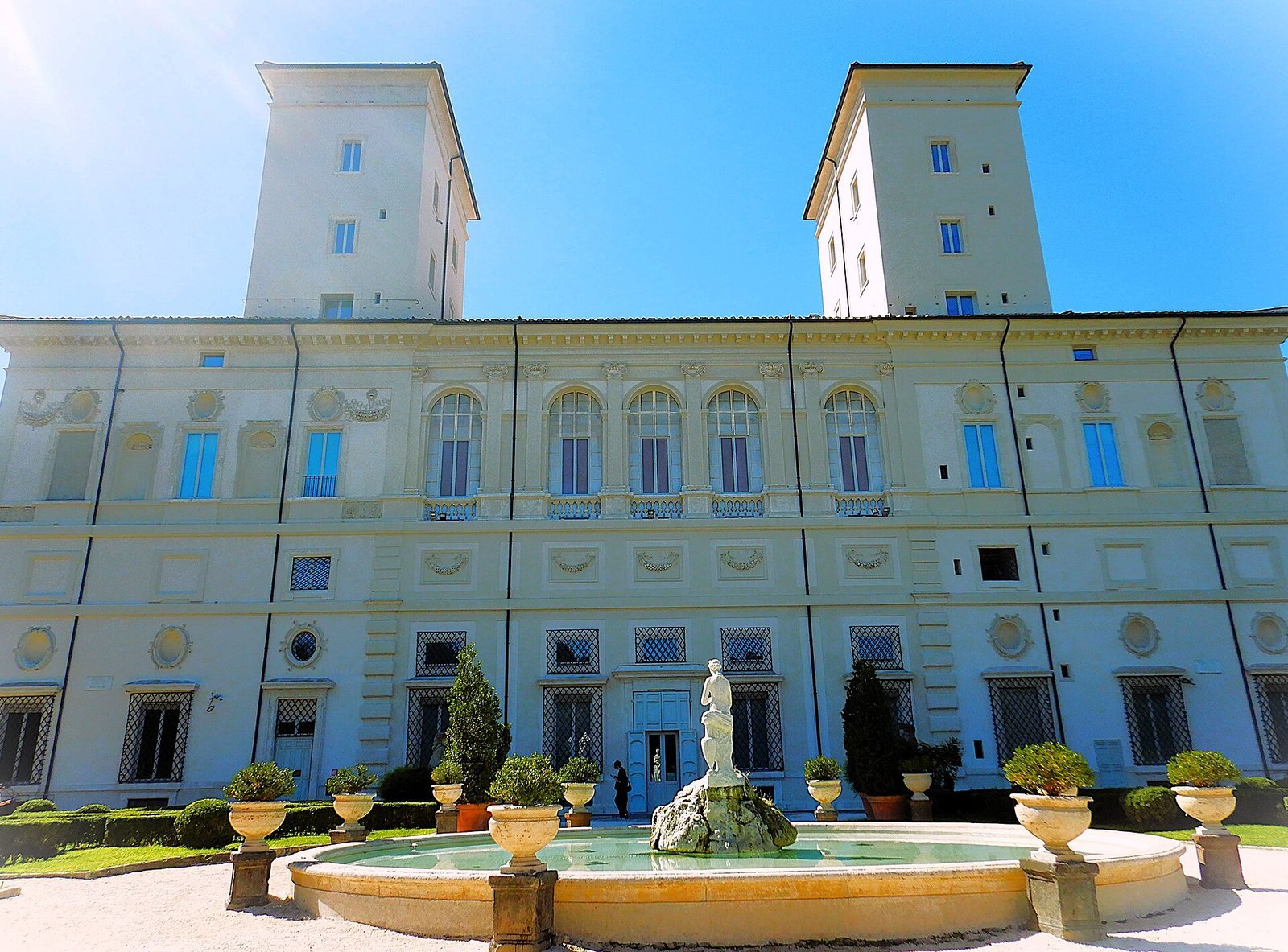
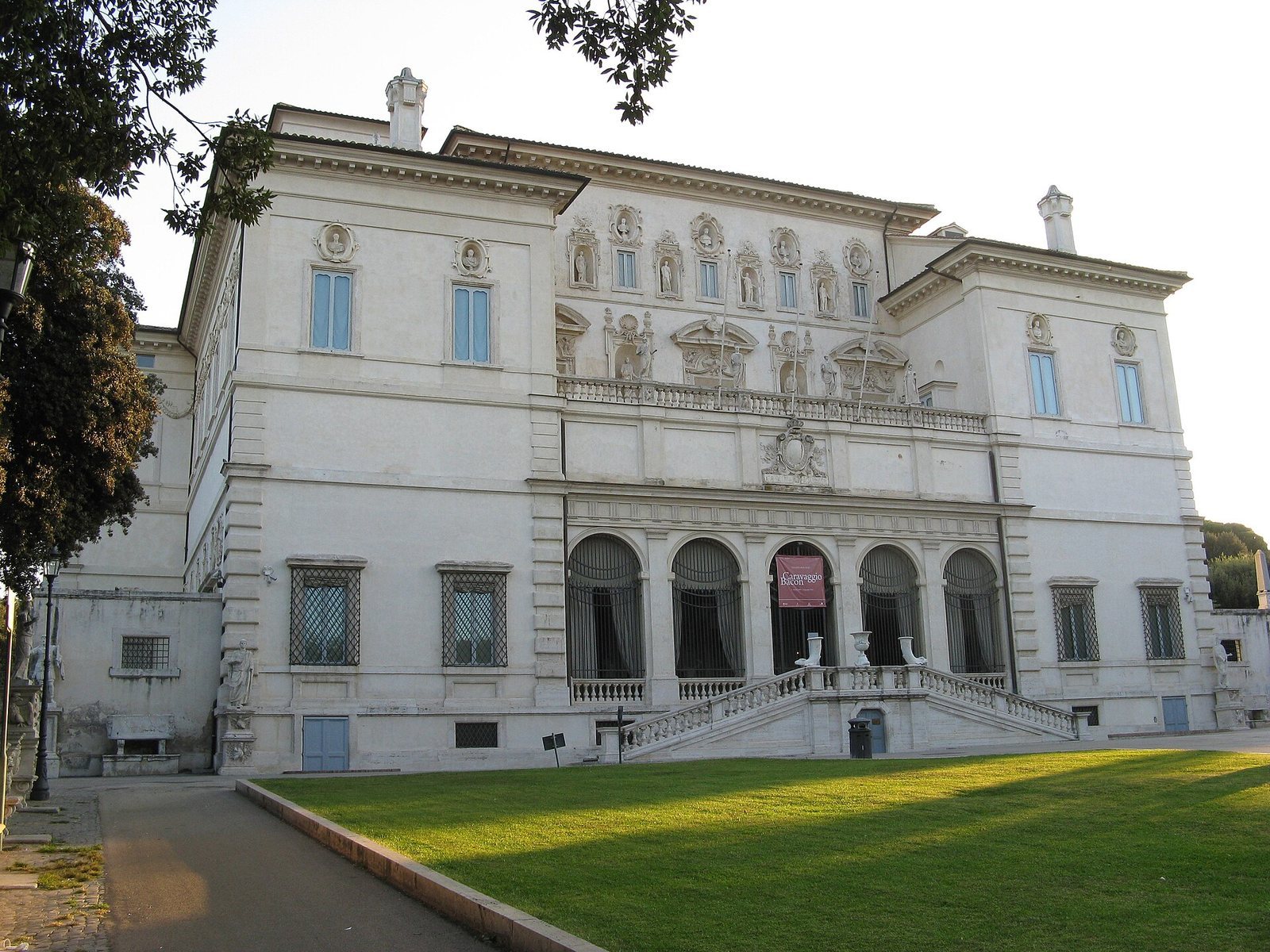
The estate brings together the three-storey Casino Nobile, a separate water-games pavilion, and landscaped grounds that include the Lake Garden. The villa’s exterior, principal rooms, garden structures, and relocated artworks preserve different parts of its changing history.
Casino Nobile
Facade and portico
The facade combines a U-shaped terrace with niches, openings, classical statues, and reliefs. The portico incorporates reused material from the Arch of Claudius, once situated on the Via Flaminia. Its double staircase was reconstructed during the 1995–97 restoration.
Central hall and loggia
The central Salone, or great hall, rises through two storeys. On the second floor, an open-sided, roofed gallery called a loggia has a ceiling fresco by Giovanni Lanfranco. The scene, known as The Gods of Olympus or Council of the Gods, uses quadratura, painted perspective that creates the illusion of architectural depth.
Interior decoration
Late-eighteenth-century redecoration removed older tapestries and leather hangings, added new ceiling decoration, and arranged sculptures and antiquities by theme. The villa’s interior was restored in the 1995–97 works.
Gardens and separate buildings
Water-games pavilion and Lake Garden
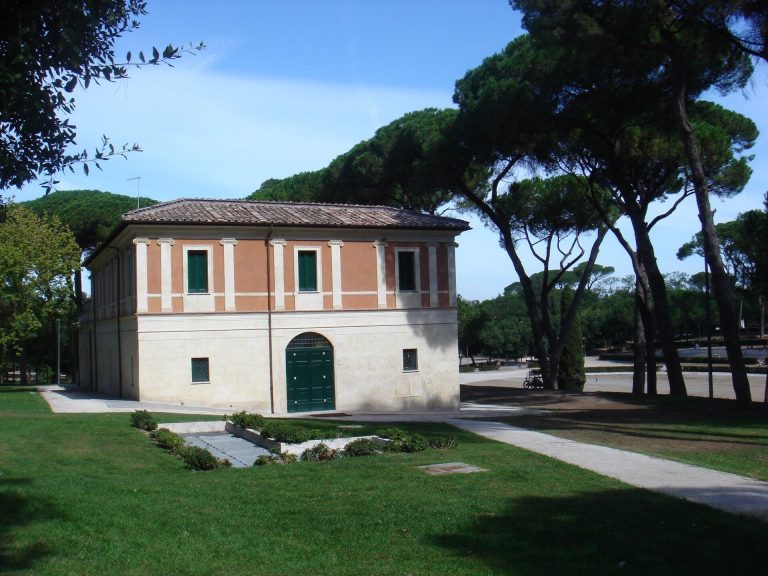
The separate water-games pavilion, known as the Casino dei giuochi d’acqua, is now an orangery, a building historically used to shelter citrus trees, and houses the Carlo Bilotti Museum. The park’s Lake Garden was laid out with fountains and small structures intended to create picturesque views.
Garden landscape
In 1644, the English diarist John Evelyn described fountains with varied mechanisms, olive groves, and small streams in the gardens. He also called them a “nursery” for ostriches, peacocks, swans, cranes, and other unusual animals.
Relocated features and artworks
Borghese Balustrade
Made in 1618 for the Casino Nobile’s south forecourt, the Borghese Balustrade had a central opening with two stone statues above it and fountains with shell-shaped basins below. G. di Gincome and P. Massoni made the balustrade, and Claude-Augustin Cayot added the statues in 1715. In 1896, William Waldorf Astor acquired it and installed it at his estate, Cliveden, in England.
Sculptures from the collection
The Borghese Gladiator, formerly one of the collection’s most admired statues, is now in the Louvre in Paris. Camillo Borghese commissioned Antonio Canova’s sculpture of his wife, Pauline Bonaparte, as Venus Victorious and placed it prominently in the villa’s galleries.