Bodleian Library: Oxford’s Main Research Library
Site at a Glance
- Popularity
- Very High
- Country
- United Kingdom
- Primary era
- Early Modern
- Eras represented
- Medieval, Early Modern, Modern
- Civilizations
- British, English
- Site type
- Civic
- Remains
- Library
On this page17 sections
History
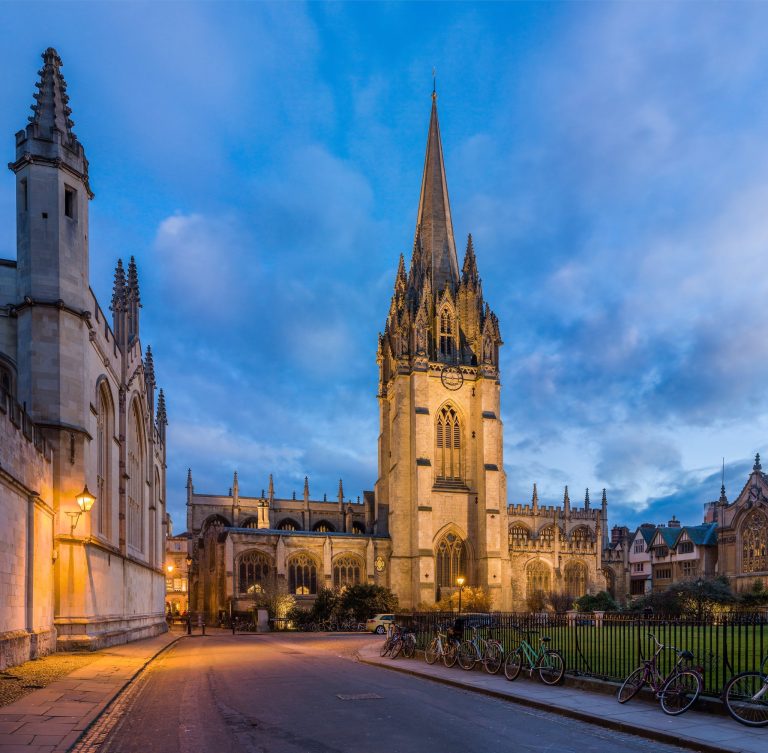
The Bodleian Library is the University of Oxford’s main research library in Oxford, United Kingdom. Its institutional history begins with its reopening in 1602, although it grew from a university library founded in the 14th century. For a period before the British Museum was established in 1753, it effectively served as England’s national library.
The medieval university library
The library’s medieval predecessor was founded under the will of Thomas Cobham, Bishop of Worcester. Its small collection of chained books was kept above the north side of the University Church of St Mary the Virgin. Chaining secured books to furniture or shelving to deter their removal. The collection grew after Humphrey, Duke of Gloucester, donated manuscripts between 1435 and 1437. A new room above the Divinity School was completed in 1488, but university funding for its upkeep and acquisitions later stopped. Books went unreturned, and the collection dwindled.
During Edward VI’s reign, manuscripts associated with Catholicism were removed from the collection. By the late 16th century, the library’s furniture had been sold, and only three books from Humphrey’s original gift remained.
Bodley’s revival and early growth
In 1598, Sir Thomas Bodley offered to finance the library’s revival. Six university members helped refit it, and Bodley added books from his own collection. It reopened on 8 November 1602 as the Bodleian Library, with about 2,000 books. A Benefactor’s Register was prominently displayed to encourage further gifts. Memories of the Reformation, when books had been removed from collections, helped motivate donors to entrust books to the library for safekeeping.
Bodley pursued works from beyond England as well. In 1603 he sought manuscripts from Turkey, and the library acquired its first Chinese book, though no one at Oxford could then read it. Francis Bacon gave the library a copy of The Advancement of Learning in 1605. English-language books remained relatively scarce, partly because scholars did not generally conduct their academic work in English.
At the suggestion of Thomas James, the library’s first librarian, Bodley agreed in 1610 to receive a copy of every book registered with the Stationers’ Company, a London book-trade guild. The collection had reached 16,000 items by 1620. Readers seeking to use it had to buy a copy of that year’s catalogue for 2 shillings and 8 pence. The Arts End was added between 1610 and 1612, and another extension followed between 1634 and 1637. John Selden’s large bequest of books and manuscripts in 1654 led to a further addition, known as the Selden End.
Expansion and new collections
The library’s holdings continued to grow through acquisitions and new responsibilities. In 1769, astronomer Thomas Hornsby observed the transit of Venus from the Tower of the Five Orders. The library purchased a large group of medieval Italian manuscripts from Matteo Luigi Canonici in 1817, followed in 1829 by Rabbi David Oppenheim’s collection, which enlarged its Hebrew holdings.
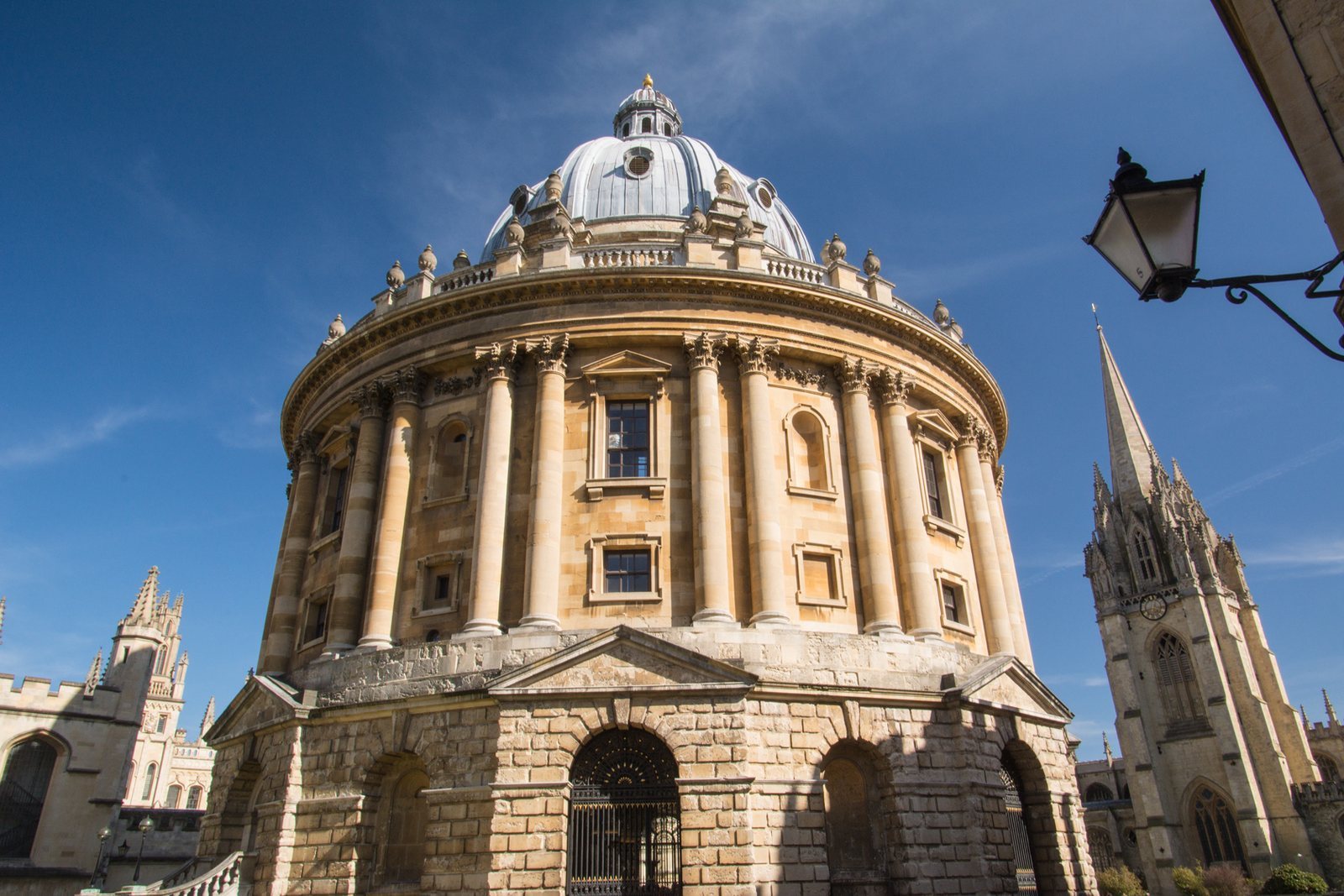
In 1860, the library was allowed to take over the adjacent Radcliffe Camera. The following year, its medical and scientific collections moved to the Radcliffe Science Library, built farther north beside the University Museum. The Clarendon Building had been built between 1711 and 1715 for the Oxford University Press printing presses. After the Press left in the early 19th century, the university used the building for administration; it transferred to the Bodleian in 1975 for offices and senior staff meetings.
The modern research library
A project to revise the printed-book catalogue began in 1907. Two years later, Chandra Shum Shere, Prime Minister of Nepal, donated a large collection of Sanskrit literature. Under the Copyright Act of 1911, the Bodleian became one of six United Kingdom libraries entitled to receive copies of published works. This legal-deposit system, which requires publishers to supply designated libraries with copies, continued the earlier arrangement with the Stationers’ Company. The collection exceeded one million books in 1914.
During the First World War, staff shortages caused by service in the armed forces and hospitals slowed the catalogue project. By 1915, only a quarter of it was complete. In July that year, fear of bombing prompted the library to move its most valuable books to a secret location and train a volunteer fire brigade. Oxford was not bombed during the war.
By the 1920s, further expansion was needed. Work on the New Bodleian began in 1937, and the building was completed in 1940. The Legal Deposit Libraries Act 2003 superseded the 1911 arrangements. The Bodleian remains one of six United Kingdom legal-deposit libraries and is entitled under Irish law to request a copy of every book published in the Republic of Ireland.
In November 2015, the collections passed 12 million items with the acquisition of Percy Bysshe Shelley’s Poetical Essay on the Existing State of Things. The 20-page pamphlet was published in 1811 and thought lost soon afterward, before its rediscovery in a private collection in 2006. Its poem and accompanying essay are believed to have contributed to Shelley being expelled from Oxford University. The library digitized the pamphlet, and other archival material was also made available online in 2015.
Several University of Oxford libraries were brought together for administrative purposes in 2000 as Oxford University Library Services. The group took the name Bodleian Libraries in 2010, with the Bodleian Library as its largest component. Oxford colleges retain independent libraries, some older than the Bodleian, and most participate in the Bodleian Libraries’ online union catalogue, SOLO. University College maintains its own catalogue. The Bodleian operates principally as a reference library, so documents generally remain in its reading rooms. It holds more than 13 million printed items and is Britain’s second-largest library after the British Library.
Remains
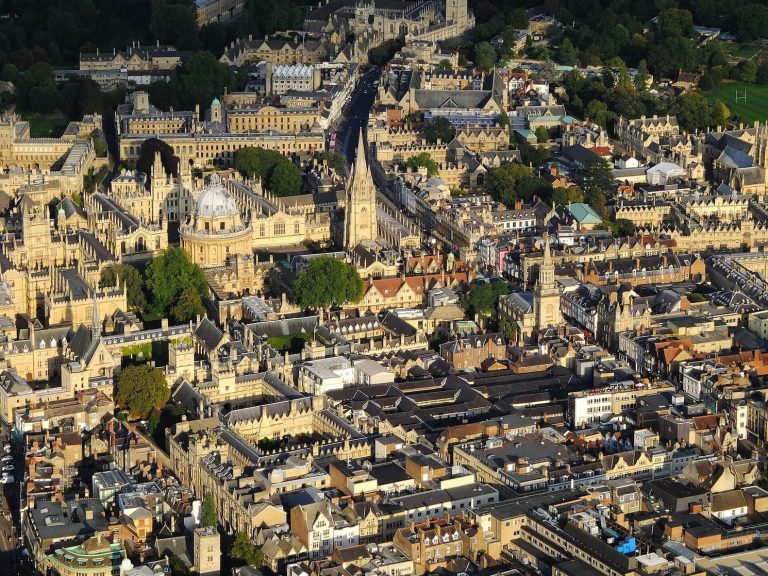
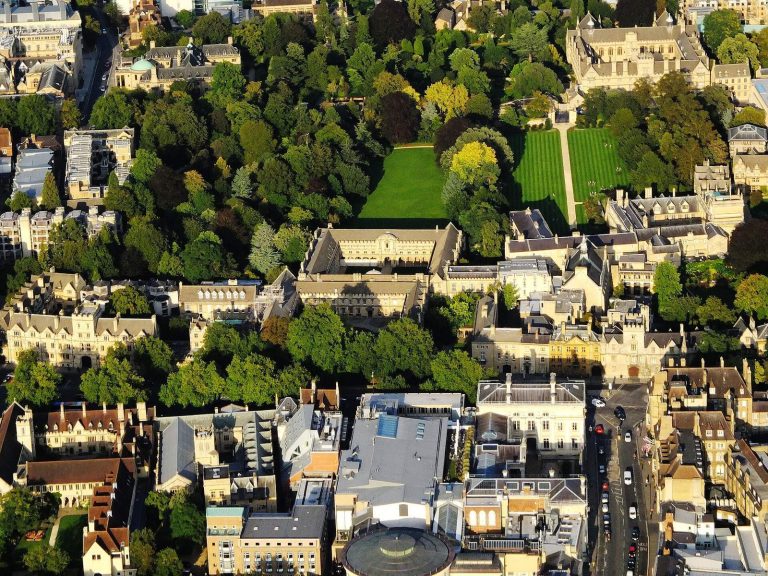
The Bodleian’s buildings form a complex of five structures near Broad Street, alongside underground book storage developed from the 19th century onward. Its principal off-site storage facility is at South Marston, on the edge of Swindon. The historic rooms, later additions and underground links reflect the changing needs of a library whose collections expanded over several centuries.
Historic buildings
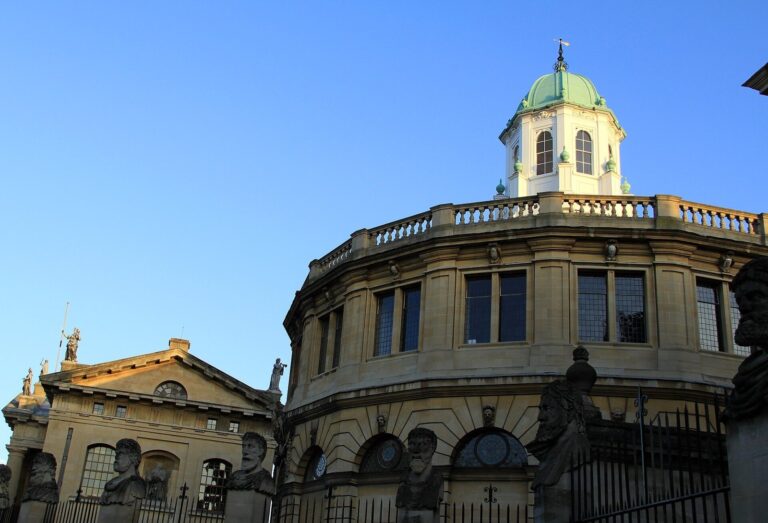
Duke Humfrey’s Library
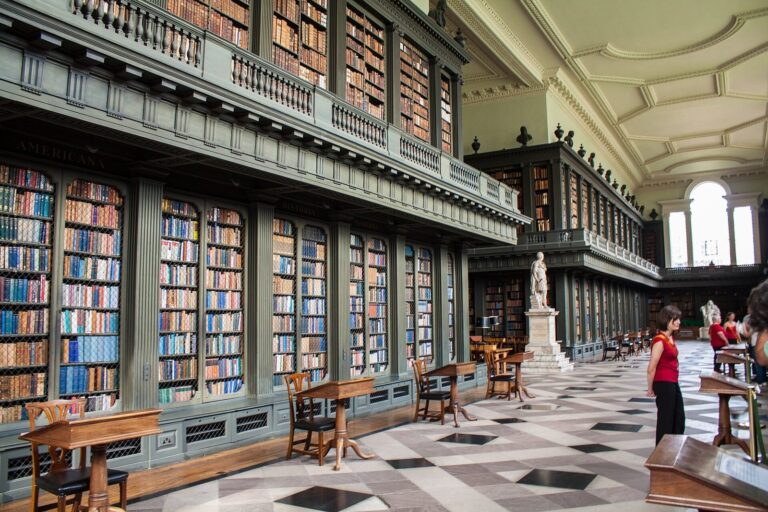
Duke Humfrey’s Library occupies a room above the Divinity School. It is part of the medieval library complex that grew around the university’s earlier collection. The room’s position above the school preserves the original arrangement of a library housed within the university’s teaching buildings.
The Schools Quadrangle and Tower of the Five Orders
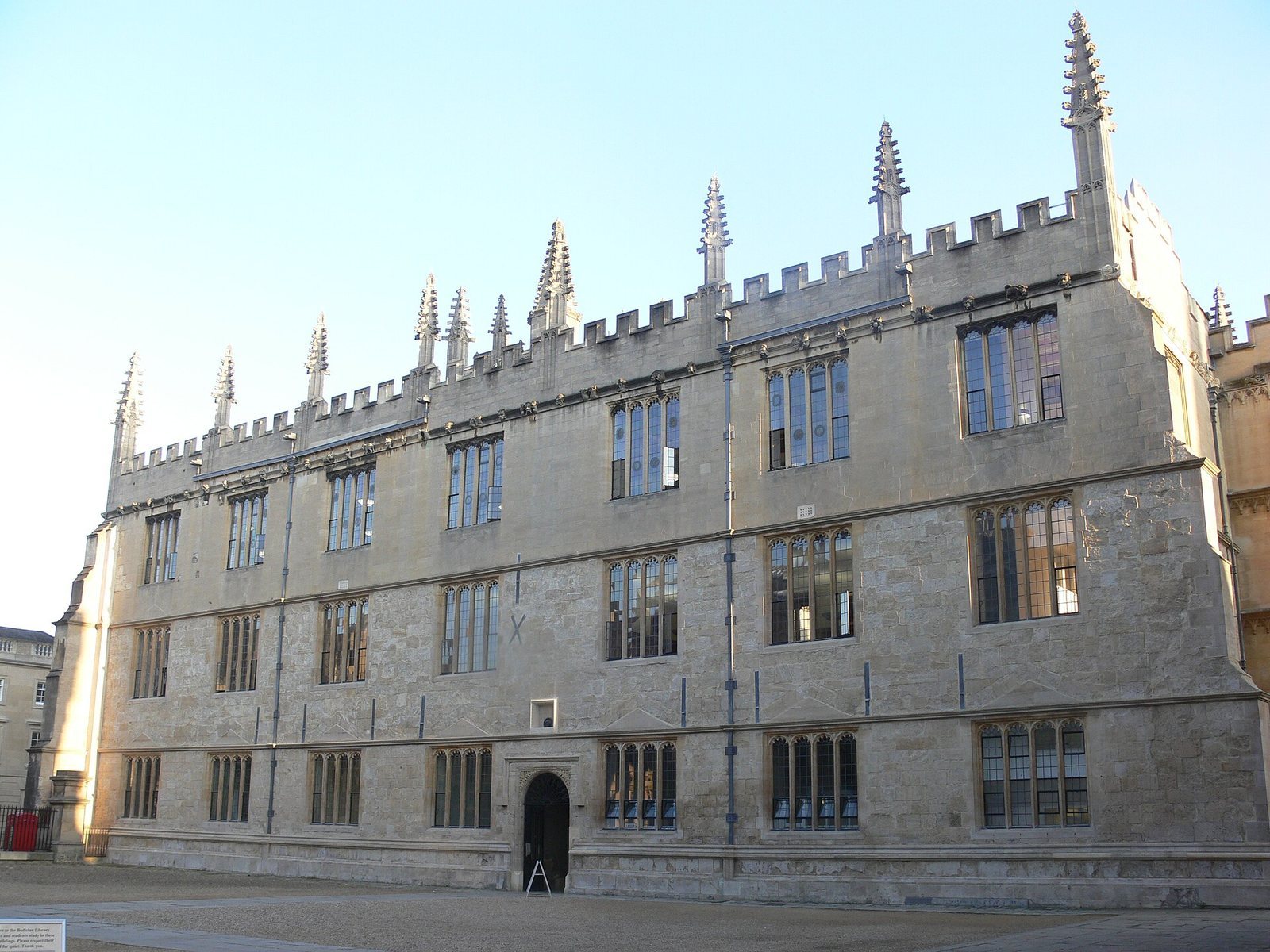
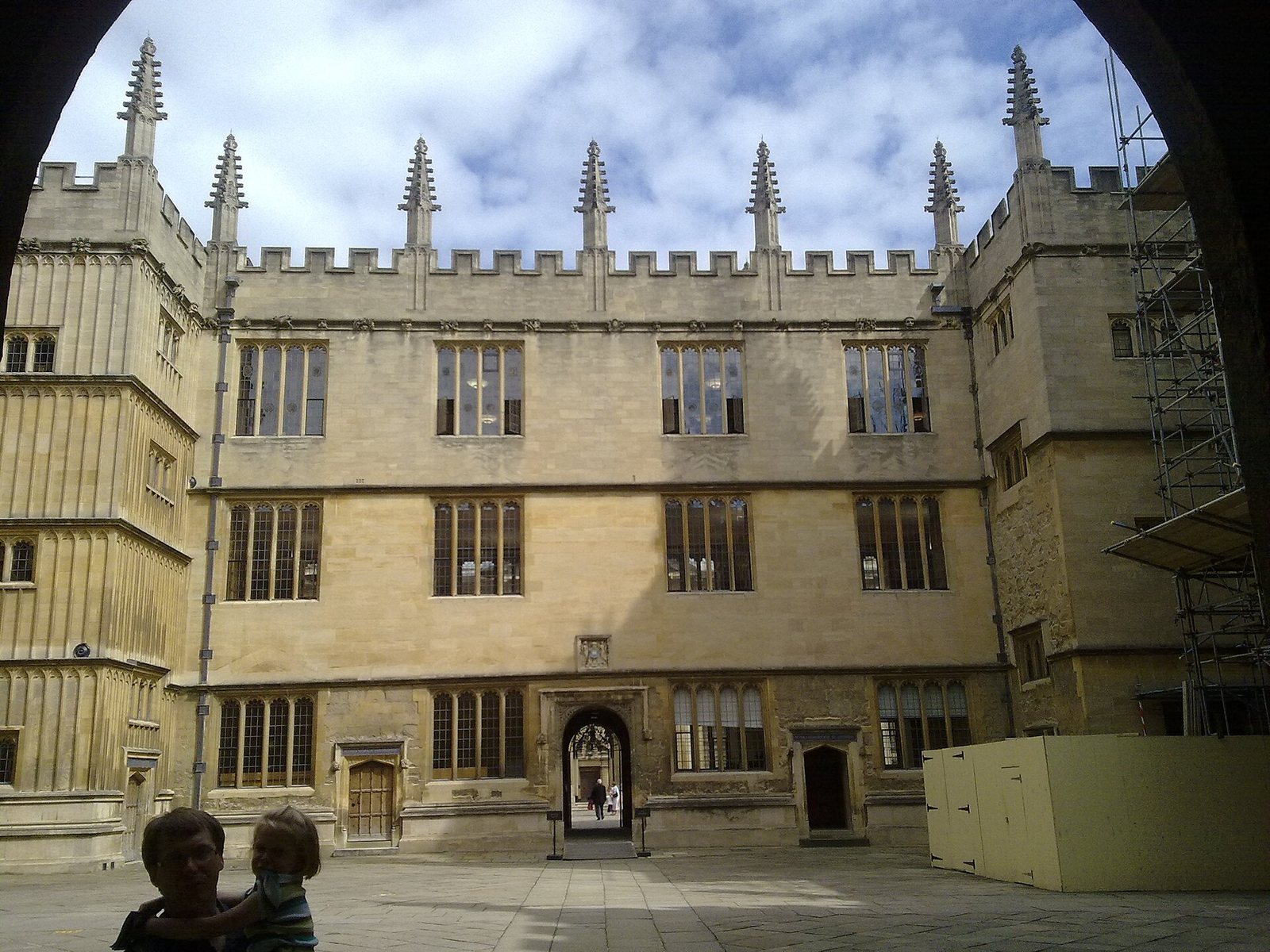
The Schools Quadrangle comprises three wings added to the Proscholium, or entrance hall, and the Arts End. Its three levels include rooms that once served as lecture spaces and an art gallery. Inscriptions above doorways still identify former lecture rooms. One room used to exhibit library treasures was later superseded by exhibition space in the Weston Library.
The quadrangle’s principal entrance is the Tower of the Five Orders. Its name refers to five classical styles of column, arranged from the Tuscan at the bottom through the Doric, Ionic and Corinthian to the Composite at the top.
Clarendon Building
The Clarendon Building now provides offices and meeting rooms for senior library staff. Its original purpose was to house the Oxford University Press printing presses, before the Press moved out in the early 19th century.
Radcliffe Camera and related libraries
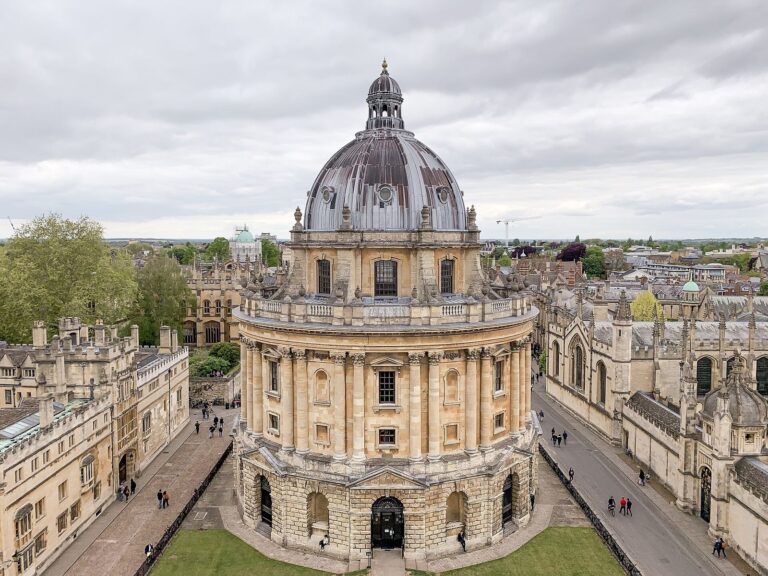
Adjacent to the Bodleian complex, the Radcliffe Camera is a domed, circular building. The underground bookstack below it and Radcliffe Square has been called the Gladstone Link since 2011. The Radcliffe Science Library, which holds the Bodleian’s medical and scientific collections, stands north of the Camera beside the University Museum.
Newer buildings and storage
The New Bodleian and Weston Library
The New Bodleian stood opposite the Clarendon Building at the northeast corner of Broad Street. Its stepped form has receding levels, like a ziggurat, and 60 percent of its bookstack lay below ground. A tunnel beneath Broad Street connected it to the older Bodleian buildings. The tunnel carried a pedestrian passage, a mechanical book conveyor and a pneumatic tube system, which moved materials through pipes using air pressure.
The tube system carried book orders until an electronic automated request system was introduced in 2002. It continued to deliver manuscripts requested for Duke Humfrey’s Library until July 2009. The conveyor, which had moved books beneath Broad Street since the 1940s, was dismantled in 2010. The New Bodleian was later rebuilt behind its original façade to improve storage for rare and fragile materials and facilities for readers. The complex now includes the Weston Library.
Manuscript and printed collections
Books and texts from Britain and Europe
The collections include illuminated manuscripts, books decorated with painted or gilded imagery, from different periods and regions. The 12th-century Ashmole Bestiary is a book about animals that gives allegorical interpretations of more than 100 creatures. Other medieval religious books include the 15th-century Abingdon Missal, a book of Mass texts made at Abingdon Abbey; the 10th- to 11th-century Leofric Missal; and the 11th-century Gospel Book of Saint Margaret of Scotland.
Among the library’s British and Irish historical texts are the 9th-century Irish Rushworth, or MacRegol, Gospels; the 12th-century Book of Glendalough, from pre-Norman Ireland; the 11th-century Annals of Inisfallen; and the 12th-century Peterborough Chronicle, one of the Anglo-Saxon Chronicles. The collection also holds four 13th-century copies of Magna Carta, out of 17 known to survive, and the 8th-century oldest surviving copy of the Rule of Saint Benedict.
Literary works include the 11th-century Cædmon’s Hymn, traditionally attributed to the early English poet Cædmon; the 15th-century Middle English anthology Fairfax MS 16; and the Vernon Manuscript, the longest surviving manuscript written in Middle English. The library holds the 12th-century Song of Roland in its only surviving Old French manuscript. It also has a 14th-century map of Great Britain known as the Gough Map and the 12th-century Old Dutch text Hebban olla vogala, long considered the only known example of Old Dutch.
Manuscripts from other regions and traditions
The Bodleian’s holdings include 140 Armenian manuscripts, the earliest dating to the 11th century, and the Cairo Geniza collection, a body of Jewish manuscripts and documents spanning the 6th to 19th centuries. The Drower Collection is the world’s most extensive collection of manuscripts belonging to the Mandaeans, a distinct religious community with its own scriptural tradition. A 6th-century Coptic codex, or book-form manuscript, known as the Bruce Codex contains Gnostic writings, associated with ancient religious movements that emphasized spiritual knowledge. Another Coptic work, Huntington MS 17, is the oldest manuscript with a complete text of the four Gospels in the Bohairic dialect.
South Asian holdings include the Bakhshali, Bower and Weber manuscripts of Sanskrit texts, dated to the 4th to 6th centuries, and the 19th-century religious work Shikshapatri, written by the Hindu teacher Swaminarayan. The 15th-century palm-leaf manuscript Bujangga Manik represents Old Sundanese literature from Java. The collection also includes four fragmented papyrus scrolls from Herculaneum, which survived the eruption of Mount Vesuvius in AD 79.
Several pre-Columbian works, from before European arrival in the Americas, preserve histories and imagery of Indigenous Mesoamerican peoples. These include the 14th- to 15th-century Mixtec Codex Bodley, the 16th-century Codex Selden and the painted Selden Roll from Mexico’s Coixtlahuaca region. The 16th-century Codex Laud is a pictorial manuscript of 24 leaves from Central Mexico, while the Codex Mendoza concerns Aztec rulers and their conquests.
Printed books, music and personal papers
Printed holdings range from a 1455 Gutenberg Bible, one of 21 complete copies known to survive, to Shakespeare’s 1623 First Folio and a 1604 first edition of Don Quixote. The 1640 Bay Psalm Book is one of 11 surviving first-edition copies of the first book printed in British North America, and the only such copy outside the United States. The library also holds a 16th-century book identified as the first printed in Arabic with movable type, John James Audubon’s The Birds of America (1827–1838), and an early edition of Yankee Doodle published after 1775.
Personal papers and literary materials include manuscripts by Jane Austen, Franz Kafka, C. S. Lewis, Mary Shelley, Percy Bysshe Shelley and J. R. R. Tolkien. The collection also preserves the original writing for Kenneth Grahame’s The Wind in the Willows. Felix Mendelssohn’s archive contains letters, drawings and music manuscripts, including the Hebrides Overture. Autograph scores, meaning composers’ original handwritten music, include works by Beethoven, Chopin, Mozart and Schubert.