Giesegaard: A Manor House and Estate in Denmark
Site at a Glance
- Popularity
- Medium
- Country
- Denmark
- Primary era
- Early Modern
- Eras represented
- Early Modern, Modern
- Civilizations
- Danish
- Site type
- Domestic
- Remains
- Manor House
On this page7 sections
History
Giesegaard is a manor house and estate in Ringsted Municipality, Denmark, established by Frederik Giese in 1683. The main building was later remodelled in Historicism, an approach drawing on earlier styles, with Renaissance Revival forms that reuse features associated with Renaissance buildings. Members of the Schack and Brockenhuus-Schack families have owned the estate since 1736.
From Skivede to Giesegaard
A village called Skivede occupied the site until the 1670s. The Crown held the land until 1668, when it transferred it to Frederik Giese in exchange for land elsewhere. Giese acquired more property in the area before establishing the estate.
Changes of ownership and the entail
After Giese died in 1693, his widow, Margrethe Elisabeth Schönbach, and their son, Christoffer Joachim Giese, inherited the estate. When Christoffer Joachim died in 1719, his mother had to surrender it to a creditor, Christian Scavenius, who sold it to Christian Carl Gabel in 1720. Gabel enlarged the estate through further land purchases. He was dismissed from his position as Chief Secretary of War, a senior official responsible for military affairs, in 1723 after losing favor at court. In 1726, the year he became diocesan governor of Ribe County, a regional administrative official, he borrowed money from Countess Anna Sophie Schack.
Schack took control of Giesegaard in 1736 when Gabel could not repay his debts. Her will established an entailed estate, a property whose inheritance rules restrict its sale or division. Mortgages delayed its formal establishment until 1766. Schack also commissioned the main building.
Succession and the estate’s division
Christian Frederik Schack inherited the estate in 1760. Knud Bille Schack became its owner in 1790 and died while travelling to Karlsruhe in 1821. His nephew, Henrik Adolph Brockenhuus-Schack, then inherited the property and became a count the following year. Henrik Adolph’s son, Knud Bille Brockenhuus-Schack, inherited Giesegaard in 1847; his son, Adolph Ludvig Brockenhuus-Schack, became owner in 1892. Michael Brockenhuus-Schack is the current owner.
The entailed estate was dissolved in 1922 under Denmark’s 1919 law on the dissolution of entailed estates. Large areas passed to the state and were divided into smallholdings. Frederik Knud Bille Brockenhuus-Schack inherited the remainder in 1924.
Remains
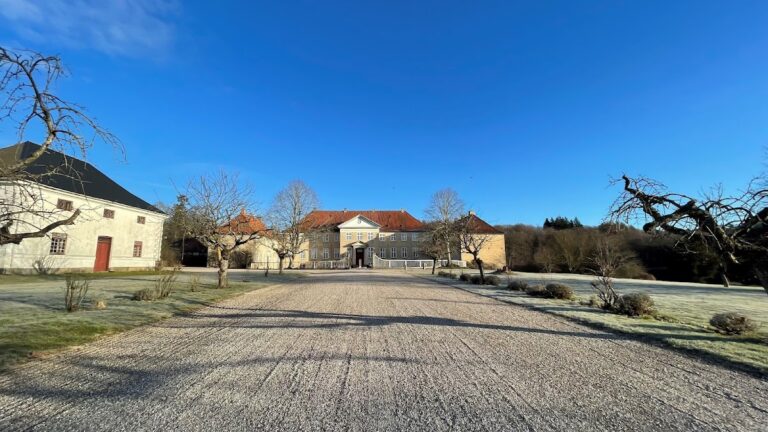
The estate covers 3,115 hectares, including 1,013 hectares of farmland and 1,499 hectares of woodland. Its principal buildings include the main house and associated farm buildings, most of which date from 1902.
Main house
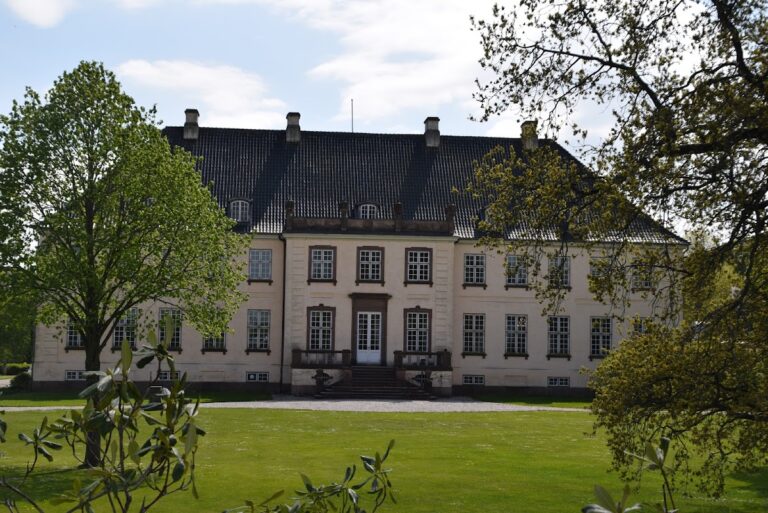
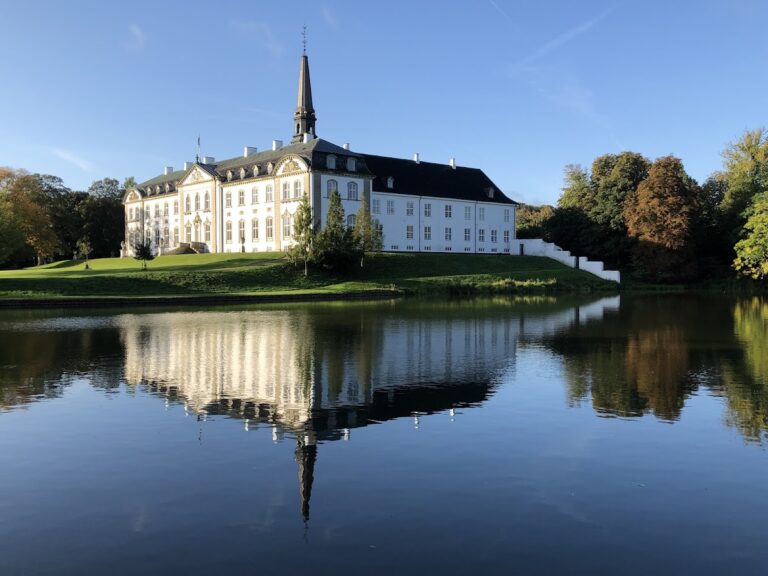
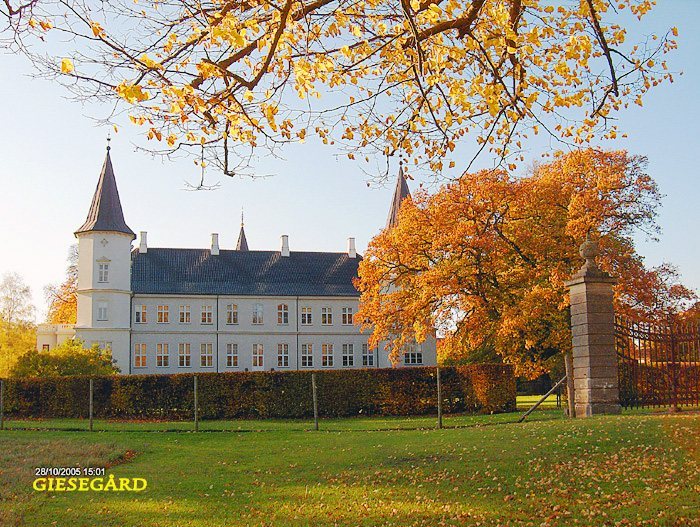
The oldest part of the main house was built between 1750 and 1751 as a single-storey structure. An additional storey was added during the 1840s, and both façades have triangular pediments. In 1873, architect Theodor Zeltner remodelled the house, changing its roof structure, adding two copper-clad towers and introducing sandstone decoration.
A restoration overseen by architect G. Tvede in 1904 removed most of the decorative features and clad the walls to give the building a more refined appearance. The house now has two storeys, white-plastered walls, two octagonal towers and a roof covered with black-glazed tiles.
Farm buildings
Most of the farm buildings associated with the estate date from 1902.