Ovetari Chapel: A Renaissance Family Chapel in Padua
Site at a Glance
- Popularity
- Very High
- Country
- Italy
- Primary era
- Medieval
- Eras represented
- Medieval
- Civilizations
- Venetian
- Site type
- Religious
- Remains
- Chapel
On this page12 sections
History
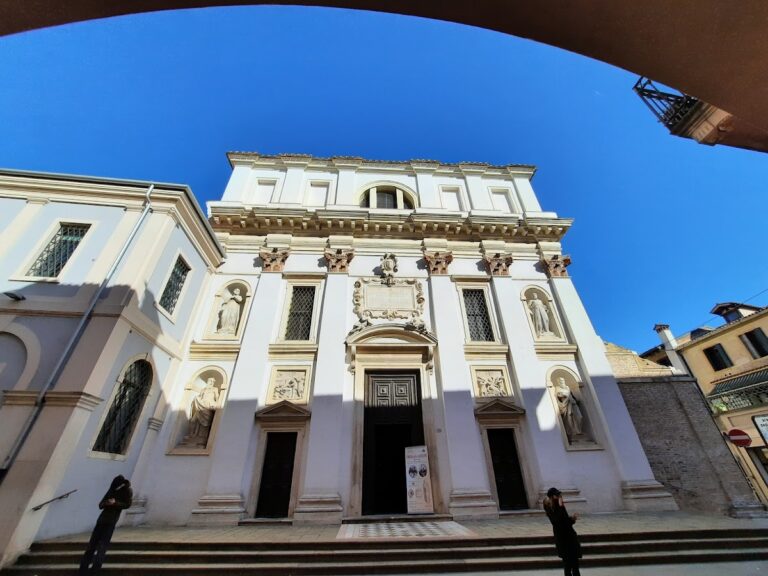
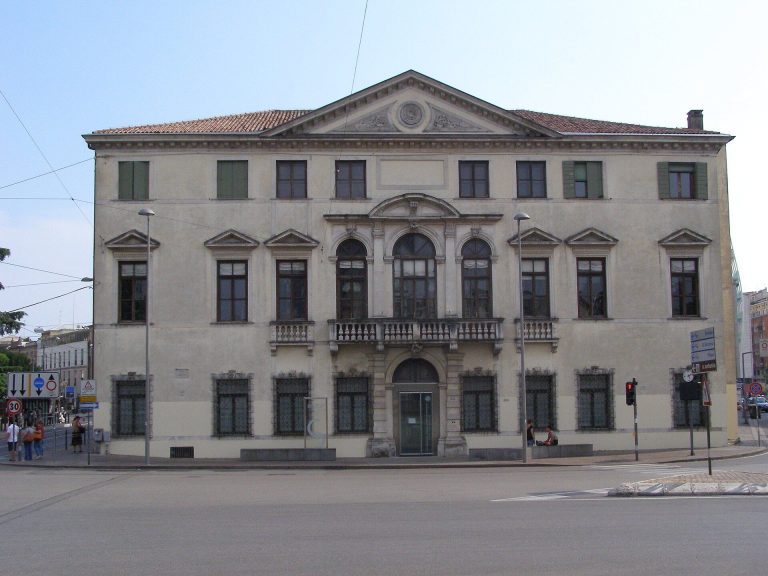
The Ovetari Chapel is a family chapel in the Church of the Eremitani at Piazza Eremitani in Padua, Italy. In 1448, Imperatrice Ovetari commissioned its Renaissance decoration with money left by her late husband, the Paduan notary Antonio Ovetari. The commission brought together painters Giovanni d’Alemagna, Antonio Vivarini, Niccolò Pizzolo, and Andrea Mantegna, then 17 and trained in Francesco Squarcione’s workshop.
Patronage and first campaign
The original plan assigned the chapel arch, cross vault, and right wall to d’Alemagna and Vivarini, with scenes from the Passion of Christ intended for the arch. Pizzolo and Mantegna were to work on the left wall and in the apse. In 1449, Pizzolo accused Mantegna of interfering with the altarpiece, prompting the patrons to redistribute the work. Mantegna probably paused his painting and visited Ferrara in connection with the dispute.
D’Alemagna died in 1450, and Vivarini left the project in 1451. Bono da Ferrara and Ansuino da Forlì then took over their work, with a style influenced by Piero della Francesca. Mantegna began painting saints in the apse and probably completed the left-wall scenes The Calling of Saints James and John and The Preaching of Saint James by 1450.
Completion and dispute
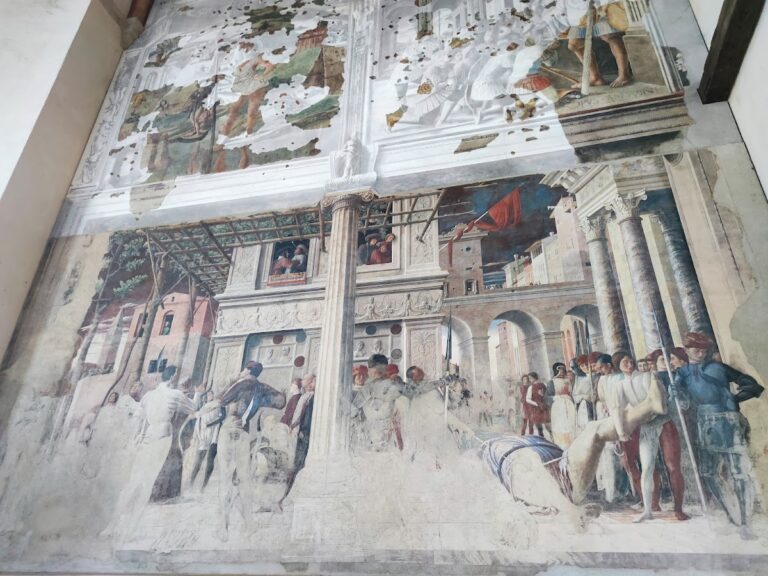
Work stopped at the end of 1451 for lack of funds and resumed in November 1453. Pizzolo died that year, and Mantegna carried the remaining campaign forward alone. By 1457, he had completed the Stories of Saint James, painted the Assumption of the Virgin on the central wall, and finished the lower scenes of the Stories of Saint Christopher. These included Saint James, son of Zebedee and one of the Twelve Apostles, and Saint Christopher, revered in Christian tradition as a martyr. Mantegna joined the Martyrdom of Saint Christopher and the transport of the saint’s beheaded body into a single composition.
In 1457, Imperatrice Ovetari sued Mantegna because his Assumption showed eight apostles rather than twelve. Painters Pietro da Milano and Giovanni Storlato were asked to assess the choice. They judged that the limited space justified the number of figures.
Damage and reconstruction
Moisture damage led to the removal of the two lower Saint Christopher scenes in 1886. The Assumption was detached about five years later. In 1941, all three paintings were taken from the church and stored in the Basilica of Saint Anthony, which protected them from the bombing that followed.
On 11 March 1944, an Allied air raid struck Padua. The target was the strategically important railway area less than a kilometre north of the church, but two bombs also hit the Church of the Eremitani, one near its façade and one at the Ovetari Chapel. The chapel was almost completely destroyed, and nearly all its frescoes were lost. The raid was carried out by 100 B-17 bombers of the U.S. Fifteenth Air Force. Fascist propaganda condemned the destruction as barbaric, while Allied observers regarded it as one of the war’s gravest losses for Italian art.
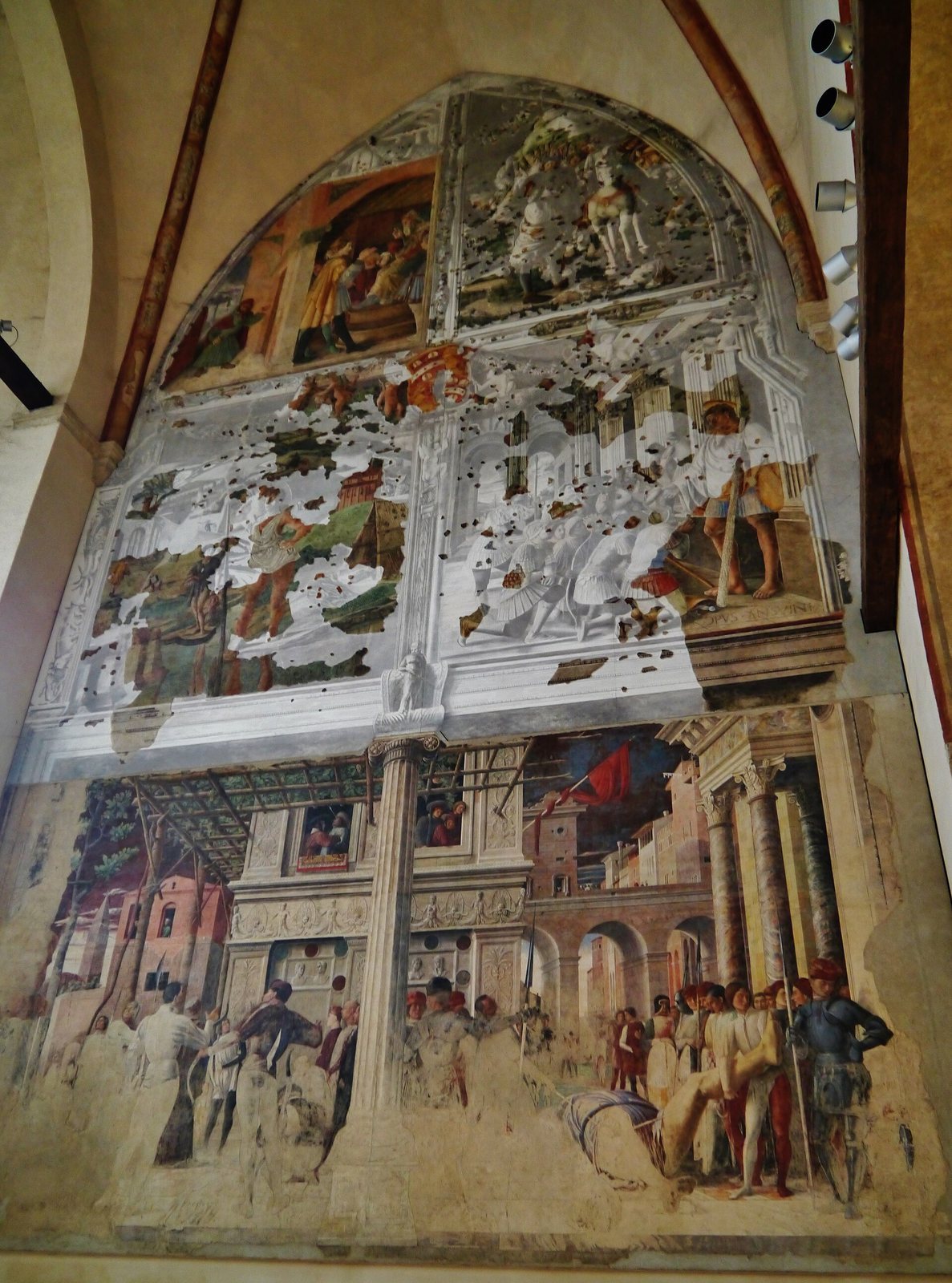
After the bombing, about 80,000 fragments, many very small, were gathered and packed into 18 wooden crates. German soldiers and local residents also took larger pieces from the ruins. Recovery and preservation began in 1946 under Italy’s Central Institute for Restoration and continued over subsequent decades. Later work used digital scans and pre-war photographs to match fragments to the paintings; another restoration phase began in the 1990s. The reassembly was completed in 2006.
Remains
The chapel occupies the right arm of the church transept. Its rectangular entrance room is covered by a cross vault formed from intersecting vaulted sections, and an arch opens into a recessed, five-sided apse. A circular opening and four tall windows in the apse provide light. The surviving decoration is a fragmentary reassembly incorporating salvaged pieces.
Fresco program
The chapel’s painted cycle was devoted to Saints James and Christopher. Each side wall carried six scenes arranged in three horizontal bands, with a rounded upper panel called a lunette. The cycle’s overall design, including its coordinated painted architectural frames, is generally attributed to Mantegna. Its stories draw on the Golden Legend, a medieval collection of saints’ lives.
Paintings and sculpture
North wall: Stories of Saint James
Mantegna painted the north wall, to the left when facing the altar. Its scenes show The Calling of Saints James and John, The Preaching of Saint James, Saint James Baptizing Hermogenes, The Judgement of Saint James, The Miracle of Saint James, and The Martyrdom of Saint James. The lunette’s perspective is tentative, while later scenes use it with greater control. In the lower scenes, a lower viewpoint links two episodes, with their perspective lines converging on a painted central column. Later backgrounds include a monumental triumphal arch, medallions, shallow column-like pilasters, sculpted figures, and large inscriptions, creating settings that evoke imagined historical reconstructions.
The Martyrdom of Saint James uses foreshortening, which shows figures at an angle to suggest depth. Its horizon lies below and beyond the image, making the figures appear from a low viewpoint. A curved ceiling with recessed panels and a gap in the tightly packed crowd deepen the composition; behind them lies an idealized medieval city. Across the scenes, Mantegna’s outlines develop from hard, sometimes delicate lines into denser, brighter hatching. The figures’ firm forms can resemble marble or hard stone, giving them a sculptural quality.
South wall: Stories of Saint Christopher
The south wall carries the Stories of Saint Christopher. Saint Christopher Leaving the King is attributed to Ansuino da Forlì, as is Saint Christopher and the King of the Devils. Bono da Ferrara signed Saint Christopher Ferrying the Child, and Ansuino signed Saint Christopher Preaching. Mantegna painted the Martyrdom of Saint Christopher and the Transportation of Saint Christopher’s Beheaded Body. In the martyrdom, painted architecture appears to open into an open-sided gallery beyond the wall. Its buildings combine classical and other forms, while the figures are more relaxed, individualized, and softly modelled than those in the James scenes, with a Venetian influence. Old copies preserve the apparent extension of figures beyond the painted frames in this scene and the Assumption; one such copy is in the Musée Jacquemart-André in Paris.
Central wall and apse
Mantegna’s Assumption of the Virgin occupies a narrow, tall area of the central wall, which contains a small window. Some surviving fragments, including one depicting an angelic seraph, may have come from the supporting piers. In narrow sections of the apse, Mantegna painted Saints Peter, Paul, and Christopher standing on clouds within a stone frame decorated with fruit garlands. The figures’ format and sculptural solidity have been compared with Andrea del Castagno’s frescoes at San Zaccaria in Venice, dated 1442.
Vault and arch
On the vault, Vivarini painted the four Evangelists, the traditional authors of the Gospels: Matthew, Mark, Luke, and John. D’Alemagna’s decorative garlands surround them. Pizzolo painted a blessing image of the Eternal Father, a traditional depiction of God the Father, and medallions of the Doctors of the Church, influential Christian theologians recognized for their teaching. They appear as learned humanists at work in their studies. Two very large heads painted on the arch are generally identified as self-portraits of Mantegna and Pizzolo.
Terracotta altarpiece
Pizzolo’s altarpiece, made of terracotta and covered with bronze, remains in the chapel in a badly damaged condition. Its devotional relief, showing sacred figures together in one setting, resembles the composition of Donatello’s Altar of the Saints.