Nemea: Sanctuary of Zeus and Site of the Nemean Games
Site at a Glance
- Popularity
- Very High
- Country
- Greece
- Primary era
- Classical
- Eras represented
- Classical, Early Modern
- Civilizations
- Ancient Greek, Byzantine, Ottoman
- Site type
- Religious
- Remains
- Sanctuary
On this page20 sections
History
Nemea is an ancient Greek sanctuary dedicated to Zeus, the chief god of ancient Greek religion, in Greece. Established in the sixth century BC, it became the setting for the Nemean Games, one of the major shared festivals of the Greek world. The sanctuary lay in the territory of Cleonae and later came under Argive administration. It was a religious center, not a city-state or a permanently settled town.
Early occupation and sanctuary
The surrounding area had been inhabited since the early Neolithic period, around 6000-5000 BC, and was occupied again during the Mycenaean period, the Late Bronze Age civilization of mainland Greece, approximately 1500-1100 BC. These earlier phases preceded the sanctuary’s role as a center for worship and athletic contests.
The Nemean Games and their traditions
At first, the Nemean Games were local contests held under Cleonae. By 573 BC, they had gained Panhellenic status, meaning that Greeks from different city-states took part. Held every two years, usually in July, they ranked among the four principal Panhellenic festivals, alongside the Olympic, Pythian, and Isthmian Games.
Two myths explained the Games’ origins. In one, Heracles, the legendary Greek hero, established them in honor of Zeus after killing the Nemean Lion, the beast associated with his first labor. This link between Heracles and the Games appears in ancient literature only from the first century AD, and other versions of the lion story do not connect it with the festival. In another tradition, the Seven Against Thebes, legendary leaders of an expedition against that city, held funeral games for the infant Opheltes. He was the son of the mythical king Lycurgus and Queen Eurydice, and was killed by a snake while his nurse, Hypsipyle, was away fetching water. Opheltes was also called Archemorus, meaning “the beginning of doom.”
Transfers and warfare
The Games moved to Argos in the late fifth century BC, with 415 BC given as the date. They returned to Nemea around 330 BC, but were transferred permanently to Argos around 270 BC. Aratus of Sicyon, a Hellenistic Greek statesman, attempted to bring them back in 235 BC, without lasting success. Mummius, a Roman commander active in Greece, held one final edition at Nemea in 145 BC. During the Roman period, the Games took place at Argos.
In 394 BC, during the Corinthian War, a conflict between Sparta and a coalition of Greek states, a major battle was fought nearby along the Nemea River. Sparta and forces from Achaia, Elis, Mantinea, and Tegea fought Boeotians, Euboeans, Athenians, Corinthians, and Argives. Sparta won, although its allies suffered substantial losses.
Later occupation and investigation
After the Games’ final move, the sanctuary gradually fell out of use, and its land became farmland and grazing ground. A Christian community occupied the area from the fourth into the sixth century AD. Around 580-590, amid Slavic incursions and changing river conditions, the site was abandoned.
People settled in the valley again from the twelfth century, during the Principality of Achaea, a medieval Frankish state in the Peloponnese, and occupation continued into the early Ottoman period. Later, a landslide blocked the Asopos River gorge, altered drainage, and formed marshland. Drainage work in 1883 made cultivation possible, and a village was built soon afterward.
Investigations began in 1776, followed by French excavations in 1884. The American School of Classical Studies at Athens excavated in 1924-1926 and returned in 1964. Annual work resumed in 1973 under the University of California, Berkeley, directed by Stephen G. Miller. The project included work on the Temple of Zeus and construction of an archaeological museum, which was transferred to the Greek state in 1984. Nemea received the European Heritage Label in 2021 for its connection to the origins of European sport and the ideals associated with classical and modern sport. A modern revival of the Nemean Games has taken place at the site every four years since 1996.
Remains
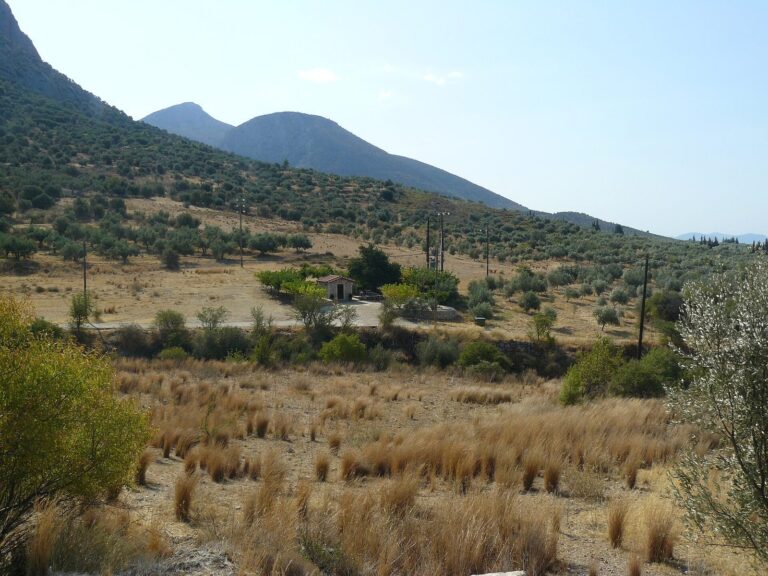
The sanctuary occupied a valley and brought together the Temple of Zeus, altars, rows of service buildings, accommodation, baths, and a stadium. A sacred enclosure also included a shrine associated with Opheltes. The surviving structures range from ancient Greek buildings to a Christian church, while excavation finds are displayed in the site museum.
The temple precinct
Temple of Zeus
An earlier temple, first built in the sixth century BC, was destroyed by fire in the fifth century BC. Its successor was erected around 330 BC over the earlier sanctuary, whose position is marked by a surviving foundation wall. The later building measured about 42 by 22 metres, was constructed mainly from limestone, and had 32 exterior columns arranged in a six-by-twelve plan. Its outer columns were Doric, while Corinthian and Ionic forms were used inside, including in the inner rows of columns and on the upper level. These are three distinct types of ancient Greek column design. The exterior columns were slender, standing about 6.34 times their diameter in height, a proportion that anticipates Hellenistic architecture, the Greek cultural period that followed the Classical age. The completed temple had no sculpted decoration.
Three columns survived from antiquity. Two were re-erected in 2002 and four more by late 2007; nine columns stood by 2011. Work on re-erecting the temple was still under way that year, and by 2014 a horizontal beam above the columns had been completed at one corner. A large statue of Zeus once stood inside, but it is lost. When the Greek writer Pausanias visited in the late second century AD, the roof had collapsed and the statue was no longer there. He described the temple as worth seeing and placed it within a grove of cypress trees.
Altars and sacred enclosure
A large altar of Zeus stood east of the temple. It was about 41 metres long, and its foundations remain. The sanctuary’s sacred enclosure contained the shrine of Opheltes, as well as a large open-air altar that has been excavated. Opheltes’ tomb was surrounded by open-air altars and enclosed by a stone wall.
Buildings for officials, athletes, and bathing
Oikoi and dining area
Nine buildings known as oikoi, the plural of a Greek word usually meaning “house,” stood in an east-west row south of the temple, facing north. Their precise date and use are uncertain. They have been understood as treasuries or meeting places, and as accommodation for priests, judges, or officials during the Games. Their limestone foundations are what remain, after damage from farming and the removal of building material. The largest, the first building in the row, measured 22.40 by 13.15 metres.
A well occupied a back room in the eighth building, perhaps for food preparation; the building was later used as a bronze-sculpting workshop. The ninth served as a cooking area for a neighboring dining establishment and was destroyed early. That dining building measured 9.82 by 7.44 metres and could hold up to eleven dining couches. A sacrificial pit lay 6.20 metres to its west; its ash and pig bones are consistent with ritual dining. Four kilns southwest of the dining area were probably used to make roof tiles during a later fourth-century BC renovation.
Athlete accommodation
The xenon, an accommodation building for athletes and trainers, stood about 70 metres south of the temple. Built around 330-300 BC, it measured about 80 by 25 metres and had at least 14 rooms over two storeys. A dining hall, called the hestiatorion, stood beside it, just south of the treasuries.
Baths and water supply
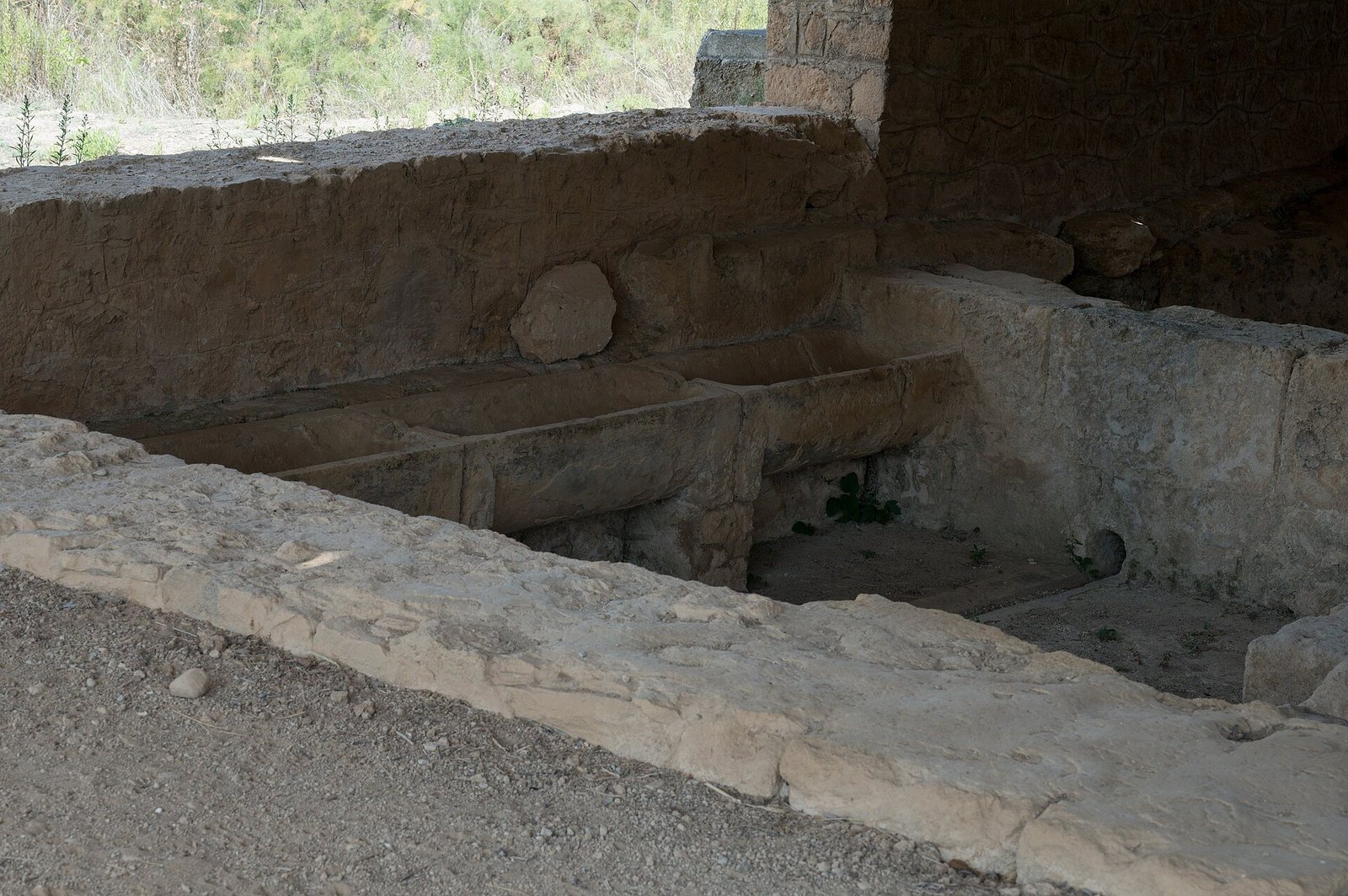
A bath building about 10 metres west of the accommodation block had three rooms: a central pool room and two rooms containing baths. A one-kilometre water channel brought spring water to the baths through a tunnel with a curved ceiling. The channel used tapered, U-shaped tiles covered by roof tiles. Parts of it remain visible near the baths.
Stadium and athlete facilities
Stadium
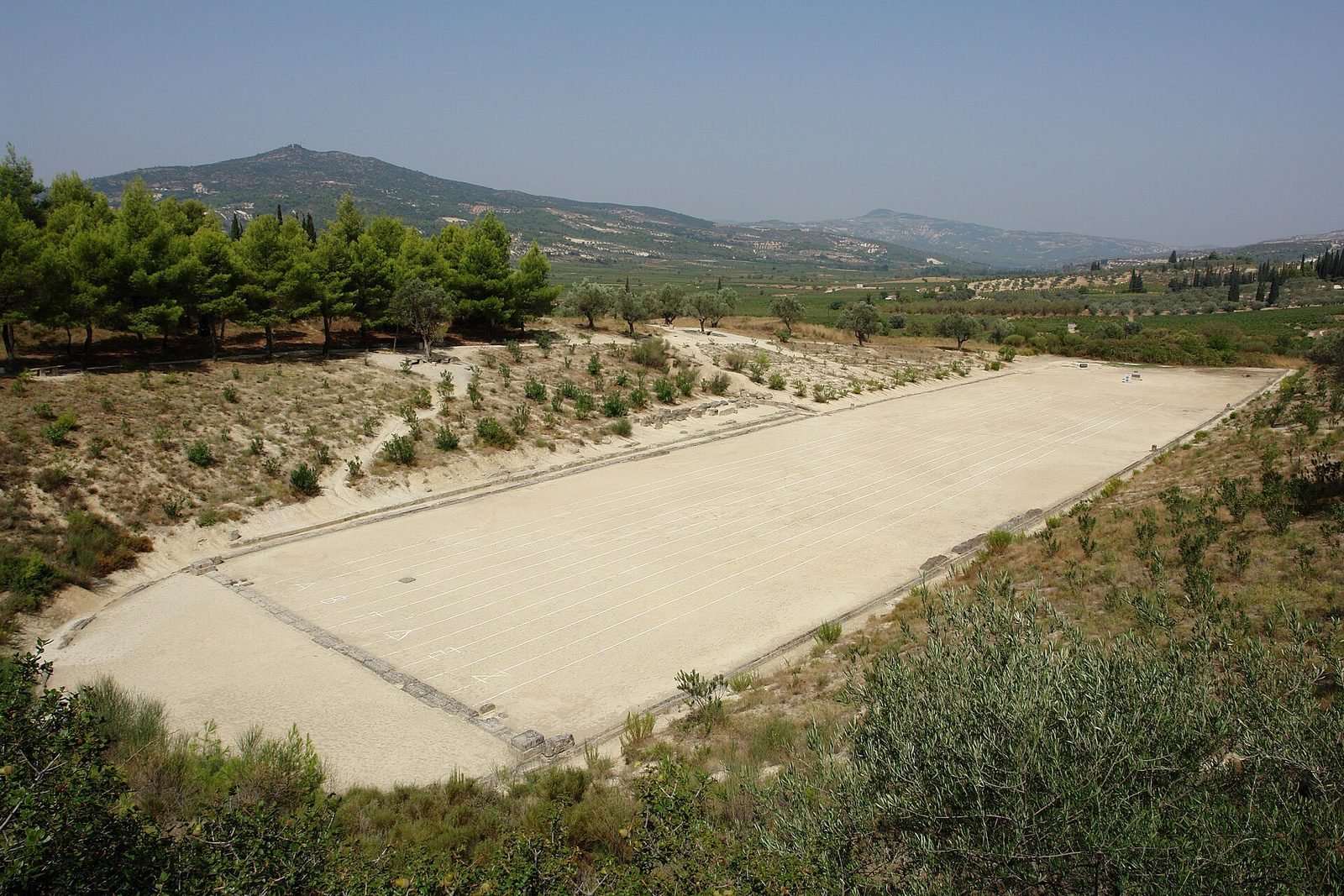
The later stadium, built around 330-300 BC, lay about 500 metres southeast of the temple on a north-south axis. It occupied a natural hollow between ridges, with the slopes serving as seating banks. The track measured 600 Greek feet, approximately 178 metres, and had six lanes marked with Greek letters. Its estimated capacity was 30,000-40,000 spectators. Most people watched from the earth banks, while a limited number of limestone seats, including places for distinguished visitors, stood near the starting end. An earlier stadium used in the fifth and fourth centuries BC probably occupied a hollow immediately west of the temple, later crossed by a stream.
Stone channels ran beside the track, and basins originally received water from a spring. Stone starting blocks remain in place, with grooves for runners’ toes and holes for the hysplex, a device that released runners together. The starting barrier is described as wooden posts joined by a crosspiece and lowered with a rope pulley. A stone starting line is also exposed.
Changing building and passage
The athletes’ changing building stood in a natural hollow east of the stadium. It had a rectangular plan and a court surrounded by columns. Stamps on roof tiles preserve the architect’s name. A passage about 36-37 metres long connected the changing area with the stadium entrance; it had a continuous curved ceiling and lay beneath roughly seven metres of earth. It is an exceptionally early surviving example of Greek vaulted construction. Victory inscriptions and the name Telestas, identified as an ancient Olympic victor, appear as graffiti on its walls. Two black marble bases found in 1974 may have supported statues of victors.
Spring, later buildings, and finds
Spring and shrine of Opheltes
A spring in the sanctuary’s southwest was known in antiquity as Adrasteia. Pausanias wondered whether its name came from a man called Adrastos who discovered it; the same name belonged to Zeus’s nurse in Cretan myth. The nearby shrine was associated with Opheltes. A burial mound in the area was thought to be the tomb of his father, Lycurgus, and a sacred grove may also have stood there. The remains of an Ottoman-period well house are near the spring.
Christian church
A Christian basilica, a large church building, was erected on the site of the athlete accommodation in the fourth or fifth century AD. Its builders reused parts of the Temple of Zeus. The church had a central hall, side passages to the north and south, and a curved sanctuary end to the east. A baptism room stood to its north, with a circular baptismal basin at its center. Most of the visible remains in this area belong to the church.
Mycenaean tomb and excavated finds
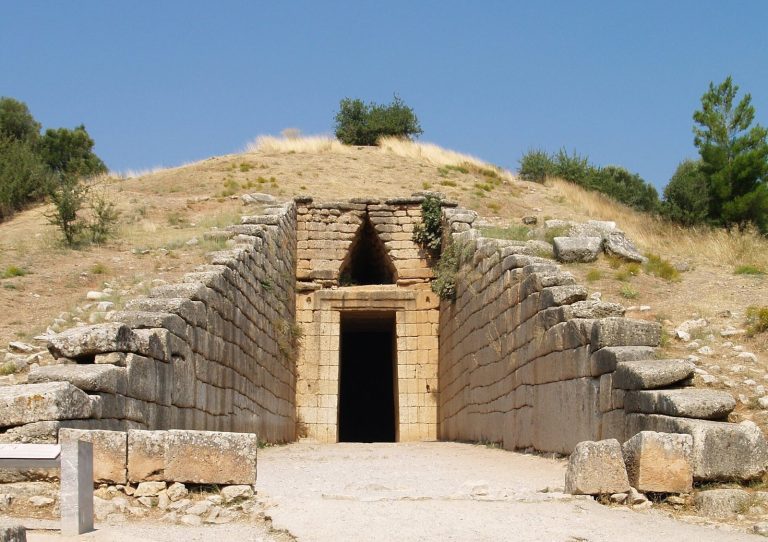
A large, intact tomb discovered at Nemea in 2018 dates to the early Mycenaean period, around 1650-1400 BC. Finds from the site include statues dedicated as offerings, fragments of sporting equipment, pottery, and coins from across the ancient world. Excavations also recovered small lion-head fittings and a gold-foil relief of Heracles wearing a lion skin tied beneath his chin. These objects are displayed in the archaeological museum, whose collections include material from Nemea and nearby areas dating from the Bronze Age to the early Byzantine period, the first centuries of the eastern Roman Empire.