Azoria: An Archaic Greek City on Crete
Site at a Glance
- Popularity
- Medium
- Country
- Greece
- Primary era
- Classical
- Eras represented
- Bronze Age, Classical
- Civilizations
- Ancient Greek, Mycenaean
- Site type
- City
On this page12 sections
History
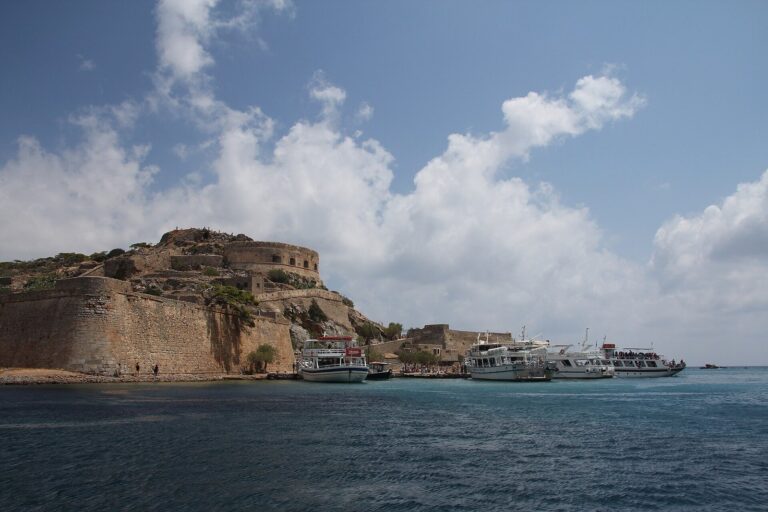
Azoria is an ancient Greek settlement on a double-peaked hill near Kavousi in Crete, Greece. Occupation began in the Final Neolithic, the last phase of the Neolithic, and continued through the Bronze Age and Early Iron Age, also called the Greek Dark Age on Crete. A settlement was in use around 1200 BC, before a Greek city of the Archaic period, the era before Classical Greece, took shape around 600 BC. The site preserves evidence of the transition from long-term settlement to an urban center.
Early occupation and the Archaic city
Azoria’s settlement history extended over many centuries before the Archaic city was established. Major changes to civic and household spaces, the construction of large public buildings, and alterations to the surrounding landscape point to a broad reorganization. This process appears to have been underway by the end of the Late Orientalizing period, a phase of early Greek history shaped by artistic influence from the eastern Mediterranean, around 640–600 BC.
Around 600 BC, older settlement remains were ritually destroyed and filled, and a new city was built over them. A bench shrine and ritual objects from the earlier settlement were reused. The altered civic and domestic spaces and the reshaping of the settlement suggest deliberate urban planning.
Destruction and later use
Fire destroyed the Archaic city in the early fifth century BC. Its public buildings were damaged and abandoned, bringing the city and its long period of occupation to an end. Use of the site resumed on a limited scale around 200 BC, probably with a single tower on the summit of the South Acropolis, the elevated central area.
Archaeological investigations
In 1900, American archaeologist Harriet Boyd-Hawes dug a trench on the southern peak. She identified pottery from the earliest levels as Late Mycenaean and Early Geometric. She assigned other finds to the Orientalizing period and the Hellenistic period, which followed the conquests of Alexander the Great.
Excavation resumed in 2002 with the Azoria Project. Its work has examined the settlement’s development from the Bronze Age and its growth into a regional center, with particular attention to the sixth-century BC city.
Remains
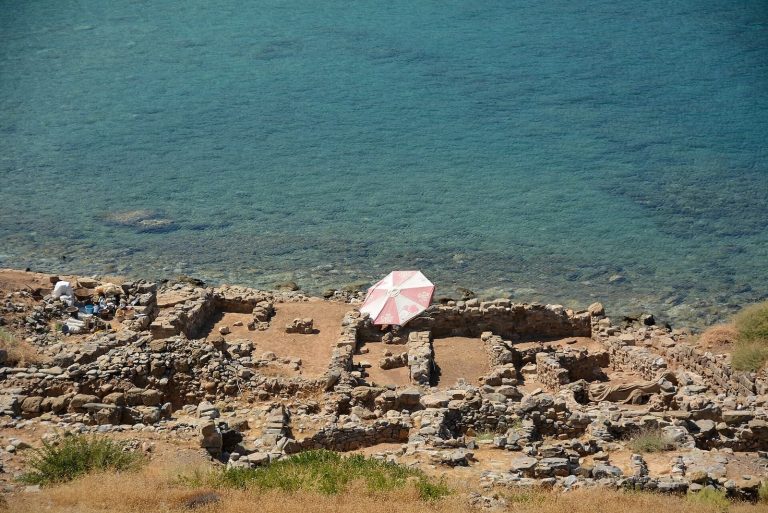
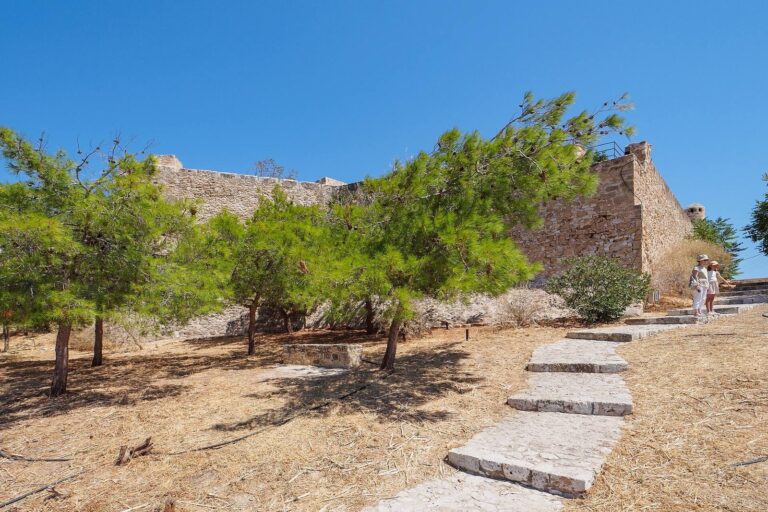
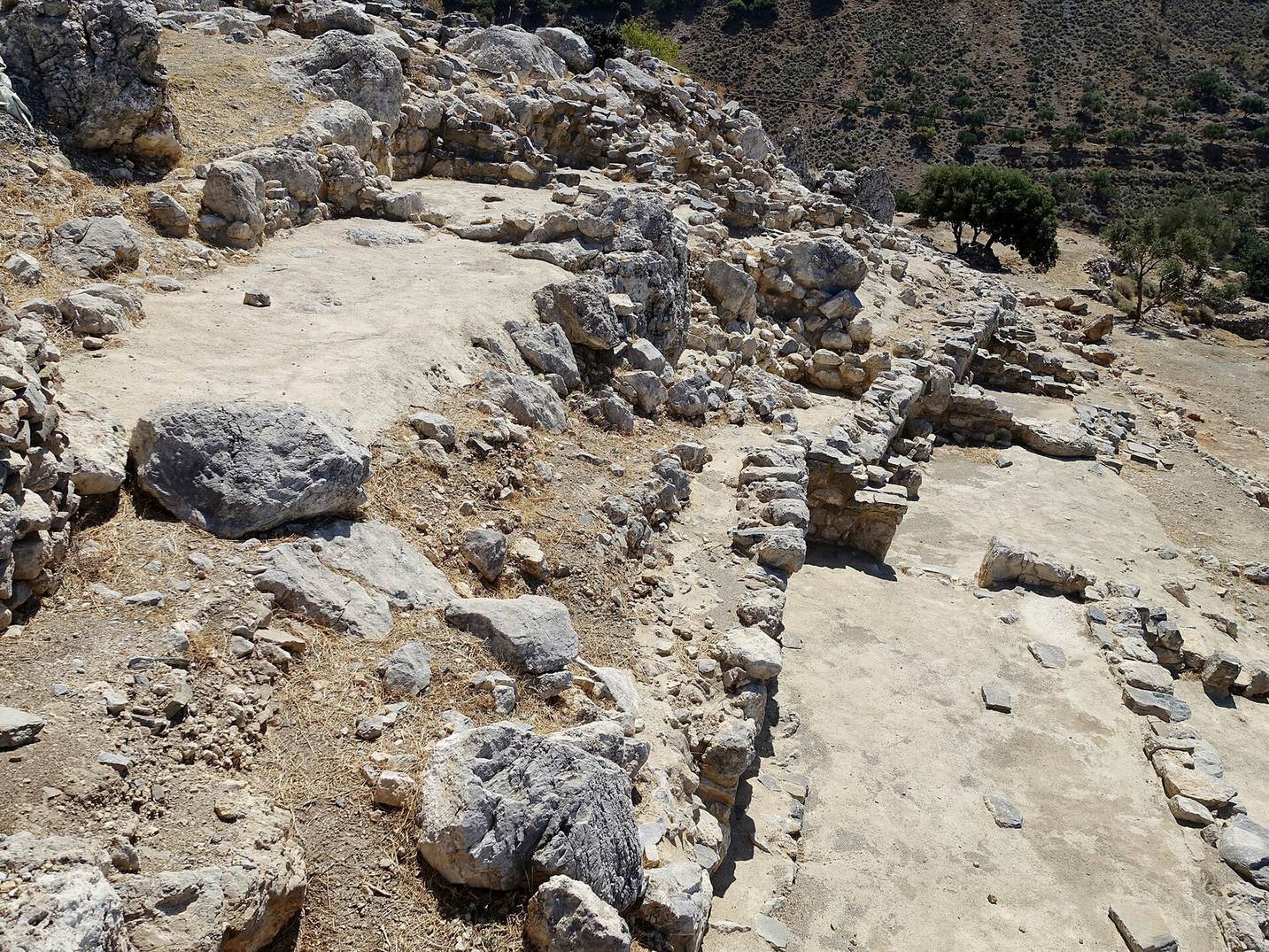
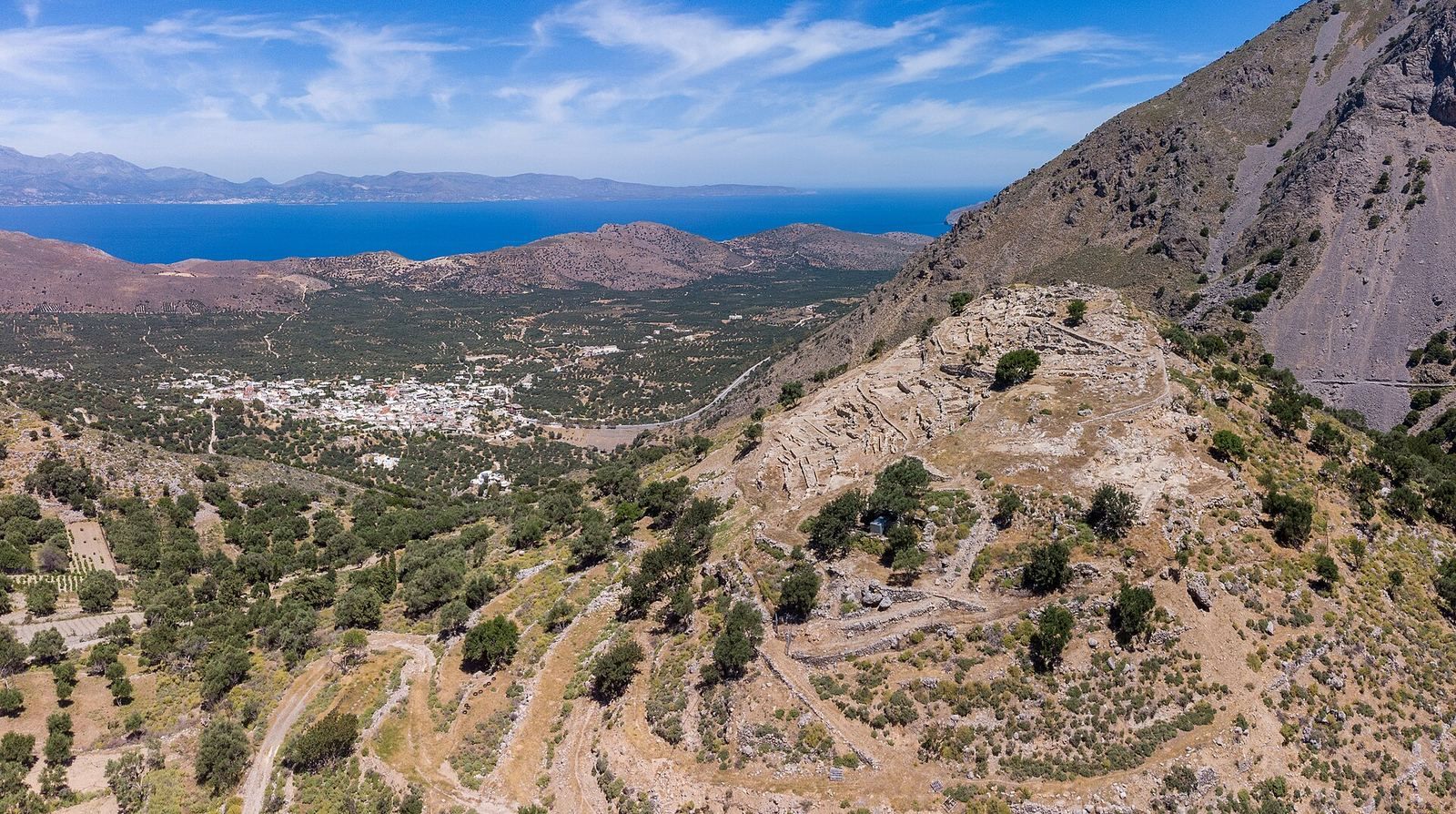
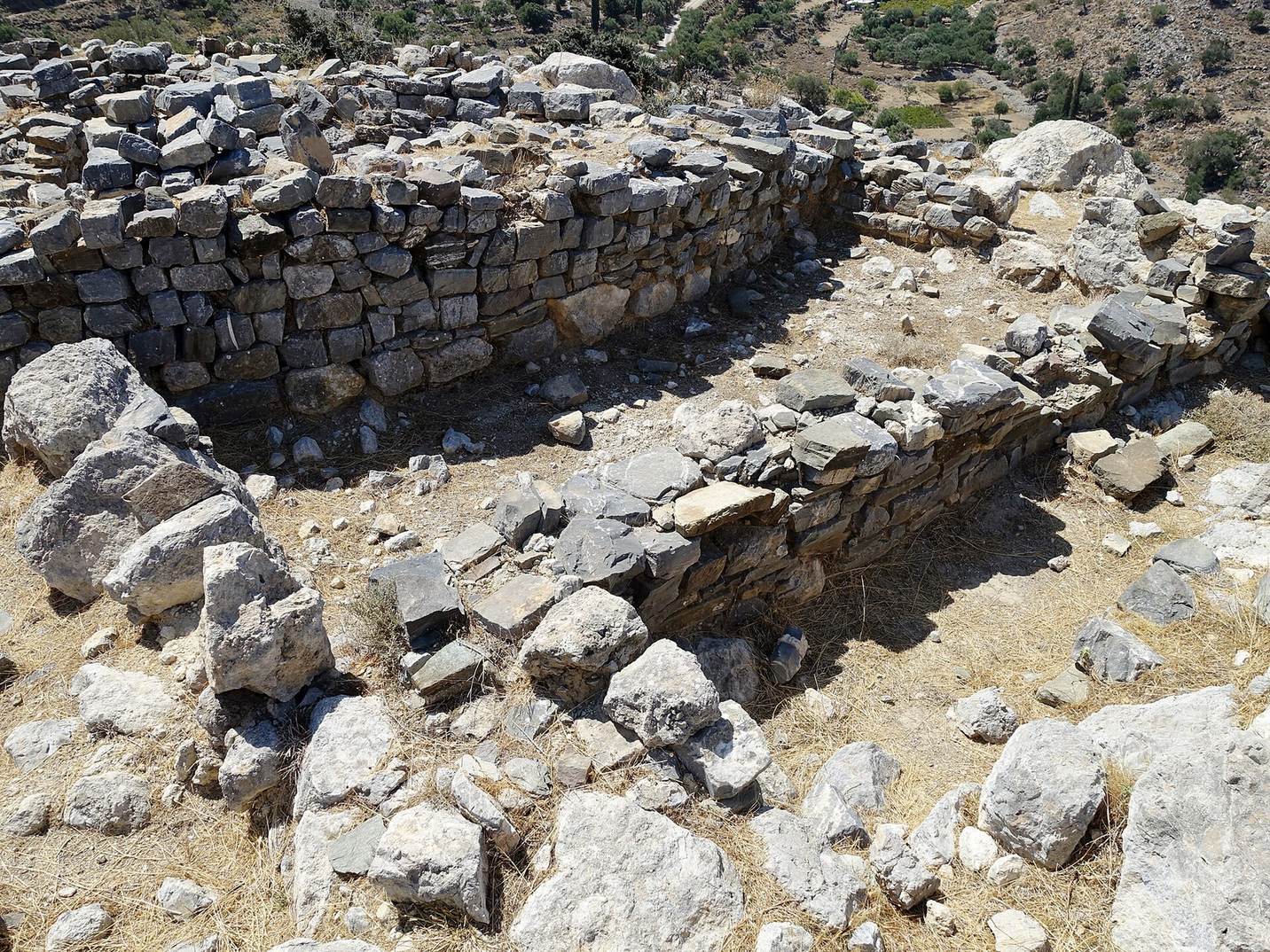
The site occupies a hill about 365 m above sea level, overlooking the Gulf of Mirabello. It lies roughly 1 km southeast of Kavousi and about 3 km from the sea, between the Isthmus of Ierapetra and the Siteia Mountains. Steep slopes required large retaining walls to support terraces. At its greatest extent, the Archaic settlement covered about 15 hectares. The most visible remains are houses and communal buildings dating to 600–500 BC. Public buildings cluster near the summit on the western and southern sides of the South Acropolis and cover more than 0.6 hectares; communal buildings also occupy the upper western slope.
Earlier settlement remains
Remains from around 1200 BC include a complex interpreted as a manor house, a temple, and a tholos, a round or beehive-shaped tomb. They represent an earlier phase of settlement beneath the later Archaic city.
Public and communal buildings
Communal Dining Building
This multi-room building contained several dining rooms, at least three storerooms, and three kitchens. Remains of grapes, olives, and grain came from the storerooms, while food debris and vessels for eating and drinking lay on the floors. Finds also included decorated stands for kraters, vessels used to mix wine and water, as well as bronze armor. Bronze weapons were apparently once hung on the walls.
The building may have served as an andreion, a Cretan communal dining hall where male citizens met in groups called hetairiai for shared meals known as syssitia. A separate room contained an altar and burned food remains, evidence of recurring sacrifices connected with the underworld.
Monumental Civic Building
The building’s main hall had an interior area of about 200 m², with a stepped bench running along its walls. An adjoining shrine comprised two rooms. The hall appears to have hosted public banquets and formal religious activities, and its ceremonial function may have resembled that of a prytaneion, a civic building associated with officials and communal functions.
Finds from the hall included roasted sheep and goat leg joints, chickpeas and other legumes preserved in pots on the floor, and vessels for dining and drinking. Stone kernoi, offering tables, were carved into the bench’s upper step. Another offering table in the Minoan style was found face down on the bench. In the shrine, a curved hearth and an altar stood with terracotta female figurines, offering stands and vessels, and food offerings. The figurines’ styles date them to the eighth and seventh centuries BC.
Service, production, and domestic areas
Olive-press building
A service building beside the Monumental Civic Building contained a well-preserved olive-press installation. Its components included a press bench and beds, sockets for wooden beams, a press weight, a roller crusher and mortar block, a collection basin, a small olive-processing mortar, a cooking stand and hearth, oil-separation vessels, and press cake. The installation represents the earliest documented lever-and-weight press of the post-Bronze Age Aegean, while an Archaic beam press is also known at Klazomenai.
Greek inscriptions and scratched marks appeared on pots from the service building. A reused storage-jar rim had handles bearing an inscription in Eteocretan, an ancient Cretan language distinct from Greek.
Storage and household buildings
Both major public buildings had associated service areas with multiple storerooms and kitchens equipped with large stone-lined hearths. Decorated large storage jars held food supplies. The site also includes a separate storage building and several excavated building complexes that appear to have housed extended families, each with its own storerooms.