Kastro Kales: A Venetian-Period Harbor Fortress in Greece


Site at a Glance
- Rating
- 4.2
- Popularity
- Medium
- Country
- Greece
- Primary era
- Medieval
- External website
- Open
- Eras represented
- Medieval, Early Modern
- Civilizations
- Venetian
- Site type
- Military
- Remains
- Fort
On this page5 sections
History
Kastro Kales is a Venetian-period fortress in Ierapetra, Greece, on the island of Crete, founded in 1212. The Venetian period was the era when the Republic of Venice governed Crete from the early thirteenth century until the island’s Ottoman conquest. Built beside the harbor, the fortress helped protect the town’s maritime approach.
Foundation and Venetian rule
One tradition attributes the fortress’s first construction to Enrico Pescatore, a Genoese pirate and maritime leader also known as Henry, Count of Malta. In this version, he later sold the fortress to the Venetians. Another tradition credits the Venetians with building it directly. An earthquake in 1508 severely damaged the structure, which was refortified in 1626 by Francesco Morosini, a Venetian military commander and statesman active in the conflicts between Venice and the Ottoman Empire.
Ottoman repairs and later damage
In 1647, Kastro Kales and the wider Ierapetra region came under Ottoman rule. The Ottoman Empire was an imperial state that governed territories across southeastern Europe, the eastern Mediterranean, and the Middle East. Ottoman authorities repaired the fortress and strengthened Ierapetra’s defenses, including the city walls. More than 150 Ottoman-built fortifications in the region were used during the Greek Revolution, the nineteenth-century struggle that led to the establishment of the independent Greek state.
The fortress suffered substantial damage in the earthquake of 6 December 1779. Further Ottoman repairs took place between 1866 and 1869. After independence, the Greeks demolished the later city walls, while Kastro Kales remained as an archaeological monument of Greece. Its name derives from the Turkish word kale or kule, meaning “castle” or “tower.”
Remains
Fortification and interior
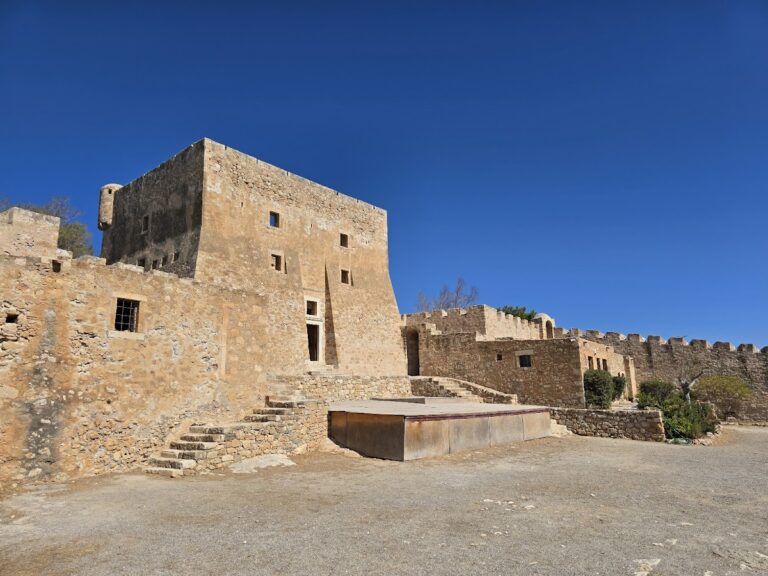
Kastro Kales stands at the southern end of Ierapetra beside the harbor. It is a relatively small rectangular fortification, measuring approximately 50 meters from east to west and 25 meters from north to south. A tower occupies each corner, and the low walls carry crenellations, the raised sections along the top of a defensive wall. Barracks lay inside the enclosure beneath the ramparts, while a water cistern occupied its center. The fortress housed a garrison of 300 people.