Panagia tou Araka: A Byzantine Monastery Church in Cyprus
Site at a Glance
- Popularity
- Medium
- Country
- Cyprus
- Primary era
- Medieval
- Eras represented
- Medieval, Early Modern
- Civilizations
- Byzantine, Crusader, Kingdom of Cyprus, Ottoman
- Site type
- Religious
- Remains
- Church
On this page11 sections
History
Panagia tou Araka is a Byzantine church near Lagoudera in Cyprus, built in the twelfth century during the medieval Eastern Roman Empire as the principal church of a men’s monastery. Its murals, completed in 1192, are associated with Theodore Apsevdis, a monk trained in Constantinople. The church stood between Lagoudera and Sarandi, away from the villages.
Foundation and twelfth-century paintings
A foundation tradition recorded by the traveler V. G. Grigorovich-Barsky in 1735 tells how a local ruler’s hawk became trapped in a bush while hunting. When people cut into the bush to release it, they found an icon of the Virgin Mary inside. A monastery was then built to shelter the icon. The name Araka has been connected both with the hawk in this story and with vetch, a flowering legume growing on the mountain slopes; the plant is considered the likelier source of the name.
The church served as the monastery’s main church, although the circumstances and precise date of its consecration remain uncertain. Its location away from nearby settlements has also led to the suggestion that it was privately owned or functioned as a monastery. The building itself dates to before 1192. An inscription gives December of that year as the completion date for its murals. The painter was the monk Theodore Apsevdis, whose training in Constantinople is also reflected in the artistic character of the paintings.
A prayer within the church identifies the aristocrat Leontios Authentes as Leon. He was probably the patron of the paintings and was seeking refuge at a nearby monastery founded by his father. The Virgin of the Passion mural has been interpreted in connection with his grief during the battles and changes of leadership that had recently affected Cyprus.
Monastic use and later changes
Water damage prompted the repair of some murals around the fourteenth century. An inscription about this work bears the name of a deacon, Leontios. When Grigorovich-Barsky visited in 1735, three monks lived at the monastery, which was then close to abandonment. The institution continued into the early nineteenth century. Women were prohibited from entering the church and prayed on its porch.
Restoration and heritage recognition
The Cyprus Department of Antiquities restored monastery buildings in 1955–1956 and 1967–1968. From 1968 to 1973, David Winfield directed the cleaning, restoration, and conservation of the murals. His wife, June Winfield, analyzed the images and produced drawings. Panagia tou Araka became part of the UNESCO World Heritage property Painted Churches in the Troodos Region in 1985.
Remains
Church and monastery buildings
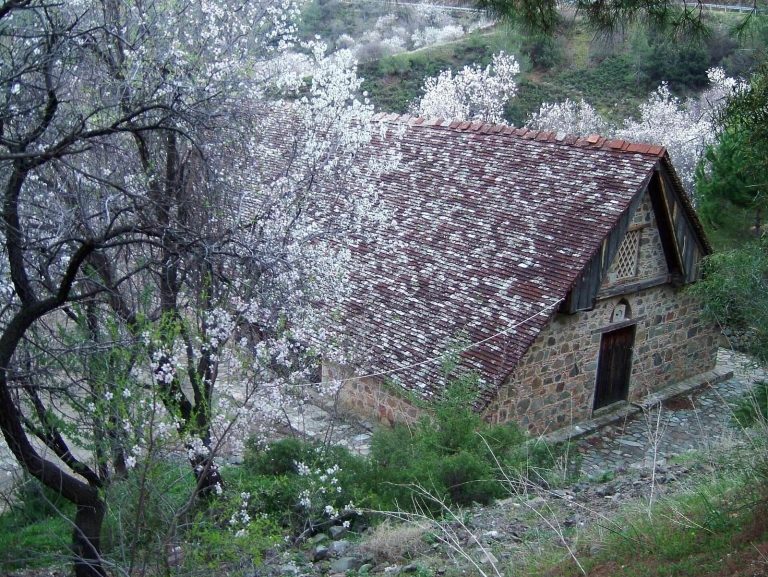
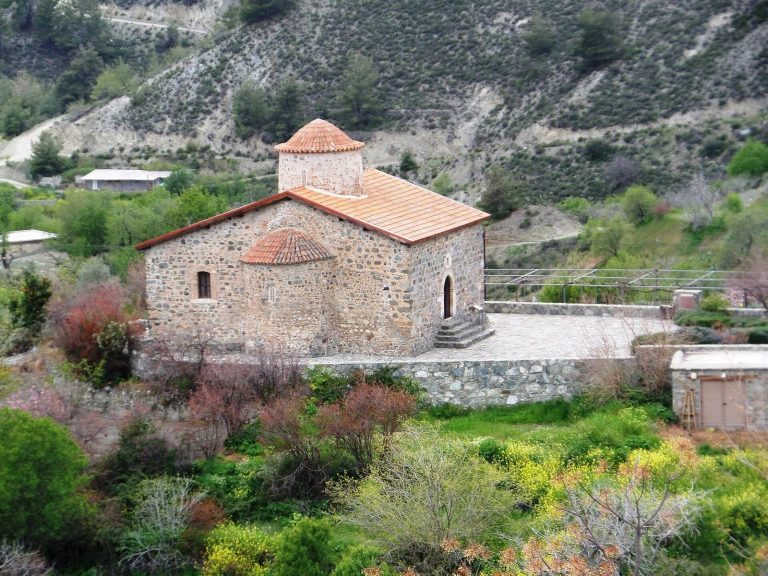
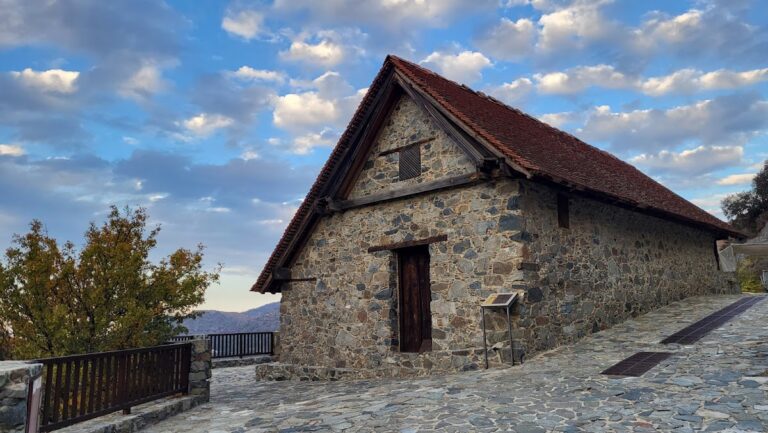
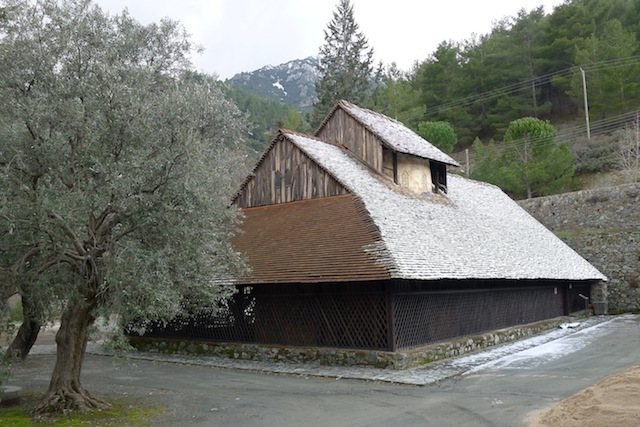
The church is a single-nave building with a vaulted ceiling, niches in each of its three side walls, and a dome resting on a low cylindrical drum, the base that supports a dome. Probably in the fourteenth century, a steep timber roof covered with flat tiles was added above the church. It extends beyond the building on three sides, while a smaller roof shelters the dome. In the eighteenth century, the western wall was removed as the church was enlarged. A surviving two-storey monastery building is now used as a residence for priests.
Paintings and furnishings
Dome and sanctuary
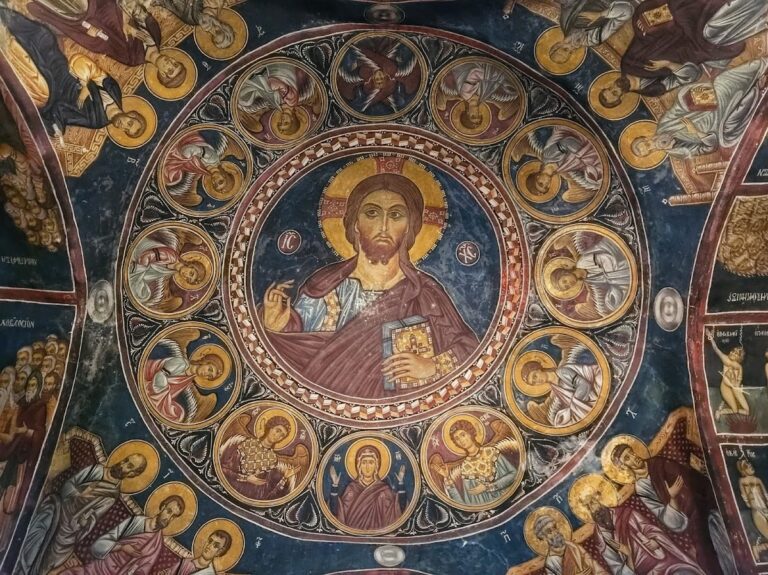
The central roundel of the dome depicts Christ Pantocrator, an image of Christ as ruler of all, against a red background. Beneath it are the Prepared Throne, an empty throne associated with Christ’s anticipated return and judgment, and angels shown in medallions. Twelve apostles holding scrolls with prophetic passages appear on the drum. In the semicircular sanctuary recess, or apse, seven Cypriot saints are painted on the wall. The curved half-dome, or conch, above the altar shows the Virgin enthroned among archangels, while the sanctuary ceiling depicts the Ascension. The sanctuary paintings differ in style from the rest of the murals and predate 1192.
Images of the Virgin and Christ Child
On the southeastern wall, the Virgin of the Passion shows Mary standing before her throne with the Christ Child. Angels carry a spear and a cross, each represented at the Child’s scale. An elaborate prayer accompanying the image names Leon as its donor. Opposite, Saint Simeon holds the Christ Child beside John the Baptist, who carries a scroll referring to Christ as the Lamb of God. The composition evokes the Presentation of Christ in the Temple. Its placement has also been interpreted as a reference to the purification of a mother forty days after the birth of her first son.
Painted arches and figures
Above the north entrance, an arch contains a fourteenth-century scene of the Presentation of the Virgin Mary in the Temple. The priest Zechariah welcomes Mary, accompanied by her parents, Joachim and Anne, and seven maidens. Below are Saint Nicholas, Saint Simeon holding the Christ Child, and John the Baptist. The arch on the south wall depicts the Dormition, the traditional Christian account of Mary’s death, with the Virgin of Araka and the Archangel Michael represented below it.
Other paintings, inscriptions, and icons
The lower register to the right of the iconostasis, the screen of icons separating the sanctuary from the main church, depicts Christ Antiphonitis, an iconographic title for Christ. The north pier shows the praying Virgin, while images of Peter and Paul appear on shallow wall projections called pilasters. Two figures of Saint Simeon, shown as stylites, ascetics who lived on pillars, stand on marble supports with capitals carved with acanthus leaves. A painting of saints also survives on the exterior south wall.
The wooden iconostasis dates to 1673, and the church’s latest layer of painting belongs to the seventeenth century. Inscriptions in the Baptism of Christ mural and on a Savior icon from the local iconostasis include monks’ names. Another inscription on the interior north lintel records the completion of the paintings. The murals use ultramarine, vermilion, gold leaf, and silver, materials available locally in the valley. Two portable icons associated with the church, depicting Jesus and the Virgin of Araka, are now held at the Byzantine Museum of the Archbishop Makarios III Foundation in Nicosia.