Our Lady of Moutoullas: A Thirteenth-Century Orthodox Church in Cyprus


Site at a Glance
- Rating
- 4.5
- Popularity
- Low
- Country
- Cyprus
- Primary era
- Medieval
- External website
- Open
- Eras represented
- Medieval, Early Modern
- Civilizations
- Crusader, Kingdom of Cyprus
- Site type
- Religious
- Remains
- Chapel
On this page10 sections
History
Our Lady of Moutoullas is a small Orthodox Christian church in Cyprus, built and decorated in 1280 during the Frankish period, the era of Latin Christian rule established after Crusader conquest. It stands on the southern edge of Moutoullas in the Marathasa valley of the Troodos range and belongs to the Metropolis of Morphou. The church is an important example of late Byzantine architecture and art in Cyprus, preserving the island’s only securely dated thirteenth-century monumental-painting ensemble.
Foundation in the Frankish period
Ioannis Moutoullas, also named Ioannis Gerakiotis in the foundation inscription, paid for the church with his wife, Irini. The inscriptions and donor portraits state that the building was completed on 30 July 1280. The two surnames appear to identify the same man. In one inscription, the name Gerakiotis, referring to the nearby village of Gerakies, seems to have been erased and replaced by Moutoullas.
The church’s small size and position at the edge of the village indicate that it served as a family chapel. During the second half of the fourteenth century, it also became a family cemetery. Contemporary documents call it the Church of the Most Holy Mother of God of Gerakiotis.
Other dedicatory inscriptions name Christoforos Omotis and his wife, Maria, as donors of the Saint Christopher fresco on the south wall of the nave. Georgios Kompotis and his wife, Irini, sponsored the enthroned Christ beside the entrance to the nave.
Later additions and changing use
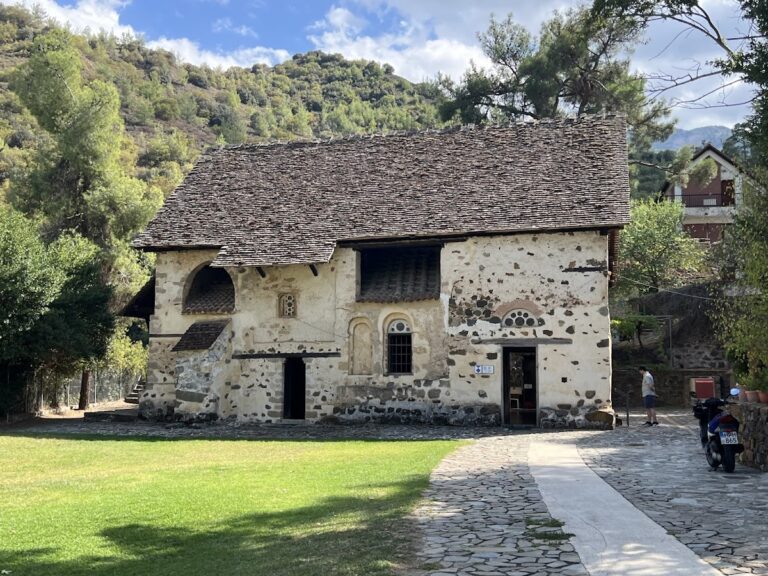
The church was enlarged after its original construction. A gallery was added along the northern and western sides of the nave during the fourteenth or fifteenth century. A narthex, an entrance vestibule, together with the western and northern parts of the church, belongs to the first half of the sixteenth century. The roof was completely reconstructed in 1951.
Artistic setting and preservation
The church and its paintings belong to the period after Cyprus was conquered by Frankish Crusaders in 1191 and became politically and artistically separated from the Byzantine Empire. The unknown thirteenth-century painter continued eleventh- and twelfth-century Byzantine, especially Comnenian, traditions while introducing Western influences in iconography, clothing, and jewelry. The frescoes remain substantially preserved, although some individual scenes are severely damaged or have been lost.
Our Lady of Moutoullas forms part of the UNESCO World Heritage property Painted Churches in the Troodos Region, inscribed in 1985 and expanded in 2001.
Remains
The surviving church combines a compact rectangular core with a later L-shaped gallery on the north and west. The original structure measures approximately 7.90 by 4.90 metres externally and consists of a single nave and sanctuary. Its steep wooden gable roof is covered with tiles. Because the ground rises sharply on the northern side, the later gallery was built at a lower level, while the northern roof slope was extended downwards to shelter it. The enlarged building measures approximately 10.70 by 6.90 metres overall, and the later narthex lies beneath the shared wooden roof.
Original church
Nave
The original nave has low entrances in its western and northern walls, each approximately 1.75 metres high. Its walls were covered with frescoes painted on lime plaster, and the interior cycle is arranged in two horizontal zones. The upper zone contains scenes from the lives of Christ and the Virgin, including the Nativity, the Raising of Lazarus, the Entry into Jerusalem, the Crucifixion, the Resurrection, and the Dormition of the Virgin. The Presentation of Christ in the Temple was added later, during the fourteenth or fifteenth century.
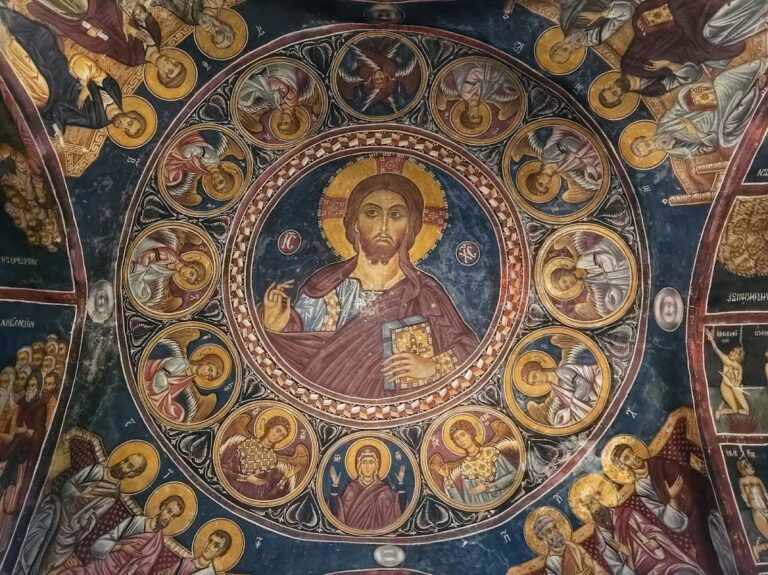
The lower zone contains frontal, full-length saints. They include Christopher, Eustathius, Paul, Andronikos, Barbara, Marina, Anastasia, Stylianos, the Archangel Michael, the Apostle Peter, George, and John the Baptist. Some figures on the south side may be healing saints. The southern wall support carries Christ Pantocrator, the Byzantine image of Christ as ruler and judge, blessing with his right hand and holding a Gospel book in his left. The northern support shows the praying Virgin.
Sanctuary
Wall pilasters on the north and south separate the sanctuary from the nave. The sanctuary ends in a semicircular apse projecting from the eastern wall. Its principal image is the Virgin in the Vlachernitissa type, shown praying with the youthful, beardless Christ Emmanuel in a medallion on her chest. Below her are concelebrating hierarchs, including Nicholas, John Chrysostom, Gregory, Basil, Epiphanius, and Auxibios. Auxibios was traditionally regarded as the first bishop of nearby Soloi and as having been ordained by the Evangelist Mark.
The eastern wall around the apse contains the Preparation of the Throne, a scene associated with the Second Coming, and the Annunciation. Beside the prothesis, the sanctuary-side space where the Eucharistic offerings were prepared, the northern wall preserves the portraits of Ioannis and Irini with their dedicatory inscription. The pilasters framing the sanctuary screen carry full-length figures of the Virgin in supplication on the north and Christ on the south. A fragment of a Virgin and Child remains beside Christ.
Gallery and later frescoes
The gallery forms a porch along the north and west sides of the church. Its southern wall contains a later eschatological cycle, probably painted in the late fifteenth or early sixteenth century. Above the entrance to the nave are the Preparation of the Throne and the Great Deesis, a devotional image of Christ accompanied by the Virgin, John the Baptist, and the Apostles.
One side of the entrance shows the inhabitants of Paradise, including saints, ascetics, martyrs, prophets, monks, and the Good Thief. The opposite side shows the condemned, among them sinful clerics, the Rich Man, the Murderer, the Denier of Christ, and the person who sleeps on Sunday. The punishments include the Unquenchable Worm, the Outer Darkness, and the Ruler of Darkness, represented as a humanlike monster.
At the eastern end of the gallery wall are the Seven Sleepers of Ephesus, the Burning Bush, Saint Barbara, and Saint Catherine. Specialized ovens near the church indicate that roof tiles may have been made at the site or close by.
Exterior paintings
Frescoes survive on parts of the exterior as well as inside the church. The southern wall of the gallery bears a later enthroned Christ and Saint George on horseback. On the northern exterior wall, scenes of the Second Coming and the Last Judgment appear on both sides of the northern entrance. These paintings date to the second half of the fourteenth century.
The principal interior cycle and the exterior paintings were probably created by different artists. The 1280 paintings use cinnabar red extensively in the upper backgrounds instead of the more usual gold or blue, giving the scenes an imperial character. Their expressive figures have oversized faces, strongly linear features, elongated heads, simplified backgrounds, and richly decorated but rigid clothing. Byzantine traditions and Western artistic influences are combined throughout the surviving ensemble.
Nearby sites