Machairas Monastery: An Orthodox Stavropegic Monastery in Cyprus


Site at a Glance
- Rating
- 4.8
- Popularity
- Medium
- Country
- Cyprus
- Primary era
- Medieval
- External website
- Open
- Eras represented
- Medieval, Modern
- Civilizations
- Byzantine
- Site type
- Religious
- Remains
- Monastery
On this page12 sections
History
Machairas Monastery is a male Orthodox monastery in Cyprus, founded in the late twelfth century and built in the Byzantine style. Belonging to the Church of Cyprus, it is one of the church’s five stavropegic monasteries, meaning that it enjoys direct ecclesiastical independence from the local diocesan bishop. Its abbot holds the rank of Bishop of Ledra.
Foundation and Byzantine privileges
The monastery’s foundation tradition centres on the hermits Neophytos and Ignatius. They are said to have discovered an icon of the Virgin Mary concealed in a cave and cleared the surrounding vegetation with a knife. The icon became known as Machairotissa, a name derived from the Greek word for “knife,” and the monastery took its name from it. Local tradition attributes the icon to the Apostle Luke.
After Neophytos died, Ignatius and the hermit Prokopios travelled to Constantinople in 1172 to seek support from the Byzantine emperor Manuel I Komnenos, who ruled from 1143 to 1180. Manuel provided funds, granted the mountain and surrounding area to the monastery, and gave it stavropegic status together with exemption from public and private taxation. The Byzantine emperors Isaac II Angelos and Alexios III Angelos later confirmed these privileges. Isaac also granted money and land in Nicosia, while Alexios gave the monastery 24 serfs.
In the early thirteenth century, Neilos enlarged the monastery and became its first enthroned abbot. In 1201 he wrote a Typikon, a written rule for worship, discipline, administration, and communal monastic life. The text preserves the principal foundation traditions. Neilos became bishop of Tamassos in 1209 and may also have served as archbishop of Cyprus between 1215 and 1221. Joachim succeeded him as abbot.
Latin rule and medieval traditions
From 1192 to 1571, Cyprus was under Latin rule, during which Frankish and Venetian authorities restricted Orthodox monasteries and interfered in their internal administration. In 1231, Machairas was associated with the martyrdom of the monks Gerasimos and Gennadios, who were executed alongside eleven monks from the Monastery of Panagia of Kantara after defending Orthodox Christianity.
The monastery’s Typikon prohibited women from entering, and tradition says that this rule remained in force for at least 150 years after the foundation. A tradition connected with the year 1357 relates that Queen Alice entered, or attempted to enter, the monastery church. She is said to have immediately lost her voice and remained unable to speak for three years. In 1393, King James I of Cyprus and his wife, Eloise, sought refuge at Machairas from a plague affecting Nicosia.
Ottoman rule and the Church of Cyprus
During Ottoman rule, from 1571 to 1878, Machairas served as a spiritual and national centre and helped preserve Christian and Greek Cypriot identity. The monastery operated a school that taught letters, the arts, and church music. It also granted land for the Pancyprian Gymnasium in Nicosia, supported schools throughout Cyprus, and assisted in the construction of a leper hospital.
Archbishop Kyprianos was born in Strovolos in 1756 and became a monk at Machairas while still young. He received his first lessons there and served the monastery for several years, including responsibility for some of its external affairs. After becoming archbishop of Cyprus in 1810, he continued to support Machairas, including through construction of the dependency of Saint Eleftherios in Nicosia. Ottoman authorities executed him on 9 July 1821 after he refused to leave Cyprus and renounce his faith. Cyprus commemorates him as a national martyr.
Fire, colonial conflict, and renewal
British administration began with the agreement of 4 June 1878. A major fire destroyed the monastery in 1892, following an earlier major fire in 1530. Reconstruction from the foundations was completed in 1900. Archimandrite Chariton travelled to the Russian Empire to collect donations for the work and raised 6,483 rubles.
Machairas later became associated with the anti-colonial struggle through Grigoris Afxentiou, a deputy leader of EOKA, the Greek Cypriot organization that waged an armed campaign against British colonial rule during the 1950s. Afxentiou frequently took refuge at the monastery. After his hideout nearby was betrayed and located, British forces fought a lengthy battle in the area. On 3 March 1957, they set the hideout alight with petrol dropped from a helicopter, killing Afxentiou rather than capturing him alive.
After Cyprus became independent, the monastery faced financial and spiritual difficulties. Archimandrite Paul, later Metropolitan of Kyrenia, began its spiritual revitalization during his abbacy from 1988 to 1993. In 1993, the Athonite hieromonk Athanasios, an Orthodox monk and ordained priest associated with the monastic tradition of Mount Athos, became abbot and began a broad renewal of the buildings and communal religious life. After Athanasios became Metropolitan of Limassol in 1999, Archimandrite Arsenios continued the work. Arsenios died on 11 September 2004 when a helicopter carrying him and Patriarch Peter of Alexandria crashed into the sea.
The recent succession of abbots comprises Mitrophanes, 1900–1937; Gregory, 1937–1948; Ireneus, 1949–1960; Elpidios, 1961–1964; Dionysios, 1964–1987; Paul, 1988–1993; Athanasios, 1993–1999; Arsenios, 1999–2004; and Bishop Epiphanios of Ledra, from 2004. The monastery remains dedicated to the Virgin Mary and celebrates the Presentation of the Virgin in the Temple on 21 November, a Christian feast commemorating Mary’s presentation at the Temple in Jerusalem. Its brotherhood is described as numbering about 30 monks, or between 20 and 30. Monks from Machairas have also restored and reopened the Monastery of the Holy Forerunner at Mesa Potamos and the Monastery of the Saviour near Episcopi in Limassol as communal monasteries. Several bishops of the Church of Cyprus, as well as Patriarch Peter of Alexandria and the former Metropolitan Paul of Kyrenia, are identified as spiritual children of Machairas.
Remains
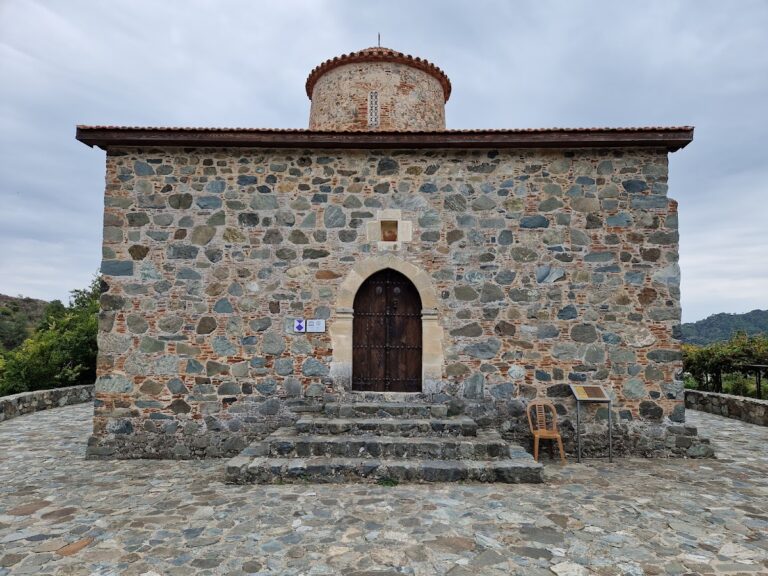
Machairas Monastery stands on the eastern edge of the Troodos range, near the summit of Kionia, at an elevation given as approximately 870 to 900 metres. It occupies a mountainside descending towards the Pedieos stream near the village of Lazanias, about 40 kilometres from Nicosia. The complex has a rectangular plan, with its principal entrance facing east and a second entrance on the western side. Byzantine-style buildings and monks’ cells are arranged around a centrally placed church.
Central church
Church interior
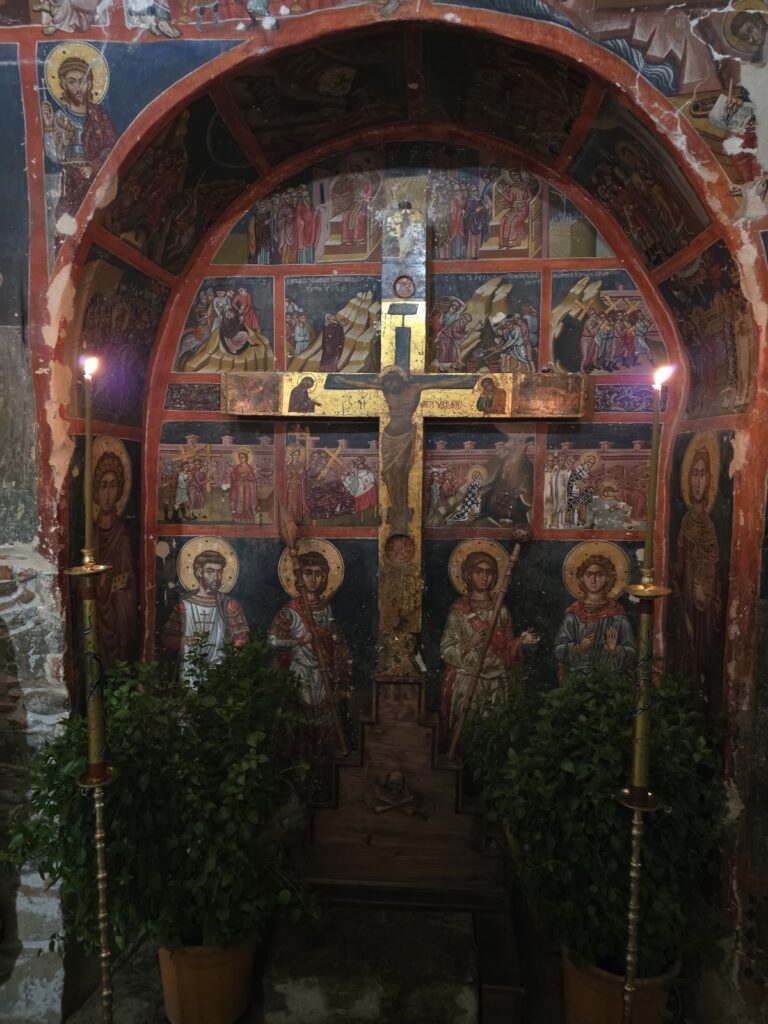
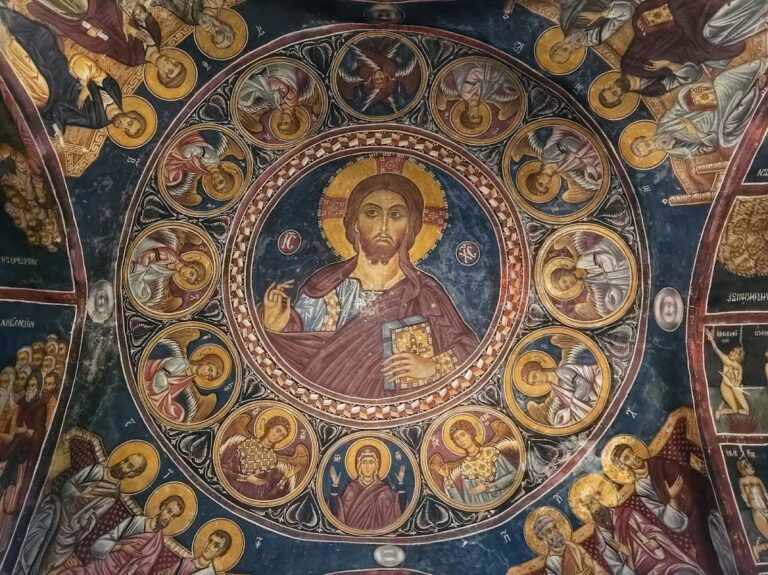
The central church forms the focus of the monastic arrangement. Its principal chapel is decorated with rows of columns, while the interior contains icons, candelabra, stone paving, and wall frescoes. The icon of the Virgin Mary occupies the central place and is identified with the Machairotissa icon associated with the monastery’s foundation tradition.
Monastic complex and working areas
Buildings and service spaces
The present complex includes newly built churches and chapels, hospitality spaces, and areas for work and services. An ecclesiastical treasury stores vessels and other sacred objects. Agricultural activity also contributes to the monks’ support, linking the monastery’s religious life with the cultivation of its surrounding mountain environment.
Afxentiou memorial area
Museum and memorial
A small museum on the grounds is dedicated to Grigoris Afxentiou. A large memorial statue stands at the location of his nearby hideout, which is associated with a cave in the surrounding area. Together, these features preserve the connection between the monastery and the anti-colonial struggle of the 1950s.
Nearby sites