Temple of Montu at Medamud: An Ancient Egyptian Sanctuary
Site at a Glance
- Popularity
- Medium
- Country
- Egypt
- Primary era
- Classical
- Eras represented
- Bronze Age, Classical
- Civilizations
- Egyptian, Ptolemaic, Roman
- Site type
- Religious
- Remains
- Temple
On this page20 sections
History
The Temple of Montu at Medamud is an ancient Egyptian sanctuary in Egypt, about 5 km northeast of Karnak and 8 km from Luxor. Its principal complex was established under Senwosret III in the Twelfth Dynasty, during the Middle Kingdom, and became an important center for Montu, the war god and tutelary deity of Thebes, and the sacred bull Buchis.
Early sanctuary and Middle Kingdom foundation
Medamud, formerly known as Madu, was a Theban outpost. A sanctuary to Montu may have existed there in the Old Kingdom, an early major period of Egyptian history. Before the Middle Kingdom temple was built, fire damaged the site and earlier mounds were levelled. The new sanctuary took the place of the earlier one.
The main temple complex dates to the reign of Senwosret III, a Twelfth-Dynasty pharaoh. It is a rare known example of a religious foundation from the Middle Kingdom. The sanctuary was altered and redecorated in later periods.
Later pharaonic and Ptolemaic phases
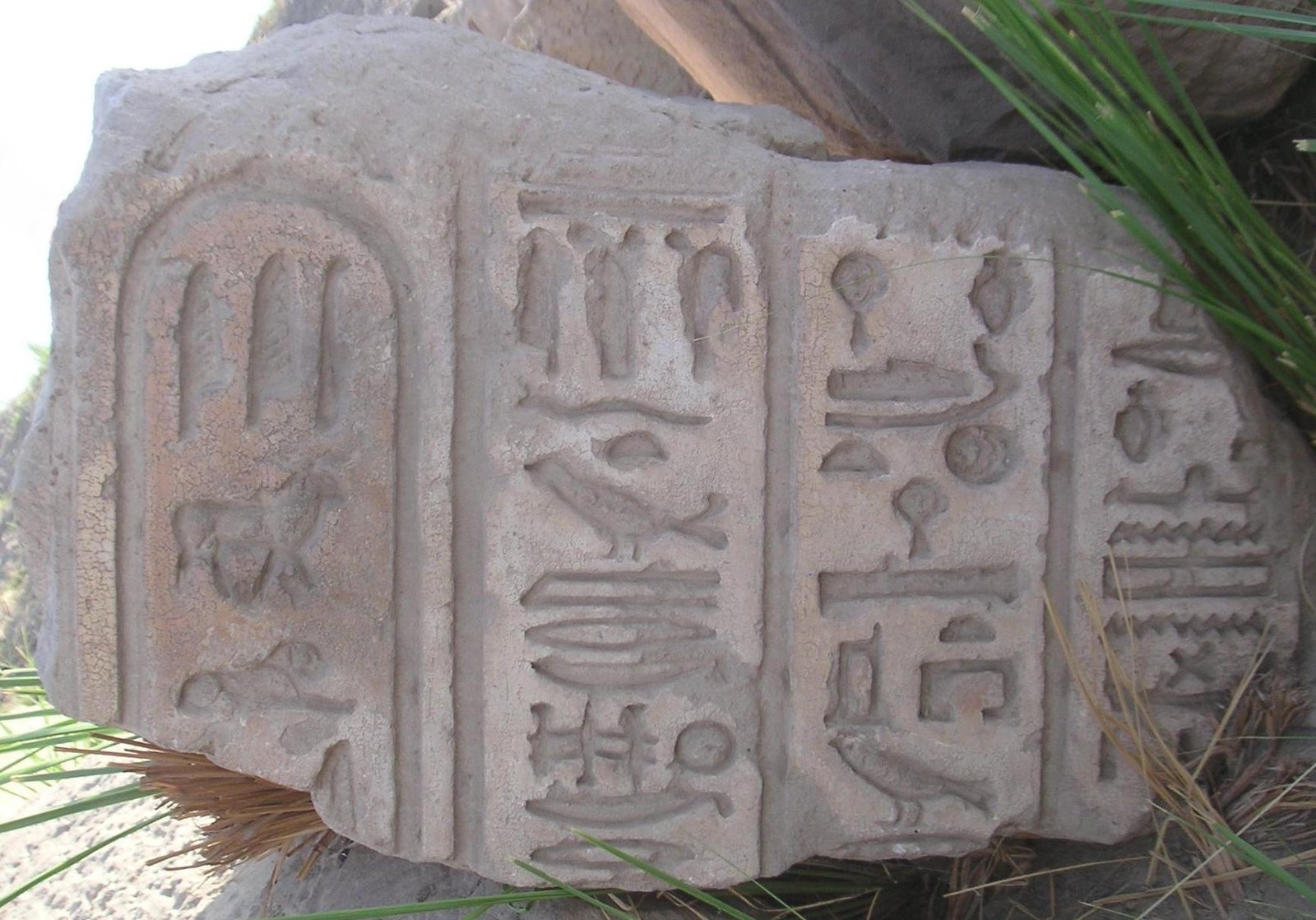
Decoration continued in the Thirteenth Dynasty. Sobekhotep II reused reliefs connected with earlier rulers, including Senwosret III, and had a chapel doorway inscribed in his own name. During the Eighteenth Dynasty, Thutmose III rebuilt the sanctuary in stone and added statues showing him in his own likeness.
Egypt’s Ptolemaic dynasty, which ruled after Alexander the Great’s conquests, brought further rebuilding and expansion. Ptolemy VIII Euergetes II was a major builder, and decoration on the entrance structures continued under Ptolemy XII. A separate building from the reign of Ptolemy II also stood within the precinct. The inner sanctuary was extensively remodelled at the start of the Ptolemaic period.
Roman worship and later use
The complex continued to grow and receive decoration under Ptolemaic rulers and Roman emperors for nearly five centuries, with work continuing through the reign of Antoninus Pius. It was an important place of worship for Montu and the sacred bulls. The site was probably regarded as the place where Montu appeared and lived in the form of Buchis. The temple at nearby Armant was probably associated with the bull’s death, while a nearby necropolis contained sacred bulls.
A three-aisled Coptic church was built on the site in the fourth and fifth centuries. Excavations at Medamud began in 1925 under Fernand Bisson de la Roque and continued in campaigns through 1932 and into the postwar period, in cooperation with the French Institute of Oriental Archaeology and the Louvre. The work uncovered numerous buildings, including the temple. Archaeologists and restorers have also worked to protect the remains from encroachment by the modern town.
Remains
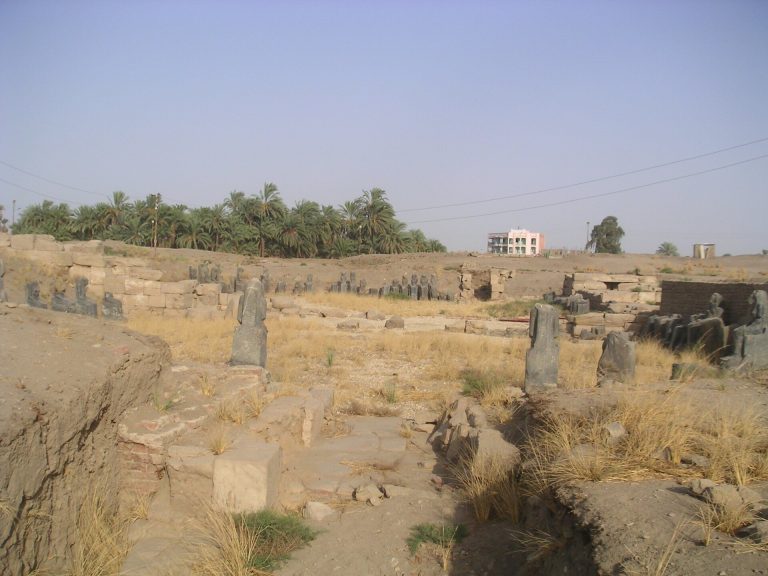
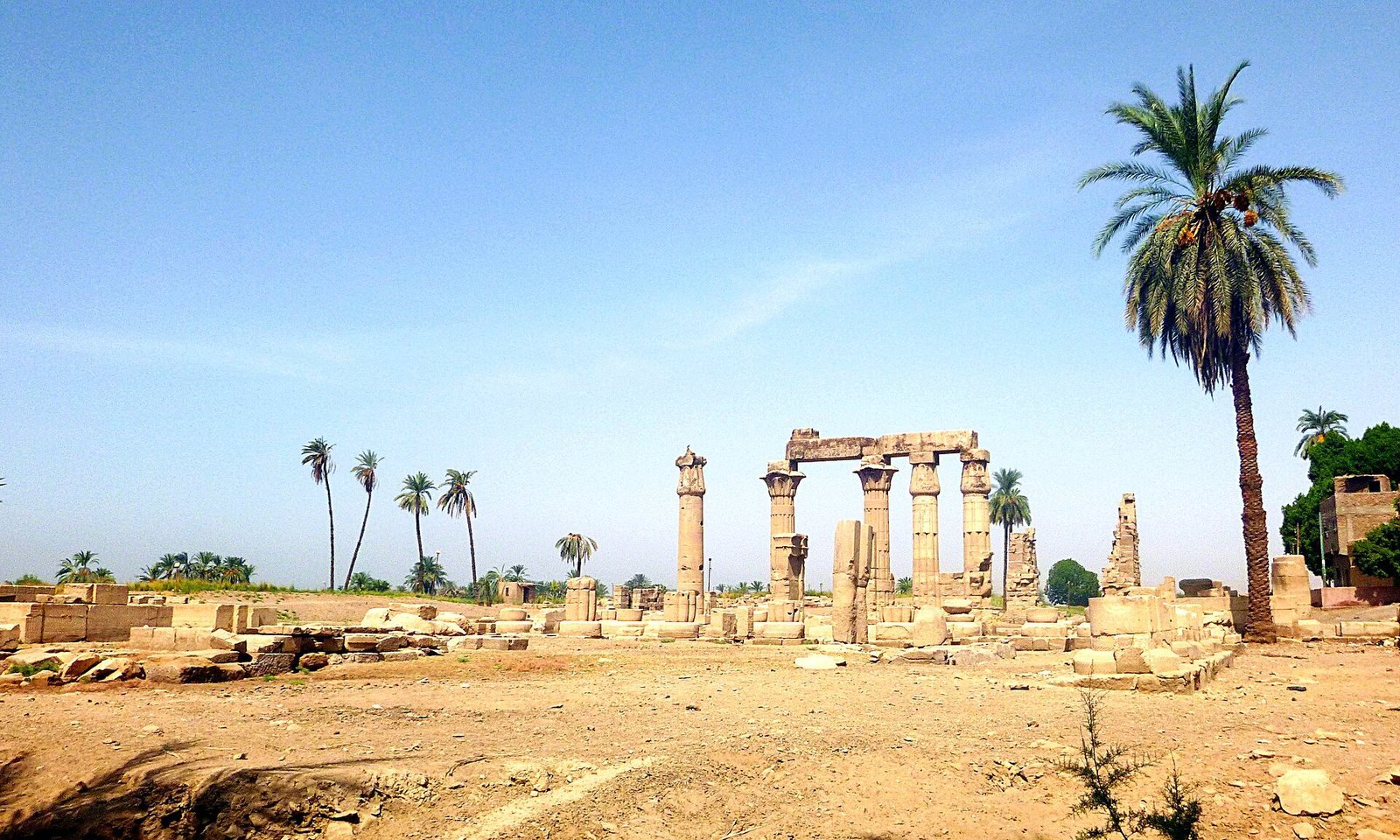
The visible ruins are chiefly Greco-Roman, within a complex shaped by successive enclosures and a processional approach. The earlier temple used mud brick, with carved stone for doorways and column bases. Later buildings combined enclosed courts, gateways, columned halls, and spaces associated with the worship of Montu and the sacred bull.
Precinct and processional approaches
Middle Kingdom enclosure
The Middle Kingdom complex occupied a rounded mound inside an enclosure measuring about 200 by 180 metres. The enclosure ran north to south, with main access from the east and north; a sacred lake was probably situated on its western side. The precinct comprised two adjoining but separate areas, interpreted as a temple to the north and priests’ quarters to the south. The southern area included storerooms, six priests’ houses, and a granary within its own wall. The two areas were connected only by way of the exterior.
Features of the Middle Kingdom temple included a raised platform, a canal, a processional avenue, a main entrance, a columned porch, a hall, and a sanctuary. The exact sanctuary plan is uncertain. It probably included a hall with a roof supported by columns, leading toward chapels or a shrine, as well as a large columned court associated with the sacred bull.
Quay and processional avenue
A canal linked Medamud with the Temple of Montu at Karnak, ending at a quay. From there, a sphinx-lined processional avenue led toward the temple. The avenue is badly ruined, while the quay is better preserved but overgrown. Its surviving surfaces bear graffiti in Demotic, a script used in ancient Egypt, along with dedications and engraved footprints associated with pilgrims.
Outer enclosure and water features
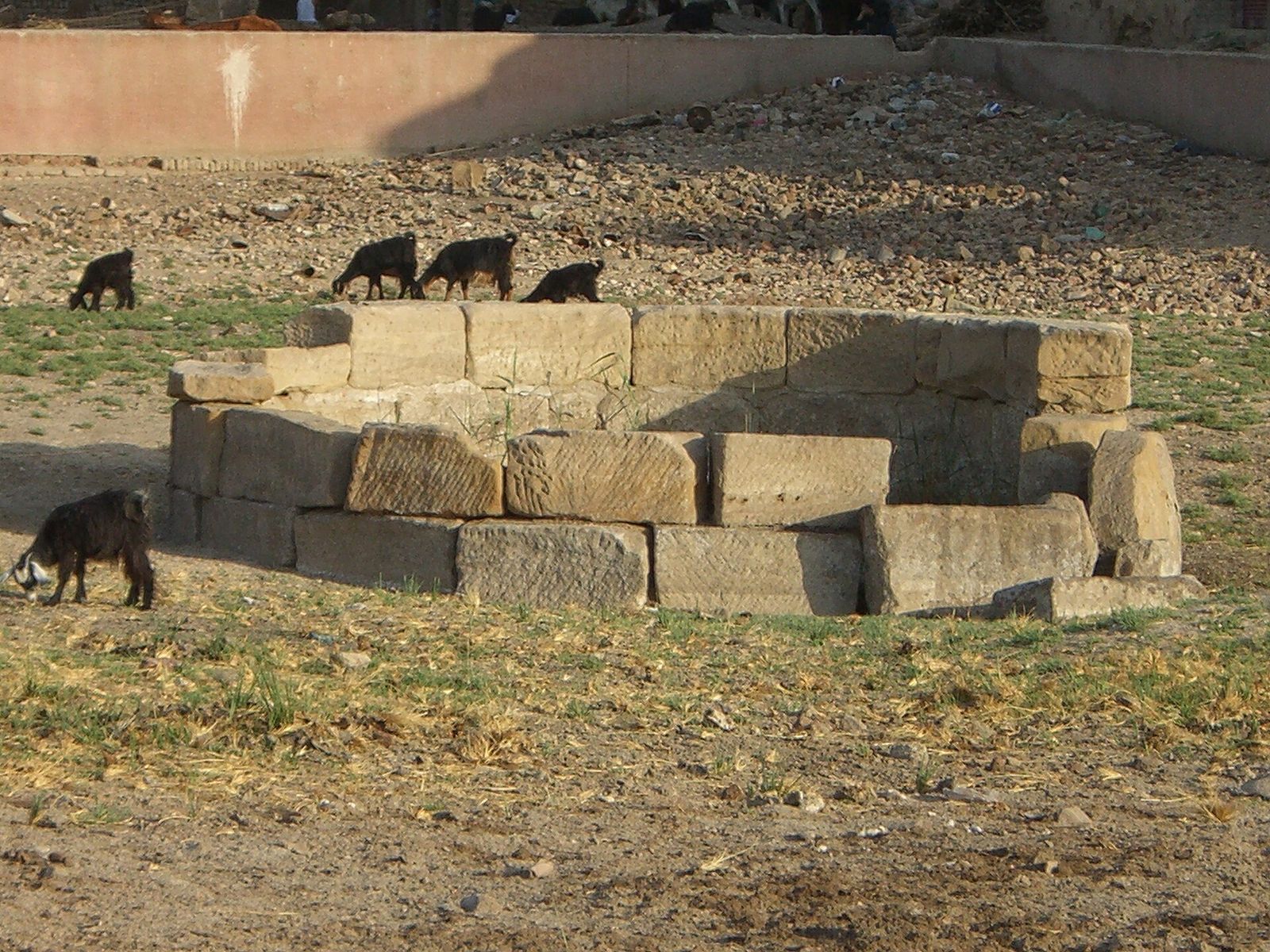
The later temple precinct included a sacred lake and a deep well. Villagers filled the well because it presented a danger to children. The entrance pylon, a monumental gateway, formed the only entrance to the New Kingdom enclosure that protected the temple and its annexes.
Axial gate and columned porch
A monumental gate pierced the Ptolemaic enclosure on the temple axis. Its decoration dates to the reign of Tiberius, and its upright doorway sides remain in place. Ptolemy VIII built a towered, columned porch around the gate, with its decoration completed under Ptolemy XII.
Entrance pylon and shelters
Along the processional axis, Ptolemy VIII also built the temple’s entrance pylon. Three smaller shelters stood before it, providing places for ceremonial boats and their bearers to pause during processions.
Second gate and Ptolemy II building
A second Ptolemaic gate gave access to a separate building from the reign of Ptolemy II. The building survives to foundation level, and its purpose is uncertain. It may have served as a birth house, a temple, or a station for a deity’s ceremonial boat.
Temple buildings and sacred-bull spaces
Great court and columned hall
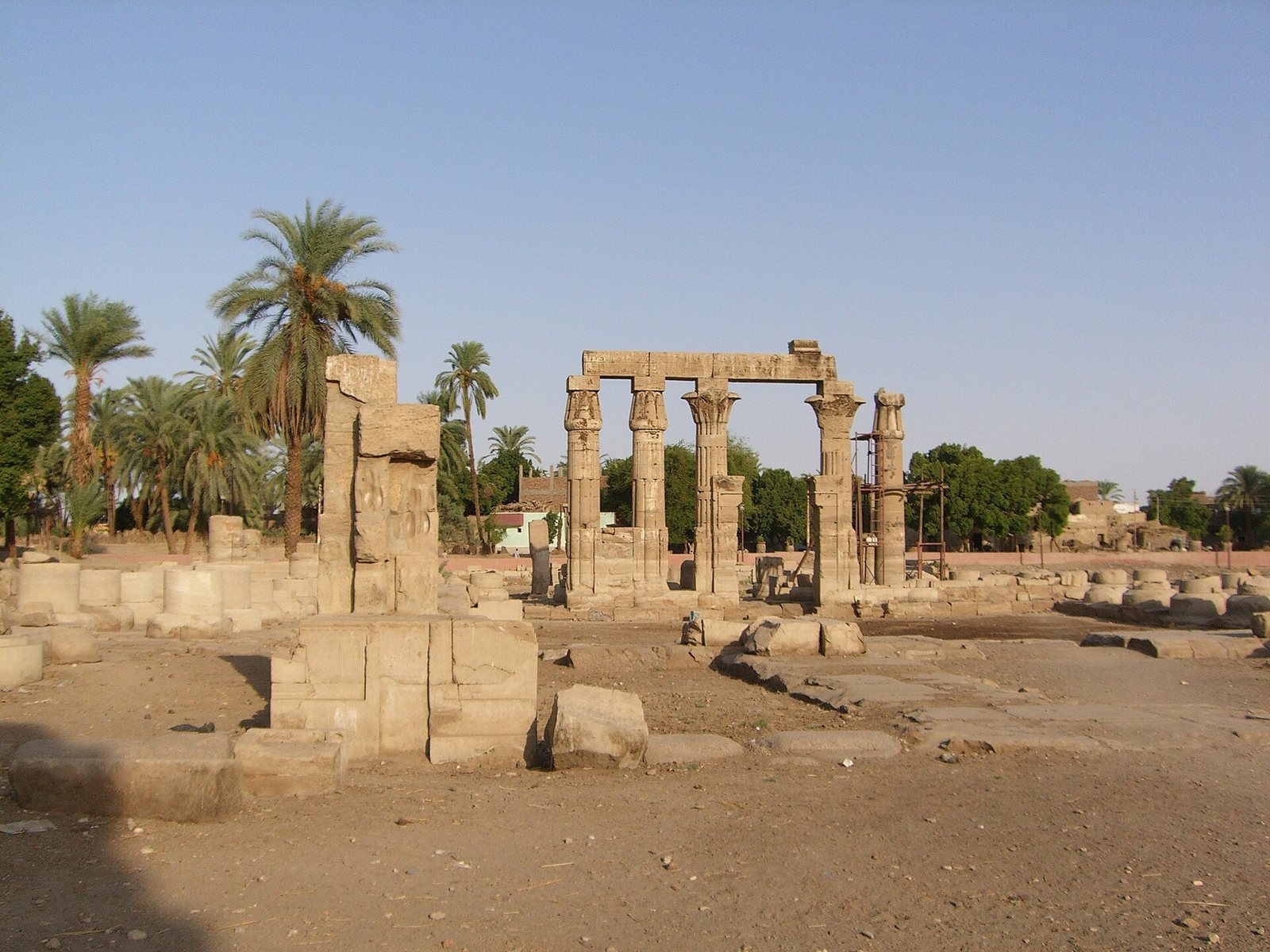
Ptolemy VIII commissioned a large court with porticoes on three sides and a sacrificial altar. Its decoration was completed under Antoninus Pius, whose royal name appears on column bases. The adjoining hypostyle hall, a roofed room supported by columns, had a twelve-column porch. Four of its six front columns remain joined by low walls, indicating the original height of the structure.
Inner sanctuary and bull courts
The surviving inner-temple features belong to the early Ptolemaic remodelling, arranged around a New Kingdom naos (shrine for a deity’s cult image). The temple proper included chapels, a hall for the god’s ceremonial boat, and the shrine, followed by a separate sekos (temple area for a sacred animal or a deity’s living form). This bull area comprised a sequence of courts, some with columns, including one with a basin or trough probably intended for the animal. Medamud preserves the sole surviving temple arrangement of this kind, which helps explain ancient Egyptian bull worship.
Reliefs and movable finds
Senwosret III doorway and statues
A doorway dating to Senwosret III is now in the Louvre. Its decoration shows the king in clothing associated with the Sed festival, a royal ceremony for renewing a pharaoh’s authority and vitality, receiving offerings from Egypt’s principal regions. Statues found at the temple show Senwosret both as youthful and vigorous and as aged. These contrasting images have probably been linked to the festival’s renewal rites.
Sobekhotep II chapel doorway
Reliefs from the Thirteenth Dynasty show Sobekhotep II welcomed by Montu in falcon-headed form. The Louvre holds the doorway’s carved side pieces and crosspiece, which Sobekhotep had reinscribed in his own name. Related reliefs are held in the Karnak Open-Air Museum.
Roman-period corridor
A long corridor within the temple enclosure preserves reliefs mainly dating to Domitian’s reign and associated with Buchis. One scene shows singers and musicians approaching a canopy sheltering the sacred bull, while Trajan, depicted in the dress of a pharaoh, makes an offering.
Sculpture in museum collections
Architectural pieces and objects removed from the temple are held in the Karnak Open-Air Museum, the Louvre, and the Museum of Fine Arts in Lyon. Most of the temple’s bull statues are now in museum collections.