Obelisk of Hatshepsut: A Royal Monument at Karnak


Site at a Glance
- Rating
- 4.8
- Popularity
- Very Low
- Country
- Egypt
- Primary era
- Bronze Age
- Eras represented
- Bronze Age
- Civilizations
- Egyptian
- Site type
- Civic
- Remains
- Obelisk
On this page10 sections
History
The Obelisk of Hatshepsut is an ancient Egyptian monument at Karnak in Luxor, Egypt, commissioned during the reign of Hatshepsut, a female Eighteenth-Dynasty ruler who held the title of pharaoh. Construction began in the 15th century BC, during her rule from 1473 to 1458 BC.
Construction at Karnak
Hatshepsut ordered a pair of obelisks for the Great Temple of Amun, one of ancient Egypt’s principal sanctuaries of the deity Amun. The monuments were erected between the temple’s Fourth and Fifth Pylons, monumental gateway structures at its entrance. Later monuments of Hatshepsut commemorated the pair’s erection as one of the achievements of her reign.
The obelisks expressed Hatshepsut’s devotion to Amun and presented the accomplishments of her rule. Their imagery also reflected the ancient Egyptian association between obelisks and solar power. The sun was understood as a force capable of giving and taking life, while the pharaoh was identified with Ra, the solar deity, and regarded as his earthly child.
Concealment and survival
After Hatshepsut’s death, her stepson and successor, Thutmose III, ordered a wall built around the pair. The wall concealed the obelisks from view, giving the surviving monument its alternative name, the “Hidden Obelisk.” One of the original pair remains standing, while the other collapsed at an uncertain date. Many fragments of the fallen monument remain near Karnak’s sacred lake and in the surrounding area.
A separate obelisk, approximately 40 metres high, cracked while it was being made and was abandoned in the Aswan quarry. Thutmose III later tried to complete it at a reduced height, but the attempt was unsuccessful. Its remains still lie in the quarry.
Remains
Monument and carved surfaces
Granite shaft
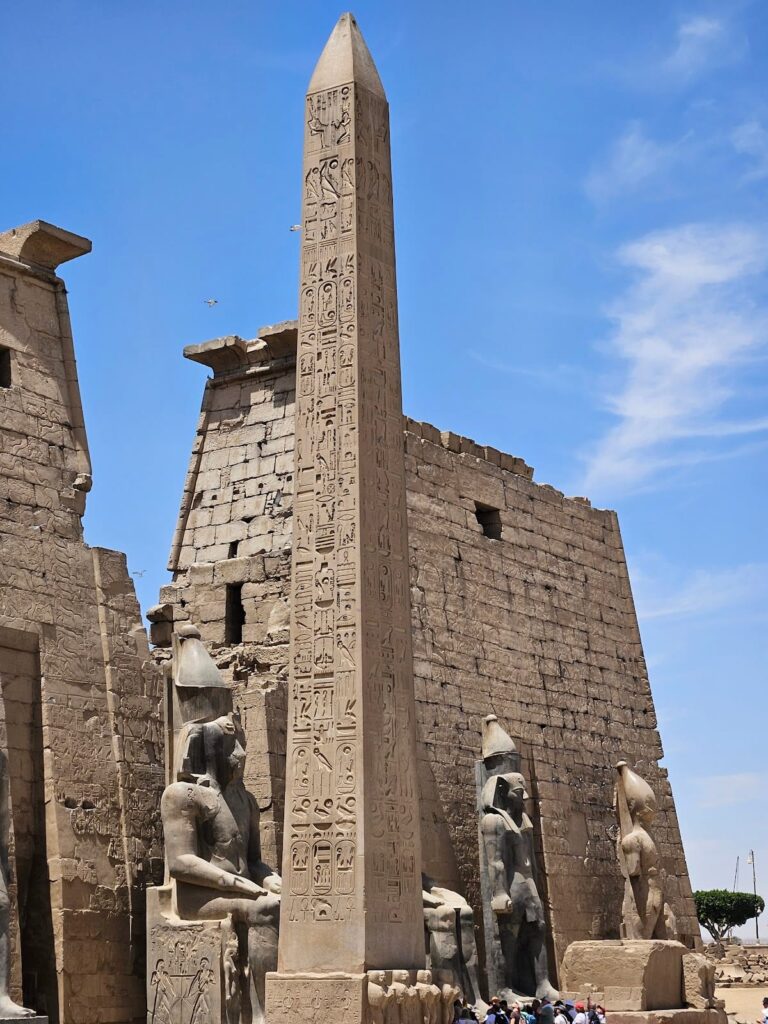
The surviving monument is a single-block obelisk with a square cross-section, tapering sides, and a pyramid-shaped summit. It stands approximately 30 metres high, with a more precise measurement of 29.56 metres, and weighs about 323 tonnes. Red granite from Aswan forms the entire monument. Its pyramidion, together with the upper scenes of the pair, was decorated with electrum, an alloy of gold and silver that gave the highest parts a bright surface in sunlight.
Inscriptions and imagery
Egyptian inscriptions cover all four sides and describe Hatshepsut’s achievements, events during her reign, and aspects of her ceremonial coronation. The surviving base contains a text of 32 horizontal lines, arranged as eight lines on each face. It describes natural and supernatural events associated with raising the pair and records Hatshepsut’s devotion to Amun.
On the upper half of each face, scenes appear on either side of a central column of inscriptions. They show Hatshepsut and Thutmose III worshipping Amun or presenting offerings to him. Later pharaohs erased many of the inscriptions and decorative elements. At 29.56 metres, the obelisk is described as the world’s second-tallest, after the Lateran Obelisk in Rome, which measures 32.18 metres.
Related monuments
Fallen companion
The second obelisk commissioned for the temple entrance collapsed at an uncertain date. Its fragments remain around the sacred lake and in the surrounding area, preserving material from the original pair.
Unfinished quarry obelisk
The abandoned third obelisk remains in the Aswan quarry. Its crack developed during construction, and the later attempt to finish it at a reduced height did not succeed.
Nearby sites