Stohánek: A Medieval Rock Castle in Czechia

Site at a Glance
- Rating
- 4.8
- Popularity
- Low
- Country
- Czechia
- Primary era
- Medieval
- External website
- Open
- Eras represented
- Medieval, Early Modern, Modern
- Civilizations
- Holy Roman Empire, Kingdom of Bohemia
- Site type
- Military
- Remains
- Castle
On this page10 sections
History
Stohánek is a short-lived rock castle in Czechia, near Ralsko-Mimoň, founded by Beneš of Vartenberk between 1427 and 1431 during the turbulent first half of the fifteenth century. It stood on land separated from the Děvín estate after the death of his father, Petr of Vartenberk of Děvín. The castle’s probable economic hinterland included Svébořice, Ploužnice, and Ostrov.
Foundation and medieval ownership
The first written mention of Stohánek dates from 1431. The following year, Zbiněk of Waldstein was recorded as its owner. In 1440, the castle was attached again to Děvín, although it probably continued to function as a separate administrative unit. Beneš and Petr of Vartenberk belonged to a noble family that held estates and castles in medieval Bohemia, while Zbiněk of Waldstein came from the Waldstein noble family.
Destruction and disappearance
The castle’s destruction has traditionally been linked with the Lusatian League’s 1444 campaign in Bohemia. The Lusatian League, also called the League of the Six Towns, was a medieval alliance based in Lusatia that undertook military campaigns in the surrounding region. The connection with Stohánek remains unsubstantiated. The last recorded reference to the castle dates from 1453, in the byname of Janaš of Stohánek, probably a man of Jan of Vartenberk. Stohánek was not included in the 1544 description of the Děvín estate.
Hermitage and later history
Between 1760 and 1773, the castle remains served as a hermitage, a small religious retreat occupied by a hermit. The first hermit built a wooden dwelling beside the rock and cut sixteen niches for Stations of the Cross images along the staircase. In 1768, Johann Wenzel Steinfelder of Holičky, known as Brother Jerome, took his place. He left the hermitage after five years, married in Svébořice in 1775, and died later that year. Estate authorities subsequently demolished the hermitage and reused its timber in house no. 44 in Svébořice.
Karolina Světlá later described the hermitage in her novella The Last Hermitess. She called the rock “Strouhánek,” a transcription of the German form “Strohanke,” and included a female assistant who had fled from a merchant, her replacement by another helper, and the hermit’s departure in 1773 because of immoral conduct. During the early twentieth century, the castle rock was adapted for tourism. A new staircase was cut along the old approach, and further alterations were made as the summit was opened to visitors.
Military use and protection
From 1946 to 1991, Stohánek lay within a military training area. Soviet soldiers stationed there carved Cyrillic inscriptions into the rock. Since 1995, the castle rock and its surroundings have been protected as the Stohánek Natural Monument, covering 0.5 hectares.
Remains
Stohánek occupies a sandstone outcrop rising approximately 23 to 25 metres above the surrounding terrain. The rock itself supplied the castle’s foundations, rooms, access routes, and defensive position, while the castle structures were built mainly of wood. An outer bailey lay at the foot of the outcrop, and the summit was reached through a cleft in the rock. Later alterations, particularly those made during the eighteenth-century hermitage period, reshaped the summit and substantially disturbed its archaeological layers.
Summit entrance and rock-cut rooms
The original route to the summit plateau passed through a cleft beginning about four metres above ground level. A door once closed this entrance, and sockets for its lintel and securing bar remain in the rock. Several rooms cut into the summit belong to the surviving remains of the wooden castle, together with a cistern, a reservoir for storing water. The largest later intervention is a rectangular chamber that served as an eighteenth-century chapel and may have originated in the medieval period.
Outer bailey features
At the foot of the rock, the outer bailey preserves spaces formed directly in the sandstone. A niche is cut into the northern side of the outcrop, while a similarly modified area on the eastern side extends for 11 metres. These features formed part of the lower area associated with the castle’s main rock-top enclosure.
Hermitage staircase
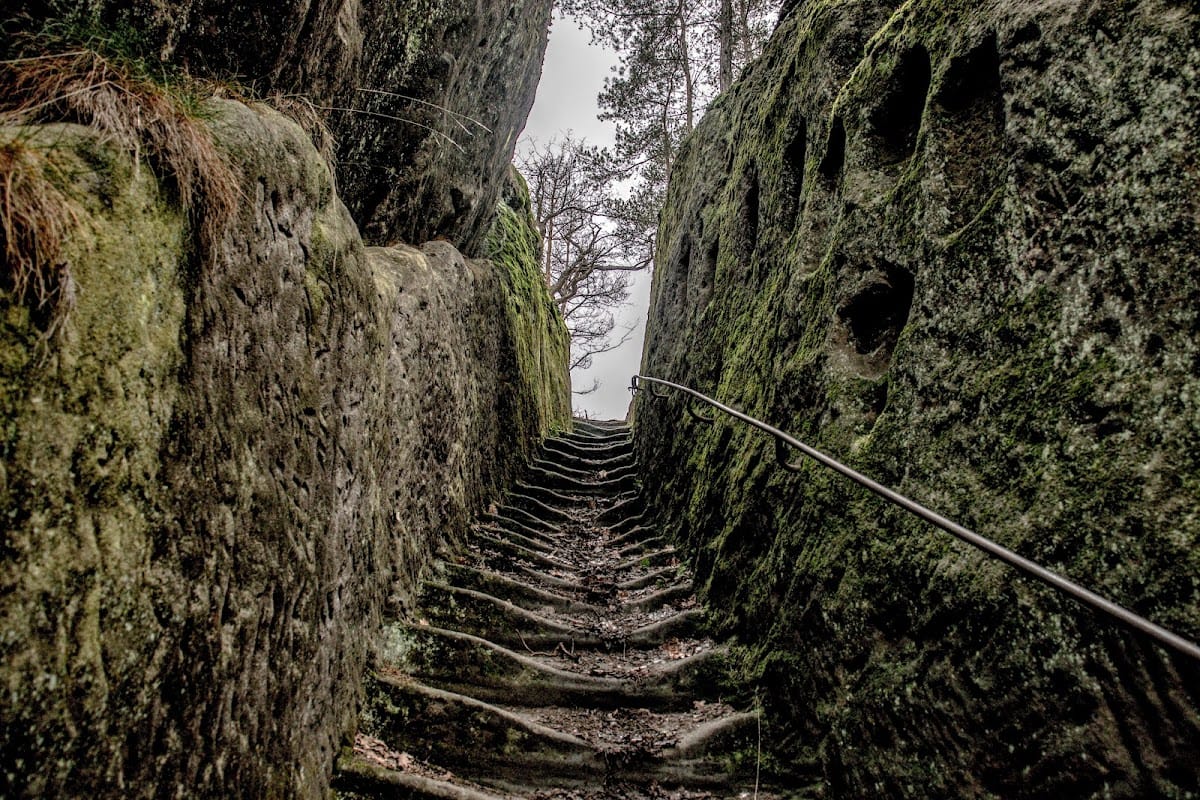
The hermitage period left sixteen niches cut beside the staircase for Stations of the Cross images. These devotional scenes represent episodes from Jesus’s path to the crucifixion. The niches belong to the eighteenth-century religious reuse of the rock and are distinct from the earlier access features cut for the medieval castle.
Archaeological and commemorative features
Surface collecting on the rock and at its foot recovered a small group of ceramic sherds dating from the turn of the fourteenth and fifteenth centuries to the middle of the fifteenth century. Some are held by the museum in Česká Lípa. A memorial stone near Stohánek commemorates Antonín Sochor, a recipient of the Hero of the Soviet Union title, the Soviet Union’s highest honorary award for exceptional military or other service. Sochor died in a traffic accident there in 1950.