Košumberk Castle: A Gothic Fortress and Renaissance Château in Czechia

Site at a Glance
- Rating
- 4.5
- Popularity
- Medium
- Country
- Czechia
- Primary era
- Early Modern
- External website
- Open
- Eras represented
- Medieval, Early Modern
- Civilizations
- Holy Roman Empire, Kingdom of Bohemia
- Site type
- Military
- Remains
- Castle
On this page12 sections
History
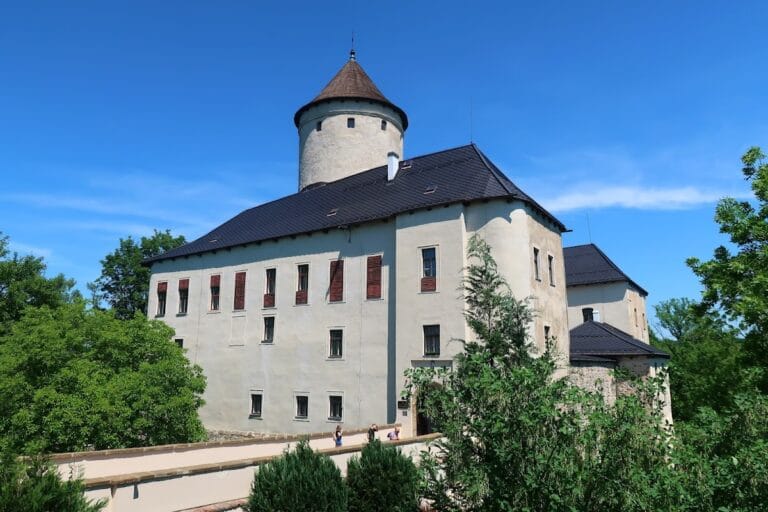
Košumberk Castle is a medieval and Renaissance castle in Czechia, near Luže. It was probably founded during the second half of the thirteenth century, and its development began with a Gothic stronghold. The oldest timber dated by tree-ring analysis was felled after 1255, while the earliest written reference to the castle dates from 1312. Ojíř of Košumberk is associated with its foundation.
The Lords of Chlum and Košumberk
By 1372, Košumberk belonged to the lords of Chlum, founders of the Slavata family of Chlum and Košumberk. The family rebuilt the castle in the Late Gothic style and used it as its seat for approximately three centuries. During the sixteenth century, however, the stone Gothic castle no longer met the family’s residential, social, and administrative needs.
Diviš Slavata founded a school of the Bohemian Brethren at Košumberk in 1540. The students included Albrecht von Wallenstein, a Bohemian nobleman and imperial commander during the Thirty Years’ War, and Vilém Slavata, a Bohemian nobleman and political official. Diviš also established a brewery below the castle.
Renaissance transformation
An expansion in the Renaissance style was already under way by 1544, as shown by a date above the gate. After a fire in 1573, apparently caused by lightning, Diviš Slavata began converting the castle into a Renaissance château. His son Jindřich and grandson Diviš continued the work, which was completed after 1600.
Jindřich Slavata of Chlum and Košumberk supported the Bohemian Brethren, served as captain of the Chrudim district, and acted as an assessor of the land court in Brno. He was also the uncle and guardian of the orphaned Albrecht von Wallenstein. Jindřich raised him for two years with his own son before sending him to the Latin school at Goldberg.
Decline and later history
Košumberk declined during the Thirty Years’ War, a European conflict that brought military occupation and heavy financial burdens to many lands. Military expenditure impoverished its owners, while Swedish troops passed through the region in 1639, 1643, 1645, and 1648.
The Jesuit order, a Catholic religious order founded in the sixteenth century, acquired the castle in 1684. With a residence near the pilgrimage church at Chlumek, the Jesuits used Košumberk chiefly for storage. Their ownership is also associated with the establishment of a church and residence. After the order was suppressed in 1773, the castle deteriorated and was recorded as abandoned by the end of the eighteenth century.
Leopold de Laing bought the estate from the Religious Fund in 1807, followed by Prince K. M. Thurn-Taxis in 1826. Neither owner lived in or maintained the castle. Public gatherings commemorating Jan Hus took place at Košumberk in 1868 and 1869.
A cooperative formed by surrounding municipalities took control of the ruins in 1920. Conservation work followed in 1922, when the Thurn-Taxis owner donated the castle to the cooperative. The castle became state property in 1953. Since the 1990s, the town of Luže has administered the site and is its current owner. Košumberk is registered as a protected cultural monument in the Czech Republic.
Remains
Košumberk stands on a hill approximately 374 metres above sea level, above the valley of the Novohradka stream. Steep slopes descending toward the stream provided a natural defensive barrier. The castle is now predominantly a ruin, with the torso of a square tower, sections of palace walls, a gate, and remnants of the fortifications surviving.
Gothic defenses
Walls and entrance tower
A substantial masonry wall enclosed the castle, reaching almost 4 metres in thickness in places. The southeast side was the most accessible approach, so it was strengthened by an elongated entrance tower. A steep drop separated the defensive wall from the palace, adding another obstacle within the defended area.
Drawbridge approach
The tower and palace were linked by a wooden bridge that could be destroyed during an emergency. A recess surviving at the elevated southeast entrance indicates the former drawbridge. The bridge was probably reached from the courtyard by a removable wooden ramp.
Renaissance buildings
Palace and courtyard front
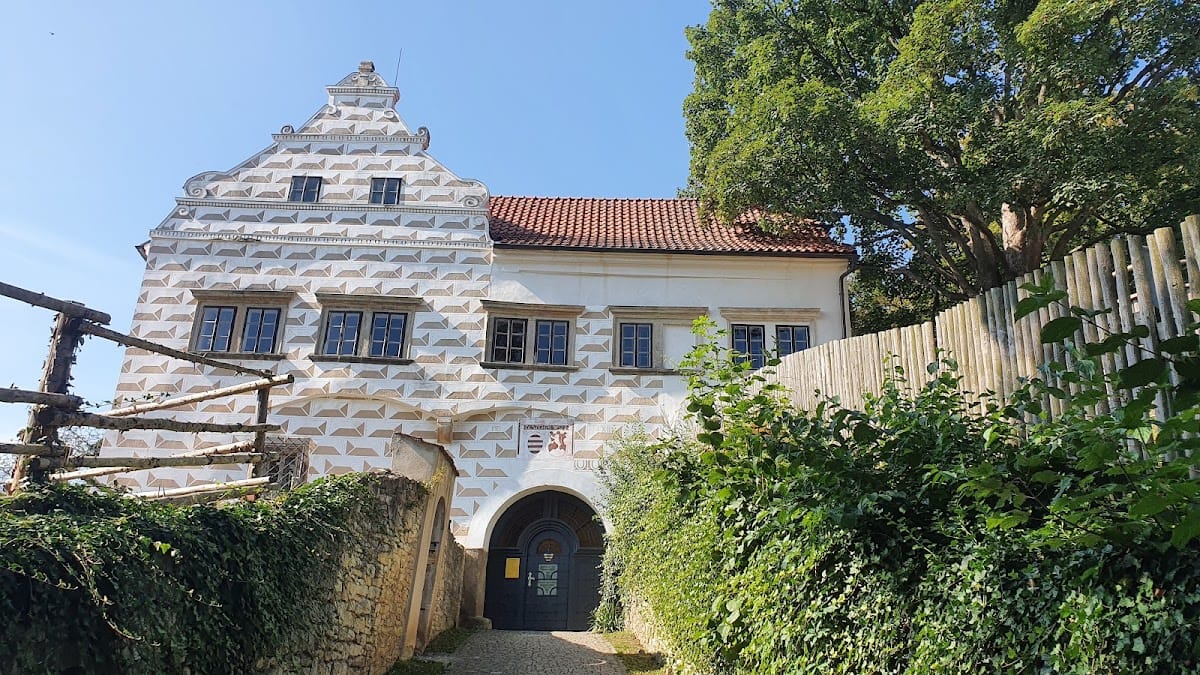
The Renaissance château consisted of a two-wing palace placed northeast of the Gothic core. On the courtyard side, an arcade loggia ran along the building, while a clock tower stood on the southern courtyard front. The façades carried sgraffito, a decoration made by cutting through contrasting surface layers to reveal an ornamental design. The surviving palace walls form part of the ruinous complex.
Burgrave’s building and museum
The Renaissance burgrave’s building is the surviving part of the complex. A burgrave was the official responsible for administering and defending a castle. The building houses a museum of the castle and the town of Luže, including a model that represents Košumberk after its Renaissance reconstruction.
Associated religious features
A chapel dedicated to Saint John of Nepomuk stands below the castle, and the Paletín Chapel is also associated with Košumberk. A large sycamore maple grows below the castle.
Nearby sites