Nové Hrady: A Fifteenth-Century Castle Ruin in Czechia
Site at a Glance
- Rating
- 4.6
- Popularity
- Medium
- Country
- Czechia
- Primary era
- Medieval
- External website
- Open
- Eras represented
- Medieval, Early Modern
- Civilizations
- Habsburg, Holy Roman Empire, Kingdom of Bohemia
- Site type
- Military
- Remains
- Castle
On this page7 sections
History
Nové Hrady is a fifteenth-century castle ruin in Czechia, originally known as Boží dům. Its foundation is associated with Zdeněk Kostka of Postupice, and the first written reference belongs to 1468–1471, in a document issued by King George of Poděbrady that has not been located. The castle occupied an isolated hill above the settlement and became the centre of an estate whose ownership changed repeatedly during the following centuries.
The Kostka estate
After Zdeněk Kostka’s death, his brother Albrecht took possession of the castle before transferring the administration of Boží dům to his nephew, Zdeněk IV Kostka of Postupice. Zdeněk IV adopted the castle’s name in his title. In 1492 he used the form “of Postupice at Boží dům,” while the name Nový hrad appeared in 1493. The later form Nové Hrady was first recorded in 1563.
Following Zdeněk IV’s death in 1510, his sons initially held the property together. Before the family division, the eldest son Vilém pledged Nový hrad for 3,800 kops of groschen to Burian Špetl of Janovice. A kop was a historical monetary unit equal to sixty groschen. Burian was residing at the castle in 1516. On 6 October 1518, the estate passed jointly to Zdeněk, Jan, and Bohuš Kostka of Postupice, who redeemed the pledge. After Zdeněk and Jan died, their shares went to their youngest brother, Bohuš III. Mikuláš of Zásmuky administered Nový hrad for Bohuš from 1536 to 1539.
Loss of the estate and changing ownership
Bohuš Kostka’s financial problems and his participation in the Estates’ Revolt of 1547, an uprising by the Bohemian estates against the Habsburg monarchy, caused him to lose much of his property. Nový hrad remained with him only as a fief, meaning land held in return for obligations to a superior authority. After Bohuš died and the Kostka line became extinct, the estate reverted to the Crown as a royal escheat, property returned to the Crown when its holder died without an eligible heir.
King Ferdinand I sold the castle in 1559 to Jan Žatecký of Weikersdorf. The estate was valued at 7,000 kops of groschen and included the castle, a manorial farm, five administrative districts, the town of Proseč, and numerous villages. Jan lived mainly in Prague and left Nový hrad to his son Vojtěch, who was responsible for paying their sisters Anežka and Anna 5,000 thalers each. Jan died in 1561. Vojtěch married Anna of Sulevice and assigned her a dower of 2,125 kops of groschen at Nový hrad. He probably died without male heirs in 1563.
On 8 September 1563, Anna and Anežka divided the inheritance, with Nový hrad going to Anna. She married Ferdinand Švihovský of Rýzmberk and transferred the property to him. After Anna’s death, Ferdinand sold Nový hrad and three villages to Mikuláš Popel of Lobkowicz on 5 February 1580.
When Mikuláš died in 1588, his underage children’s property was administered by their uncle Ladislav Popel of Lobkowicz. Ladislav borrowed 6,150 kops of groschen from his wife, Magdalena of Salm, to preserve his brother’s indebted estates. When the children came of age, Jan Viktorin Popel of Lobkowicz took control, but the debts rose again. Magdalena then assumed the administration while Jan Viktorin and his brother Mikuláš divided the family property. Mikuláš received Nové Hrady and disputed its ownership with Magdalena until 1595. He died without descendants in 1599, and his sister Anna inherited the estate until her death in 1604.
The Trautson and Chamaré periods
Anna’s husband, Count Paul Sixt of Trautson, inherited Nové Hrady after her death. The estate remained with his descendants until 1750, although its owners did not live at the chateau and instead governed it through appointed officials. Paul Sixt remained loyal to Ferdinand II during the Estates’ Revolt. The rebels confiscated his property, but the Trautsons recovered it after the Battle of White Mountain in 1620, which ended the Bohemian revolt and strengthened Ferdinand II’s control over Bohemia.
Near the end of the Thirty Years’ War, Swedish troops looted and devastated the chateau in 1645. It was provisionally repaired and continued to serve as the administrative centre of the estate. On 5 June 1750, the indebted Count Joseph of Trautson sold Nové Hrady to the free lady Anna Barbara Chamaré. The estate then comprised the castle, a manorial farm, a brewery, a town, and twenty villages. The new owners began repairs, including the construction of a chapel around 1753.
In 1767, Countess Anna Barbara established the Nové Hrady Stations of the Cross on the castle hill. This devotional route, made up of successive stations commemorating episodes of Christ’s Passion, later crossed the area of the former castle fortifications. In 1773, Jan Antonín Harbuval Chamaré decided to create a Rococo chateau. Rococo was an eighteenth-century architectural style associated with light, ornamental, and asymmetrical decoration. The masonry of the old castle was dismantled and reused as building material.
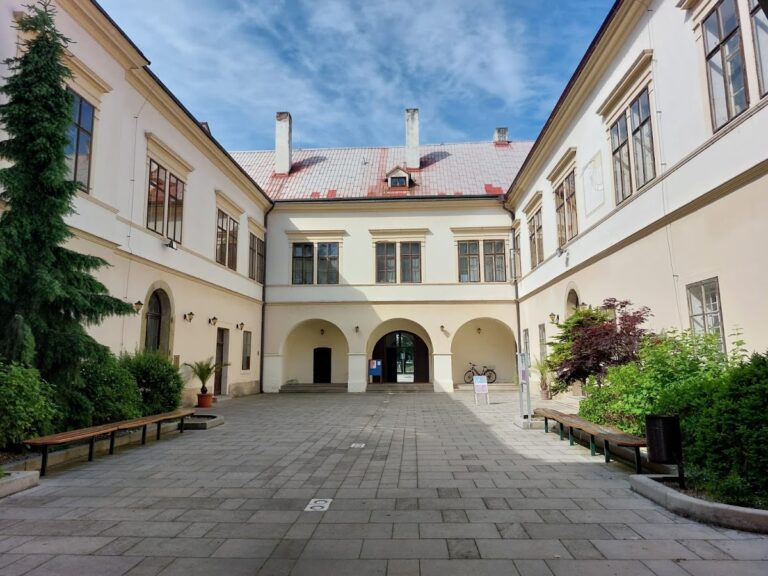
Nové Hrady is protected as a cultural monument. Later alterations changed parts of the archaeological remains. A waterworks building disturbed the eastern side of the castle core in 1929, and park landscaping carried out by Cyril Bartoň of Dobenín in the 1930s levelled part of the southern area.
Remains
Hilltop fortifications
The ruin stands on an isolated hill above Nové Hrady. Its broad, flat summit offered a defensible position and enough room to camp a sizable military detachment. The castle was founded in the second half of the fifteenth century, when active artillery-defence systems were already known, but it did not possess such systems.
A rampart, an earthen defensive embankment, and a ditch surrounded approximately three quarters of the perimeter. An outer defensive area occupied the southern side, where the final section of the approach road passed through the fortifications. The first gate stood near the seventh station of the Stations of the Cross, beside a semicircular, bastion-like projection extending southward. The second gate lay beyond the fourteenth station and gave access to the castle summit.
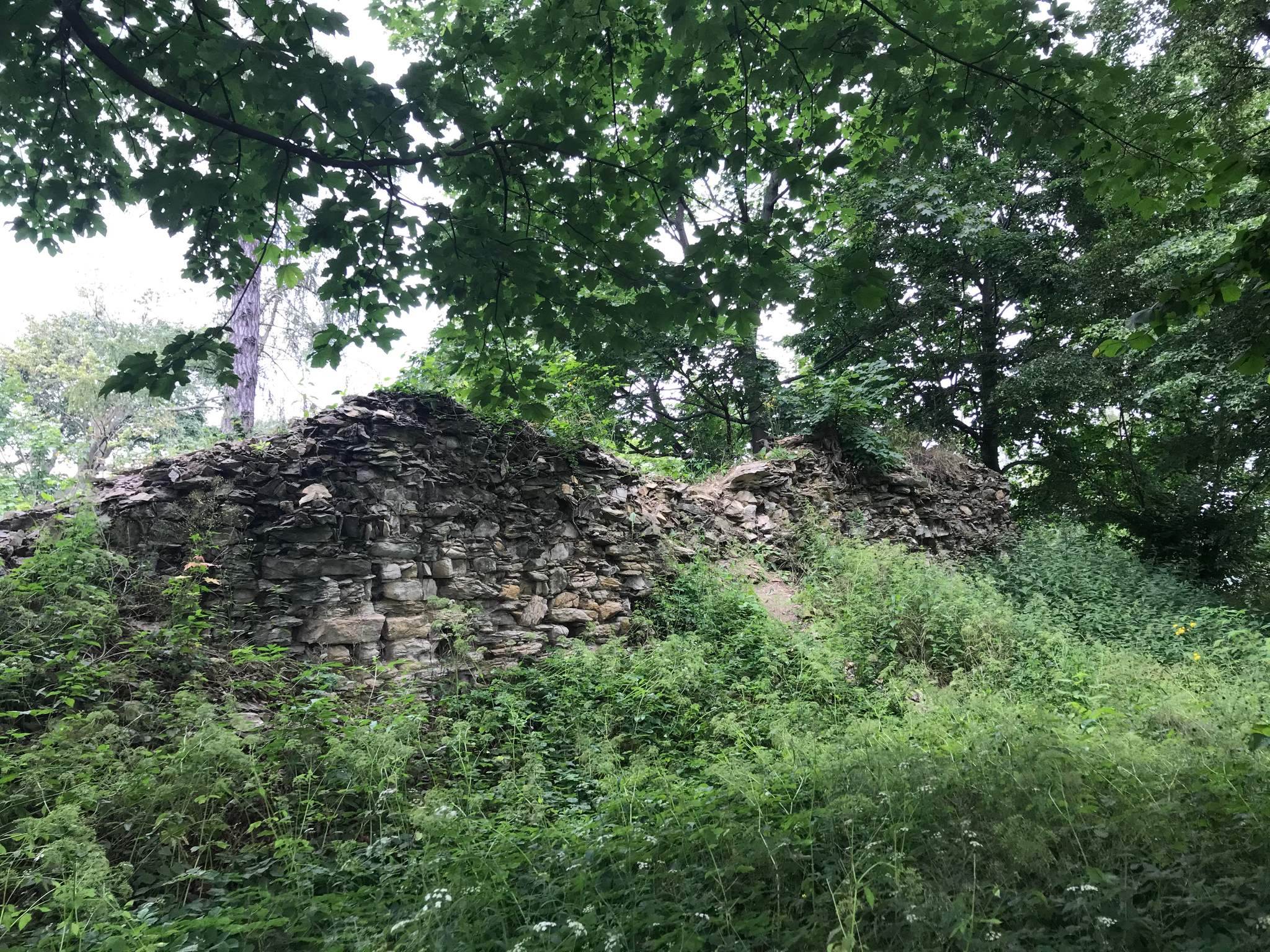
The summit was enclosed by a wall approximately 1.4 metres wide, built of marlstone. A fragment about 20 metres long survives on the northwestern side, while relief traces of the wall remain visible around most of the perimeter. A building stood along the wall on the entrance side. The former castle masonry was largely removed in the eighteenth century for the construction of the Rococo chateau, so the fortifications are now represented mainly by earthworks and small masonry fragments.
Castle core
The castle core occupied the northeastern part of the fortified area. It survives chiefly as rampart-like earthworks with fragments of masonry. Its eastern side was disturbed by the waterworks building erected in 1929, while park alterations in the 1930s levelled the southern part of the core. Together with the perimeter traces, these terrain features mark the position of the former buildings and defensive works.
The chapel built around 1753 belongs to the period when the Chamaré owners repaired the castle before the old masonry was dismantled for the new chateau. The surviving physical evidence therefore combines fortification traces, scattered masonry, altered ground levels, and features associated with the eighteenth-century transformation of the hilltop.