Hřídelík: A Ruined Rock Castle in Czechia


Site at a Glance
- Rating
- 4.4
- Popularity
- Low
- Country
- Czechia
- Primary era
- Medieval
- External website
- Open
- Eras represented
- Medieval, Modern
- Civilizations
- Habsburg, Holy Roman Empire, Kingdom of Bohemia
- Site type
- Military
- Remains
- Castle
On this page8 sections
History
Hřídelík is a ruined rock castle in Czechia, situated on the southern edge of Blíževedly. It was probably established at the initiative of the Prague bishopric before 1300, on a steep sandstone rock formation. Archaeological research found evidence of settlement on the site during the second half of the thirteenth century.
Medieval Foundation and Ecclesiastical Use
The castle may have been built by the Berka von Dubá family, a noble lineage active in medieval Bohemia. Its existence is indirectly associated with Martin of Hřídelík, who administered Blíževedly in 1292. The first written mention of the castle dates from 1334.
Hřídelík lost importance in 1375, when the Prague archbishopric acquired the nearby Helfenburk estate. It was then used as a prison for priests convicted by the ecclesiastical court of the Prague archdiocese, an institution that judged religious and disciplinary offences among the clergy. A record of this function survives from 1395. That same year, plans were made to convert the castle into a Dominican monastery, although the proposal was not carried out.
Destruction and Later Reuse
The castle was damaged and abandoned during the Hussite Wars, fifteenth-century religious and political conflicts in Bohemia linked to the Hussite reform movement and the campaigns against it. It is generally thought to have been destroyed during this period. Later cadastral records called the site the Old House or Old Castle, while another name, Little Wave, was used in German.
In the early nineteenth century, Augustin Hille, bishop of Litoměřice, ordered a brick summer residence to be built on the ruins. The building was used as an inn but was soon abandoned, and it had deteriorated severely by around 1850. The hollowed and overhanging rocks later provided shelter for beggars and vagrants.
In 1906, the Blíževedly innkeeper Franz Josef Pietzsch cleared debris from the ruins and exposed the former courtyard and several chambers for use as a summer inn. This enterprise was short-lived. Before the First World War, cavities in the rock were used as drying houses, and hop gardens were established on the slopes. Hřídelík is now protected as a cultural monument of the Czech Republic and is state-owned.
Remains
Rock Castle Core
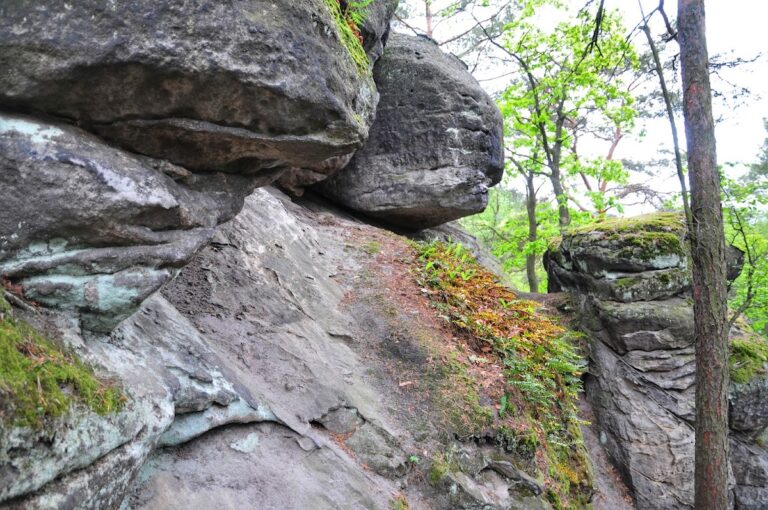
Hřídelík belongs to the group of rock castles, whose defensive works and buildings were constructed on or partly cut into a natural rock formation. The castle occupies a steep sandstone pillar rising to approximately 362 metres above sea level, with the ground falling sharply toward the south. A small summit platform formed the castle core and was enclosed by a surrounding wall.
Enclosing Wall and Palace
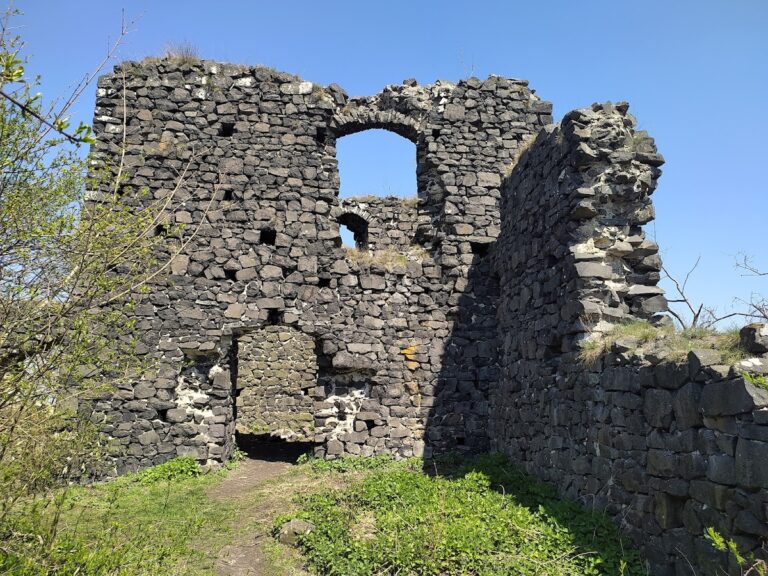
Sections of the former enclosing wall survive to about half a metre high. Within the core stand the remains of a rectangular palace, built of stone in the Gothic style. The palace is reached through an approximately 18-metre-long underground passage that bends before entering the building. Its form includes a Gothic profile, characterized by pointed-arched architectural lines.
Rock Chambers and Moat
The south-eastern part of the rock contains partly hewn covered spaces and natural rock overhangs. Other surviving elements include fragments of the original walls and the former moat, a ditch that formed part of the castle’s defenses. The moat is now planted with old fruit trees.
Nineteenth-Century Residence
The brick summer residence built on the medieval ruins in the early nineteenth century was a separate later structure. After its brief use as an inn, it was abandoned and became severely dilapidated, leaving the medieval rock castle remains and the later brick building as distinct phases in the site’s physical history.