Poppi Castle: A Medieval Fortress-Palace in Tuscany

Site at a Glance
- Rating
- 4.6
- Popularity
- Medium
- Country
- Italy
- Primary era
- Medieval
- External website
- Open
- Eras represented
- Medieval, Early Modern, Modern
- Civilizations
- Grand Duchy of Tuscany, Republic of Florence
- Site type
- Military
- Remains
- Castle
On this page9 sections
History
Poppi Castle is a medieval fortress-palace in Poppi, Italy, built and enlarged under the Guidi counts during the thirteenth century. The Guidi were a noble family who controlled much of the Casentino and a network of castles, including Romena and Porciano, for approximately 350 years. The castle became an important centre of their territorial power before passing under Florentine rule.
Early Fortress and Guidi Rule
The earliest written reference to the castle dates to 1169, when it belonged to the Abbey of San Fidele de Strumi. Records from the 1190s, including one from 1191, identify it as a possession of the Guidi counts. Its foundations indicate that an earlier defensive structure occupied the site before the end of the twelfth century.
Renovation began in 1274 under Count Simone Guidi and his son Guido. The oldest parts visible today belong to the second half of the thirteenth century. The authorship of this work remains uncertain. The older section has been attributed to Lapo di Cambio, while the later thirteenth-century work is traditionally associated with Arnolfo di Cambio, a Florentine architect and sculptor. Tradition also holds that Arnolfo used Poppi Castle as a prototype for Florence’s Palazzo Vecchio.
From Guidi Power to Florence
The Guidi family continued to rule the Casentino after its defeat at the Battle of Campaldino, fought on 11 June 1289 between forces aligned with Arezzo and Florence. Their control ended after the Battle of Anghiari in 1440, when Count Francesco dei Guidi took the side opposed to Florence. Milanese forces were defeated by the Florentine army commanded by Niccolò Piccinino, forcing Francesco to surrender. The Guidi counts were spared but exiled, and their rule in the Casentino came to an end.
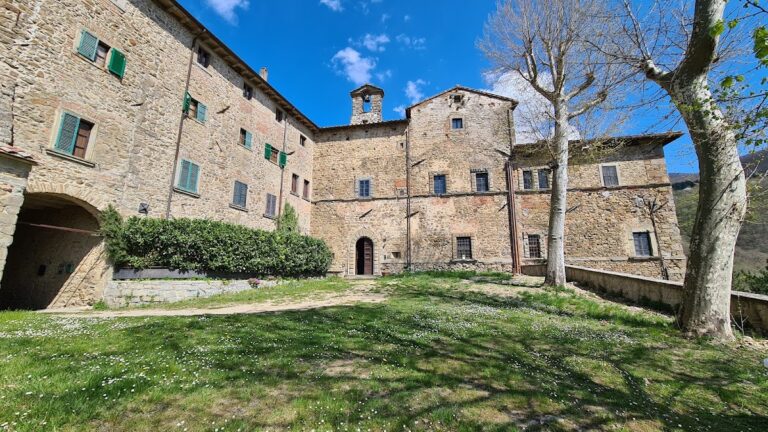
Poppi then remained under Florentine rule until the unification of Italy in 1860. Additions made over approximately the next 150 years created the inner courtyard and introduced other Renaissance elements. For many years the castle also housed Poppi’s municipal administration. It is now owned by the Commune of Poppi, restored, and included in the Casentino Ecomuseum’s system of castle heritage. Its present institutions include the Campaldino battle museum, the Rilliana Library, and the Giovanni Gualberto Miniati Documentation Centre.
Remains
Fortified Residence
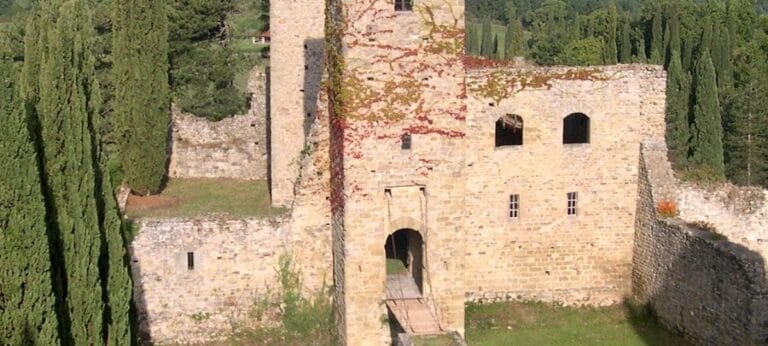
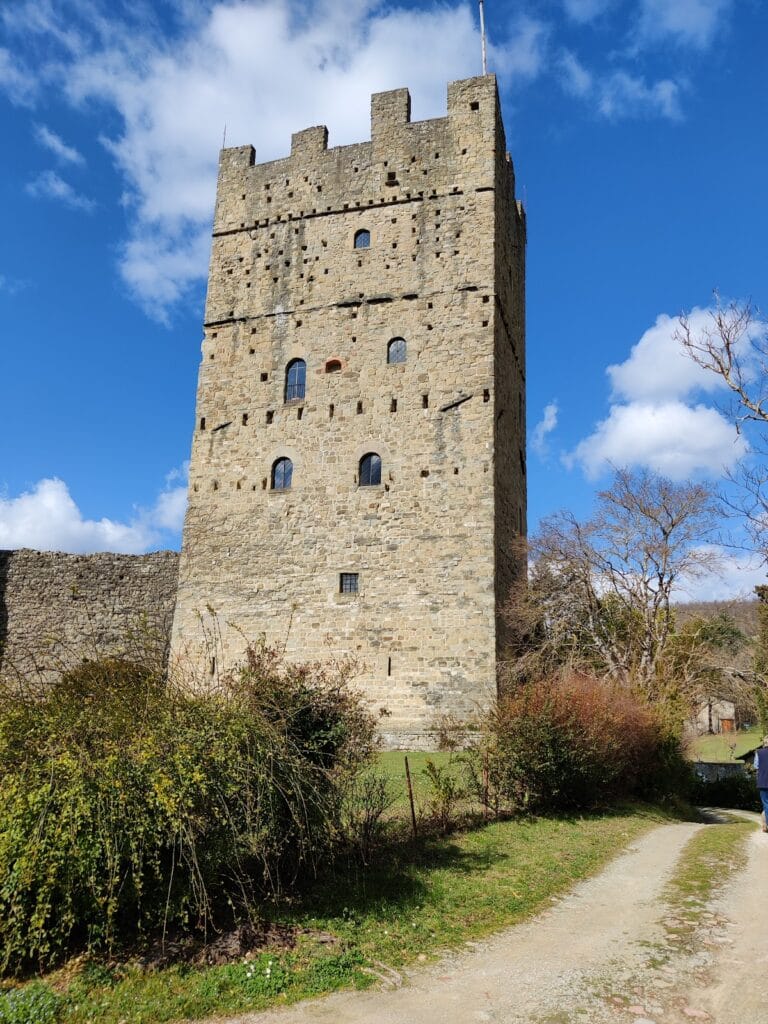
Built chiefly of sandstone, the castle combines a fortified residence with surviving elements of an earlier defensive structure. The tower and the keep on the left date from the second half of the thirteenth century. The original tower was reportedly taller and had machicolations, projecting parapets with openings through which defenders could drop missiles onto attackers. A later keep was added to the right of the original tower and incorporated into the residence, with a prison beneath it. At the end of the thirteenth century, the mullioned windows, which are divided by vertical stone supports, were enlarged to give the façade a more elegant appearance.
Courtyard and Staircase
Later construction formed the inner courtyard. A monumental stone staircase rises from the courtyard to the first floor and was built in the 1470s. It is traditionally attributed to Jacopo di Baldassarre Turriani and may have followed a design by Brunelleschi. Coats of arms belonging to Florentine families that ruled Poppi during the fifteenth and sixteenth centuries cover the staircase walls. At its top stands a stone-serena statue of a mounted knight, generally identified as Guido di Simone da Battifolle and attributed to an early fifteenth-century Florentine sculptor working in the manner of Niccolò di Piero Lamberti.
Guidi Chapel
Reached from the inner courtyard, the Guidi Chapel has a single nave and is almost entirely covered with frescoes. The painted cycles present the stories of Saint John the Baptist, Saint John the Evangelist, and the life of the Virgin Mary, with saints represented below. The vault has enthroned Evangelists at its four corners. The frescoes are attributed to Taddeo Gaddi, a Florentine painter and pupil of Giotto, during his youthful period in the 1320s. Restoration carried out from 1988 to 1990 confirmed this attribution.
The chapel’s decoration includes imitation marble, a painted niche containing small vessels, a painted polyptych, geometric framing, painted panels, and architectural forms. A frescoed trompe-l’oeil polyptych, an illusionistic multi-panel altarpiece designed to appear three-dimensional, occupies a niche beneath a window.
Tower and Later Alterations
Lightning struck the castle’s tower during the nineteenth century. It was subsequently rebuilt and substantially remodelled into its present form, leaving the tower as a visible combination of medieval origins and later reconstruction.
Library and Collections
The Rilliana Library occupies a castle wing transferred to it in 1911. The wing contains five large rooms and a small salon. Its holdings include approximately 25,000 old books, 868 manuscripts, including 150 medieval manuscripts, and 930 fifteenth-century incunabula, books printed in Europe before 1501. The collection began with the bequest of Count Fabrizio Rilli Orsini and grew through private gifts such as the Soldani bequest and the transfer of collections from suppressed monastic institutions, including Camaldoli Hermitage, the Capuchin Friars’ monastery, and the Vallombrosan monastery of San Fedele at Poppi.
A painting by Giovanni Martinelli shows the Virgin and Child giving the Rosary to Saint Dominic, accompanied by Saints Francis, Catherine of Alexandria, Lucy, and Joseph. Signed and dated 1647, it came from the Church of San Michele Arcangelo at Biforco. After restoration for a 2001 exhibition, it was placed in the castle in 2001 and remained there for security reasons. A 1:32-scale diorama of the Battle of Anghiari is located in the castle crypt.
Nearby sites