Castello di Quero: A Fourteenth-Century Venetian Fortress in Italy


Site at a Glance
- Rating
- 4.4
- Popularity
- Low
- Country
- Italy
- Primary era
- Medieval
- External website
- Open
- Eras represented
- Medieval
- Civilizations
- Venetian
- Site type
- Military
- Remains
- Castle
On this page6 sections
History
Castello di Quero is a fourteenth-century fortified complex in Italy, at Santa Maria in Setteville, Veneto, built under the Republic of Venice to defend the Piave frontier against Austrian incursions. Known popularly as Castelnuovo, it also controlled an important river route and later became a religious site connected with the Somaschi order.
From Castelvecchio to the Venetian fortress
An earlier castle, called Castelvecchio in historical chronicles, stood a little farther south. Troops led by Gerardo de’ Taccoli, bishop of Belluno, besieged it in 1196, after which the castle was dismantled. The replacement fortress was built around 1376 by Jacopo Cavalli, a captain of the Republic of Venice, the maritime and territorial state that governed much of northeastern Italy. Construction was completed in 1379, when the stronghold became operational with a garrison of eighteen soldiers.
Beyond its military role, the castle served for centuries as a customs point for traffic on the Piave. Its strategic military purpose ended during the sixteenth century, although the complex remained involved in later conflicts. In 1411, the army of Feltre attacked and occupied it for a time. Venetian forces subsequently recovered the castle and partly damaged its main tower during the recapture.
Warfare and religious memory
Castello di Quero was drawn into the War of the League of Cambrai, an early-sixteenth-century conflict in which Venice faced a broad coalition of European powers and Italian states. During the First Battle of the Piave in the First World War, a campaign fought along the Piave River in northeastern Italy, Austrian forces bombarded, stormed, and captured the fortress. The fighting caused further damage.
As the fortress declined, the complex was first converted into an inn and later into a hotel. The Somaschi Fathers, members of the Clerics Regular of Somasca, purchased it in 1924. They completely restored it in 1927 and established a religious house and place of worship there.
The Somaschi connection is rooted in the life of their founder, Gerolamo Miani, a nobleman who had served as castellan, the official responsible for governing and defending a castle, at Quero. On 27 August 1511, French forces attacking the castle with nearly 3,000 infantry under the Albanian general Mercurio Bua captured Miani and chained him in the fortress’s underground cells.
According to tradition, Miani prayed in despair during the night and was miraculously freed through the intervention of the Madonna. He then went to Treviso to offer the chains of his captivity to the Madonna of Miracles. This episode is traditionally regarded as the beginning of his conversion, which later led him to establish the Somaschi order. Castello di Quero is recognized as Italian national heritage.
Remains
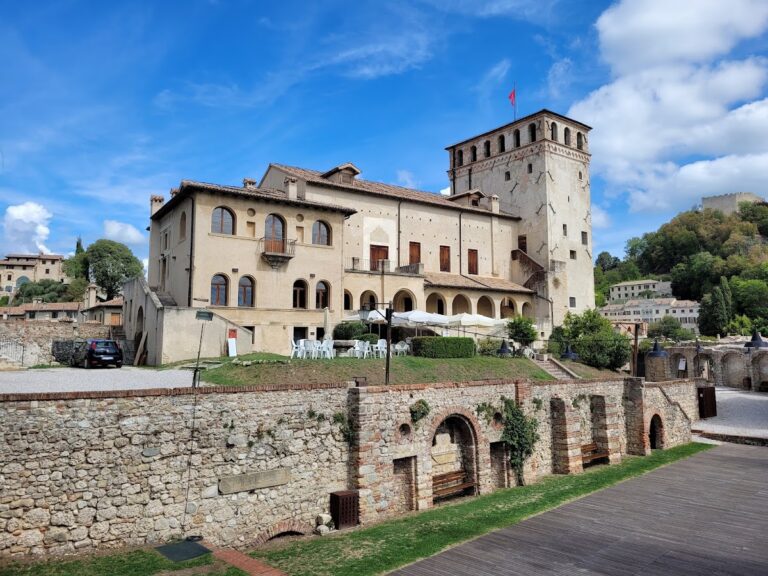
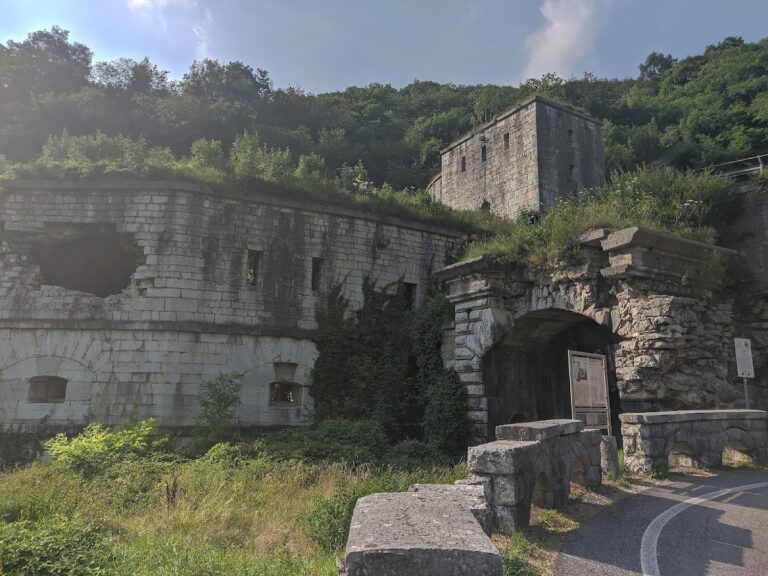
Castello di Quero is a stone-built complex organized around two substantial towers and a surviving elevated passage. The fortress stands beside the Piave, while the connecting structure rises above the principal road through the area. That road was already an important communication route in antiquity, giving the castle a position suited to controlling movement through the surrounding area.
Towers and river defenses
The larger tower retains machicolations, projecting defensive openings through which defenders could drop or throw objects onto attackers below. A smaller tower was founded directly on the bed of the Piave. It was formerly connected to another tower on the opposite bank by a chain used to regulate river traffic. The opposite-bank tower was accidentally destroyed in 1885.
Connecting passage
A surviving passage spans the space between the two towers and rises above the principal road. Its elevated position forms the remaining physical link between the tower structures and reflects the complex’s relationship with both the road and the river. The passage and the towers preserve the main elements of the fortress’s defensive and traffic-control arrangement.
Nearby sites