Castello della Rancia: A Medieval Fortification near Tolentino
Site at a Glance
- Rating
- 4.3
- Popularity
- Medium
- Country
- Italy
- Primary era
- Medieval
- External website
- Open
- Eras represented
- Medieval, Early Modern
- Civilizations
- Papal States
- Site type
- Military
- Remains
- Castle
On this page9 sections
History
Castello della Rancia is a medieval fortress in Italy near Tolentino, built in its present form between 1353 and 1357 by the Da Varano, the ruling family of Camerino. Its position helped defend the Chienti valley and control the Roman road beside it. The castle takes its name from an ancient granary, or grancia, a word derived from the Latin granica.
Cistercian origins and the Da Varano fortress
By the end of the twelfth century, the site contained a granary belonging to the Cistercian monks of nearby Fiastra Abbey. The Cistercians were a Catholic monastic order whose communal life emphasized disciplined agriculture, and the estate included a fortified farm-granary dependent on the abbey. A fortification already stood there before the thirteenth century and was used by the monks.
Between 1353 and 1357, Rudolfo II of the Varano family expelled the monks and reshaped the earlier stronghold into the castle seen today. The architect Andrea Beltrami completed the work in 1357. The new fortress served both as a defensive position and as a means of controlling movement through the valley and along the nearby Roman road.
Religious and agricultural reuse
By 1581, the Jesuits had taken possession of Fiastra Abbey. The castle had by then lost its military importance and became part of a large agricultural estate. It also served as a hostel for pilgrims travelling toward Rome. The Jesuits, members of the Society of Jesus, were a Catholic religious order founded in the sixteenth century.
In 1782, Pope Pius VI granted the possessions of Fiastra Abbey, including Castello della Rancia, to the Bandini noble family. Maria Sofia Gravina di Ramacca, the family’s last descendant, transferred the castle to the Municipality of Tolentino in 1974. The municipality remains its owner.
The Battle of Tolentino and later interpretation
Castello della Rancia was heavily contested during the Battle of Tolentino on 2 and 3 May 1815, fought at the end of the Napoleonic conflicts. Joachim Murat, a French Napoleonic marshal and King of Naples from 1808 to 1815, led troops against Austrian forces seeking to restore Bourbon rule in Naples. The Austrian victory forced Murat’s troops to retreat.
The battle is commemorated by the annual “Tolentino 1815” event held in the countryside around the castle. After restoration, the building became home to the Gentiloni-Silverj Archaeological Museum.
Remains
Fortified enclosure and entrance
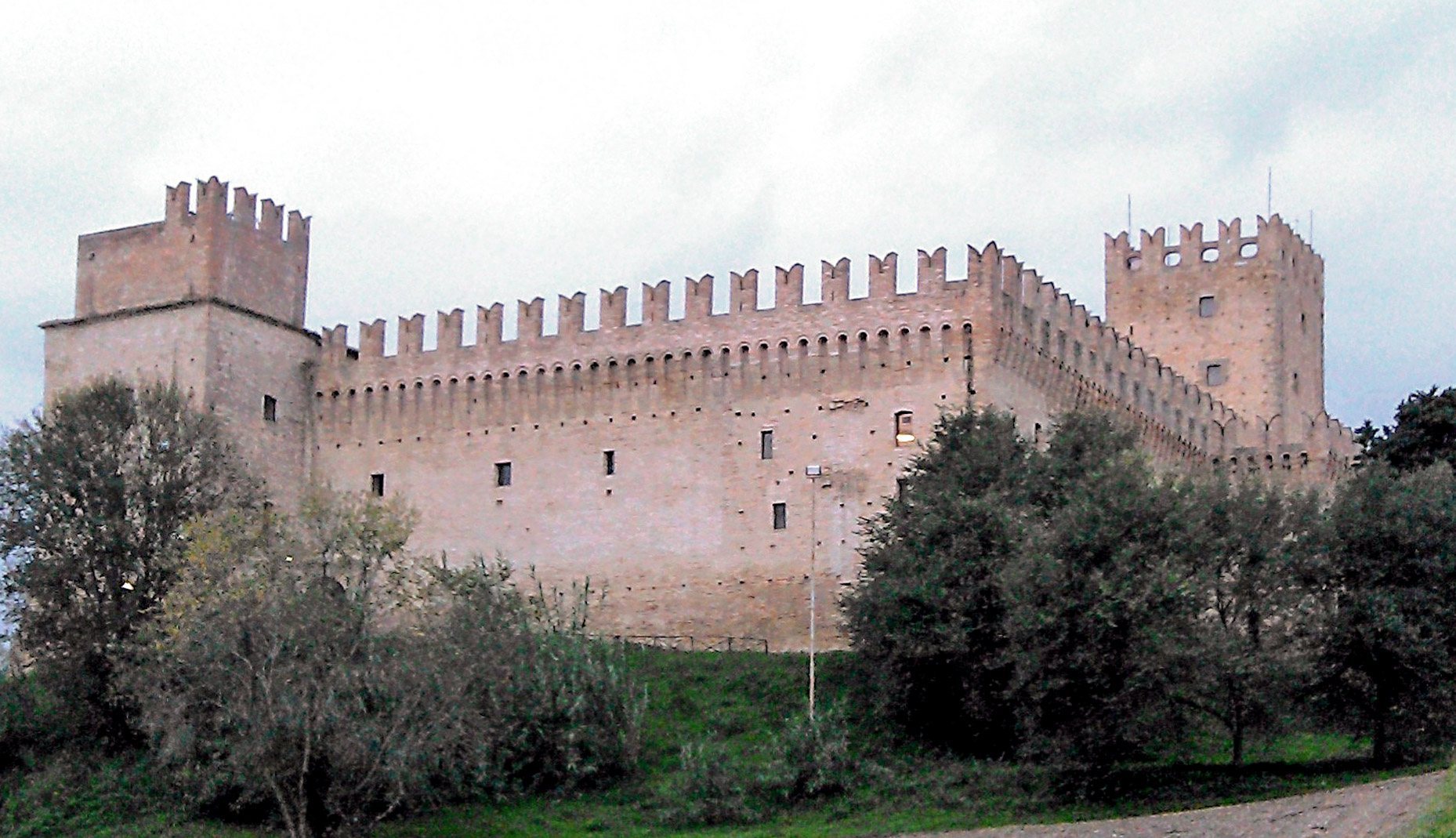
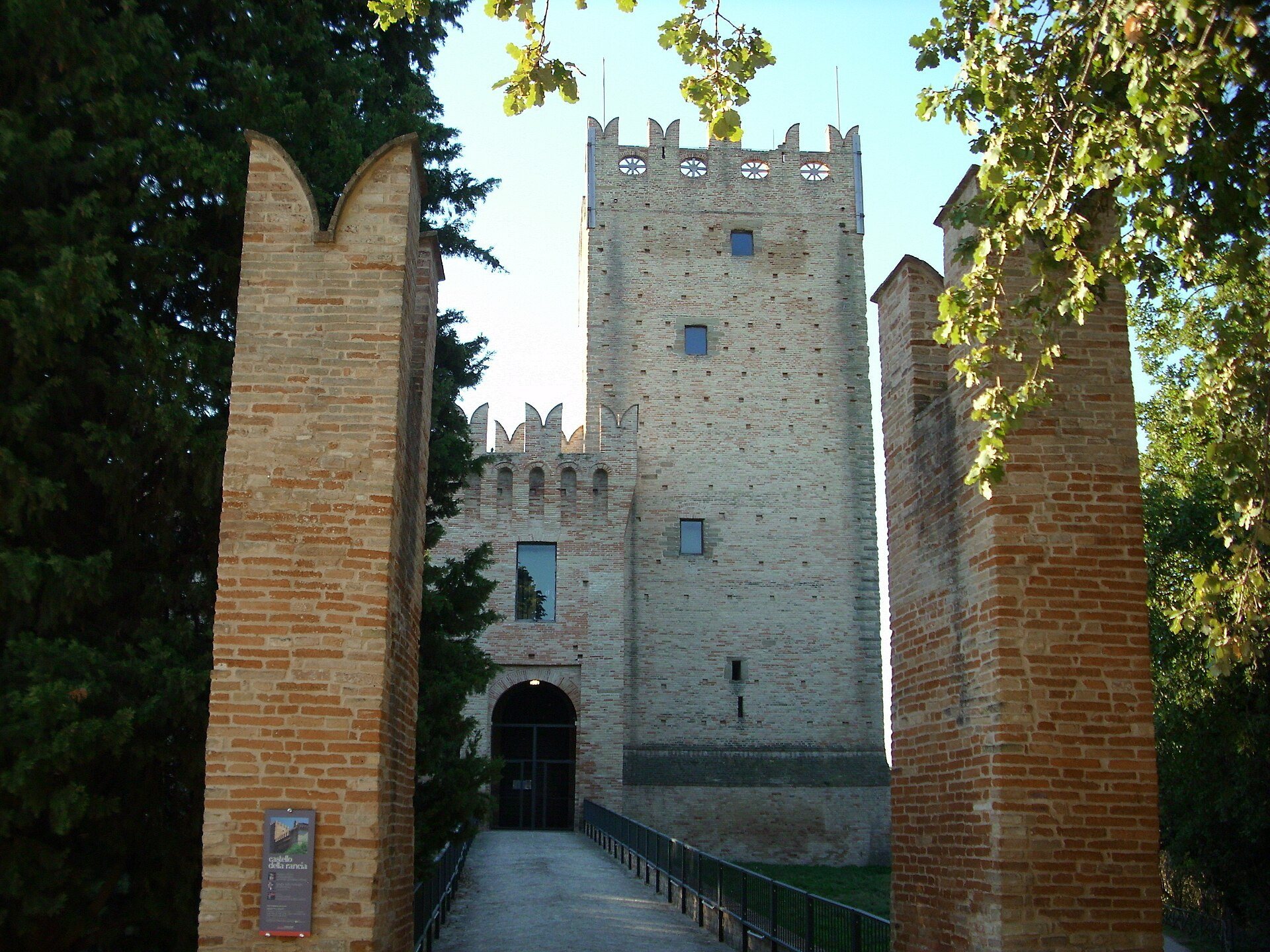
The castle stands in the Rancia district on the plain along the left bank of the Chienti River, nearly 7 km from Tolentino. Its quadrangular enclosure is formed by crenellated walls, meaning parapets with alternating raised sections and openings, and is reinforced by three corner towers. A further tower protects the main entrance. The entrance was once approached by a drawbridge, which was later replaced by a masonry bridge.
Keep and prison level
The keep, the castle’s principal fortified tower, rises approximately 25 m and contains four floors. The first three floors have cross-vaulted ceilings. The semi-basement is lit by two high loopholes and formerly served as a prison. Large iron rings fixed into the walls indicate how prisoners could be restrained.
Courtyard and residential spaces
Two porticoes extend along adjoining sides of the courtyard. Their round arches rest on cylindrical brick pillars, while a very deep cistern occupies the courtyard’s center. On the first floor, another portico adjoins a large hall that probably formed part of the castle’s residential area.
Chapel and traditions
The courtyard provides access to a small Baroque chapel erected by the Jesuits. Unconfirmed testimony maintains that a second cistern once stood at the courtyard’s center and that many people killed during the 1815 battle were buried there. A medieval underground passage is also said by legend to connect the castle with the Basilica of San Nicola in Tolentino. The castle remains relatively well preserved and restored.