Our Lady of Kazan Church on the Torg: An Orthodox Church in Vologda
Site at a Glance
- Popularity
- Low
- Country
- Russia
- Primary era
- Early Modern
- Eras represented
- Early Modern
- Civilizations
- Russian
- Site type
- Religious
- Remains
- Church
On this page9 sections
History
Foundation and early churches
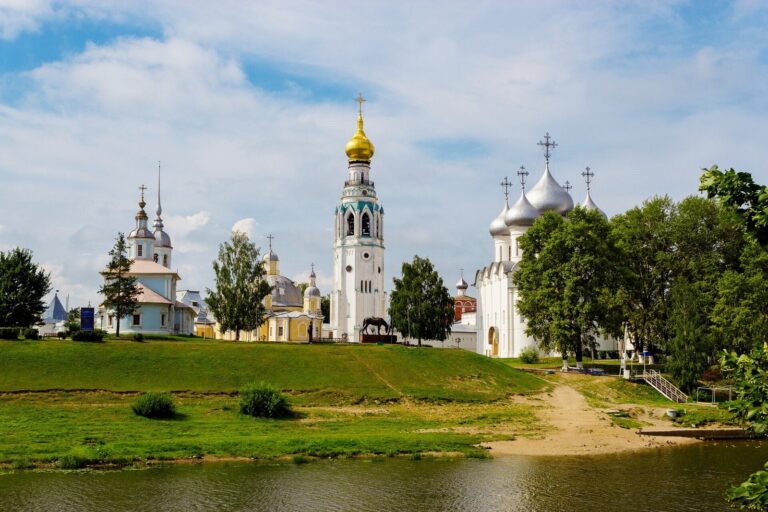
Our Lady of Kazan Church on the Torg is a Russian Orthodox church in Vologda, Russia, associated with Ivan IV, known as Ivan the Terrible, and the founding of the city’s fortified central precinct, the Vologda Kremlin. The Vologda chronicler Ivan Slobodskoy records that Ivan ordered a stone city founded on 28 April 1566. Historian N. I. Suvorov linked that date to the laying of a wooden church dedicated to the apostles Jason and Sosipater, regarded in Orthodox tradition as members of the Seventy Apostles, an early group of Christian missionaries. That church was the predecessor of the Kazan church.
The early church stood near the tsar’s palace. The palace’s own church was dedicated to Joachim and Anna, and was later rededicated to the Intercession, the Orthodox observance of the Virgin Mary’s protection of the faithful. The name “on the Torg” came into use in the 20th century, referring to a nearby market. Trading rows had stood close by since the 17th century. Earlier names associated the church with Fish Row and, later, the Swamp, apparently recalling the marshy ground.
Fires and rebuilding
A fire in 1605 destroyed the palace and the churches of Joachim and Anna and Jason and Sosipater. The latter church was rebuilt with a dedication to the Kazan Icon of the Mother of God, a revered Orthodox image of the Virgin Mary, as devotion to the icon spread after the events of 1612. The altar of Jason and Sosipater was transferred to a side chapel.
A new trading complex was built nearby in the early 17th century. A 1627 land record describes a wooden Kazan church with chapels dedicated to Jason and Sosipater, as well as a separate wooden church dedicated to Dmitry of Moscow, a son of a Russian tsar. The two churches probably served as the parish’s heated winter church and unheated church. After fires in 1636, 1661, and 1680, the Dmitry church was not rebuilt; wooden structures bearing crosses were set up at its former site.
In 1679, a fire that began in the trading complex’s row of icon shops destroyed the Kazan church, though much of its property was saved. Parishioners asked Archbishop Simon of Vologda and Belozersk for permission to rebuild. The resulting wooden church had a hall and bell tower and remained in use until the second half of the 18th century. A stone church was built between 1749 and 1760.
Parish life and closure
In 1820, the Kazan church became affiliated with the Church of the Intercession on the Torg. From 1832, it served as the heated church for winter worship, while summer services took place at the Intercession church. The parish consequently became known as Pokrovo-Kazansky. On 14 May 1907, the Russian Orthodox priest John of Kronstadt celebrated the Divine Liturgy there while travelling to his home village of Sura. It was his final visit to Vologda.
The church closed on 4 June 1929. Proposals to use the building for confectionery production or as a tractor-repair workshop were set aside, and it was assigned to the district archive bureau for storing documents. Its crowning elements were removed in the 1930s. The tent-roofed bell tower was dismantled in the late 1940s or early 1950s, damaging part of the attached hall. Trading offices dealing in dairy products occupied the building until the 1970s. After the city bazaar moved, officials considered demolishing the church for an administrative building on Trade Square, but built offices elsewhere and assigned the church to a motor convoy inspection service.
Restoration and renewed worship
Efforts to restore the church and revive the parish began in the early 1990s, led by Vasily Pavlov, rector of the Intercession church, and a community headed by D. N. Tikhomirova. In 1992, the ruined building was transferred to the Intercession community. A restoration project designed by architect G. P. Belov began in the 2000s and is ongoing. A 1995 presidential decree placed the church under federal protection as a cultural heritage monument.
A separate parish was established on 16 June 2014, and a prayer service before the Kazan Icon was held in the church on 20 July. On 11 May 2015, Metropolitan Ignatius of Vologda and Kirillov, a senior bishop, celebrated the first Divine Liturgy there since its closure. The church belongs to the Russian Orthodox Church and the Diocese of Vologda and Kirillov, a territorial church district overseen by a bishop.
Remains
Plan and exterior
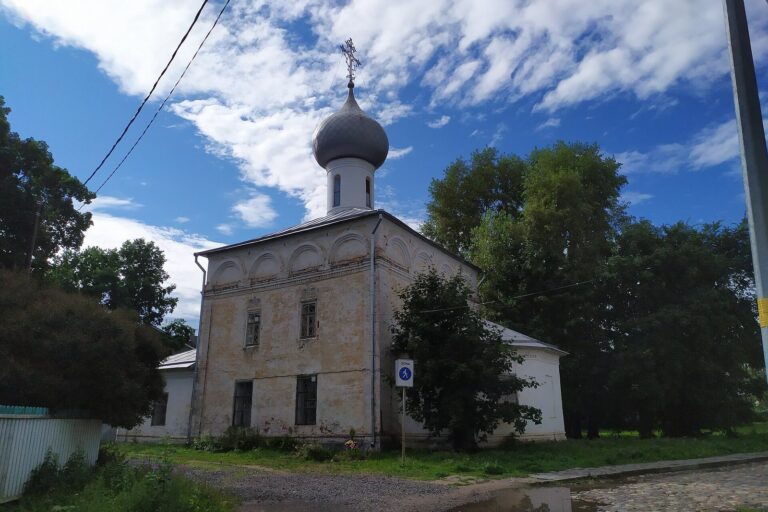
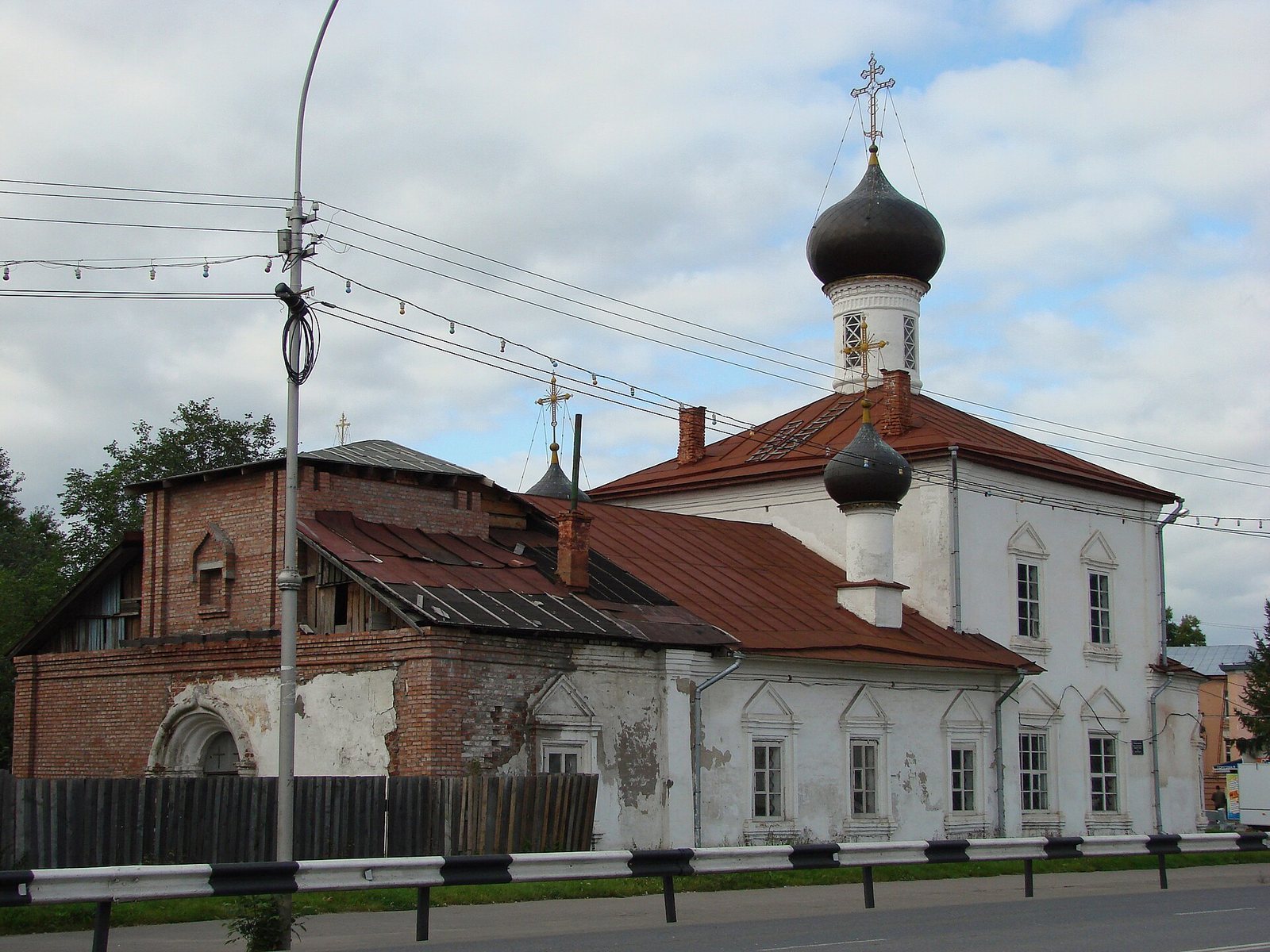
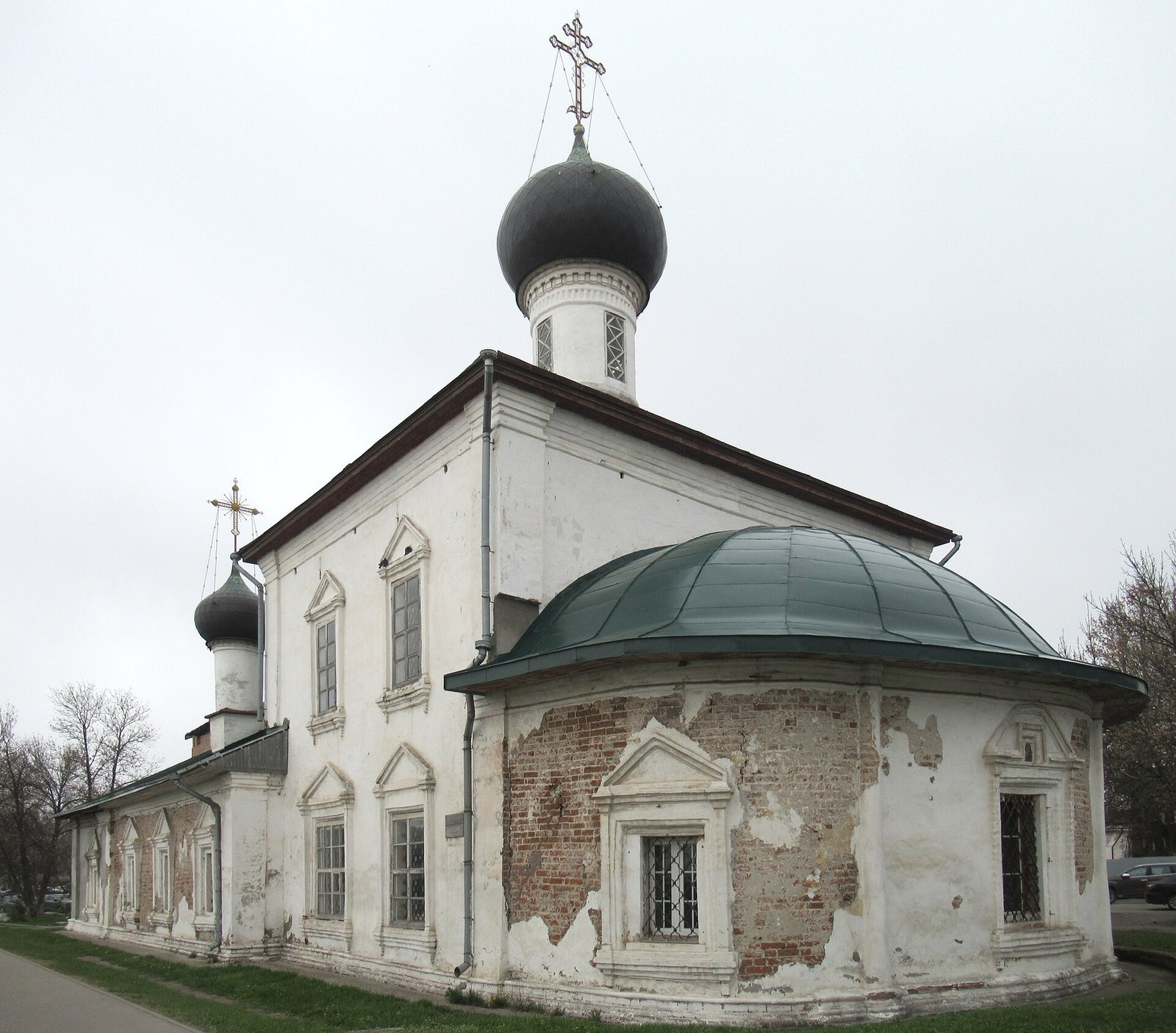
The stone church is a massive, single-domed building without internal pillars. Its four-sided main block is elongated across its width and rises above a broad attached hall, called a refectory, and a short apse, the projection at the altar end. Flat vertical bands mark the corners, while simple elements crown the walls. The building combines forms associated with 17th-century architecture and 18th-century details.
Bell tower and restoration
An octagonal bell tower rises from a square base and adjoins the refectory. Its design, along with the deeply set entrance and paired half-columns at the corners, follows 18th-century forms. Restoration has reinstated the domes and repaired damaged masonry, while work on the bell tower has also begun.
Chapel, paintings, and furnishings
The main altar is dedicated to the Kazan Icon of the Mother of God, and a side chapel is dedicated to Jason and Sosipater. The main altar remains under restoration, so services are held in the apostles’ chapel. Wall paintings made in the 1760s and retouched later lie beneath subsequent layers of oil paint. They have been tentatively attributed to Yakov Alekseev Korostin and his son Fyodor, painters associated with Spaso-Prilutsky Monastery; they may be the only work connected with Vologda masters. Restoration in the second half of the 20th century revealed fragments of a Transfiguration scene, a Last Judgment scene called The Woman Clothed with the Sun on the south wall, and a depiction of the Heavenly Jerusalem on the vault. Before the church closed, it held a five-tier gilded screen of icons separating the sanctuary from the worship space. An icon screen for the Jason and Sosipater chapel was completed in 2017. A 1723 calendar of saints’ feast days was also kept in the church; an earlier belief that the Stroganovs donated it was later rejected.