Church of the Visitation of the Virgin Mary and Monastery of the Brothers of Mercy: A Baroque Church, Monastery, and Hospital in Bratislava
Site at a Glance
- Popularity
- Low
- Country
- Slovakia
- Primary era
- Early Modern
- Eras represented
- Early Modern
- Civilizations
- Habsburg, Hungarian
- Site type
- Religious
- Remains
- Monastery
On this page11 sections
History
The Church of the Visitation of the Virgin Mary and Monastery of the Brothers of Mercy is a Baroque Catholic complex in Bratislava, Slovakia, established by the Brothers of Saint John of God, with its church completed in 1692 and monastery built in 1723–1728. The Brothers were a Catholic religious order particularly associated with caring for the sick. The church, monastery, and hospital served the order’s charitable work, and the hospital was intended to help the city’s poor. The complex is regarded as one of Bratislava’s most valuable Baroque religious buildings.
The brothers arrive in Bratislava
The Brothers of Saint John of God arrived in Bratislava in 1672 at the invitation of Juraj Selepčéni, then the Catholic Archbishop of Esztergom. On donated land outside the city walls near Laurinc Gate, they established a church, monastery, and hospital. Turkish raids in the 1680s burned this first complex.
Rebuilding and expansion
Benefactors supported a new church and monastery after the fire, with Baron Ján Maholányi financing the church. Its foundation stone was blessed on 2 July 1690, and construction was completed on 13 May 1692.
After the church was finished, Cardinal Leopold Kolonič, a senior Catholic church leader in the Habsburg lands, bought a palace immediately to its south to serve as a new monastery. His death and the Rákóczi uprising delayed construction. The uprising was an early eighteenth-century revolt against Habsburg rule in the Kingdom of Hungary, led by Francis II Rákóczi. The monastery was built in 1723–1728, completing the complex nearly four decades after work on the new church began. Its design followed the Brothers’ principal monastery in Vienna, adapted by a Bratislava builder to local conditions.
Remains
Complex layout
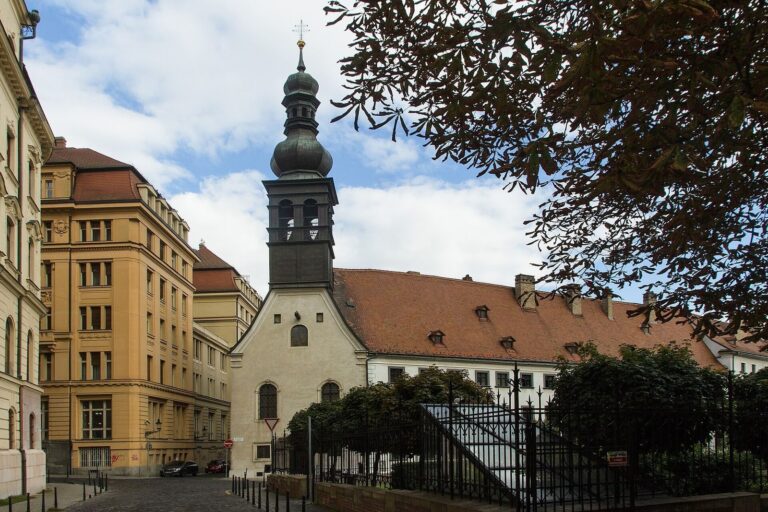
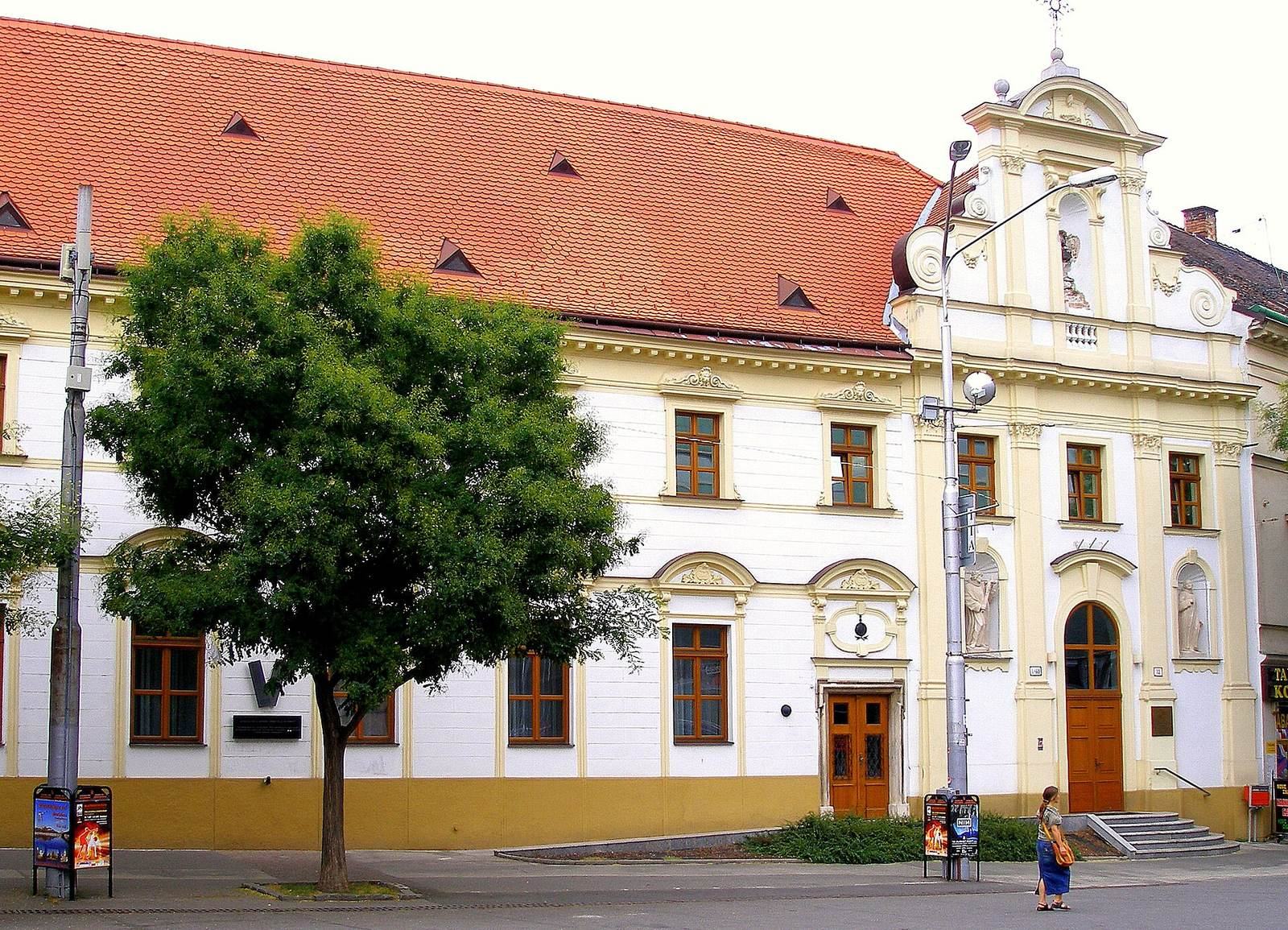
The complex faces the square along its full width. The church stands between the monastery’s side wings, while the hospital occupies the southern part. The one-storey monastery surrounds an enclosed courtyard with a covered walkway, or cloister. Grounds behind it included a vegetable garden, orchard, and park.
Church form and exterior sculpture
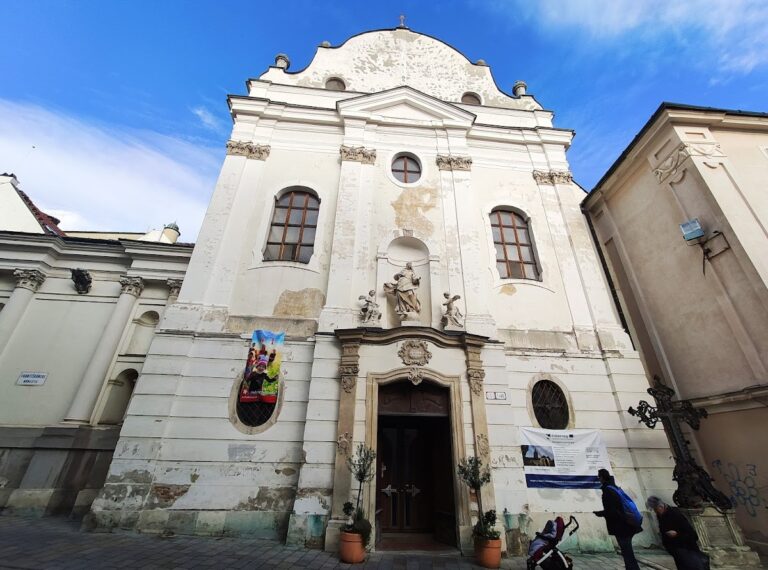
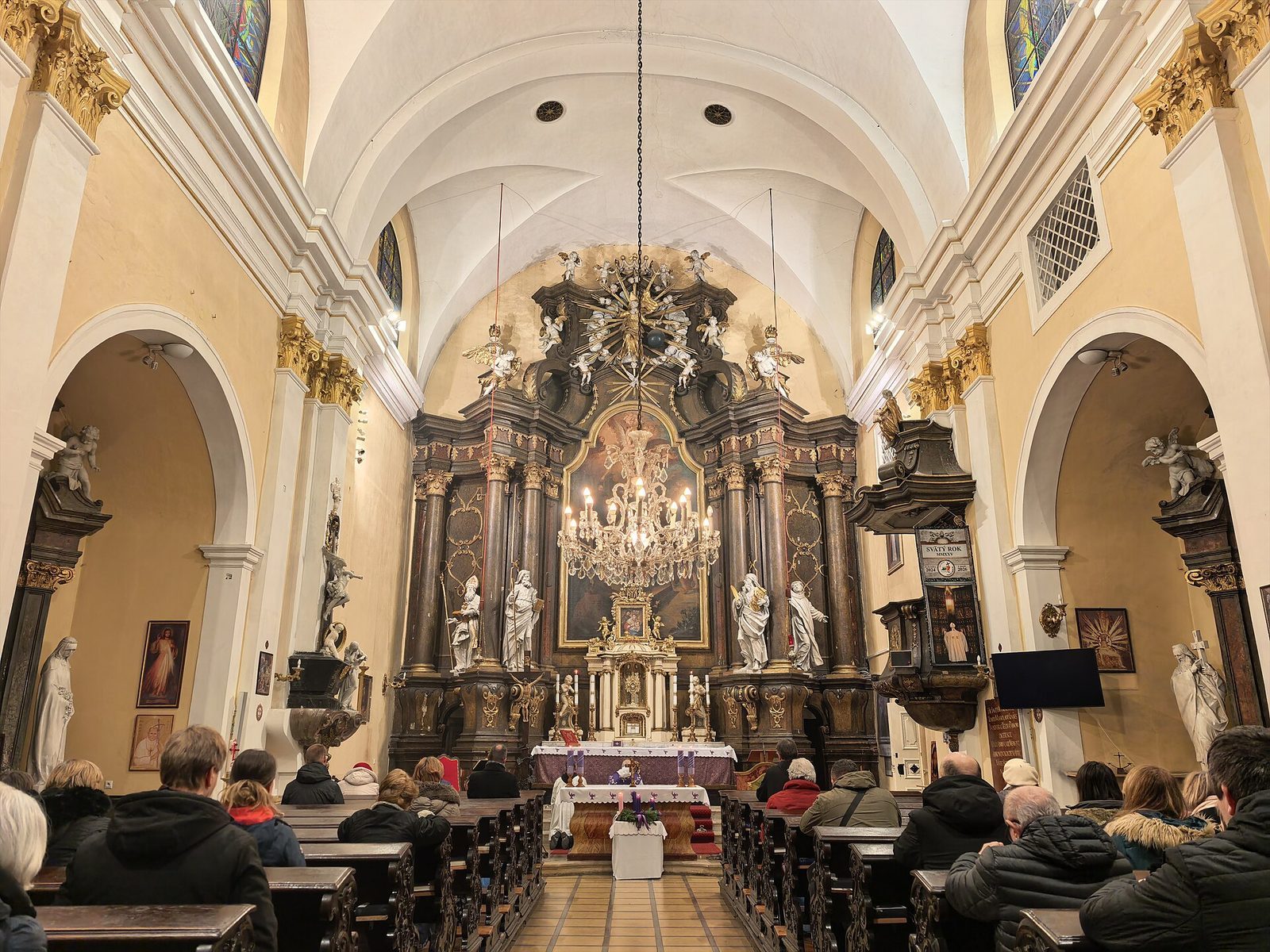
The church is a stone building with a single main nave. Stone Baroque sculptures decorate its façade and the projecting sections of the monastery’s side wings. Made at different times by different workshops, these include figures of Saints Peter and Paul in the lower façade niches, probably by the Viennese sculptor Ján Schwanthaler. The interior furnishings have been compared with those of Rome’s principal Jesuit church, the Church of the Gesù.
Altars and furnishings
Main altar
Dating to 1735–1737, the main altar fills the presbytery, the area around the altar reserved for clergy. Its columned structure has a triangular-topped upper section. The central painting shows the Visitation of the Virgin Mary and was made by the German late Baroque artist Martin Speer, who also painted the side-altarpieces. Statues of Saints Augustine, Zechariah, Joachim, and John of God stand beside the altar; above them are angels and figures of God the Father and the Holy Spirit as a dove.
Side altars
The six side altars are dedicated to Saint Barbara, Saint John of God, Saint Joseph, Saint John of Nepomuk, the Sacred Heart, and the Virgin Mary. The Saint Barbara altar has sculptures of Saints Ludmila and Elizabeth, while the altar of Saint John of God features Saints Cyril and Methodius. The Sacred Heart altar was originally dedicated to the Holy Cross and displayed a Crucifixion image. The Virgin Mary image sits in a Rococo frame, a style associated with lighter, more ornamental decoration. Bratislava sculptor Alojz Rigele made the altar sculptures.
Pulpit
A Baroque pulpit decorated with reliefs of saints dates to the first half of the eighteenth century.
Tomb monument
A marble tomb monument to Count O’Neil was made in 1745 by the Viennese sculptor Balthasar Ferdinand Moll.