Admont Abbey: A Benedictine Monastery in Austria
Site at a Glance
- Popularity
- Very High
- Country
- Austria
- Primary era
- Modern
- Eras represented
- Medieval, Early Modern, Modern
- Civilizations
- Austria-Hungary, Austrian Empire, Duchy of Styria, Habsburg, Holy Roman Empire
- Site type
- Religious
- Remains
- Monastery
On this page18 sections
History
Foundation and medieval community
Admont Abbey is a Benedictine monastery in Admont, Austria, founded in 1074 by Archbishop Gebhard of Salzburg on land bequeathed by Hemma of Gurk. Benedictine life follows a rule centered on prayer, work, and study. The foundation, traditionally dated to 29 September, had the support of three bishops, the Benedictine abbot Arno of Salzburg, and Styrian nobles, clergy, and laypeople. Twelve monks from St. Peter’s Abbey in Salzburg formed the first community under Isingrin, Admont’s first abbot. The abbey is dedicated to Saint Blaise.
Giselbert, the second abbot, introduced the Cluniac reform, a movement to renew Benedictine discipline and organization. Around 1120–1121, Abbot Wolfhold established a women’s convent that educated girls from noble families; it was later dissolved during the Reformation. A scriptorium, where manuscripts were copied and produced, operated at the abbey in the twelfth century. Admont also developed as a religious, educational, artistic, and scholarly center. Engelbert of Admont, abbot from 1297 to 1327, was a prominent scholar whose writings included more than 40 treatises.
Political influence and intellectual life
Admont’s abbots took part in regional affairs as well as religious life. In 1292, Heinrich II supported the territorial rulers, including Duke Albert I, during the noble uprising associated with the Landsberger Bund, a league of Styrian nobles. In 1459, the lords of Pranckh granted the abbey a charter giving it the right to levy taxes independently.
Wars against the Ottoman Empire and the Reformation brought a prolonged decline. Abbot Valentine resigned because of his Reformed views. Catholic reform and renewed institutional activity in response to the Protestant Reformation, known as the Counter-Reformation, brought a revival, particularly under Abbot Johann Hoffmann. The abbey was flourishing again around 1600. Its educational work included a secondary school, later moved to Judenburg, and faculties of theology and philosophy. The abbey school was established in 1644.
Baroque renewal and the library
During the seventeenth century, Abbots Matthias Preininger and Urban Weber led a Baroque redevelopment of the abbey and church. Baroque describes an ornate early-modern style. Weber, abbot from 1628 to 1659, expanded the library, established an abbey residence at Röthelstein, and developed the Marian pilgrimage site at Frauenberg, about eight kilometres away. From 1765 to 1776, the abbey was enlarged to include a new library hall, completed in 1776.
Fire and reconstruction
A major fire in 1865 destroyed almost the entire monastery, including the church organ made by Franz Xaver Krisman in 1782, and consumed most of the archive and its contents. The library survived. Reconstruction began in 1866 under architect Wilhelm Bücher, who designed a Neo-Gothic rebuilding, a revival of Gothic forms. The plan was only partly completed, and rebuilding remained unfinished in 1890. The new church was consecrated on 12 September 1869 under Abbot Zeno Müller.
The fire also destroyed a natural-history cabinet maintained by Abbot Gotthard Kuglmayr from 1809. Beginning in 1866, Father Gabriel Strobl rebuilt the collections, working on them for 44 years and becoming a noted insect researcher.
Suppression, return, and collections
Financial crises in the 1930s forced the sale of artworks, including the Admont Madonna, created around 1310. After Austria’s annexation by Nazi Germany, the abbey was dissolved, its property confiscated, and the monks expelled. In 1938, the Gestapo placed the institution under provisional management, interrogated priests, and arrested one priest and four lay brothers. The abbey’s assets were seized that September, and remaining valuables were expropriated in November 1939. The community had to leave by 1 January 1940 and returned in 1946.
Between 1938 and 1940, many natural-history specimens and objects from the art collection were taken to the Joanneum, while a separate exchange brought other natural-history specimens into Admont. Some removed specimens began returning after 1945, but restitution remained incomplete in 2021. In 1940, students at a Nazi boarding school destroyed an oversized statue of Saint Benedict in the Benedict Chapel on their teachers’ instructions and buried its fragments in the garden. The local Hitler Youth vandalized the abbey crypt in 1943.
The art-history museum was founded in 1959, substantially expanded from 1980, and given its present form in 2003. The abbey began developing a contemporary-art collection in 1997. From 2002, it commissioned multisensory works intended to be accessible to blind and sighted visitors.
Remains
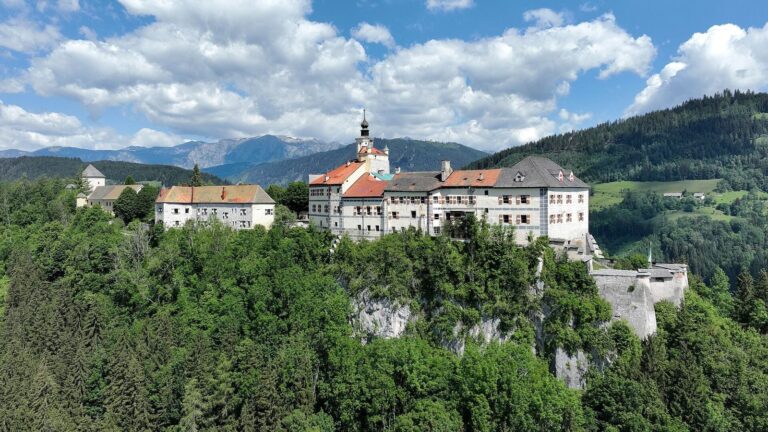
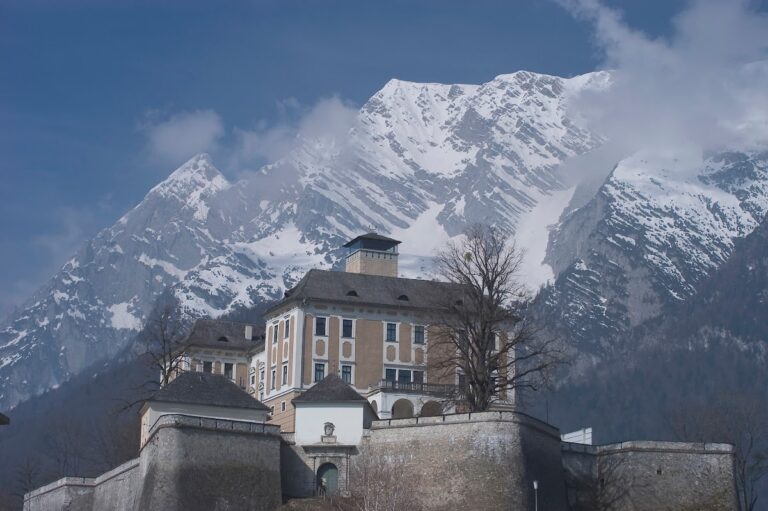
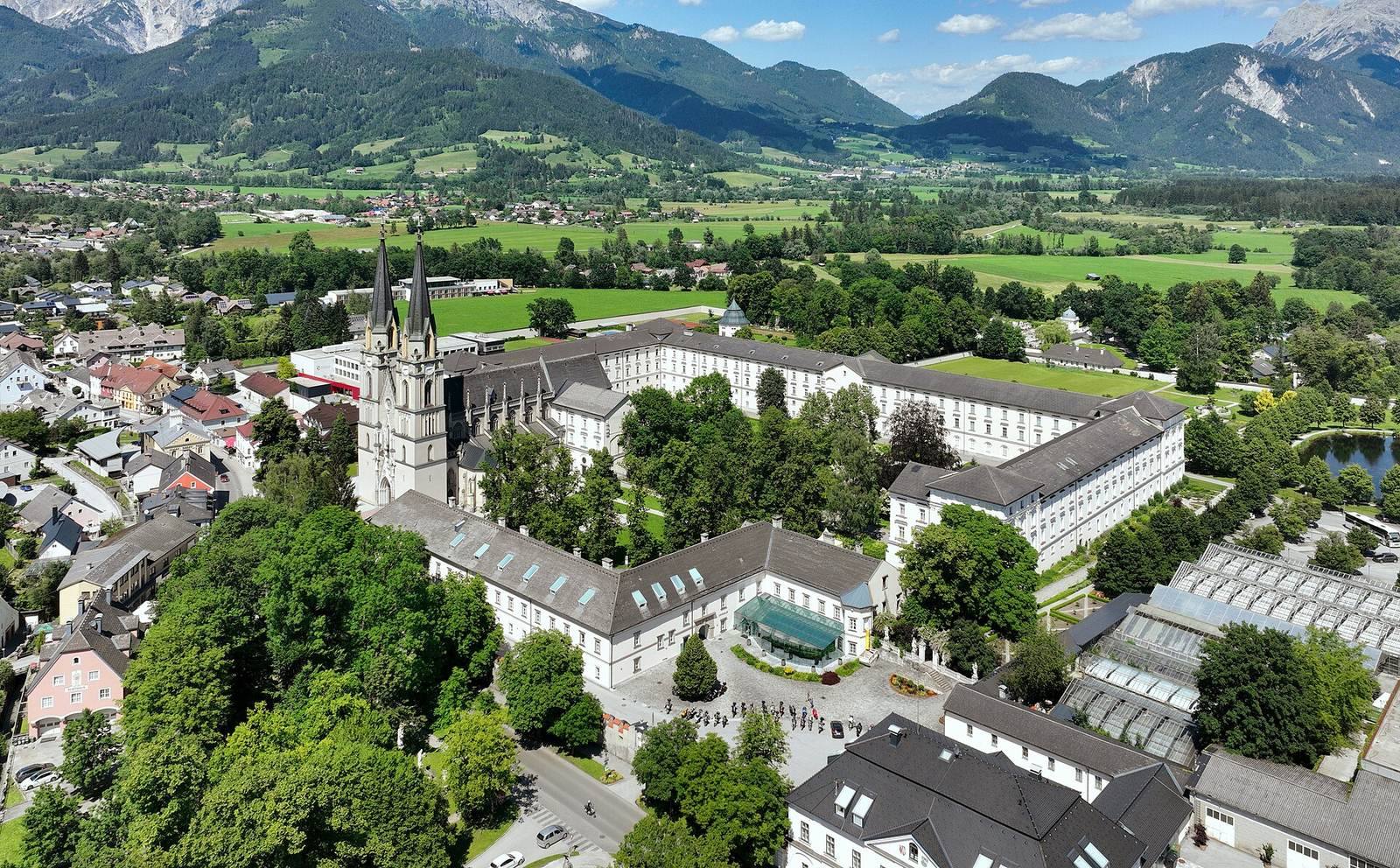
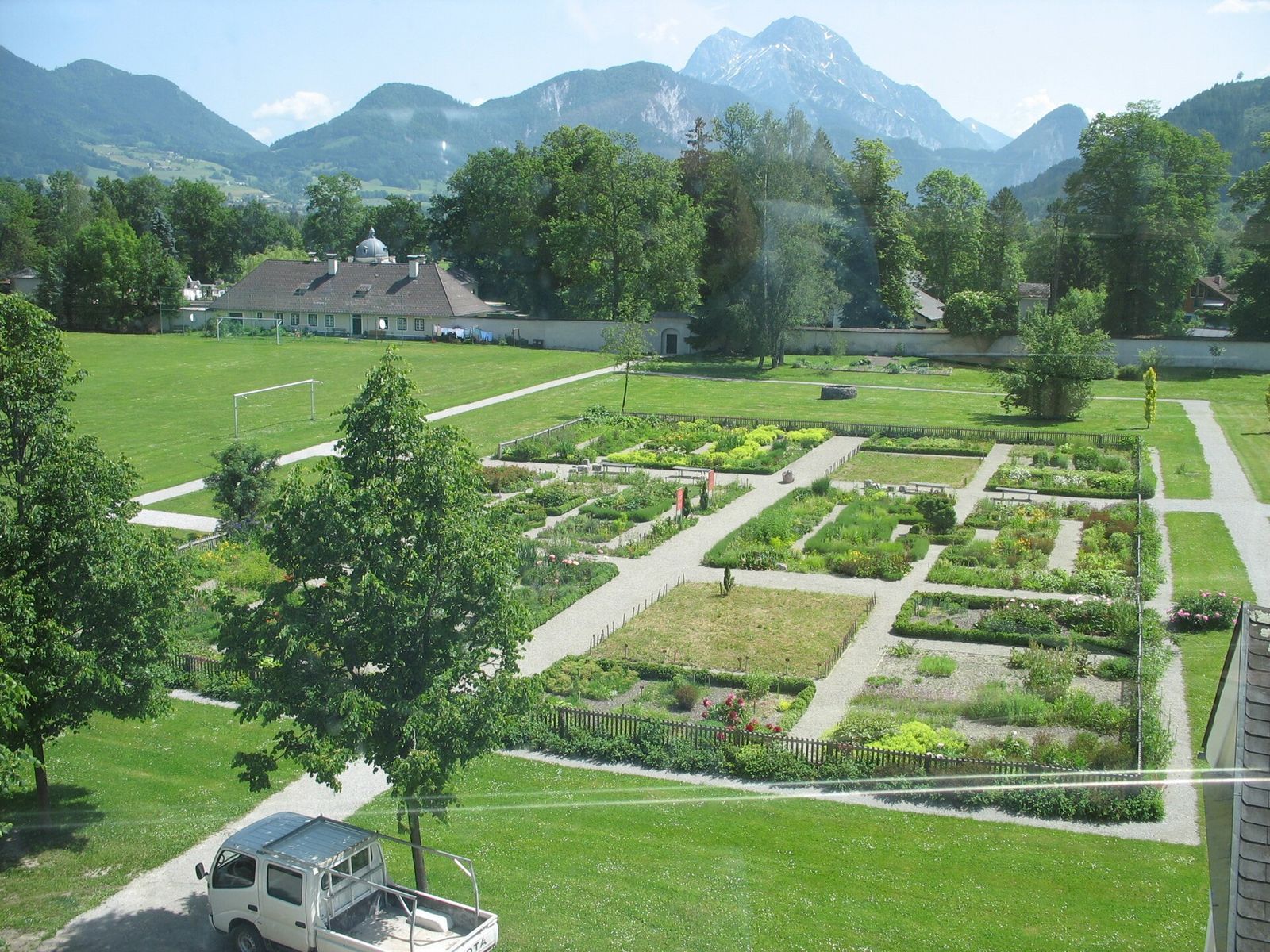
The abbey stands beside the Enns River in Admont, at the edge of Gesäuse National Park. Its grounds include the church, library hall, and museum, as well as a convent garden with a pavilion completed in 1661, a herb garden, and a Baroque fire-water pond. The church combines surviving elements of earlier buildings with a Neo-Gothic basilica, while the library and museum preserve extensive architectural and artistic collections.
The abbey church
Earlier church buildings
The present church is the fifth on the site. Around 1121, the earliest church was replaced by a Romanesque basilica, a medieval church with a long central space and side aisles, supported by marble columns and arranged in three aisles. A fire in 1152 damaged it; repairs were completed by 1165. Two sacristies, rooms for liturgical objects and vestments, were added around 1250. One stored precious objects and vestments, while the other held books and the archive. Parts of both survive within the present building.
Rebuilding in the Gothic style, a medieval architectural style, began in 1276, and the abbey’s building workshop continued work through the fifteenth century. Under Abbot Wilhelm von Reissberg, the church gained a long nave and a chapel of the Holy Sepulchre, representing Christ’s tomb. A late-Renaissance phase completed by 1626 added stuccoed ceilings, an abbot’s burial crypt beneath the presbytery, the sanctuary around the altar, and the convent building. Baroque altars and an organ case followed.
Neo-Gothic church and layout
After the 1865 fire, Wilhelm Bücher designed the replacement church, inspired by Regensburg Cathedral. It was described as Austria’s first Neo-Gothic church and incorporated modern materials, including Portland cement, a hydraulic cement that hardens when mixed with water. Most fire-damaged walls were demolished, while the choir apse, the rounded end of the sanctuary, and a twelfth-century Romanesque side portal survived.
The church has a three-aisled nave, a single-aisled choir, and a western entrance porch between two towers about 74 metres high. The façade carries figures of Saints Benedict and Scholastica, with Saint Blaise above the west door. Inside, molded supports separate the central nave from lower side aisles, and rows of shallow arches decorate the upper walls. Each side aisle has vaulted ceilings, five chapels, and six altars; the church contains 13 altars in all.
Altars, chapels, and furnishings
The high altar is made of white Carrara marble and bears a statue of Saint Blaise carved by Josef Linser in 1895. Compartments in the altar table contain relics of five Benedictine martyrs dated 1896. Six tapestries made between 1698 and 1730 by the embroidery workshop led by Brother Benno Haan decorate the hexagonal sanctuary. Romanesque wall paintings and a late-Gothic crucifix beneath the arch leading to the choir also survive. The crucifix is dated 1518 and attributed to Andreas Lackner. In the choir, windows depicting scenes from the life of Mary were made in 1914 by Franz Xaver Zettler’s Munich workshop.
The Marian Chapel contains Martino Altomonte’s 1726 painting of the Immaculate Conception, surrounded by 15 carved medallions by Josef Stammel depicting mysteries of the Glorious Rosary. In the chapel dedicated to Saint Benedict, a statue made by Ignaz Brandstätter in 1874 stands with a Baroque crucifix from the workshop of Johann Meinrad Guggenbichler. Stammel carved a Holy Sepulchre into a rock formation in the Saint Joseph Chapel in 1730. The funerary chapel has a Saint Barbara altar with a painting dated 1695 by Georg Bachmann.
Other works in the church include Stammel’s Admont Nativity scene, a Baroque crucifix in the Saint Peter Chapel, and an old copy of the Gothic Admont Madonna. The founders’ chapel has an altar to Hemma of Gurk and an oval Baroque painting of Saint Rupert of Salzburg. Other chapels are dedicated to Saints Sebastian, Anne, Vincent, and Scholastica. A separate Baroque chapel honors Saint Blaise. Seven bells cast by the St. Florian bell foundry hang in the towers; the largest, the Blaserin, is noted for carrying its sound across the valley.
Library hall
Architecture and decoration
Designed by Joseph Hueber and completed in 1776, the library hall measures about 70 metres long, 14 metres wide, and 13 metres high. Seven connected spaces have elliptical or circular plans, shallow domes, and transverse arches. Stucco, gilding, and frescoes by Bartolomeo Altomonte decorate the hall, which receives light through 48 windows. Bookcases line its walls. Behind doors disguised with book-spine designs, spiral staircases lead to an upper level bordered by a balcony with a metal railing. Sculptural decoration by Josef Stammel contrasts with the hall’s Enlightenment design.
Books and manuscripts
The hall holds about 70,000 volumes, within the abbey’s total collection of about 200,000. The holdings include more than 1,400 manuscripts and around 900 to 1,000 incunabula, books printed before 1501, and early printed works. Some of the oldest manuscripts came from St. Peter’s Abbey in Salzburg.
Museums and collections
The museum occupies two wings of the abbey over four floors. Its displays bring together natural-history specimens, works of art, and objects from the abbey’s collections.
Natural-history collection
The Lion Room and southeast pavilion retain historic interiors and display native and exotic animals, rocks, and minerals. Other displays include insects and reptiles, as well as a wax-fruit collection made by Father Constantin Keller. The collection contains about 250,000 insect specimens, including approximately 80,000 flies. Its fly collection is among Europe’s three largest.
Art-history collection
The art-history museum displays paintings, sculpture, and objects from the ecclesiastical treasury, spanning the Romanesque period through the Rococo. Its holdings include the Gebhard mitre, a bishop’s liturgical headdress dated to the late fourteenth century, fifteenth-century stained glass, and liturgical embroideries from Benno Haan’s workshop. Other objects include a medieval crozier, the ceremonial staff of a bishop or abbot, associated with Gebhard and fitted with an ivory curved head; an abbot’s crozier with a narwhal tusk dated around 1680; and a portable altar dated 1375 and associated with Bishop Albrecht of Sternberg.
The monastery museum also displays 85 medieval sculptures, panel paintings, and stained-glass works from the Mayer Collection. They include works from around 1400 and pieces by Niklaus Weckmann and Hans Klocker. The church’s old copy of the Gothic Admont Madonna is also part of its furnishings.
Contemporary art
The contemporary-art collection includes works by more than 150 artists, mostly Austrian. It features commissioned works made for particular settings, including multisensory pieces designed to be experienced through touch and sound as well as sight.