St Martin’s Church, Herzele: A Roman Catholic Parish Church
Site at a Glance
- Popularity
- Very Low
- Country
- Belgium
- Primary era
- Modern
- Eras represented
- Medieval, Early Modern, Modern
- Civilizations
- Belgian, Dutch, Holy Roman Empire, Spanish
- Site type
- Religious
- Remains
- Church
On this page15 sections
History
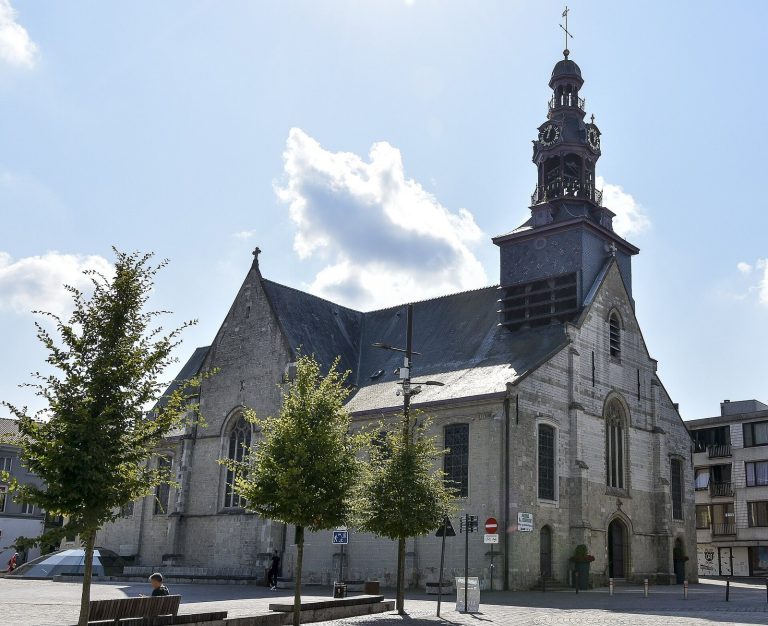
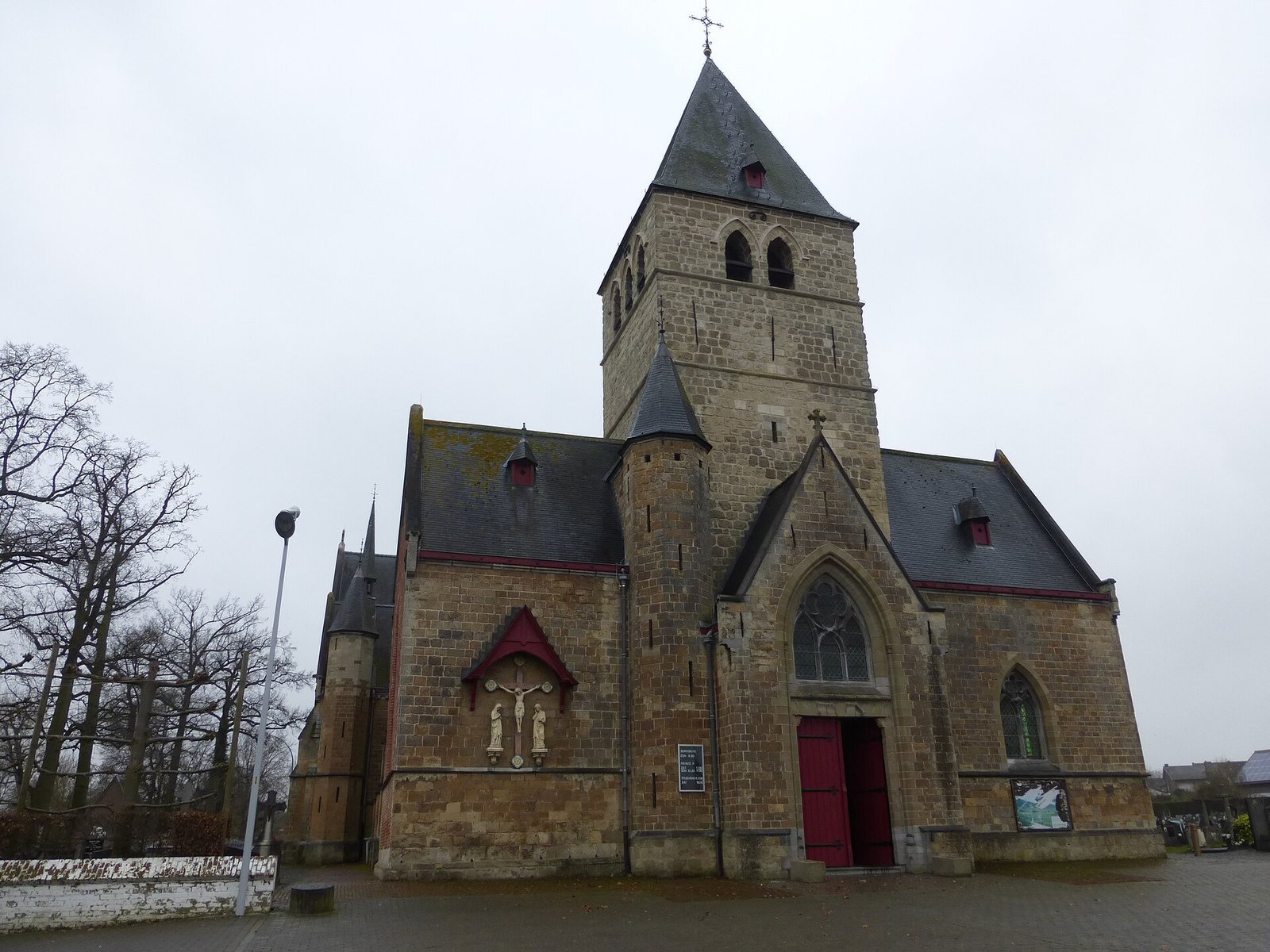
St Martin’s Church, Herzele, is a Roman Catholic parish church in Belgium, dedicated to Martin of Tours, a fourth-century Christian bishop. Its history reaches back to the tenth century, and the present church is the fifth building on the site. Rebuilt in Neo-Gothic style, a later revival of Gothic forms, it was completed in 1913.
Early church and conflict
A fire occurred at the rear of the church in the thirteenth century. Later, the building was plundered by Louis of Male, the Count of Flanders, in 1381. Maximilian of Austria, a Habsburg ruler who became Holy Roman Emperor, sent an army that attacked it in 1485. Spanish forces took the church in 1579.
Rebuilding and enlargement
Warfare later destroyed the church, and rebuilding began in 1600. The work was completed in 1625. In the nineteenth century, the church was enlarged. In 1829 its western section and central choir, the area around the altar, were demolished. A new nave, or main body of the church, and choir were built west of the older section, and the tower became the entrance.
In 1906, Viscount du Parc Locmaria, a nobleman ranked below a count, commissioned a new design. Expansion began in 1908, and the design was completed in 1911. Restoration work started the following year. Before demolition began, a temporary church was built so residents could continue attending services. Work on the old building started on 1 March 1913, and rebuilding was completed that year. The church was inaugurated on 9 August 1914. The westward expansion was considered necessary because the war had increased the number of churchgoers.
Parish and heritage
Repairs to the window divisions and stained glass, the tower, and the natural-stone facing began in 2001. The church received protected heritage status in Flanders on 30 January 2013. It is now the principal church of the Herzele-Houtem parish.
Remains
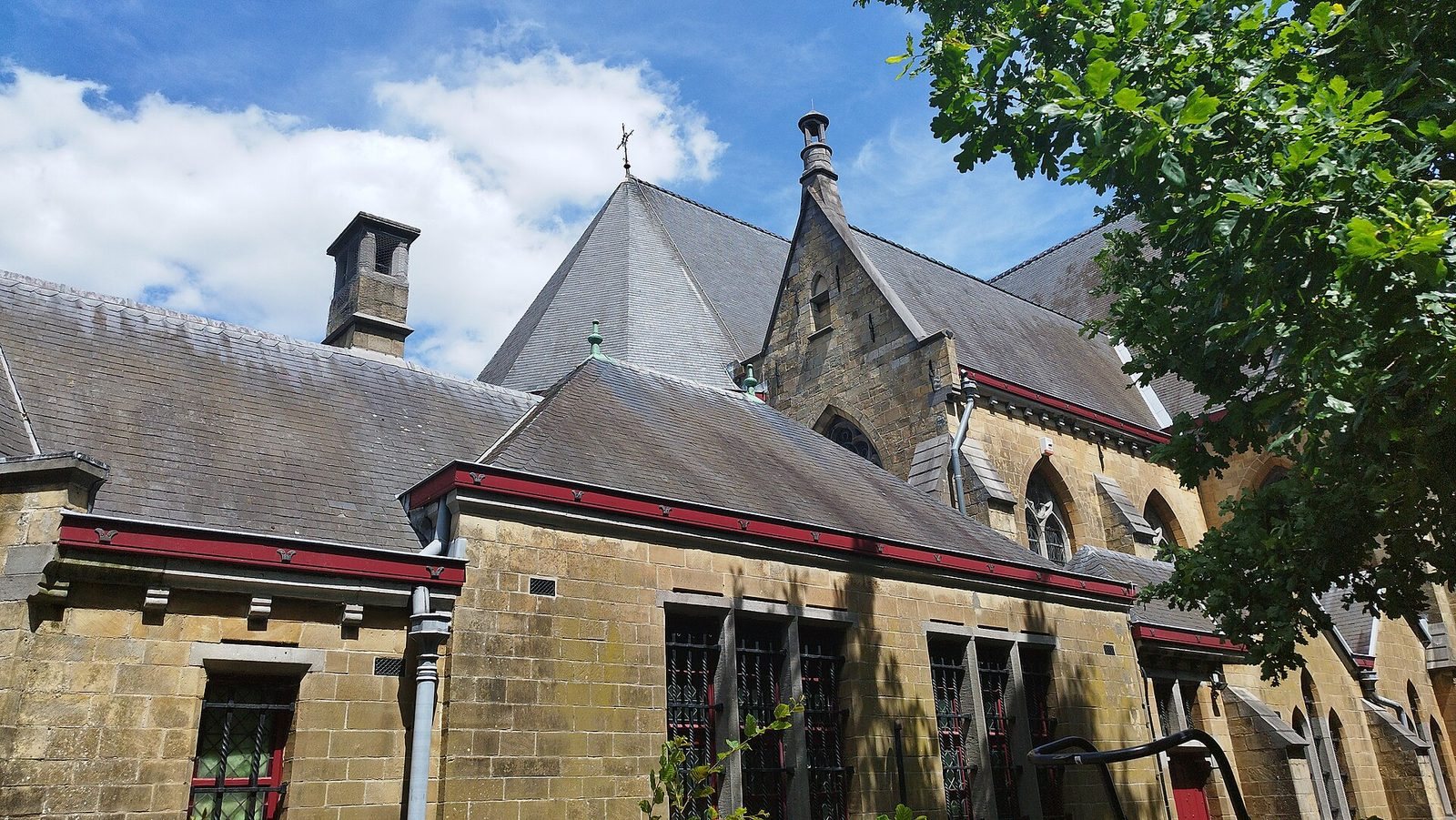
The church has a cross-shaped plan and faces west. Its Neo-Gothic design includes pointed stained-glass windows and ornamental stone tracery that divides and decorates the windows. The building also preserves traces of an earlier Gothic church, while the tower is Romanesque in style. Its listed floor area is 6,567.37.
Structure and surviving phases
The exterior foundations were left on their existing lines during the nineteenth-century rebuilding. In the 1913 demolition, the outer walls of the nave were retained up to window height, along with the tower and the sixteenth-century side chapels. Vertical stone divisions, known as mullions, are part of the church’s windows, which were included in repairs begun in 2001.
Tower
The lower part of the tower is its oldest surviving section and dates to the rebuilding of 1600–1625. It is built of white sandstone quarried locally at Borsbeke and Balegem. The tower’s bell openings are unevenly arranged, with three on one side and two on the other.
Churchyard
The churchyard surrounds the building and is partly bounded by a white-brick wall. It contains Belgian and British war graves from both world wars.
Altars and baptismal font
A sandstone block altar stands in each side chapel beside the tower. On the north side, an altar dedicated to Saint Roch, a medieval saint traditionally invoked against plague, holds a central statue of Roch, flanked by John the Baptist, the preacher who baptized Jesus, and Saint Barbara, an early Christian martyr. To the left of the main altar is a bluestone baptismal font with a copper cover mounted on a supporting pillar. The font dates to 1616. The central altar, or altar table, was made around 1913 in Neo-Gothic style by Remi Rooms, with work by the contractor Burxelman of Ledeberg. Made from wood from pruned branches and acacia, it has hand-carved circular mandala designs, geometric symbolic patterns, on its front, back, and sides.
Other furnishings
Furnishings from earlier periods were reused in the church. Fragments remain of an oak communion rail. The seventeenth-century pulpit has reliefs showing Matthew, traditionally one of the four Gospel writers, and symbols of the four Evangelists. Two eighteenth-century confessionals came from the former church; two more, in Neo-Gothic style and probably made around 1920, stand on either side of the church. The organ was made in 1856 and remains in good condition, although it can no longer be played. It bears a 1929 signature by organ builder Oscar Anneessens.
Stained-glass windows
Windows behind the altar
The west-facing windows behind the altar date from the twentieth century. Hendrik Coppejans made the central window, which depicts Calvary, the place of Jesus’s crucifixion. On its left is an apparition of the Sacred Heart, a Christian devotion focused on Jesus’s heart as a sign of divine love, to Margaret Mary Alacoque, a seventeenth-century French nun. The right-hand window depicts the Supper at Emmaus, an episode in the Gospel tradition. These three windows are estimated to date to around 1934. The outer left window shows Peter, an apostle of Jesus, receiving the keys; the outer right shows the stoning of Stephen, revered as the first Christian martyr. De Loore designed these two windows, which César Vanhevele made in Ghent; they are dated to the period from 1898 to 1956.
Choir windows
Two large windows in the choir, the area around the altar, depict the Coronation of Mary and Saint Roch. Michel de Loore designed them, and César van Heeffler made them in 1954.
Crosswise-section windows
Two windows in the transept, the crosswise part of the church, were installed in 1961. M. Nevens designed them and Herman Mortier made them. The right-hand window depicts Saints Joseph and Martin; the left shows Agnes and Barbara, both early Christian martyrs.
Paintings and statues
Paintings hang on both sides of the church entrance. In the Holy Sepulchre Chapel, named for the tomb associated with Jesus’s burial, a painting depicts the Descent from the Cross. It includes a series of Stations of the Cross, devotional scenes recalling the route to crucifixion, painted by Jozef Meganck (1807–1891). Another painting, showing the martyrdom of Livinus, a missionary bishop and martyr remembered in Flanders, dates to 1603. Statues of Saints Cornelius, a third-century pope and martyr, and Martin stand between the portal and the nave. Other wooden figures depict Roch, Rita, a fifteenth-century Italian nun later venerated as a saint, and Theresa. A seventeenth-century wooden statue of Jesus in the tomb stands in the side chapel near the entrance.