Church of Saint Nicholas in Pyzhy: A Seventeenth-Century Russian Orthodox Church in Moscow
Site at a Glance
- Popularity
- High
- Country
- Russia
- Primary era
- Early Modern
- Eras represented
- Early Modern, Modern
- Civilizations
- Russian
- Site type
- Religious
- Remains
- Church
On this page13 sections
History
The Church of Saint Nicholas in Pyzhy is a Russian Orthodox church in Moscow, Russia. A regiment of Streltsy, Russian military units armed with firearms, built it between 1657 and 1672 in Russian Patternwork, a seventeenth-century style known for elaborate ornament.
Origins and Streltsy foundation
A wooden church dedicated to the Annunciation stood on the site by 1593, probably in connection with a nearby Streltsy settlement. The stone church kept that dedication. Vasily Ivanovich Filosofov commanded the regiment during the 1650s; Bogdan Pyzhov succeeded him in 1668. Pyzhov’s name became associated with the church, the surrounding locality, and Pyzhevsky Lane.
Changing dedications and nineteenth-century damage
In 1691, side chapels were founded in honor of Saint Nicholas and Anthony and Theodosius of the Caves, eleventh-century monks linked to the founding and early growth of the Kyiv Pechersk Monastery. Devotion to Saint Nicholas of Myra, a widely venerated Christian saint, eventually gave the church its present name.
French forces badly damaged the church after entering Moscow in 1812. Restoration began in 1848 with financial support from the Lyamin merchant family and continued for about forty years. Further repairs and alterations followed. The altar dedicated to Anthony and Theodosius was dismantled in 1858.
Closure and return to worship
After the Pokrovsky Church at the Marfo-Mariinsky Convent closed in 1928, some of its furnishings were brought to Saint Nicholas. Tatyana Grimblit sang in the choir from March 1928 until April 14, 1931, and was later canonized as a martyr. The priest Nikolai Pomerantsev also served there and was later canonized as a New Martyr, an Orthodox title associated with Christians who endured persecution, particularly under Soviet rule.
The church closed in 1934. Its last rector before closure, Gabriel (Igoshkin), served from 1928 to 1934 and was later canonized as a Venerable Confessor, an Orthodox title for a monastic saint who suffered persecution for the faith but survived. The building was subsequently used as a dormitory for construction workers, then housed machine-building laboratories and workshops of Rosmonumentiskusstvo.
The Russian Orthodox Church regained the building in 1990. The first service after its return took place at the Saint Nicholas side altar on July 11, 1991; services at the main altar resumed in 1992, and a third side altar entered liturgical use in 1993. The church remains active and is a federally significant cultural heritage monument in Russia.
Remains
Plan and exterior
Main volume and apses
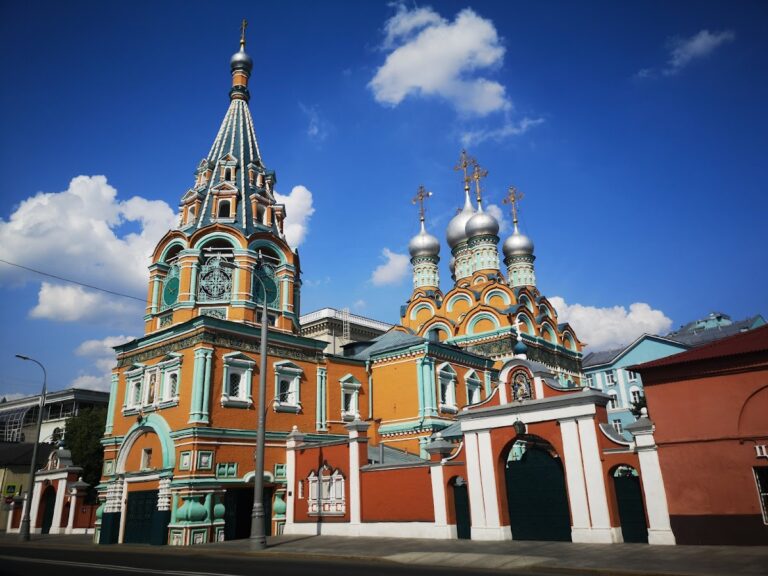
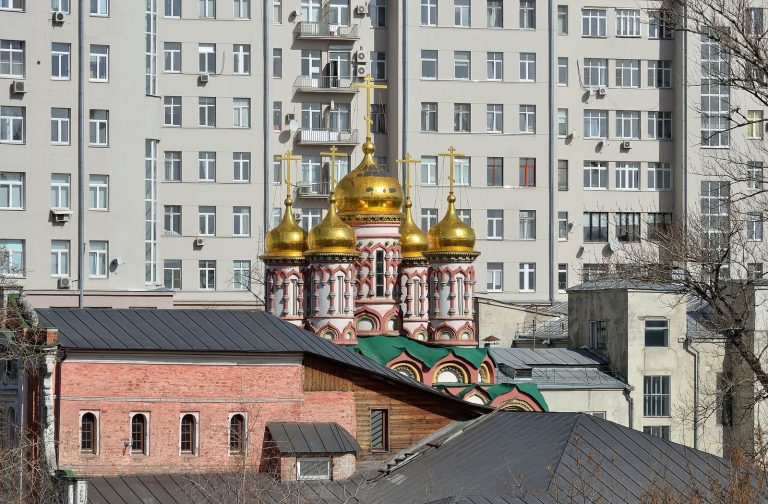
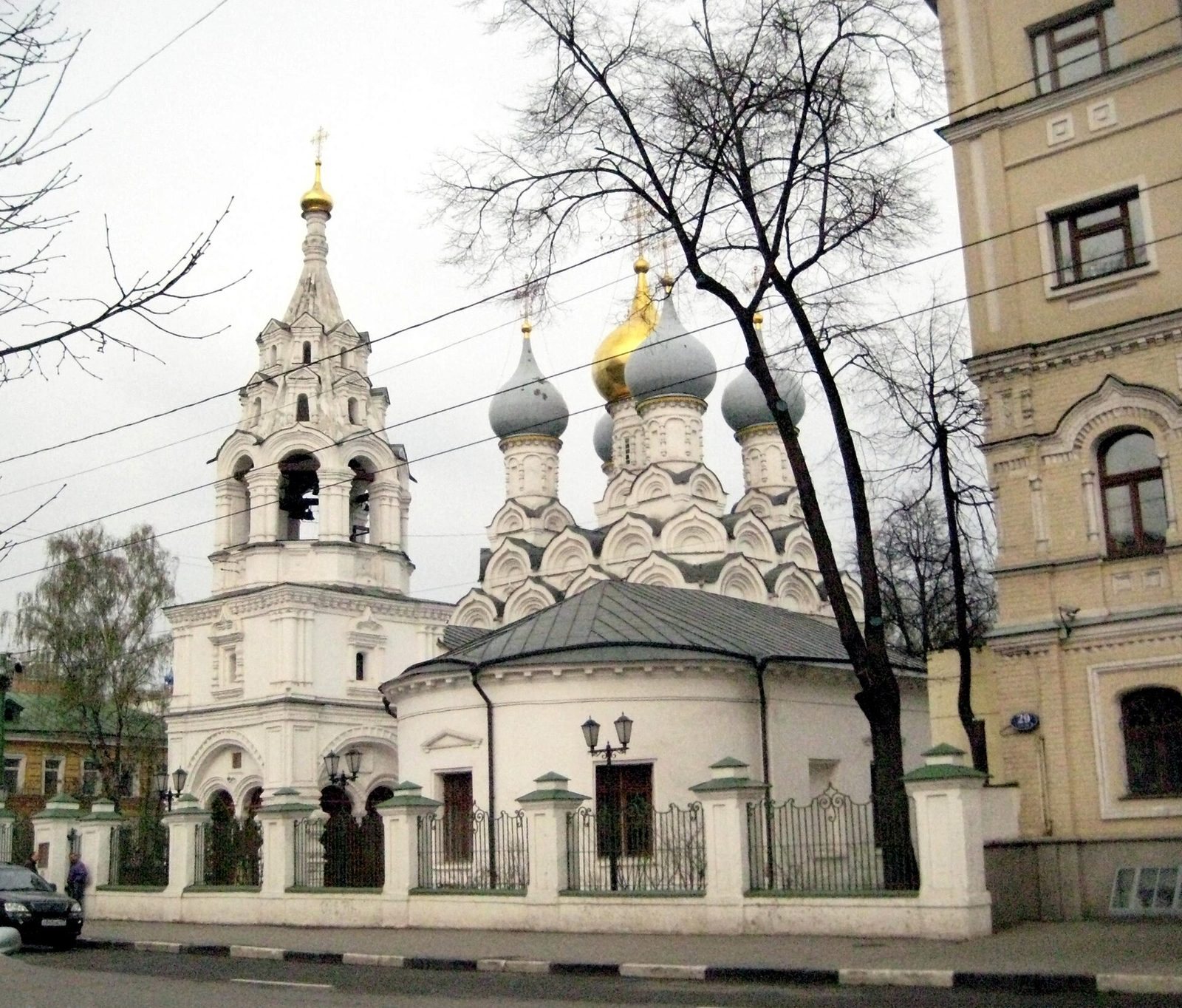
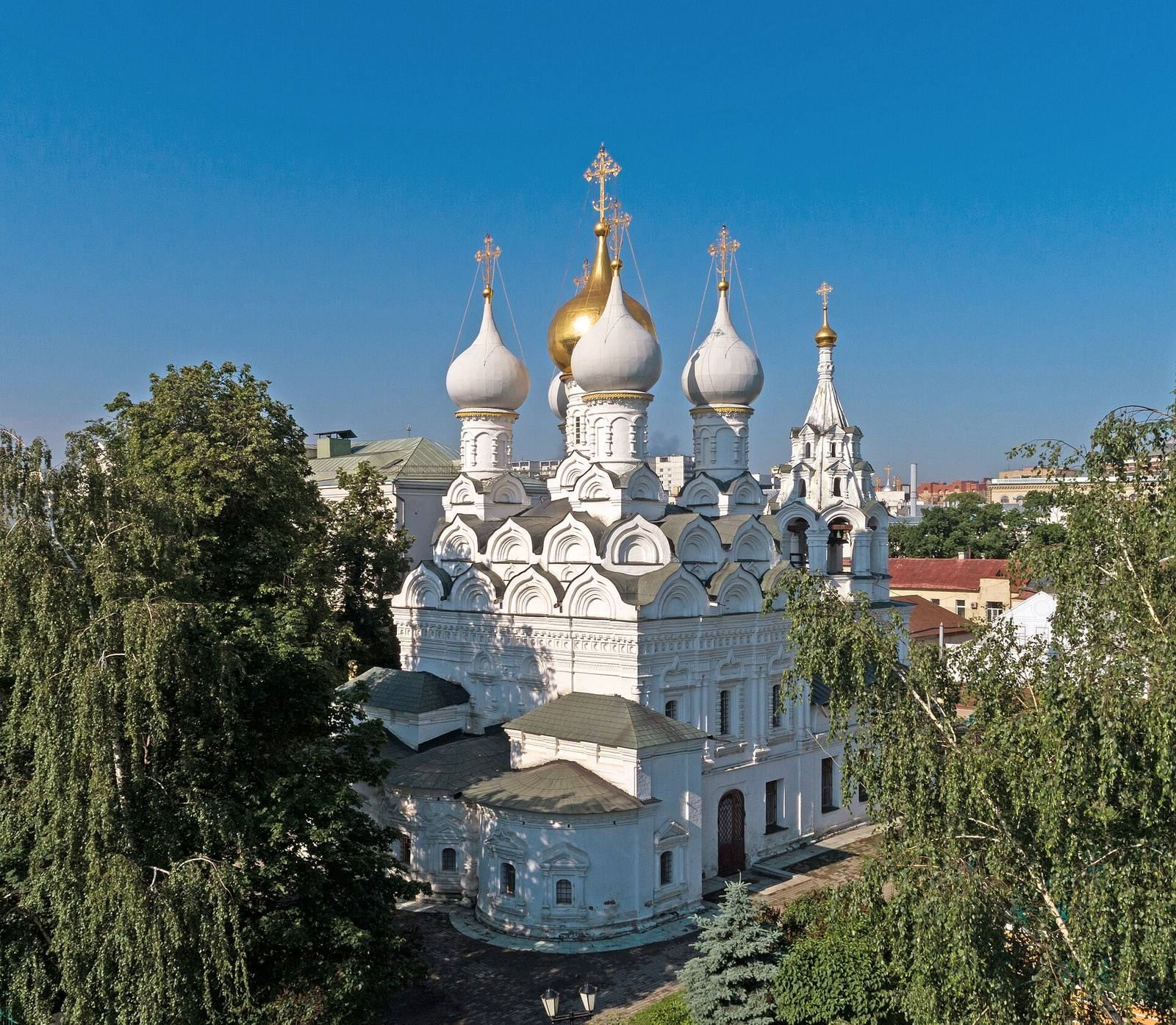
The church’s central structure is a five-domed, pillarless cube, decorated with patterned brickwork, an elaborate horizontal band of trim, and tiers of kokoshniks, curved gable-like forms used as ornament. Cube-shaped chapels occupy the northeastern and southeastern corners. Their broad, semicircular apses, or rounded projecting ends, largely screen the chapel forms. The two side apses are equal in size and align with the main altar apse, creating a three-part eastern end.
Entrance axis and bell tower
A connecting hall, known in church architecture as a refectory, and a slender bell tower extend along the building’s principal axis in a longitudinal arrangement. The tower has a steep, tent-shaped roof and a richly ornamented entrance arch suspended from its structure. Together, these elements form the church’s elongated plan.
Eastern front and south chapel
The eastern facade faces Bolshaya Ordynka and is especially ornate. A Saint Nicholas chapel attached to the south side of the seventeenth-century church was rebuilt in 1810 in Classical forms, interrupting the symmetry of the overall composition.
Interior and nearby buildings
Altars, icon screens, and frescoes
The church has three side altars dedicated to Saint Nicholas, Saint Vladimir of Kyiv, and the Russian New Martyrs and Confessors. Saint Vladimir was a medieval ruler associated with the Christianization of Rus’; the New Martyrs and Confessors are Orthodox Christians canonized for enduring persecution, especially under Soviet rule. Two iconostases, screens of icons separating the sanctuary from the main worship space, were made by I. V. Klimenko between 1992 and 2003. A. Sokolov painted frescoes late in the nineteenth century; some survive in the Saint Nicholas altar.
Relics and icon
A cross-shaped reliquary, a container for sacred relics, holds fragments attributed to 72 saints. The church also has an icon of Nicholas II, Russia’s last emperor, whom the Russian Orthodox Church canonized as a passion-bearer, a saint who meets death in a Christlike, non-resisting manner. Tradition holds that the icon exudes myrrh, a fragrant, oil-like substance associated with miraculous icons in Orthodox belief.
Clergy house
A two-storey clergy house stands nearby. Designed by Alexander Nikiforov in 1890, it is a nineteenth-century architectural monument.