Santa Maria del Suffragio: A Baroque Roman Catholic Church in Rome
Site at a Glance
- Popularity
- Medium
- Country
- Italy
- Primary era
- Early Modern
- Eras represented
- Early Modern, Modern
- Civilizations
- Papal States
- Site type
- Religious
- Remains
- Church
On this page18 sections
History
Santa Maria del Suffragio is a 17th-century Baroque Roman Catholic church on Via Giulia in Rome, Italy. Baroque was an ornate European artistic style prominent during that century. Dedicated to the Virgin Mary, the church belongs to the parish of San Giovanni Battista dei Fiorentini in the Diocese of Rome, the ecclesiastical territory administered by a bishop.
Confraternity and construction
The church’s origins lie in a Catholic lay devotional association, or confraternity, founded in 1592 at San Biagio della Pagnotta. Its members prayed for souls in purgatory, a state of purification after death in Catholic belief. Pope Clement VIII approved the confraternity in 1594, and Pope Paul V raised it to the higher rank of archconfraternity in 1620, citing its growth and importance.
As San Biagio became too small for the group, it acquired part of a nearby site in 1607. The land had been intended for a Palace of the Courts, planned and begun under Pope Julius II by the Renaissance architect Bramante, but never completed.
In 1662 the confraternity commissioned Carlo Rainaldi to design a church. His initial oval concept was abandoned in favor of a revised plan. Construction was completed in 1669, while work on the interior decoration continued until 1685.
Later history and commemorations
Giovanni Battista Nolli’s 1748 map of Rome identifies the church as number 560. Santa Maria del Suffragio is also associated with the Venerable Archconfraternity of the Assumption and Monte dei Morti of Vico Equense. The latter name means “Mount of the Dead” and refers to a traditional Catholic association or fund connected with prayer and assistance for the dead.
Tito Armellini restored the church and altered its interior in 1868. In the 20th century, the church became the burial place of Luigi Novarese, a priest who founded several religious associations, including the Centre for Volunteers of Suffering, the Silent Workers of the Cross, the Marian Priestly League, and the Brothers of the Sick. Pope Francis beatified Novarese, formally declaring him blessed, on 11 May 2013.
At Novarese’s request, his friend Monsignor Alfonso Carinci was also buried in the church. Carinci had served as secretary of the Congregation of Rites, a former Roman Curia department responsible for liturgical matters and causes of saints.
Remains
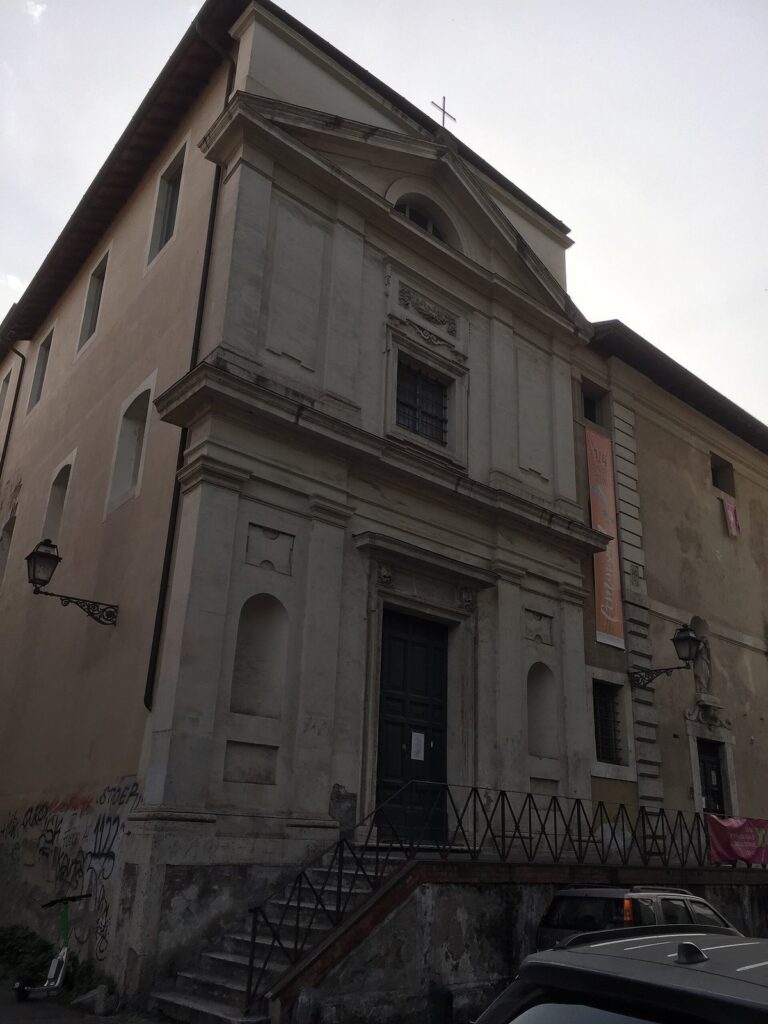
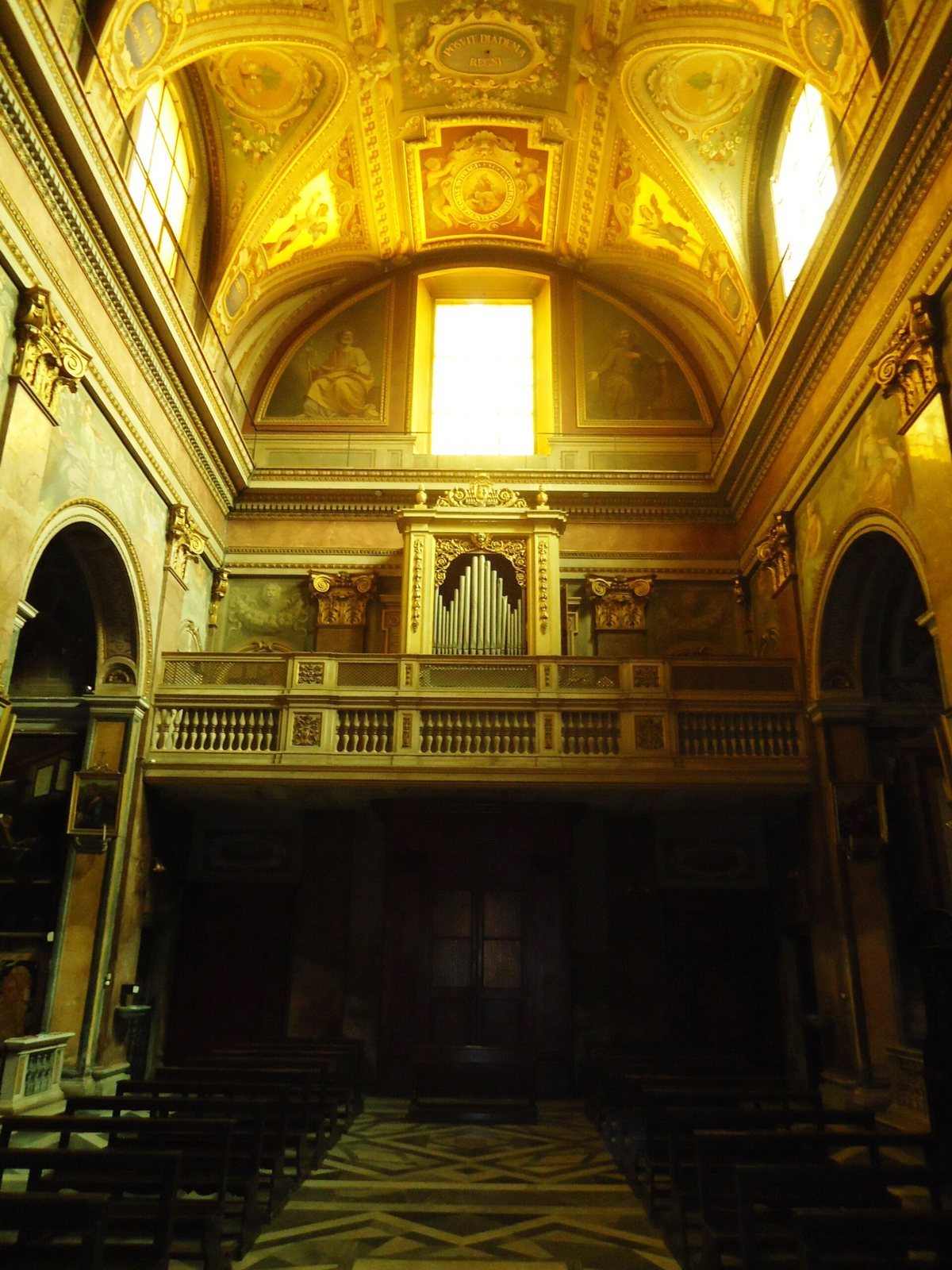
The church has a rectangular plan, with a single nave flanked by three chapels on each side. A barrel vault, or continuous arched ceiling, spans the nave and includes lunettes, crescent-shaped architectural surfaces. The façade and interior reflect the building’s Baroque design.
Structure and decoration
Façade
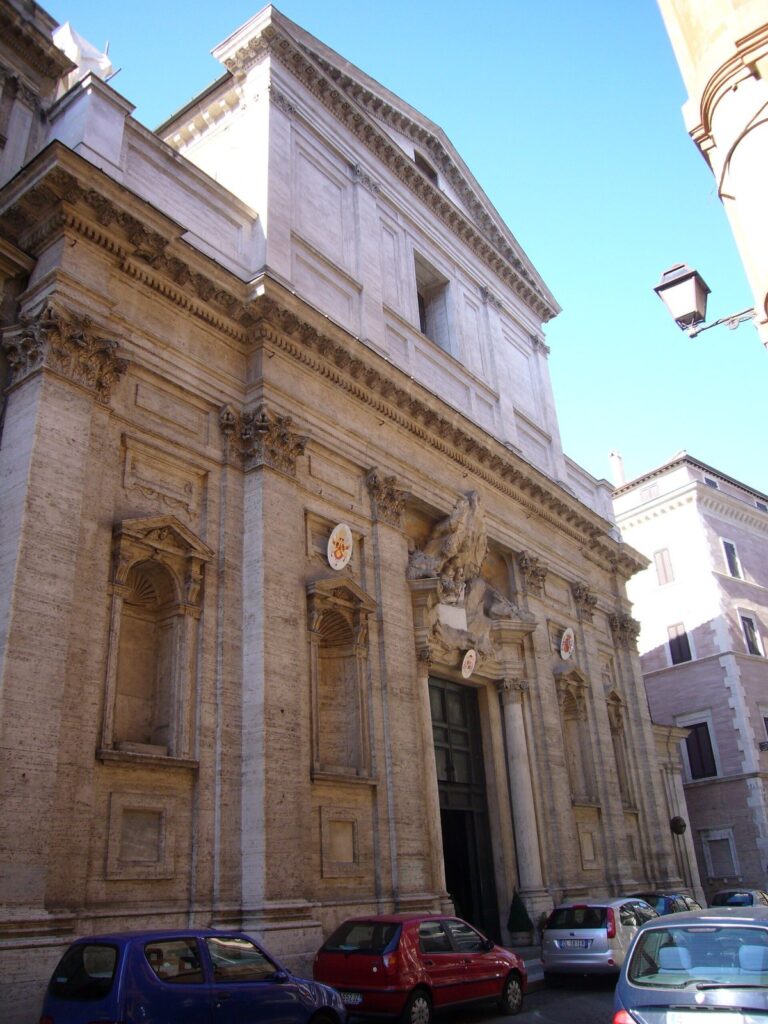
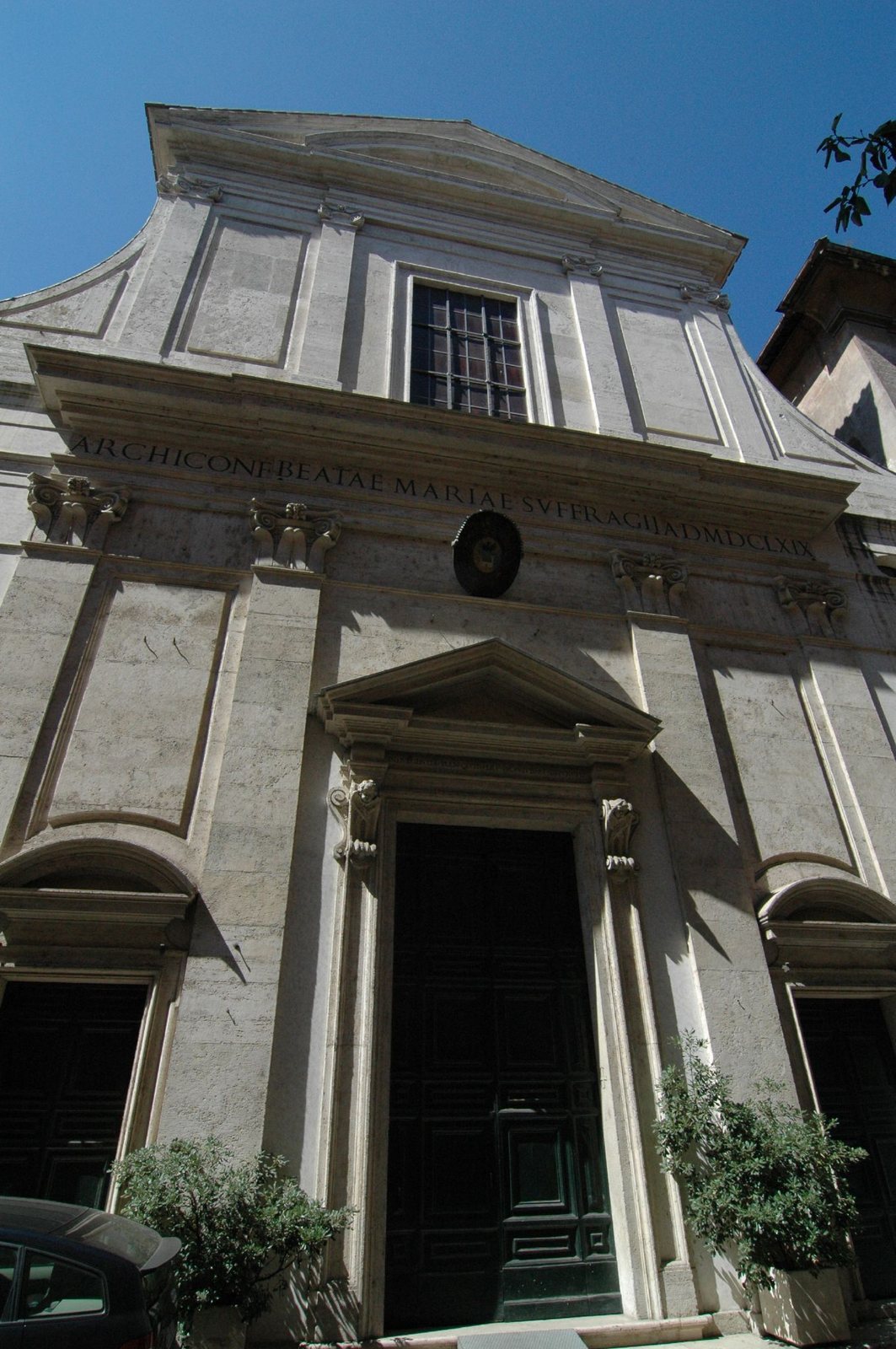
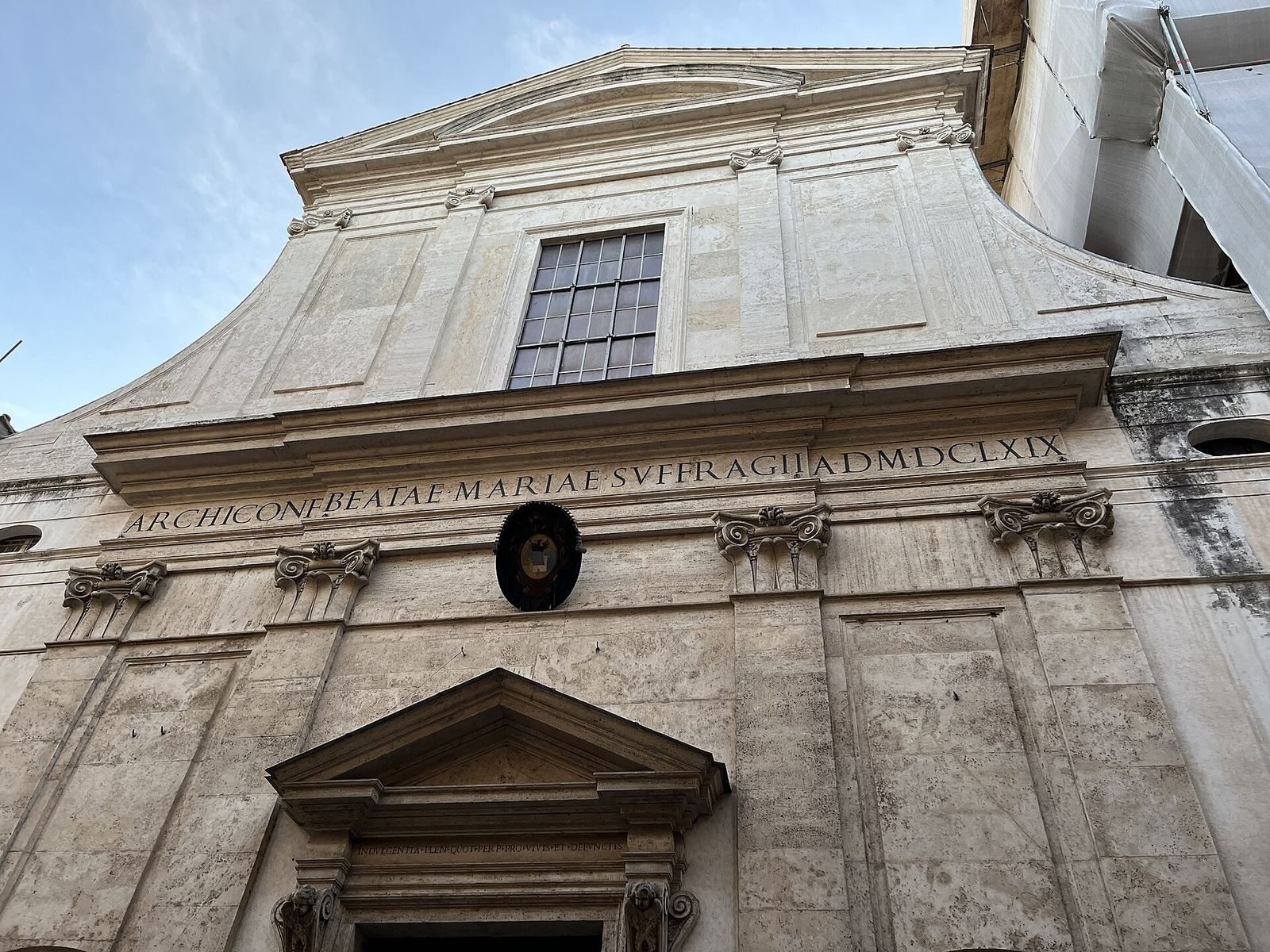
The two-storey façade has four flat Ionic pilasters on each level, each with a capital in the Ionic style. Three portals open at ground level, with a large central window above. A strongly projecting cornice divides the storeys. The main portal has a triangular pediment, a gabled feature above a doorway; the side portals have lower, curved pediments. A triangular pediment crowns the façade and incorporates a curved form. An inscription runs across the decorative band between the two levels.
Nave and choir
Cesare Mariani’s ceiling fresco depicts the Coronation of the Virgin. In the spaces between the vault’s arches and its frame, winged child figures carry Marian symbols: the Morning Star, Seat of Wisdom, Mystical Rose, Queen of Virgins, Palm in Kadesh, Olive in the Fields, Cedar in Lebanon, and Balsam in Jericho.
Carlo Rainaldi designed the choir and its altarpiece. Giuseppe Ghezzi painted the high altarpiece, showing the Virgin Mary with souls in purgatory. In the curved ornamental band above, Giovanni Battista Beinaschi painted the Eternal Father in Glory; his Assumption appears in the crescent-shaped surface above the altar.
Right-hand chapels
Nativity chapel
The first chapel on the right is dedicated to the Nativity of Jesus. Isabella Moroni commissioned Giovanni Battista Natali to decorate it in 1678 with scenes of the Adoration of the Magi, the Dream of Saint Joseph, and the Adoration of the Shepherds. The chapel also contains funerary monuments to engraver Gaspare Moroni, who died in 1669, and painter Pietro Martire Neri, who died in 1661.
Chapel of Our Lady, Consoler of the Afflicted
Carlo Rainaldi designed the second chapel on the right, first dedicated to the Petrosini family and later to Our Lady, Consoler of the Afflicted. An 18th-century image of the Virgin is accompanied by Girolamo Troppa’s Sacrifice of Isaac on the left and Giacinto Calandrucci’s Jacob’s Dream on the right.
Third chapel on the right
Giovanni Battista Contini designed this chapel, which has stucco decoration by Paolo Naldini. An image of the Virgin, supported by angels, stands at the altar. Giuseppe Chiari painted the Birth of the Virgin on the left wall and the Adoration of the Magi on the right. Naldini also made the chapel’s funerary monuments to Gaspare and Elena Marcaccioni in the 1670s.
Left-hand chapels
Chapel of Saints Hyacinth and Catherine
The first chapel on the left is dedicated to the Dominican saints Hyacinth and Catherine of Siena. Daniel Seiter’s altarpiece depicts the Madonna and Child with both saints.
Chapel of Saint Joseph Calasanz
The second chapel is dedicated to Saint Joseph Calasanz, a Catholic priest and educator who founded the Piarist order. It contains three paintings by Sebastiano Ceccarini showing scenes from Calasanz’s life.
Chapel of the Crucifix
The third chapel on the left, under the patronage of the Mazzetti di Pietralata family, is dedicated to the Crucifix. Its altar holds a large 18th-century wooden crucifix surrounded by twelve carved wooden reliquaries, containers for religious relics. Episodes from the Passion of Christ appear in a ceiling fresco. Marble funerary monuments to members of the Mazzetti family occupy the walls. A confessional on the chapel’s left is traditionally associated with Saint Vincent Pallotti, a 19th-century Italian priest and founder of the Union of Catholic Apostolate, who was believed to have used it to hear confessions.
Oratory and memorials
Adjacent oratory
The adjacent oratory, a small place of worship associated with the church, contains two paintings by Giovanni Battista Beinaschi that were formerly in the choir: Christ Raising Lazarus and Daniel in the Lions’ Den. Giuseppe Ghezzi’s works there include the Madonna of the Rosary, the Presentation of the Virgin in the Temple, and the Assumption.
Tombs and memorial
Novarese’s tomb is positioned above Carinci’s. A memorial plaque for Carinci carried Pope Paul VI’s description of him as ‘a luminous example of the Roman clergy.’