Santa Croce alla Lungara: A Roman Catholic Church in Trastevere
Site at a Glance
- Popularity
- Medium
- Country
- Italy
- Primary era
- Early Modern
- Eras represented
- Early Modern, Modern
- Civilizations
- Papal States
- Site type
- Religious
- Remains
- Church
On this page7 sections
History
Santa Croce alla Lungara is a Roman Catholic church on Via della Lungara in Rome’s Trastevere district, Italy, built in 1619 as part of a complex that served women seeking to leave prostitution. Dedicated to the Holy Cross, it belongs to the parish of Santa Dorotea. The church and convent became associated with religious communities whose work included prayer, penance, and support for women.
Foundation and early purpose
In 1615, the Spanish Carmelite Domenico di Gesù e Maria established a hospice on Via della Lungara. It offered women leaving prostitution a convent-like setting for prayer and penance. Baldassarre Paluzzi Albertoni and Maximilian I, ruler of Bavaria, funded the adjoining convent. Cardinal Antonio Barberini commissioned the church. An alternative name, Santa Croce delle Scalette, referred to the double staircase at its entrance.
Religious communities and expansion
In the late 17th century, the Augustinian Oblates, a women’s religious community in the Augustinian tradition, took over the church and convent. The name Santa Croce della Penitenza referred to the sisters. The convent closed during the French occupation of Rome in 1802.
In 1839, Pope Gregory XVI entrusted the church and convent to the Sisters of the Good Shepherd, a Catholic women’s congregation founded in Angers in 1835 by Marie-Euphrasie Pelletier. The sisters also received women in Rome involved in prostitution, and the church became known as Chiesa del Buon Pastore, or Church of the Good Shepherd. In 1854, Pope Pius IX ordered an extension of the convent, designed by the Italian architect Virginio Vespignani. The expanded institution cared for female offenders, girls at risk of physical abuse outside its walls, women seeking to leave destructive circumstances, and women abused by their husbands.
State ownership and later use
The Italian state expropriated the complex in 1873, but the nuns were allowed to remain because of the importance of their work. The complex underwent restoration in 1900 and 1924. In 1985, the Sisters of the Good Shepherd left, and the complex passed to the City of Rome. Two years later, the convent building passed to the women’s section of ARCI, an Italian cultural and recreational association, and the church closed. The former convent is now occupied by the Casa Internazionale delle Donne.
Remains
Exterior
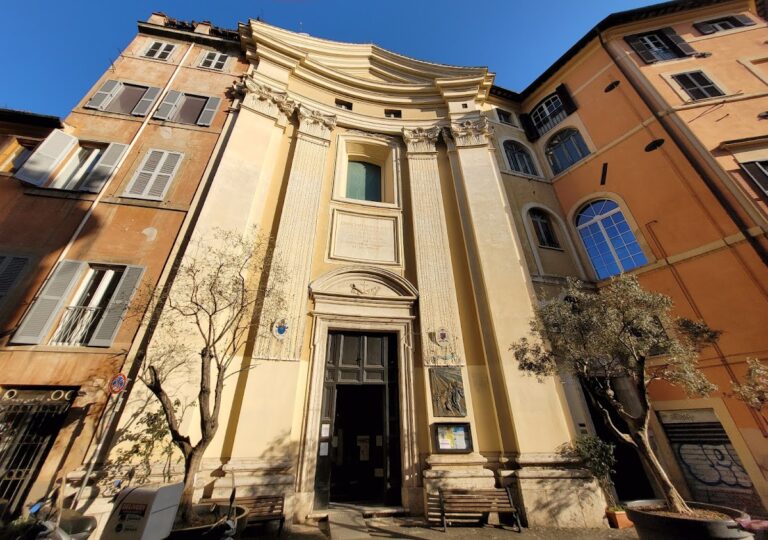
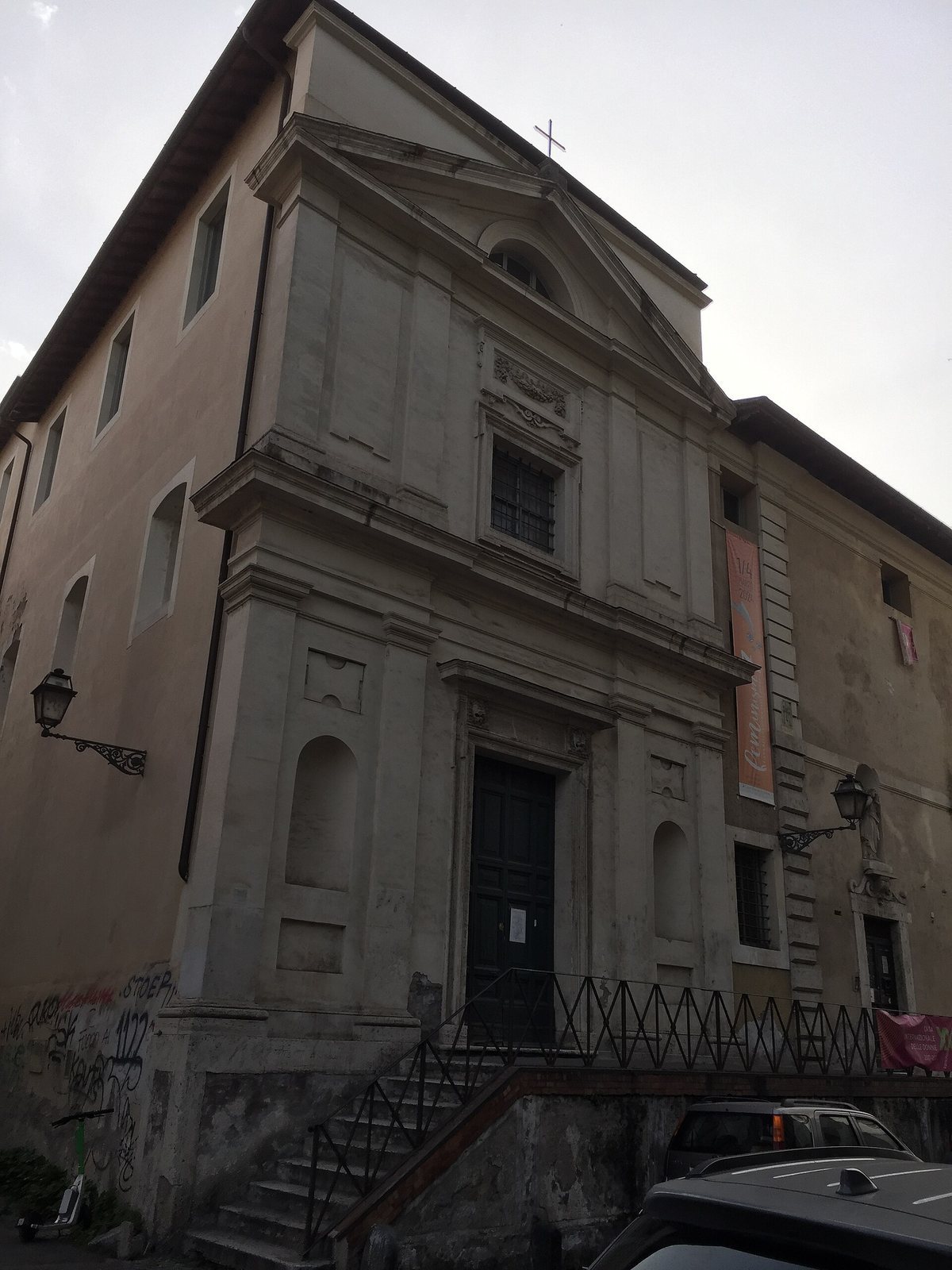
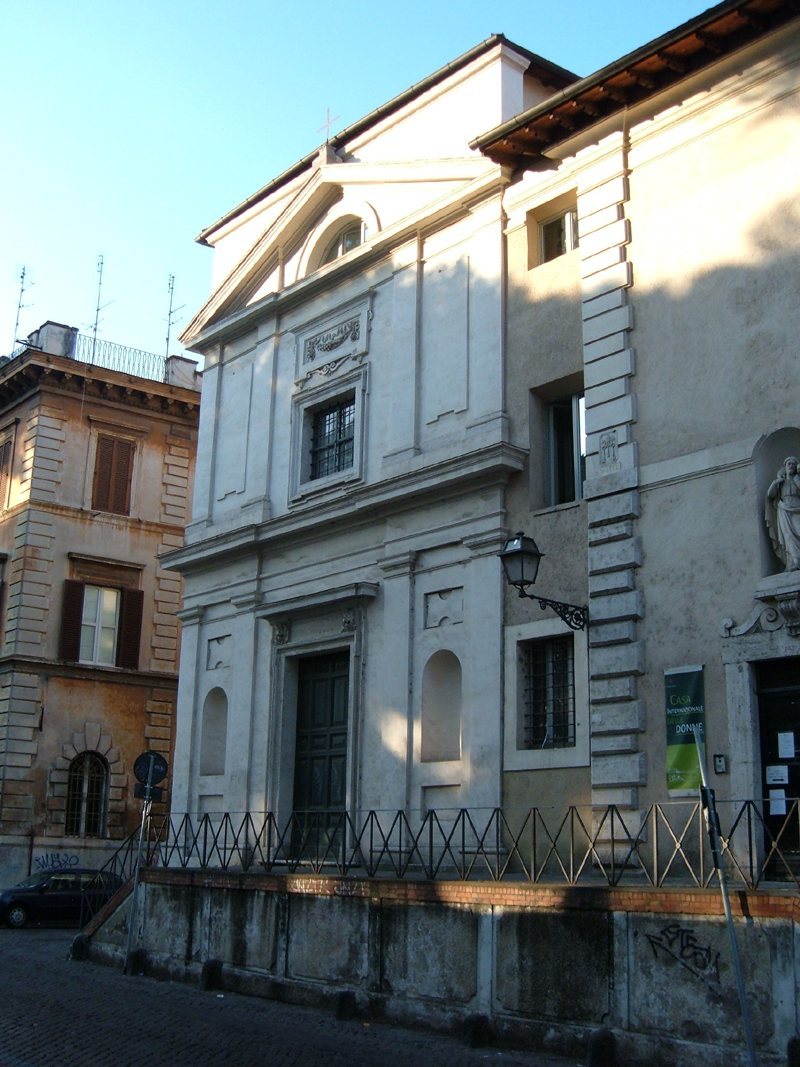
A double staircase rises from Via della Lungara to the church and former convent. The church has a single nave, its main interior hall, and a façade arranged in two levels. On the lower level, four pilasters, shallow wall supports, carry an entablature, the horizontal structure above them. It has a plain band and a strongly moulded projecting edge. The entrance’s projecting edge rests on brackets with lion heads, while the pilasters frame empty, round-arched recesses. Above, four pilasters without decorated tops support another entablature and a triangular pediment. Its enclosed center contains a semicircular window, and the pilasters flank a square window topped by a plaster garland. To the right of the church façade is the former convent entrance, above which stands a statue of Christ as the Good Shepherd dated 1839.
Interior
The interior decoration shifted in the 19th century toward neoclassical forms, a revival of classical design. The church has three altars. Its high altar is made of multicolored marble and has a small temple-shaped structure above it. The original painting, Christ Carrying the Cross by Terenzio da Urbino, was replaced in the 18th century by a Crucifixion by Troppa. In 1924, S. G. Piniberti’s painting of the Sacred Heart of Jesus replaced that work. Troppa also painted an Annunciation for the right side altar, while a painting of the penitent Mary Magdalene hung above the left altar. Wall paintings depict the theological virtues of faith, hope, and charity, together with the cardinal virtues of prudence, justice, fortitude, and temperance. An inscription once placed above the high altar commemorated the church’s consecration in 1619. A plaque on Via della Penitenza commemorates the convent’s extension in 1854.